
Direct Answer: Clean soil from a site cut usually goes to a quarry, an engineered fill site, or a nearby property that needs import material. Mixed soil with concrete or brush gets sorted and priced separately.
A property owner getting ready to build in Carmel sent us a note that read like a short shopping list. Cut and grade the site, haul off the excess dirt, about 500 cubic yards, then a driveway approach, a retaining wall, and drainage.
That one line about hauling off the dirt hides the part almost nobody plans for. The soil does not vanish when the excavator lifts it. It turns into a trucking job, a disposal job, and a paperwork job, all running at the same time.
So here is what I want to walk through: where excess dirt goes after excavation, why the export costs more than the digging, and the handful of decisions that actually move the number on a Monterey County lot.
500 Cubic Yards Is 40 to 50 Truck Loads
Depending on the truck, a load of soil runs somewhere around 10 to 14 cubic yards. Do the math on 500 yards and you are looking at roughly 40 to 50 round trips before the site is clean.
That is the part homeowners rarely picture. The hole itself might take a machine two or three days. The trucks may be running longer than that, and every one of them is burning fuel, driver time, and a tipping fee at the other end.
What drives the cost of a site cut, in rough order:
- Haul distance to the nearest facility or fill site that will take the material
- Number of round trips, which depends on truck size and site access
- Material condition, since wet or mixed soil weighs more and costs more to place
- Tipping or acceptance fees, which vary by facility and by material type
- Machine hours, which matter, but usually less than people expect
I tell people this plainly: the hole is the easy part. The export is the expensive part. Once you understand that, every money saving idea starts pointing in the same direction, which is moving fewer yards a shorter distance.
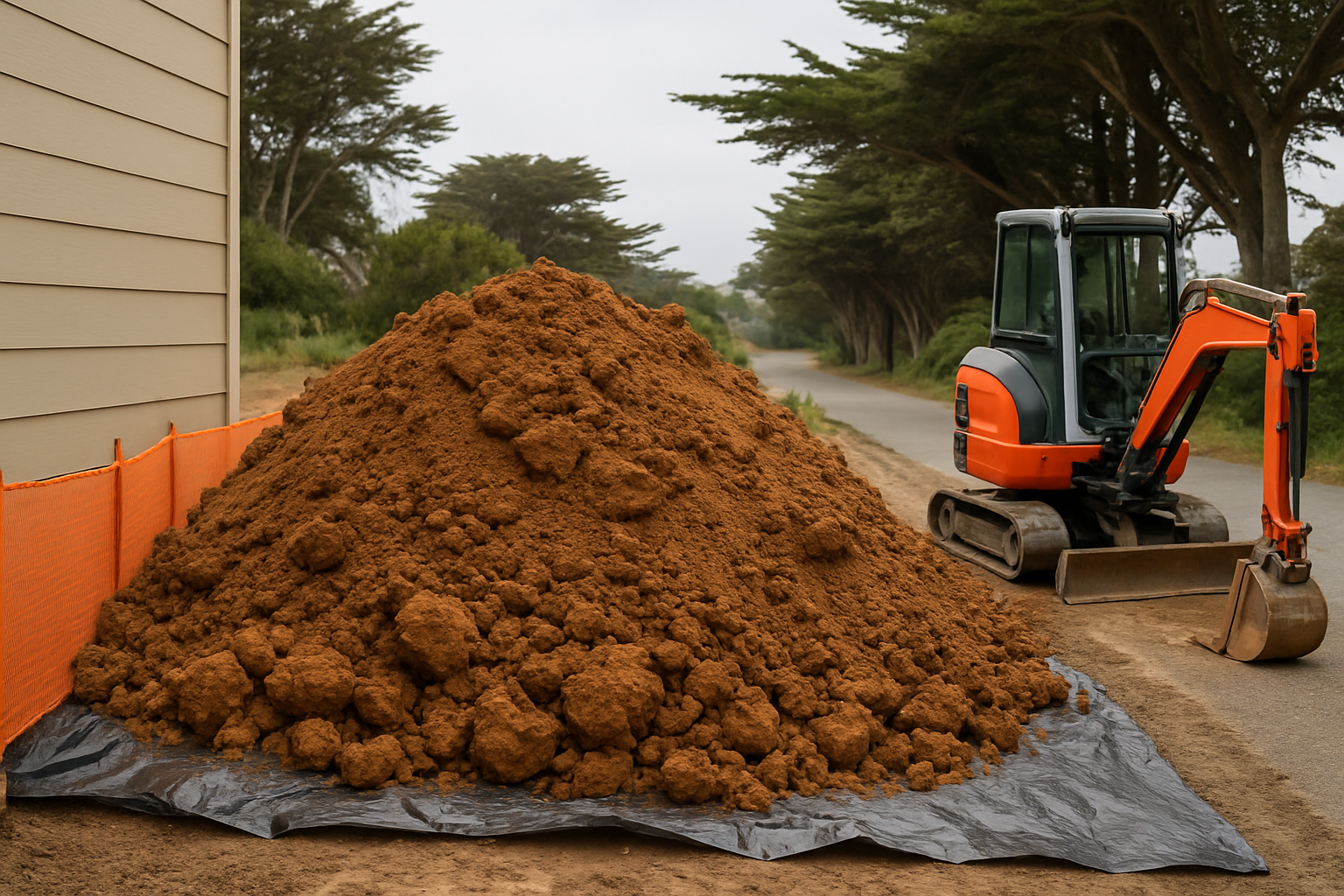
The Cheapest Dirt Is the Dirt That Never Leaves
Every yard of soil that stays on the property never gets loaded, hauled, or tipped. That is the single biggest lever on a site cut, and it gets decided on paper long before a machine shows up.
Material can often stay on site to:
- Build up a pad for the house, garage, or ADU
- Backfill behind a retaining wall or a foundation
- Raise a low spot that has been holding water for years
- Shape a driveway approach or a bench for equipment access
But soil is not automatically reusable. Sonoma’s clay and a lot of Monterey County’s heavier soils behave badly as engineered fill unless they are placed in thin lifts at the right moment and compacted to spec. On a sloped lot, a soils engineer may limit where fill can go at all, and how tall it can be.
One homeowner near Pinole wrote to us after a city inspector caught up with terracing done years earlier. Dirt from a wall project had been pushed uphill and shaped into a play area, and now the grading needed to be legalized with a permit and probably a soils engineer.
This is why I push for the volume question to get answered early. A good site plan should tell you how much material comes out, how much can legally stay, and where the balance goes. If you want the longer version of that, read what a site plan actually controls.
The Same Number That Drives Haul Cost Triggers County Review
Cubic yards are not just a budget figure. They are a permit trigger.
- Sonoma County requires a grading permit for cuts or fills over 50 cubic yards
- Monterey County sets its threshold at 100 cubic yards
A project moving 500 yards is far past both. So the export volume shows up on the plans, it gets reviewed, and it gets inspected. That also means the material cannot quietly get spread out over the back of the lot to skip a trip to the scale.
I have seen this trip people up in a specific way. Someone estimates 200 yards, plans a small haul, then the actual cut comes in at 450 because the pad had to drop another foot for drainage. Now the volume no longer matches the approved plan, and the fix is a revision, not a shovel.
Accurate volume estimating is a compliance issue first and a budgeting issue second. If you are still early in the process, whether you need a civil site plan before pulling a grading permit is the right question to sort out next.
Where the Soil Actually Goes
Here is the short version of what happens to 500 cubic yards once it comes out of the ground.
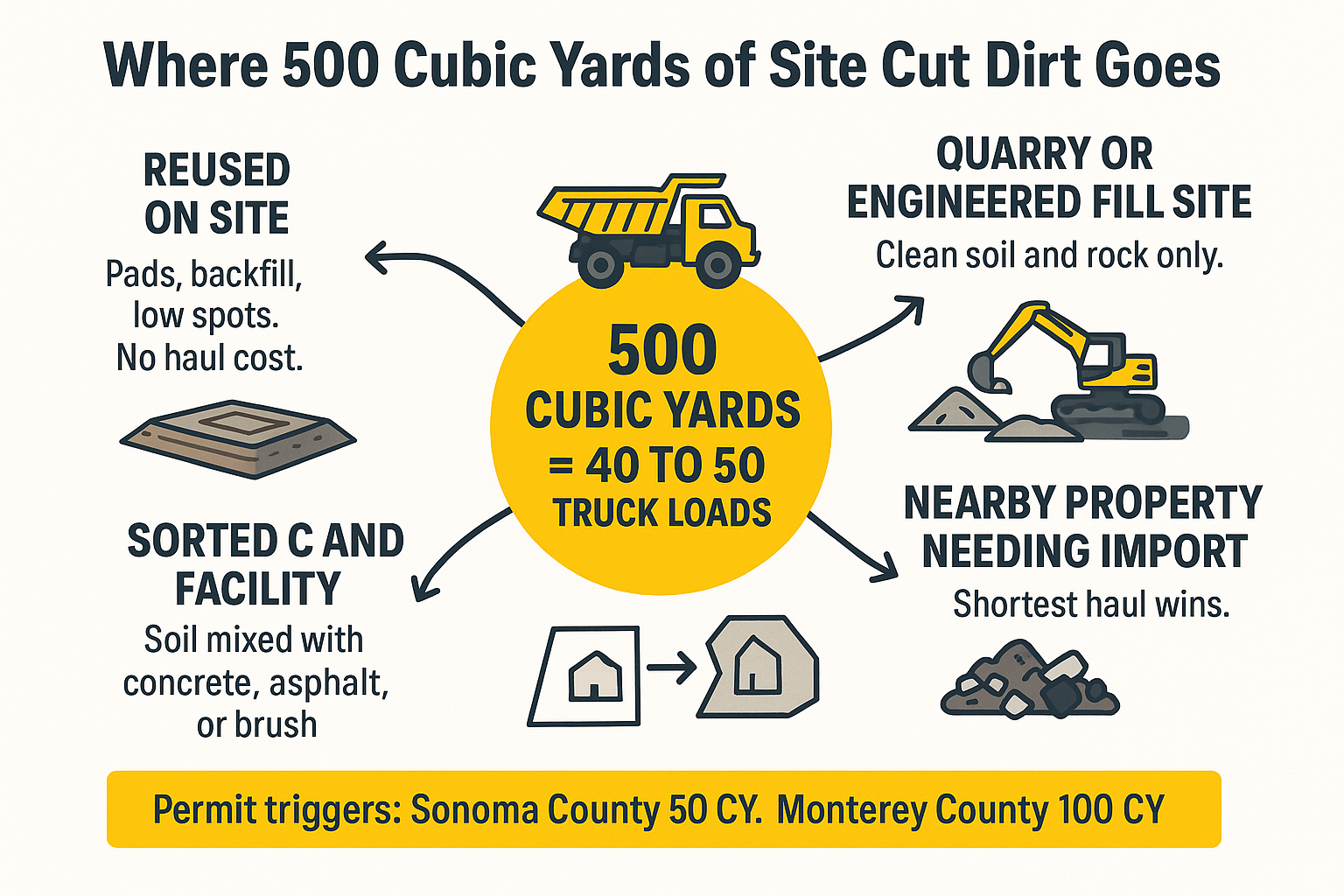
Clean Soil Does Not Go to the Dump
Most homeowners assume the trucks are headed to a landfill. Usually they are not.
Clean soil and rock are useful material. It generally ends up at:
- Quarries and aggregate yards that accept inert fill
- Engineered fill sites where the material gets placed and compacted for a future use
- Another property nearby that needs import material to raise a pad or build a road
That last one is the best case. A neighbor two miles away who needs 300 yards of fill can cut your haul distance dramatically. It does not happen every time, but it is worth asking about before the trucks get scheduled.
Mixed material is a different story. Soil with broken concrete, asphalt chunks, stumps, or brush in it has to be sorted, and it gets priced differently at the gate.
Paperwork matters here too. Cities in Monterey County require a construction and demolition recycling plan filed before the permit is issued, with a 65 percent diversion requirement for debris and 100 percent accountability for inert material like soil, concrete, and asphalt. The City of Salinas construction and demolition waste application spells out how that reporting works.
Keeping loads clean and separated is not a nice to have. It protects your final sign off.
What Happens to Each Type of Material
Not everything that comes out of a site cut travels the same road. Here is how the material usually splits up.
| Material | Likely Destination | What Drives the Cost |
|---|---|---|
| Clean native soil | Reused on site, quarry, or a nearby fill site | Haul distance and moisture content |
| Clean rock and rubble, no rebar | Quarry or crushing yard | Facility acceptance fees and load cleanliness |
| Soil mixed with concrete or asphalt | Sorting and recycling facility | Sorting labor and separate tipping rates |
| Stumps, brush, and green waste | Green waste or grinding facility | Volume, bulk, and extra truck trips |
| Soil mixed with old debris or unknowns | Testing first, then a permitted facility | Testing, handling, and facility restrictions |
Truck Access Quietly Reshapes the Whole Plan
On the Central Coast, access decides the truck, and the truck decides the trip count.
Things I look at on a site walk:
- Narrow lanes and tight corners around Carmel and Pebble Beach where a full size end dump simply will not turn
- One lane private roads off Highway 1 with no room for two trucks to pass
- Steep hillside driveways where a loaded truck cannot climb back out safely
- Overhead limbs and power lines that a raised dump bed will hit
- Whether there is a spot for a staging area so material can be stockpiled and loaded in batches
When only smaller trucks fit, the same 500 yards turns into 60 or 70 loads instead of 45. Nothing else about the job changed.
Moisture is the other quiet cost. Wet clay weighs noticeably more than dry clay, and weight limits fill a truck before volume does. The same dirt hauled out of a Santa Rosa or Salinas Valley lot in August can cost less per yard than it does in February.
This is exactly why a phone estimate falls apart on anything past a few loads. I need to see the road, the turnaround, and the slope. If your lot sits near the coast, coastal lot site prep in Monterey County covers more of what the terrain changes.
Real Levers to Bring the Number Down
Cost sensitivity comes up on nearly every call, and I would rather give people levers than reassurance.
A homeowner in Aptos offered to cut and stack his own brush so we would only need to haul it. That instinct is right, even though the savings usually land somewhere else, because the trucking and the tipping are the real expense, not the cutting.
The bigger levers, in the order I would use them:
- Design the grade so less material leaves. Balancing cut and fill on the plan beats negotiating a haul rate.
- Time the work in the dry season. Lighter loads, better truck access, fewer erosion controls.
- Keep loads clean and separated. Mixed material costs more at the gate and slows the recycling paperwork.
- Hunt for a nearby import site. Distance is the number one cost driver on export.
- Ask how your scope is being priced. By the yard, by the load, by the hour, or by the ton changes the conversation.
That last point matters more at scale. One ranch owner contacted us about moving tens of thousands of tons over a decade, and pricing at that volume behaves nothing like a one day residential haul. Know which side of that line your project sits on.
One last practical note. We handle both sides of the material equation, hauling spoil off a site and sourcing base rock, gravel, and fill through our own supplier network. On a haul heavy job that means one crew tracking volumes, load counts, and disposal paperwork, instead of an excavation contractor and a separate trucking outfit pointing at each other when the numbers do not match.
Frequently Asked Questions About Hauling Off Excavated Dirt
Can I just spread the extra dirt somewhere on my own property?
Sometimes, but not quietly. Once you are over 50 cubic yards in Sonoma County or 100 cubic yards in Monterey County, that fill needs a grading permit, and on a slope it may need a soils engineer to say where it can go and how it gets compacted. Spreading it to avoid a haul is how people end up legalizing grading years later.
How do I know how many cubic yards my site cut will actually produce?
It comes off the plans, not off a guess. A civil site plan or topographic survey gives cut and fill quantities, and those numbers get checked against what the pad and drainage actually require. If your estimate came from someone eyeballing the lot, expect the real number to move.
Does soil get tested before it can be hauled away?
Clean native soil from a residential lot usually does not need testing. If the property had old fill, a shop, a tank, or unknown debris in the ground, a facility may require testing before accepting it, and that adds time to the schedule.
Is it cheaper to haul dirt in summer than winter?
Often, yes. Wet clay is heavier, so trucks hit weight limits before they fill up, and soft ground makes access harder. Dry season work also means fewer temporary erosion controls on an open site.
Who is responsible for the recycling paperwork?
It depends on how the contract is written, so ask up front. In many Monterey County jurisdictions a recycling plan has to be filed before the building permit is issued, and the receipts from the facility are what close it out at the end.
Planning a site cut in Monterey County?
If you are staring at a plan that says haul off excess dirt and you are not sure what that turns into, the volume, the access, and the destination are the three things worth pinning down first. DW Excavation works throughout Monterey County and Sonoma County, and we are glad to walk a site and talk through the numbers before anyone schedules a truck. You can reach us at 707-601-9091 or through the contact page at dw-excavation.com.