
Direct Answer: Electrical trenching means digging a marked, code-depth trench, placing conduit, then backfilling and compacting it. In California, most residential branch circuit conduit sits at least 18 inches deep, with more required under driveways.
Most people who call me about electrical trenching already know what they want. They want power out to a hot tub deck, a detached shop, a new solar array, or a well pump. What they don’t know is who digs the trench, how deep it has to be, what goes in it, and who puts the driveway back together.
I get versions of this call constantly. One homeowner needed roughly 75 feet of trench for a solar project that crossed both lawn and a paved path. Another wanted power run out to a hot tub deck. A property in the Pajaro Valley area needed close to 200 feet through mixed terrain.
Same job type, three different price tags, and the reason is almost always what the trench has to cross. Here is how these jobs actually go on the ground in Monterey County and along the Central Coast.
Who Does What on a Residential Electrical Trench Job
This is the first thing worth sorting out, because it decides how many phone calls you make.
On a typical residential job, the work splits like this:
- The excavation contractor handles the 811 locate request, the trench itself, bedding material, conduit placement in the trench, backfill, compaction, and surface restoration.
- The licensed electrician handles the conductors, the panel or subpanel, terminations, bonding, and the final hookup.
- The county or city inspector signs off on the open trench before anyone backfills it.
That middle item catches people off guard. In most cases the trench gets inspected while it is still open, with conduit laid in and visible. If you backfill early, you may be digging it out again.
I tell homeowners to line up the electrician first, or at least at the same time. The electrician’s plan tells me the conduit size, the route, the depth, and where the stub-ups need to land. Trenching before that conversation happens is how you end up with a trench in the wrong place.
If you have already dealt with a sewer trench for an ADU, the sequencing will feel familiar. Different pipe, same rhythm of locate, dig, inspect, backfill.
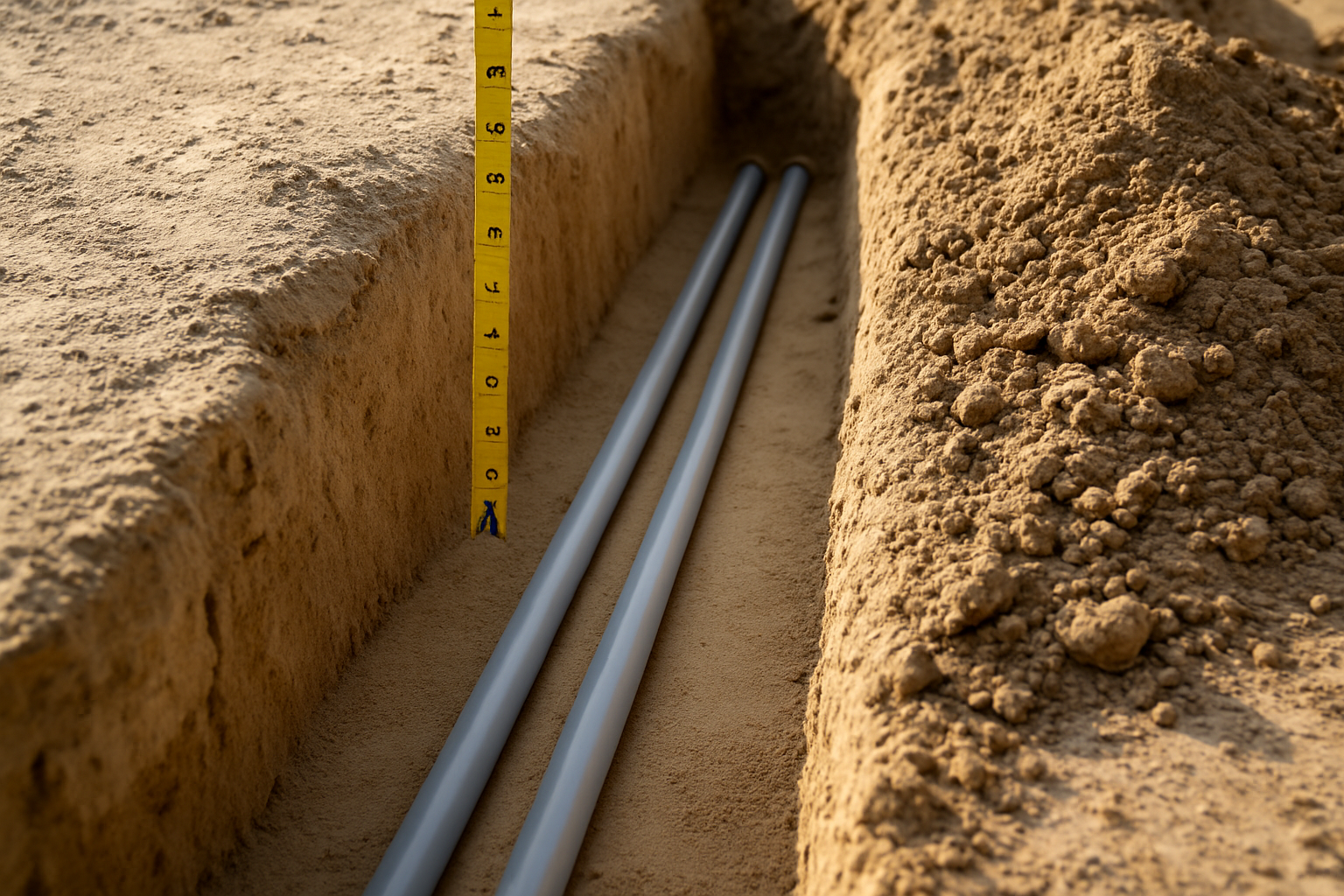
How Deep Does an Electrical Trench Need to Be in California?
California follows the National Electrical Code with local amendments, and the depth depends on what the conduit is and what is above it.
As a general rule for residential work:
- PVC conduit carrying branch circuits: about 18 inches of cover under open ground.
- Under a driveway or paved area: deeper, because the code treats vehicle traffic differently.
- Direct burial cable without conduit: deeper again, which is one reason I usually see conduit specified instead.
Those are minimums, not targets. When I bid a trench, I often propose going deeper, and there are real reasons for it.
What pushes depth down on a real property:
- Existing utilities in the way. A gas line or water service crossing the route forces the electrical trench under it with proper separation.
- Future grading. If the finish grade is going to drop later, today’s 18 inches becomes tomorrow’s 12.
- Soil conditions. Loose sandy soil common in parts of Marina and Seaside behaves differently than the tighter soils inland toward Salinas, and trench walls tell you quickly what you are working with.
- Irrigation and landscape work. Anything that gets dug into later, like planting beds, is worth clearing by a margin.
Deeper trench means more spoil, more backfill, and more time. But re-digging a trench because a shovel found your conduit is worse.
What Changes the Cost of a Residential Electrical Trench
Every property is different, so treat this as general market context rather than a quote. These are the factors that actually move the number on a residential trenching job.
| Factor | Why It Affects Cost | Typical Impact |
|---|---|---|
| Length of run | More linear feet means more machine time, spoil handling, and backfill | Scales fairly predictably |
| Soft ground only (lawn, dirt, beds) | Fastest ground to work in, simple restoration | Lowest cost per foot |
| Hardscape crossing (concrete, asphalt, pavers) | Saw-cutting, demolition, haul-off, and surface repair | Often the single largest line item |
| Known utilities in the route | Hand digging near marked lines, slower and more careful | Adds time, not always material |
| Rock, roots, or old buried debris | Slows excavation and may require different equipment | Highly variable |
| Site access | Tight side yards may mean smaller machines or hand work | Can double labor hours |
The Hardscape Crossing Is the Part That Costs Real Money
If your trench has to cross a concrete driveway, a paved walkway, or a compacted gravel drive, that section is usually the most disruptive and most expensive part of the whole job.
A proper hardscape crossing runs through a real sequence:
- Saw-cut clean, straight lines so the repair has square edges to bond and sit against.
- Controlled removal of the cut section, with debris hauled off rather than piled in the yard.
- Trench excavation to the required depth for a traffic area.
- Conduit placement on proper bedding, not on rock or chunks of broken slab.
- Backfill in lifts with mechanical compaction, not one dump and a stomp.
- Surface restoration matched to what was there.
Compaction is where sloppy work shows up fastest. Loose backfill under a repaired slab settles, and on the Central Coast the first serious winter storm is what reveals it. You get a crack, then a dip, then a low spot that collects water right against your driveway.
The soft-to-hard transition is the weak point. Water follows the trench line, so if the backfill is loose there, you have basically built a drain toward whatever is downhill. I have seen the same failure pattern in drainage trenching that was never compacted correctly.
Questions worth asking any contractor about the crossing:
- Will you saw-cut or break it out?
- What backfill material are you using, and in what lift thickness?
- What are you compacting with?
- Who is responsible if the patch settles this winter?
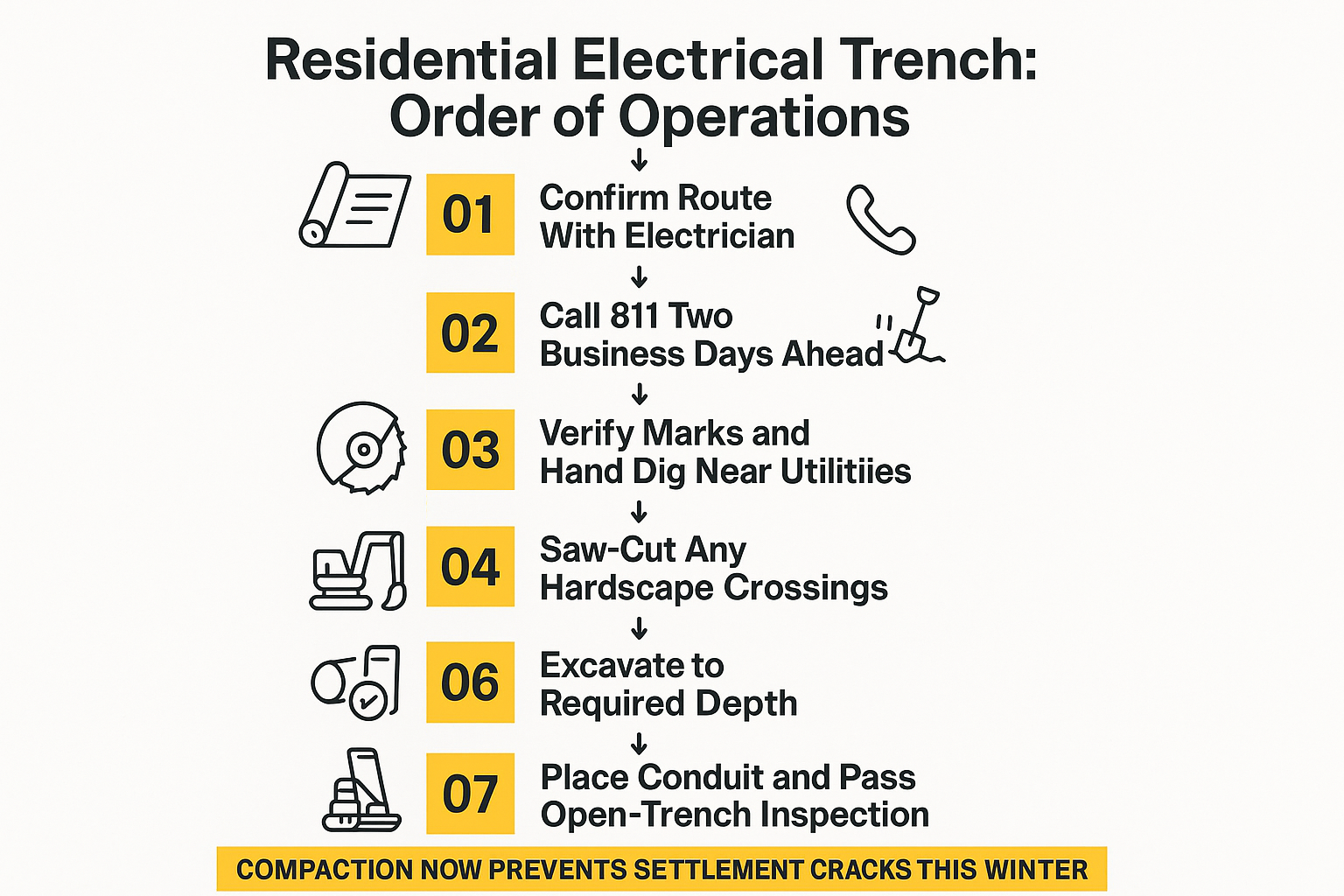
The Order of Operations on a Residential Electrical Trench
This is the sequence I follow on most residential electrical trenching jobs, from first phone call to final surface repair.
Why the 811 Call Sets Your Start Date
This is the piece homeowners underestimate most, and it is the one that moves your calendar.
California law requires notification before excavation, and there is a minimum two-business-day lead time before digging can begin. So the homeowner who calls on Thursday hoping to trench Monday morning is already tight. You can read the state requirements through the California Underground Facilities Safe Excavation Board.
Here is what the locate process actually looks like:
- A ticket goes in describing the dig area and the type of work.
- Utility operators send locators out to mark their facilities with paint and flags, using standard color codes.
- Marks are valid for a limited window, so timing the dig to the locate matters.
- Anything not covered by 811, like private lines on your side of the meter, is still your unknown.
That last point is the one I want people to hear. On an older Monterey County property, there is almost always something in the ground nobody mapped: an old gas stub, abandoned irrigation, a prior electrical run to a shed that somebody buried at eight inches with no conduit.
811 marks public utility facilities. It does not find private irrigation or a previous owner’s improvised wiring. That is why we hand dig in the tolerance zone and slow down near marks instead of trusting a bucket.
Skipping the call is illegal, and it is genuinely dangerous. A bucket tooth into a gas service is a different kind of bad day than a broken sprinkler line.
Frequently Asked Questions About Residential Electrical Trenching
Can I dig the trench myself and have the electrician drop the wire in?
Some homeowners do, and for a short run through soft dirt it can work. But you still owe the 811 notification, you still have to hit the depth the inspector expects, and you still have to backfill and compact correctly. Once a hardscape crossing or a 100 foot plus run is involved, hand digging stops being a savings.
Do I need a permit just to trench for an electrical line?
The electrical work itself is typically permitted through the building department, and your electrician usually pulls that. Grading permits are a separate matter and are tied to volume of earth moved. Monterey County’s grading permit threshold sits at 100 cubic yards, and Sonoma County’s is 50, so a normal residential trench rarely trips it on its own. Larger site work can.
How long does a residential electrical trench job take?
For a straightforward soft-ground run, often one to two days of machine time once locates are done. Add a concrete or asphalt crossing and you add days, because the repair has to cure before it gets used. The open-trench inspection sits in the middle of that timeline and depends on the inspector’s schedule, not mine.
Can you trench in the winter?
Sometimes, but wet ground changes everything. Saturated soil is harder to compact properly, trench walls are less stable, and a hardscape patch placed in bad conditions is a patch you will look at for years. On Central Coast properties I would rather push a trench two weeks than backfill mud.
What if you hit something unmarked in my yard?
It happens on older properties. We stop, figure out what it is, and talk to you before going further. If it is an abandoned line, it usually gets documented and removed or capped. If it is live and unmapped, that becomes a conversation with the utility or your electrician before the trench continues.
Planning an Electrical Trench on Your Property?
If you are working out a route, a depth, or how a driveway crossing gets put back together, we walk properties across Monterey County and the Central Coast to look at the ground before anyone quotes a number. Our team can be reached at 707-601-9091 or through the contact page at dw-excavation.com for a free estimate. Bring your electrician’s plan if you have one, since it answers half the questions on its own.