
Direct Answer: Most drainage trenching fails because of design errors, not bad materials. If the outlet location, pipe diameter, and soil permeability aren’t matched to actual site conditions, the system will back up or route water somewhere worse.
I’ve walked properties where a homeowner paid good money for a French drain two or three years earlier, and the trench is doing nothing useful. Water still pools in the same corner. The pipe is there. The gravel is there. But nobody thought carefully about where the water was supposed to go when the drain filled up — and in Sonoma County clay, that happens faster than most people expect.
Most people searching for a drainage trenching contractor in Sonoma County have already lived through at least one failure. They’re not starting from scratch with a general curiosity question. They want to know why the last system didn’t work, and what actually needs to happen differently. That’s what I want to explain here.
This isn’t a pitch for any particular product or method. It’s an honest look at the two things that cause the most drainage trench failures we see in the field: outlet design and design capacity. Get those wrong, and the rest of the installation doesn’t matter.
The Soil Problem Nobody Warns You About
Sonoma County’s clay soils are a drainage paradox. The same soil that causes water to pool on your surface is also the soil that limits how fast a French drain can push water into the ground around it.
A standard French drain works by collecting surface or subsurface water in a perforated pipe, surrounded by gravel, and allowing it to slowly percolate into the native soil. In sandy or loamy soils, that works well. In heavy clay — which covers a significant portion of Santa Rosa, Windsor, and the unincorporated valley floors — percolation rates can drop to near zero during a sustained rain event. The gravel fills. The pipe fills. And the drain stops functioning within a few hours of the storm starting.
I’ve seen this described by homeowners as the drain working at first, then failing when it really matters. That’s not a defective install — that’s a percolation-dependent drain installed in soil that can’t absorb water fast enough under load.
The fix isn’t a bigger trench. It’s a different outlet strategy:
- Daylighted outlet: The drain pipe runs to an open outlet on a lower slope or at the property edge, where water exits freely by gravity. No percolation required.
- Dry well in a permeable layer: If you can get below the clay horizon — sometimes 4 to 6 feet down in parts of Sonoma County — there are often more permeable soil layers that will accept water. A dry well positioned there can give the system somewhere to drain.
- Storm drain connection: In urban and suburban areas, connecting to the public storm drain system is sometimes an option, but it requires coordination with the city or county public works department and can involve additional permit steps.
The outlet type matters more than almost any other decision in a drainage trench project. I’d rather spend time getting the outlet right than spend money on premium pipe that drains nowhere.
Design Capacity: What the November 2024 Storm Taught Us
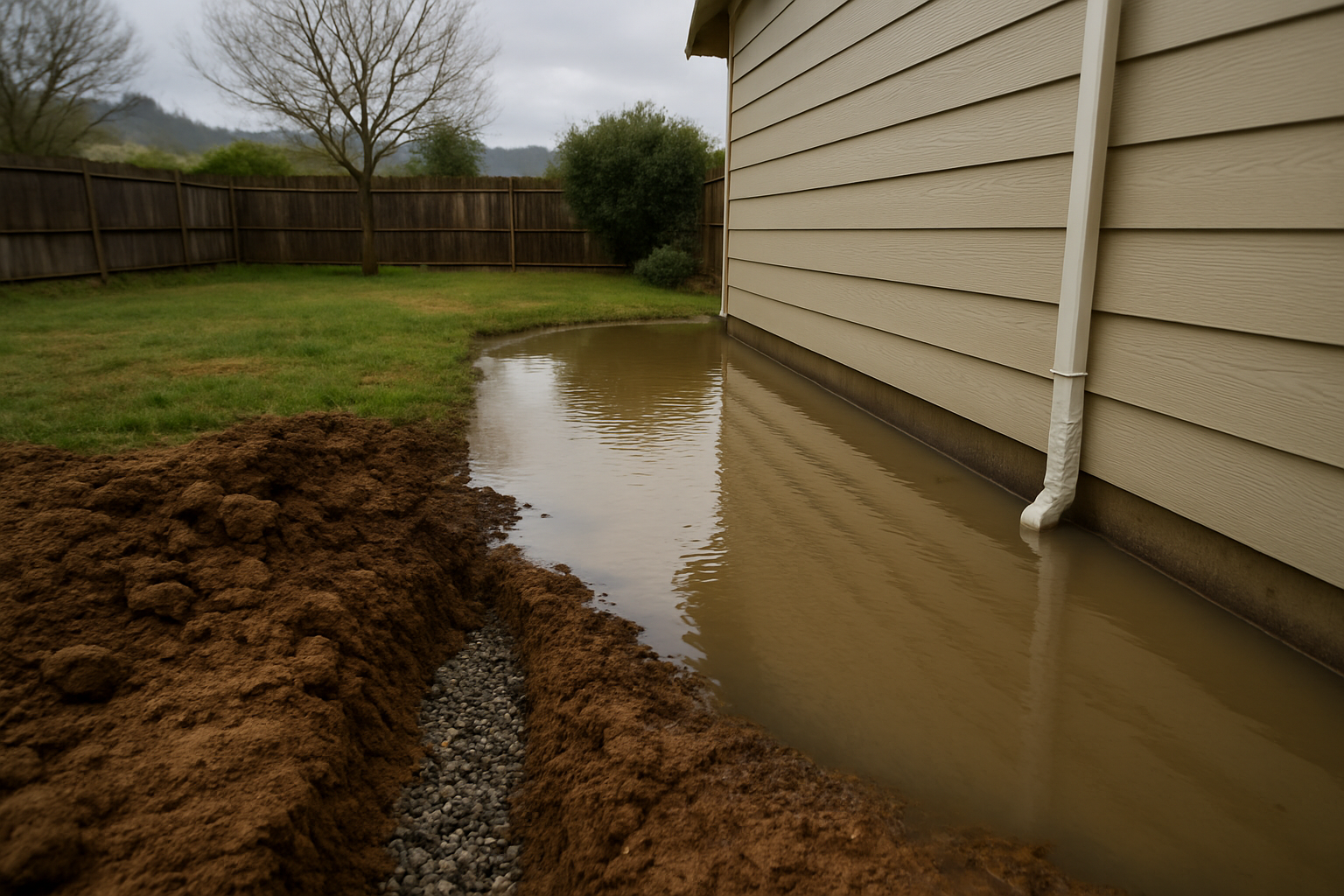
The November 2024 atmospheric river dropped over 12 inches of rain on the Santa Rosa area in roughly three days. That event stress-tested every drainage system in Sonoma County at the same time — and a lot of them failed, not because they were poorly built, but because they were built for a different storm.
Drainage systems are typically designed to handle a specific storm event — the 10-year storm, the 25-year storm, or the 100-year storm. Those numbers refer to statistical return intervals: a 25-year storm has a 4% chance of occurring in any given year. The November 2024 event was well beyond what a standard residential drainage system is sized for.
A system designed to handle a 10-year event may perform perfectly during an average wet season and collapse completely under three days of back-to-back atmospheric river rain. That’s not a failure of workmanship. But it does raise the question of what the right design standard should be for a property in a region that’s now seeing more frequent extreme rain years.
We had a homeowner reach out recently about roughly 50 feet of French drain on an existing property — a scope that sounds simple on the surface. But before we could say anything meaningful about pipe diameter, depth, or outlet placement, we needed to answer: how much water is this system going to be asked to move during a heavy event? What’s the drainage area feeding into it? What’s the slope? And critically, where does the water go when the drain is full?
That’s not overthinking a small job. That’s the actual question. Fifty feet of trench sized for normal rainfall in a yard that collects runoff from a 3,000-square-foot roof and a paved driveway is undersized from day one.
For context on how stormwater design standards work, the California Stormwater Quality Association’s BMP handbook is a reference point many engineers use when sizing residential and small commercial drainage systems. It doesn’t replace a site-specific assessment, but it illustrates why generic pipe sizing tables are a starting point, not an answer.
We also find that knowing whether your property was graded correctly in the first place is often the missing piece before any drainage work makes sense — if the finish grade is routing water toward the foundation instead of away from it, a trench won’t solve the problem.
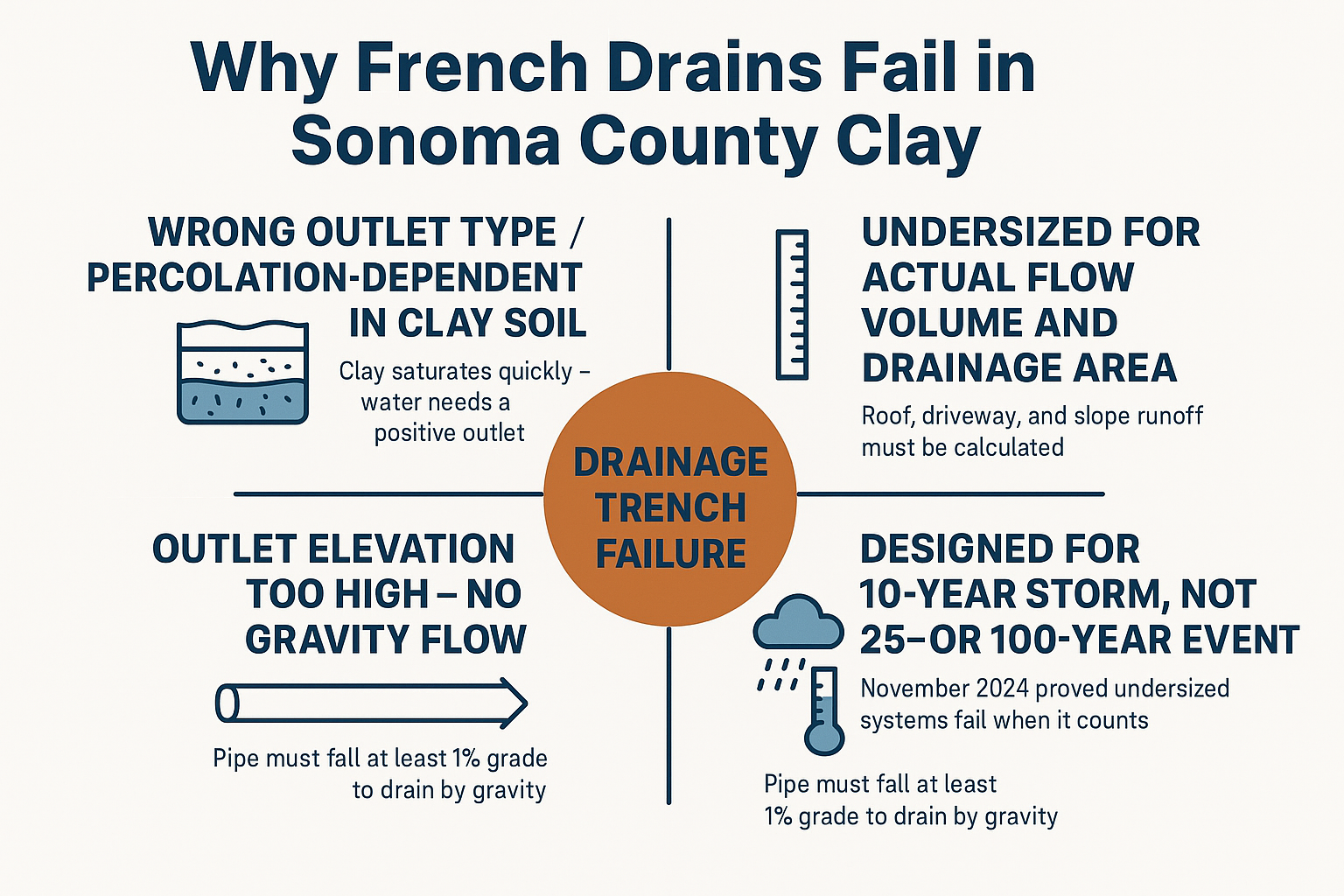
French Drain Failure: The Most Common Reasons at a Glance
This infographic breaks down the four most common reasons drainage trenches fail — from design stage through installation.
What a Proper Site Assessment Actually Looks At
A drainage trench project that’s done right starts with a site walk, not a measurement. Before we talk about pipe size or trench depth, there’s a set of site-specific questions that have to be answered.
What we’re evaluating before any trench gets dug:
- Total drainage area: How much land — including rooflines, hardscape, and slope — is feeding water toward the problem zone?
- Soil type and depth to permeable layers: In Sonoma County, this often means probing below the clay to understand where a dry well or deeper trench might actually work.
- Outlet elevation: The most critical number. Where is the lowest available point where water can exit? Is there a positive gravity path to get there?
- Slope of the trench run: A perforated drain pipe needs to fall at least 1% grade — about 1 inch per 8 feet — to move water consistently. Less than that and sediment builds up and the pipe stops draining.
- Connection to public systems: If the outlet connects to a street gutter, a public storm drain, or any drainage infrastructure, that triggers coordination with Sonoma County or the relevant city public works department, separate from any grading permit.
On the permit side: Sonoma County requires a grading permit for any cut or fill over 50 cubic yards. Most residential drainage trenches don’t hit that threshold, but if you’re doing larger drainage work on a rural or agricultural property — the kind that involves road drainage, swales, or significant earthmoving — you can approach it quickly. And if the disturbed area exceeds one acre, you’re looking at a Construction General Permit and a Stormwater Pollution Prevention Plan (SWPPP) under the State Water Board’s general permit program.
Most homeowners don’t realize those thresholds exist until a project is already moving. We’d rather flag them at the assessment stage.
If your drainage situation ties back to a hillside or slope, the excavation decisions behind a retaining wall project are worth understanding too — slope drainage and wall drainage are closely connected, and solving one without the other usually means coming back.
Outlet Type Comparison: Which Works in Sonoma County Clay
Not every outlet option works on every site. Here’s how the three main approaches compare for Sonoma County conditions.
| Outlet Type | How It Works | Works in Heavy Clay? | Key Requirement |
|---|---|---|---|
| Daylighted outlet | Pipe exits at a lower slope or property edge; water drains freely by gravity | Yes — best option for clay sites | Requires a downhill exit point with clear path |
| Dry well (deep permeable layer) | Water collected in a pit below the clay horizon where soil can absorb it | Yes — if permeable layer is reachable | Needs soil probing to confirm depth and permeability |
| Storm drain connection | Drain ties into public storm drain infrastructure | Yes — bypasses soil entirely | Requires public works coordination and permit approval |
| Percolation into native clay | Water disperses into surrounding soil through gravel and pipe perforations | No — clay saturates too quickly under heavy rain | Only suitable for very minor, slow-flow situations |
The Questions Worth Asking Before You Hire Anyone
When you’re talking to a drainage trenching contractor, the conversation should cover more than price per linear foot. If a contractor gives you a quote without asking about your outlet elevation, your drainage area, or what the soil looks like below the surface — that’s a signal.
The questions I’d want answered before committing to any drainage trench installation:
- Where exactly does the water exit when the drain is full? If the contractor can’t point to a specific location on your property, that’s a problem.
- What storm event is this system sized for? A fair answer is honest about the tradeoff — sizing for a 25-year event costs more than sizing for a 10-year event, but given what Sonoma County has seen in recent winters, that gap in protection is worth understanding.
- Will this require a permit? Any trench work connecting to a public drainage system should prompt that conversation, regardless of soil volume.
- What happens if the percolation rate is lower than expected? A good contractor has an answer ready — usually a backup outlet plan or a dry well option.
We also get calls from homeowners dealing with recurring pooling in the same spot every season. Understanding why water returns to the same location is often the first step before any physical drainage work starts — sometimes the answer is grading, not trenching.
For properties near creeks or with active bank erosion, the drainage picture is more complicated. Riparian lot erosion control involves a different set of considerations than a standard yard drainage trench, and the permit process can involve state and regional agencies beyond just the county.
Frequently Asked Questions About Drainage Trenching in Sonoma County
How deep does a French drain trench need to be?
It depends on what the drain is protecting. A trench meant to intercept surface runoff might only need to be 18 to 24 inches deep. A foundation drain or a system trying to get below a clay layer to reach permeable soil can go 4 feet or more. Depth is determined by what you’re intercepting and where the water needs to go — not by a standard number.
Why did my French drain stop working after a few years?
The most common cause is sediment and fine clay particles clogging the gravel and pipe perforations over time. If the system was installed without a proper filter fabric separating the gravel from the surrounding clay soil, those fines migrate into the trench and reduce flow capacity every season. The second most common cause is an outlet that was never adequate to begin with — it worked during light rain and failed once the drain filled up under a real storm.
Do I need a permit to install a drainage trench on my residential property in Sonoma County?
For most residential drainage trench projects, a standalone grading permit isn’t required because the excavation typically falls under Sonoma County’s 50 cubic yard threshold. But if the trench outlet connects to a public storm drain or street gutter, that connection requires coordination with the city or county public works department regardless of soil volume. And if you’re on a larger rural parcel where the overall project disturbs more than one acre of soil, a Construction General Permit and SWPPP may apply under the State Water Board’s program. When in doubt, confirm before you dig.
Can a drainage trench fix standing water near my foundation?
Sometimes, but not always on its own. A foundation perimeter drain (French drain installed around the footing) can intercept subsurface water moving toward the foundation. But if water is pooling against the foundation because the finish grade slopes toward the house, a trench won’t fix the underlying grading problem — it will just manage the symptom. The most durable fix usually involves correcting the grade first and adding drainage second.
What’s the difference between a French drain and a catch basin system?
A French drain collects water along a linear path — it’s designed to intercept sheet flow or subsurface water moving through soil. A catch basin collects water at a single low point, like a surface inlet, and then routes it through a solid pipe to an outlet. Many sites need both: the catch basin handles concentrated surface flow at the low point, while the French drain handles the water that moves through the soil between storms. Using one without the other, when both are needed, is a common design gap.
How much does drainage trenching cost in Sonoma County?
Costs vary significantly depending on trench length, depth, outlet type, soil conditions, and whether any permit coordination is required. In general market terms, residential drainage trench projects in the Sonoma County area can range from a few thousand dollars for a simple surface drain to considerably more for systems requiring deep excavation, dry wells, or public storm drain connections. The most reliable way to get a number that reflects your actual site is to have a contractor walk the property before quoting — scope that looks simple from the street often looks different once someone sees the soil and the outlet options.
Have a Drainage Problem Worth Talking Through?
If you’ve got standing water that keeps coming back, a French drain that stopped working, or a site you want assessed before the next wet season, we’re available to take a look. DW Excavation works throughout Sonoma County, Monterey County, and the broader Central Coast — and we know the soil conditions and permit requirements in both markets well. Call us at 707-601-9091 or reach out through the contact page at dw-excavation.com to start the conversation.