
Direct Answer: Water pools in the same spot because the ground there can’t drain fast enough — usually due to poor grading, compacted soil, or a buried low point that has nowhere to send water.
Every time it rains, the same corner of your yard fills up with water. You wait a few days, it slowly disappears, and you tell yourself it’s fine. Then the next storm hits and it’s back — same spot, same puddle, sometimes bigger.
This isn’t random. Standing water that returns to the exact same location after every storm is telling you something specific about what’s happening underground or with the grade of your property. In Monterey County, where coastal clay soils and hillside runoff are part of the landscape, this pattern is one of the most common problems we see on residential and commercial properties.
This article walks through the real reasons water pools in the same place, what that means for your property long-term, and how drainage problems get fixed — for good.
The Most Common Reasons Water Keeps Returning to One Spot
When water finds the same low point every storm, it’s following the path of least resistance. That path was created by one or more of these underlying conditions:
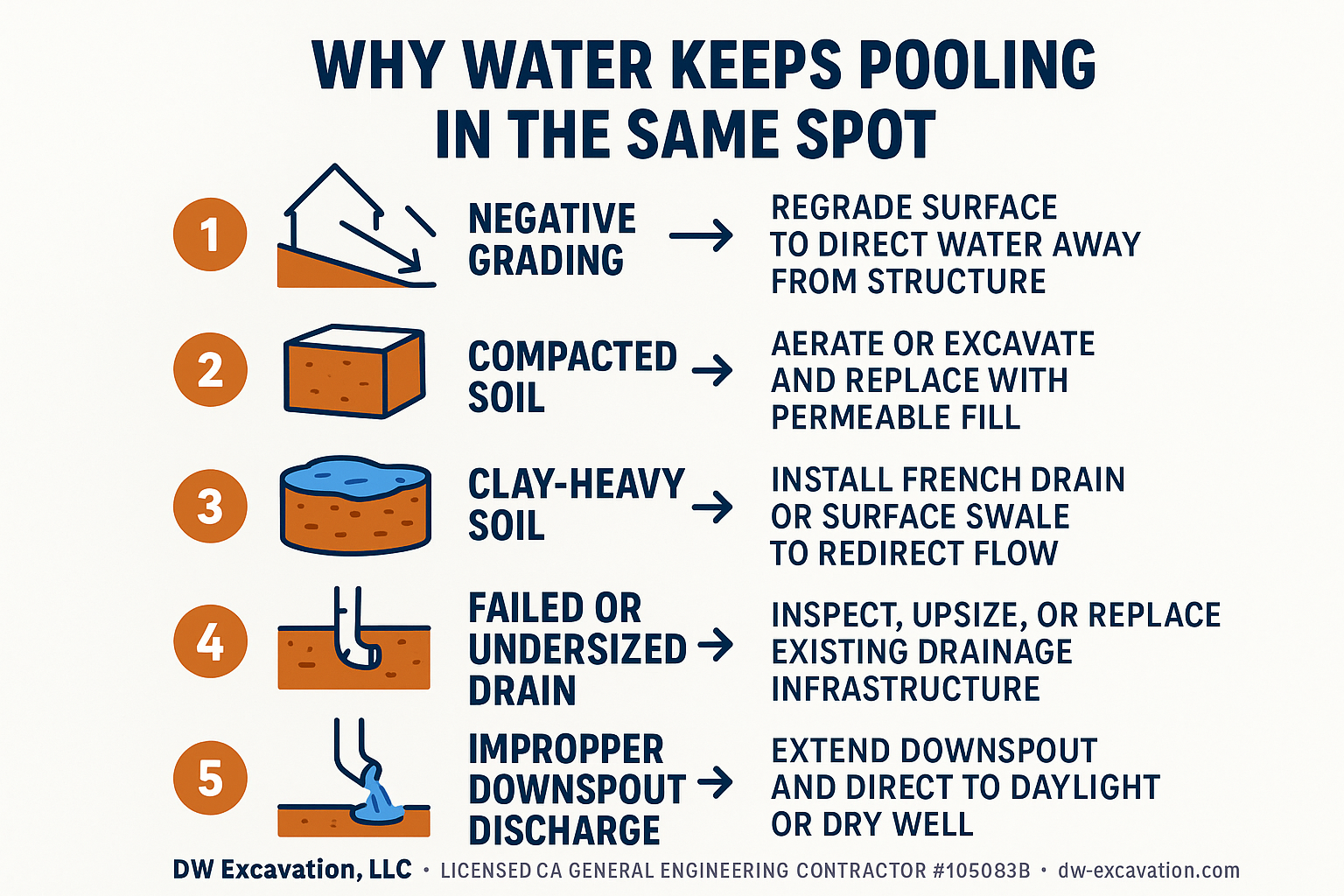
- Negative grading — the ground slopes toward your house or toward a low point instead of away from it
- Compacted soil — foot traffic, vehicle weight, or construction activity has packed the soil so tight that water can’t absorb into it
- Clay-heavy soil — Monterey County has significant clay content in many areas, and clay sheds water instead of absorbing it
- Buried hard surfaces — old concrete slabs, construction debris, or decomposed granite layers underground block downward drainage
- A broken or undersized French drain — if drainage infrastructure was installed but undersized or failed, water backs up and surfaces in the same weak point
- Downspout discharge — a gutter downspout that dumps directly onto a flat or low area will create a puddle every single time
Most homeowners assume the problem is just “bad soil.” But soil type is only one piece. The grade of the land — meaning how the surface slopes — is usually the bigger issue. If grading was done wrong from the start, water will always find its way back to that same problem spot.
Why Monterey County Soil Makes This Worse
Monterey County isn’t a single soil type — it shifts depending on where you are. Properties near Salinas and the Pajaro Valley sit on heavy agricultural clay that swells when wet and nearly seals the surface. Coastal areas around Seaside and Marina have sandy loam that drains fast but erodes quickly under channeled runoff. Hillside properties above Carmel Valley deal with shallow topsoil over fractured rock, where water moves laterally instead of straight down.
All three of these soil conditions create pooling — just for different reasons. Clay holds water on the surface. Sandy soil erodes channels that send water rushing to low points. Hillside rock deflects subsurface water toward whatever path is open.
After the 2023 Pajaro flooding and the atmospheric river events that hit the Central Coast in late 2024, we saw properties that had minor pooling issues turn into full-scale drainage failures — because the soil was already saturated and had nowhere left to send water. The spots that pooled before pooled catastrophically after.
Understanding your specific soil type matters before any drainage fix gets started. What works in Marina won’t work the same way in Carmel Valley. This is part of why proper yard drainage troubleshooting in Santa Rosa or Monterey County requires someone who knows the local ground — not just a generic French drain spec from the internet.
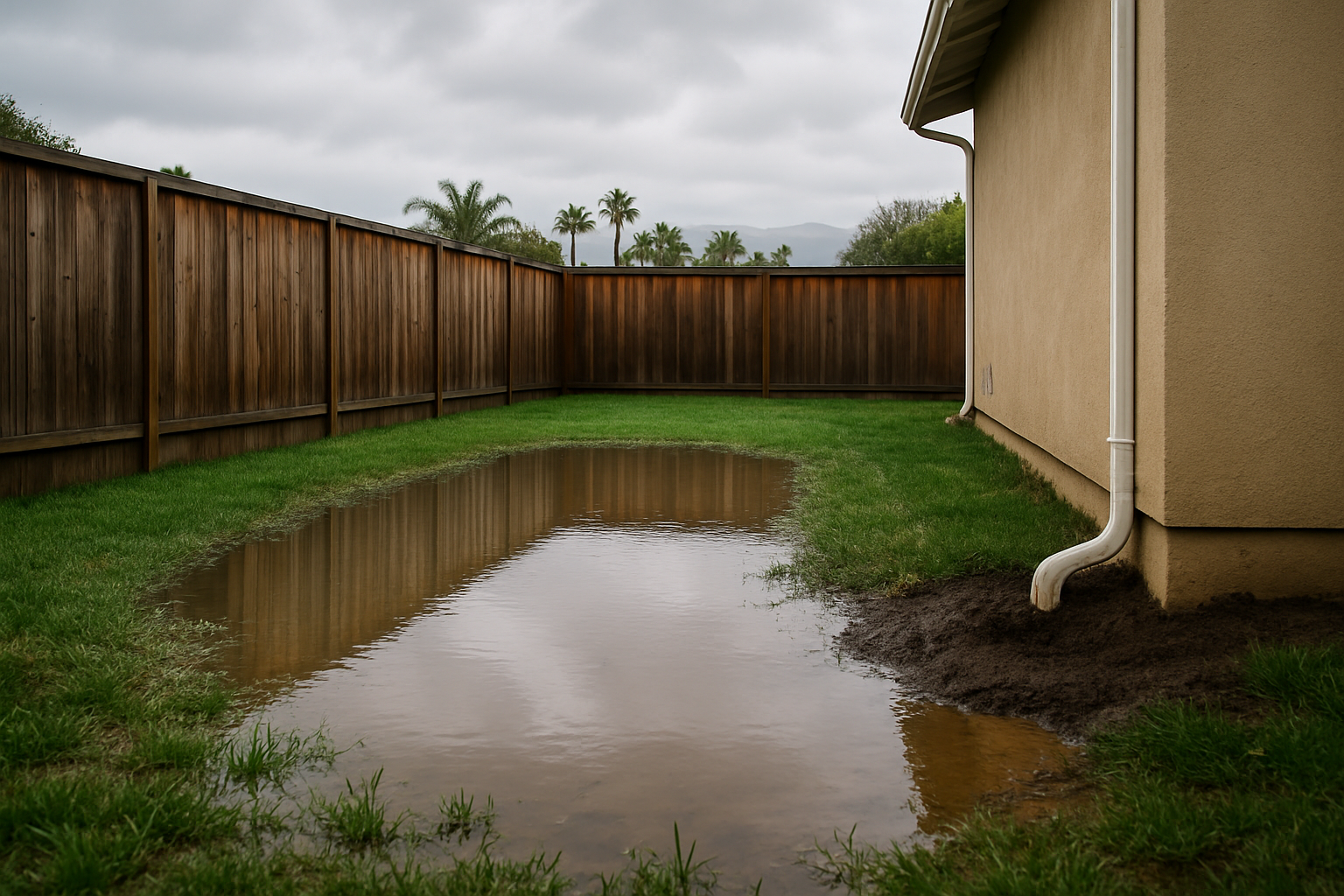
What Happens If You Leave It Alone
Standing water isn’t just a cosmetic annoyance. Over time, it creates a chain of property damage that gets more expensive the longer it sits.
Here’s what we see happen when pooling goes unaddressed:
- Foundation damage — water that pools against or near a foundation creates hydrostatic pressure that cracks slabs and footings over time
- Soil erosion — standing water that eventually drains will carry topsoil with it, carving channels and destabilizing slopes
- Septic system stress — in properties with septic, saturated soil near drain fields causes system backups and premature failure
- Mosquito and pest problems — Monterey County vector control issues are well documented in neighborhoods near seasonal standing water
- Structural settling — when soil gets repeatedly saturated and then dries out, it shrinks and swells in cycles that cause hardscape and foundations to shift and crack
If your pooling spot is within 10 feet of your home’s foundation, that’s not a landscaping issue — that’s a site drainage issue that needs a real fix. You can read more about how soil conditions interact with foundation work in our guide on what soil conditions make foundation work harder in Monterey County.
The longer standing water is ignored, the more expensive the eventual repair becomes. A grading correction that costs a few thousand dollars today can prevent a foundation repair that runs $20,000 to $80,000 later.
The 5 Most Common Causes of Yard Pooling (And What Fixes Each One)
This infographic breaks down the five root causes of recurring yard pooling and the specific fix that addresses each one.
How Drainage Problems Actually Get Fixed
The right fix depends entirely on what’s causing the pooling. There’s no one-size solution. Here’s how the process typically works:
Step 1 — Site assessment. A contractor walks the property, identifies where water enters, where it pools, and where it needs to exit. This includes checking the grade, soil type, and any existing drainage features.
Step 2 — Identify the drainage path. Every water drainage solution needs a legal outlet — a storm drain, a dry creek, a swale to daylight, or a municipal connection. If there’s no clear path, water will just move the problem somewhere else.
Step 3 — Choose the right system. Common fixes include:
- Regrading — reshaping the surface so water flows away from problem areas
- French drains — perforated pipe buried in gravel that collects and redirects subsurface water
- Surface swales — shallow channels that guide sheet flow across the yard to a safe exit point
- Catch basins — below-grade inlets that capture surface pooling and connect to a pipe system
- Dry wells — underground chambers that hold water and release it slowly into permeable soil layers below the clay
Step 4 — Permits where required. In Monterey County, grading work that involves cuts or fills over 100 cubic yards requires a grading permit from the county. For smaller drainage work, permit requirements depend on scope — but any work that ties into the municipal storm system will need approval.
You can see how storm drainage systems work in more detail in our guide on Sonoma and Monterey storm water system solutions.
Drainage Fix Comparison: What Works for Which Problem
Not every drainage solution fits every situation. Here’s a quick breakdown of common fixes, what problem they solve, and what kind of property they work best on.
| Fix Type | Best For | When It’s Not Enough |
|---|---|---|
| Regrading | Surface pooling, negative slope near foundation | When subsurface drainage is blocked or soil is too compacted |
| French Drain | Subsurface water, clay-heavy soils, hillside properties | When there’s no legal outlet for the discharge end |
| Surface Swale | Sheet flow across flat or gently sloped yards | When neighboring properties or structures are in the water’s path |
| Catch Basin + Pipe | Concentrated pooling in driveways, patios, or hardscape areas | When the receiving line is undersized or already backed up |
| Dry Well | Sites with no outlet to daylight and permeable soil below clay | When soil permeability is too low to accept water over time |
| Downspout Extension | Pooling directly caused by gutter discharge | When the larger yard grade is still directing water to the same spot |
What to Expect When You Call a Contractor for This
A lot of homeowners doing yard drainage troubleshooting in Santa Rosa or Monterey County waste time calling the wrong type of contractor first. Landscapers can plant around a drainage issue, but they rarely fix the grade. Plumbers handle interior water — not site drainage. This work lives in the excavation and grading trade.
When you call a licensed excavation contractor, here’s what a proper first conversation should include:
- Where exactly the water pools — describe the location relative to your house, fences, or hardscape
- How long it takes to drain — hours means surface issue, days means subsurface blockage or clay layer
- Whether it’s gotten worse — pooling that expands over time usually means a degrading drainage system or changing soil conditions
- Proximity to your foundation, septic, or utilities — this changes the approach significantly
A good contractor won’t quote you a fix over the phone without seeing the site. If someone gives you a price for drainage work without walking the property, that’s a red flag.
Also worth knowing: if your property is in a FEMA flood zone — which applies to parts of the Pajaro Valley and low-lying areas near the Salinas River — any drainage modification may need to be reviewed against your flood zone designation. This is part of the permit assistance we walk clients through as part of the project planning process. Our guide on how to get your site plan approved faster covers this type of regulatory detail.
When the Problem Is Bigger Than One Puddle
Sometimes the recurring puddle is a symptom of a larger site drainage failure. This is especially true on properties that were graded during a previous build and never had a drainage plan done correctly.
Signs that the problem is bigger than a single low spot:
- Water enters from neighboring properties and has no exit path on yours
- Your yard takes more than 72 hours to drain after a normal rain event
- You have multiple pooling areas in different parts of the property
- You’ve noticed cracks in your driveway or hardscape near the wet areas — which often signals soil movement underneath (why driveways crack is often a drainage story)
- Erosion or soil loss is visible on slopes or near the pooling zone
In these cases, spot-fixing one area often just moves water to the next weak point. A whole-property drainage assessment — looking at how water enters the site, moves across it, and exits — is the only way to solve it for good.
Built for long-term stability means fixing the actual cause, not just burying a pipe where the water currently sits.
Frequently Asked Questions About Yard Drainage and Water Pooling
Is it normal for water to pool in my yard after every rain?
Some temporary pooling right after a heavy storm is normal. But if water sits in the same spot for more than 24 to 48 hours after a typical rain event, that’s a sign your drainage isn’t working. It won’t fix itself over time — it usually gets worse.
Can I fix yard drainage myself, or do I need a contractor?
Minor issues like redirecting a downspout or adding a small surface swale can be DIY projects. But if the problem involves grading, subsurface drainage, clay soil, or proximity to a foundation, you need a licensed excavation contractor. Doing it wrong can push the problem onto neighboring properties or create new erosion.
Do I need a permit to fix drainage on my property in Monterey County?
It depends on the scope. Monterey County requires a grading permit for any cut or fill exceeding 100 cubic yards. Work that connects to the municipal storm system will need additional approvals. A licensed contractor should handle permit assessment before any work starts.
How much does it typically cost to fix a yard drainage problem?
It varies significantly by what’s causing the issue and the size of the property. A simple downspout extension or small swale might run a few hundred dollars. A full regrading project or French drain system on a larger property can run $5,000 to $20,000 or more depending on depth, length, and site conditions. Get a site assessment before expecting any real number.
Can standing water damage my foundation even if it’s not touching the house?
Yes. Water that pools within 10 to 15 feet of a foundation creates soil saturation that can migrate under the slab or footings. Over time, the repeated wet-dry cycle causes soil to shift, which puts stress on the foundation. It doesn’t have to be touching the wall to cause damage.
Ready to Stop Watching the Same Puddle Form Every Winter?
If you’re dealing with recurring yard pooling on a Monterey County property — whether it’s near your foundation, along a fence line, or spreading across your yard after every storm — DW Excavation can walk your site, identify the root cause, and give you a clear picture of what a real fix looks like. Call us at 707-601-9091 or visit dw-excavation.com to request a free estimate.