
Direct Answer: A driveway lasts when the ground beneath it is properly graded, compacted, and drained. Without that foundation, even quality asphalt or concrete will crack and fail within a few years.
A lot of Monterey County homeowners have watched a new driveway start falling apart before they even finished paying for it. Cracks running across the surface, soft spots near the apron, water pooling after every rain. It’s frustrating — and it’s almost never the asphalt’s fault.
The truth is, most driveway failures start below the surface. What you see on top is just the end result of whatever was — or wasn’t — done underneath. The mix, the thickness, the slope, the drainage — all of it matters before a single ton of material gets laid.
This guide walks through exactly what separates a driveway that holds up for 20+ years from one that starts failing in two. We’re talking real site prep, real drainage, and the local soil and weather conditions here on the Central Coast that most installers either don’t know about or don’t bother with.
It Starts With What’s Under the Surface
People focus on the top layer — asphalt vs. concrete, color, finish. But the sub-base is what actually determines how long a driveway survives.
The sub-base is the compacted material that sits between the native soil and your paved surface. In most residential applications, that means 4 to 8 inches of crushed aggregate — gravel, decomposed granite, or crushed base rock — packed down to a specific density before anything goes on top.
Skip that step, or rush it, and the surface above will shift, crack, and sink. It’s that simple.
Here in Monterey County, the challenge is that the soil beneath your driveway is rarely stable on its own. Coastal areas near Marina and Seaside sit on sandy, loosely packed soil that shifts under load. Inland areas toward Salinas deal with heavy clay that expands when wet and contracts when dry — which is hard on anything sitting on top of it.
A solid sub-base accounts for all of that. It spreads the weight of vehicles evenly and keeps the surface from moving when the ground below does. Why your pavement keeps failing is almost always traced back to what happened — or didn’t happen — at this stage.
Grading and Drainage Are Non-Negotiable
Water is the number one enemy of any paved surface. And Monterey County gets plenty of it — especially in years like 2023 when the Pajaro Valley flooded and properties across the region took on more water than anyone planned for.
A properly built driveway sheds water. It does that through slope — typically a 2% grade (about 1/4 inch of drop per foot) away from the structure and toward a drainage point. That sounds minor, but it’s the difference between water running off and water sitting on the surface, soaking in through cracks, and freezing or softening the base below.
When grading is wrong, water pools in the same spot every time it rains. That’s not just a cosmetic problem — it’s the beginning of a failure cycle.
Drainage planning should also account for:
- Where runoff goes once it leaves the driveway surface
- Side swales or catch basins if the driveway is long or slopes toward the house
- French drains or perforated pipe in areas with chronic saturation
- Tie-ins to the property’s stormwater system so you’re not just pushing water to a neighbor’s lot
In Monterey County, grading work over 100 cubic yards requires a permit. That threshold matters — not because most residential driveways hit it, but because it tells you the county takes site drainage seriously. Any contractor who doesn’t mention it probably isn’t thinking past the surface.
The Materials Matter — But Not the Way Most People Think
Asphalt and concrete are both good driveway materials when installed correctly. The debate over which one to choose often distracts from the bigger question: was the ground under either one prepared properly?
That said, material selection does matter for longevity — and the Central Coast climate plays a role in that decision.
Asphalt tends to perform better in areas with temperature swings and occasional frost. It’s slightly flexible, which helps it handle ground movement without cracking as catastrophically as concrete. It also costs less upfront — typically $3 to $7 per square foot installed in Monterey County, depending on thickness and access.
Concrete is harder, handles vehicle weight better over time, and lasts longer when properly sealed — but it’s less forgiving of poor sub-base work. Cracks in concrete are more visible and harder to repair.
One thing both materials share: they need adequate thickness. A residential driveway handling standard passenger vehicles needs at minimum 3 inches of compacted asphalt over a proper base, or 4 inches of concrete. Driveways that need to handle heavier loads — trucks, RVs, delivery vehicles — need more.
If you’re curious about what repaving costs in this market, the 2026 cost to repave driveway asphalt guide breaks it down by material and project size.
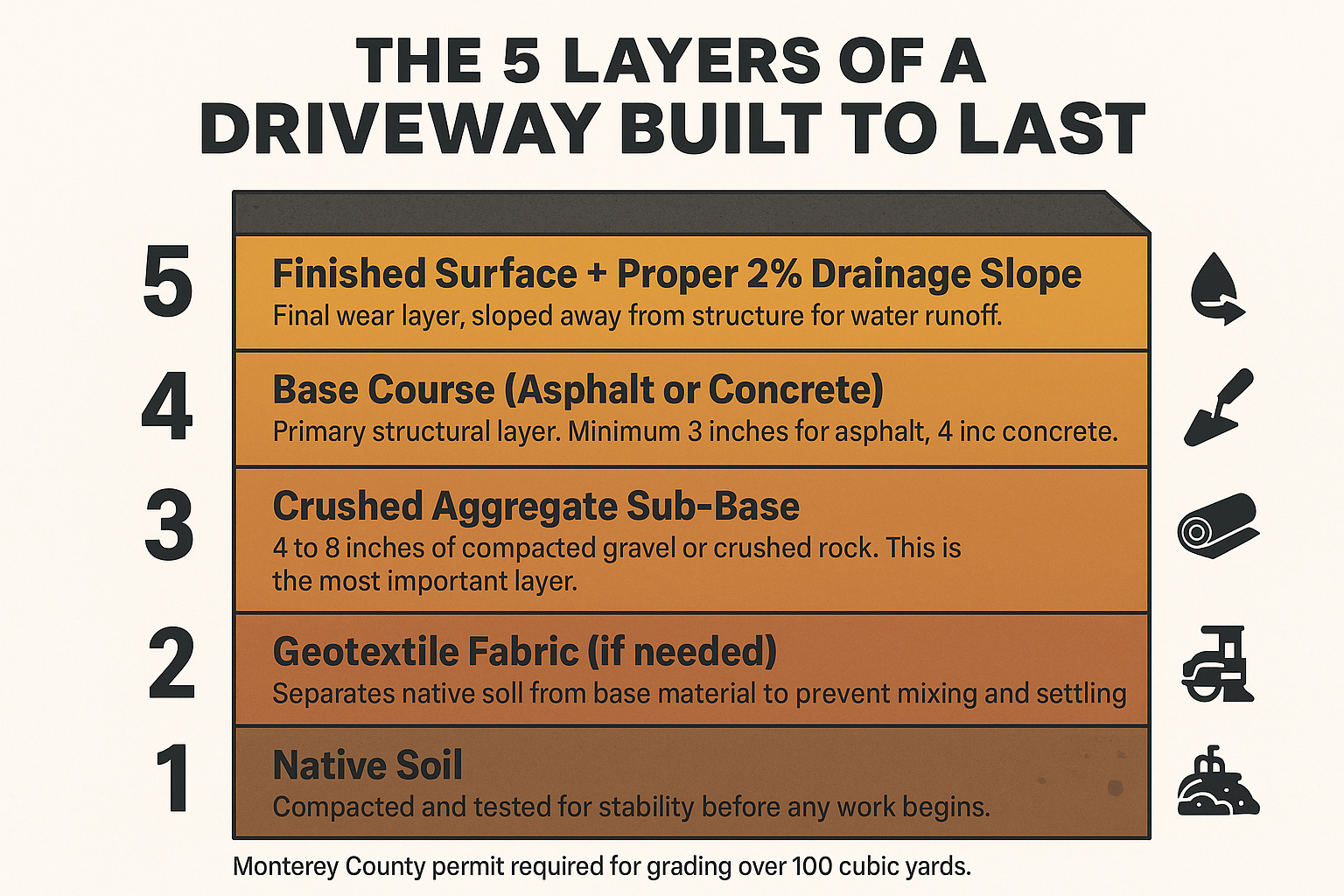
The 5 Layers of a Driveway Built to Last
This infographic shows the cross-section of a properly built driveway — from native soil to finished surface — and what each layer does.
Why So Many Driveways Fail in the First Three Years
A driveway that cracks in year two or three didn’t fail because of bad luck. It failed because something was wrong from the start — and why your new driveway started cracking so fast almost always traces back to one of a handful of root causes.
The most common ones we see:
- Inadequate compaction — the base material was laid but not properly packed down, leaving air pockets that collapse under load
- Wrong sub-base depth — not enough material to distribute weight, especially under heavy vehicles or in soft soil zones
- No drainage planning — water has nowhere to go and starts breaking down the base from below
- Asphalt laid too thin — cutting material costs at the expense of structural integrity
- Poor edge support — the edges of the driveway weren’t built up or supported, so they crumble first
- Surface installed over wet or unstable soil — rushing the job before the ground was ready
In coastal Monterey County, the combination of sandy soil near the bay and heavy rain events creates a particularly punishing environment for driveways that weren’t built with drainage in mind. The November 2024 atmospheric river events that hit Sonoma and the broader Central Coast were a reminder of what happens when site drainage is treated as an afterthought.
A Sonoma County local paving contractor working in that storm’s aftermath saw driveway after driveway buckle — not from the rain itself, but from the water that had nowhere to drain.
Driveway Lifespan by Build Quality and Maintenance
This table compares expected driveway lifespan based on how the project was prepared and maintained — not just what material was used on top.
| Build Approach | Expected Lifespan | Common Failure Point |
|---|---|---|
| Proper sub-base + grading + drainage | 20–30 years | Surface wear only, manageable with sealing |
| Adequate base, no drainage planning | 8–12 years | Edge crumbling, water infiltration cracks |
| Minimal base, fast install | 3–6 years | Widespread cracking, soft spots, sinking |
| Surface-only patch or overlay | 2–4 years | Re-cracking along original failure lines |
| No base prep, native soil only | 1–3 years | Full failure, requires complete removal and rebuild |
What Good Site Preparation Actually Looks Like
Before any material touches the ground, the site needs to be cleared, excavated to the right depth, graded to the correct slope, and compacted in lifts — meaning the base material is added in layers, each one packed down before the next goes on.
For a standard residential driveway, that process looks like this:
1. Strip and excavate — remove topsoil, vegetation, and any soft material down to stable ground
2. Check sub-grade stability — probe or test the native soil to see if it needs reinforcement
3. Install geotextile fabric if soil conditions require a separation layer
4. Place and compact aggregate base in 2 to 4 inch lifts until full depth is reached
5. Check grade and slope with a level — confirm the 2% drainage pitch before paving
6. Inspect edges to make sure the perimeter has enough support
7. Install surface material at the correct thickness
Every step matters. Skipping or shortcutting any one of them is how you end up back at the beginning in three years.
If you’re also planning drainage improvements alongside your driveway project, understanding Sonoma and Monterey stormwater systems can help you see how the two connect.
How to Choose the Right Contractor for a Driveway That Lasts
The paving industry has a lot of guys who show up with hot mix and a roller but skip the site prep conversation entirely. That’s not a driveway contractor — that’s a paver. And there’s a difference.
A contractor who builds driveways to last will talk about the ground before they talk about the surface. They’ll ask about drainage, about what’s underneath, about whether the area has a history of water problems. They’ll pull permits when required and follow county grading standards.
Here’s what to look for when evaluating contractors:
- They inspect the site before quoting — not just measure the square footage
- They explain the sub-base plan and can tell you exactly how deep and what material
- They address drainage as part of the scope, not an afterthought
- They hold a valid CA contractor’s license — check it at the CSLB before signing anything
- They know local permit requirements — in Monterey County, grading over 100 cubic yards triggers a permit; they should know that without being asked
- They don’t offer the lowest price with the fastest timeline — that combination almost always means corners are being cut below the surface
You can also ask to see past projects — driveways they installed 3 to 5 years ago that you can look at and walk on. A contractor confident in their prep work won’t hesitate to show you.
Frequently Asked Questions About Driveway Longevity
How thick should my driveway asphalt be in Monterey County?
For a standard residential driveway, 3 inches of compacted asphalt over a proper crushed aggregate base is the minimum. If you’re parking heavy trucks or equipment, bump that to 4 inches or more. The base layer underneath matters just as much as the asphalt itself.
Can I just repave over my cracked driveway instead of tearing it out?
Sometimes, but it depends on why the cracks are there. If the sub-base is compromised or the drainage was never right, an overlay will crack in the same places within a few years. It’s worth having someone look at the root cause before deciding. This guide on driveway cracking explains when an overlay works and when it doesn’t.
Do I need a permit to repave my driveway in Monterey County?
Repaving an existing driveway surface typically doesn’t require a permit on its own. But if the project involves grading work — moving or placing more than 100 cubic yards of material — a grading permit is required by Monterey County. Any contractor working on your site should be able to tell you upfront whether your project triggers that threshold.
How often does a well-built driveway need to be sealed?
For asphalt, every 2 to 4 years is a reasonable range depending on sun exposure, traffic load, and whether cracks have started to form. Sealing too often can cause buildup that actually weakens the surface. The 2026 driveway sealing guide covers exactly when to seal and when to skip it.
What’s the biggest mistake homeowners make when planning a new driveway?
Focusing on price per square foot without asking what’s included in the base prep. The cheapest bid almost always means the least sub-base material and the least compaction work. You pay for it later — usually with a full removal and rebuild that costs two to three times more than doing it right the first time.
Ready to Build a Driveway That Actually Holds Up?
If you’re planning a new driveway or trying to figure out why an existing one is already failing, DW Excavation works with homeowners and property owners throughout Monterey County — from Salinas and Seaside to Marina and the Pajaro Valley — to get the site prep right before anything gets paved. Call us at 707-601-9091 or reach out through the contact page at dw-excavation.com to talk through your project.