
Quick Answer
A storm water system moves runoff away from structures, controls erosion, and reduces flood risk on your property. If it’s undersized, clogged, or poorly graded, water will find the weak spot fast. The right fix depends on your site, soil, slope, outlet, and local permit requirements.
If you're reading this, there's a good chance water is already showing up where it shouldn't. Maybe a driveway is washing out, a crawlspace stays damp, an ADU lot holds water after every storm, or an older drain line just can't keep up anymore.
On California properties, especially in Sonoma County, Monterey County, and along the Central Coast, a storm water system isn't just a box to check on a plan set. It's part of whether the site stays usable, stable, and buildable.
What Is a Storm Water System and Why It Matters
A storm water system is the set of features that collects, moves, slows, stores, and sometimes filters rain runoff across a property. That can include gutters, area drains, catch basins, swales, culverts, trench drains, underground pipe, detention areas, and outlet structures.
Its job is simple to describe and easy to get wrong in the field. Keep water from backing up near foundations, prevent soil from washing away, and avoid sending dirty runoff across neighboring property or into places it shouldn't go.
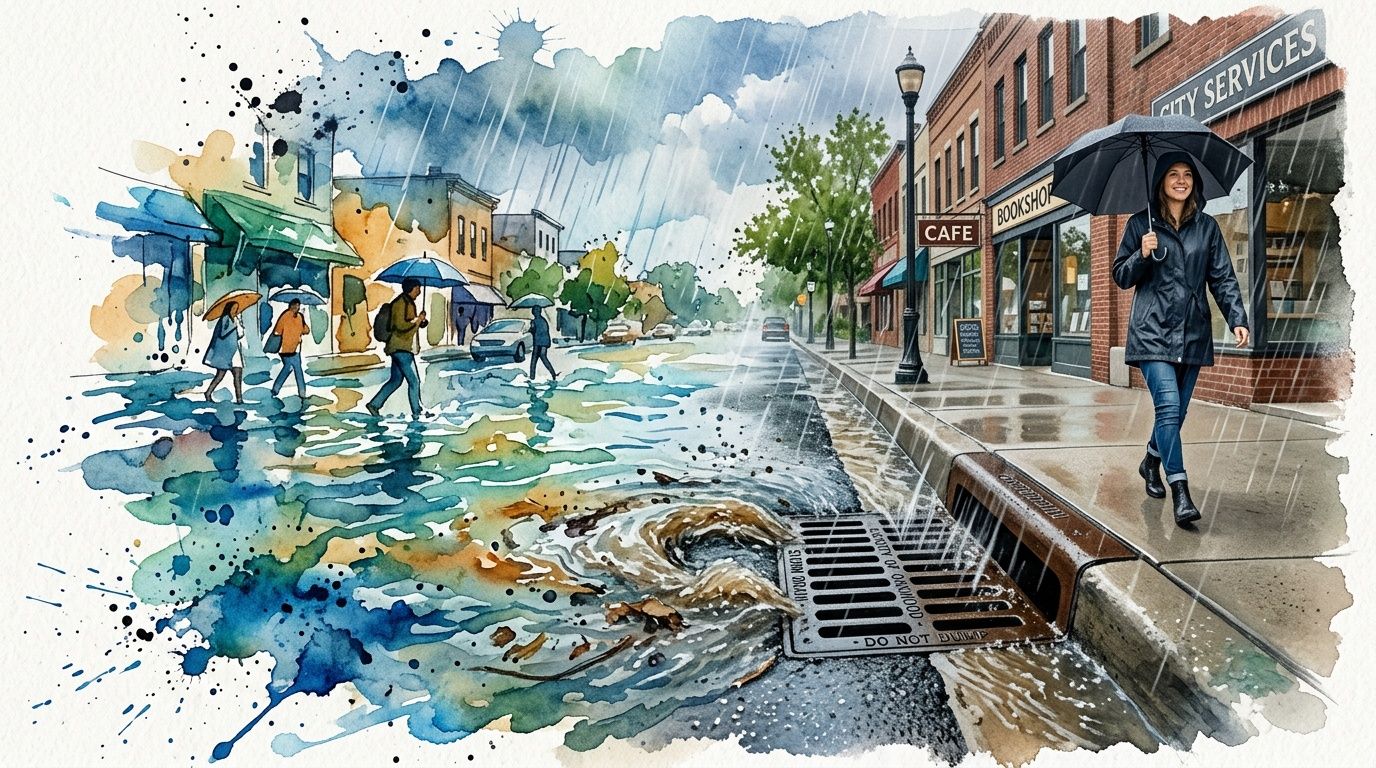
What a working system actually protects
A lot of owners think first about puddles. The bigger issue is what those puddles turn into over time.
- Foundation trouble can start when runoff ponds next to slabs, stem walls, or retaining areas.
- Erosion shows up on slopes, at driveway edges, below downspouts, and around outlet points.
- Water quality problems happen when runoff carries sediment, oil, fertilizer, or debris off the site.
- Usability issues affect access roads, parking areas, patios, and any low spot people need to cross.
If you're also looking at roof runoff as part of the problem, this essential home gutter guide gives a clear overview of how gutters fit into the larger drainage picture.
Why property owners should take it seriously
The financial risk is not theoretical. Stormwater runoff and flooding have caused $156.8 billion in U.S. losses since 2000, tied to aging infrastructure and stronger storm impacts, according to Bluefield Research's summary of NOAA stormwater damage data.
That kind of number matters because the same failure pattern shows up on private property at a smaller scale. A blocked inlet, a crushed line, or a bad grading decision can turn one hard storm into repair work on paving, foundations, landscaping, fencing, or interior finishes.
Practical rule: Water doesn't need a dramatic failure to cause damage. A small grading mistake repeated through one wet season is enough.
For homeowners and small developers, the first step is usually figuring out whether the issue is surface runoff, a subsurface pipe problem, or both. A good place to start is reviewing common drainage solutions for homes so you can match the symptom to the likely fix.
Common Types of Storm Water Systems
No single storm water system fits every lot. The right choice depends on space, slope, soil, how quickly water arrives, and whether you're trying to move it away, hold it briefly, or let it soak in.
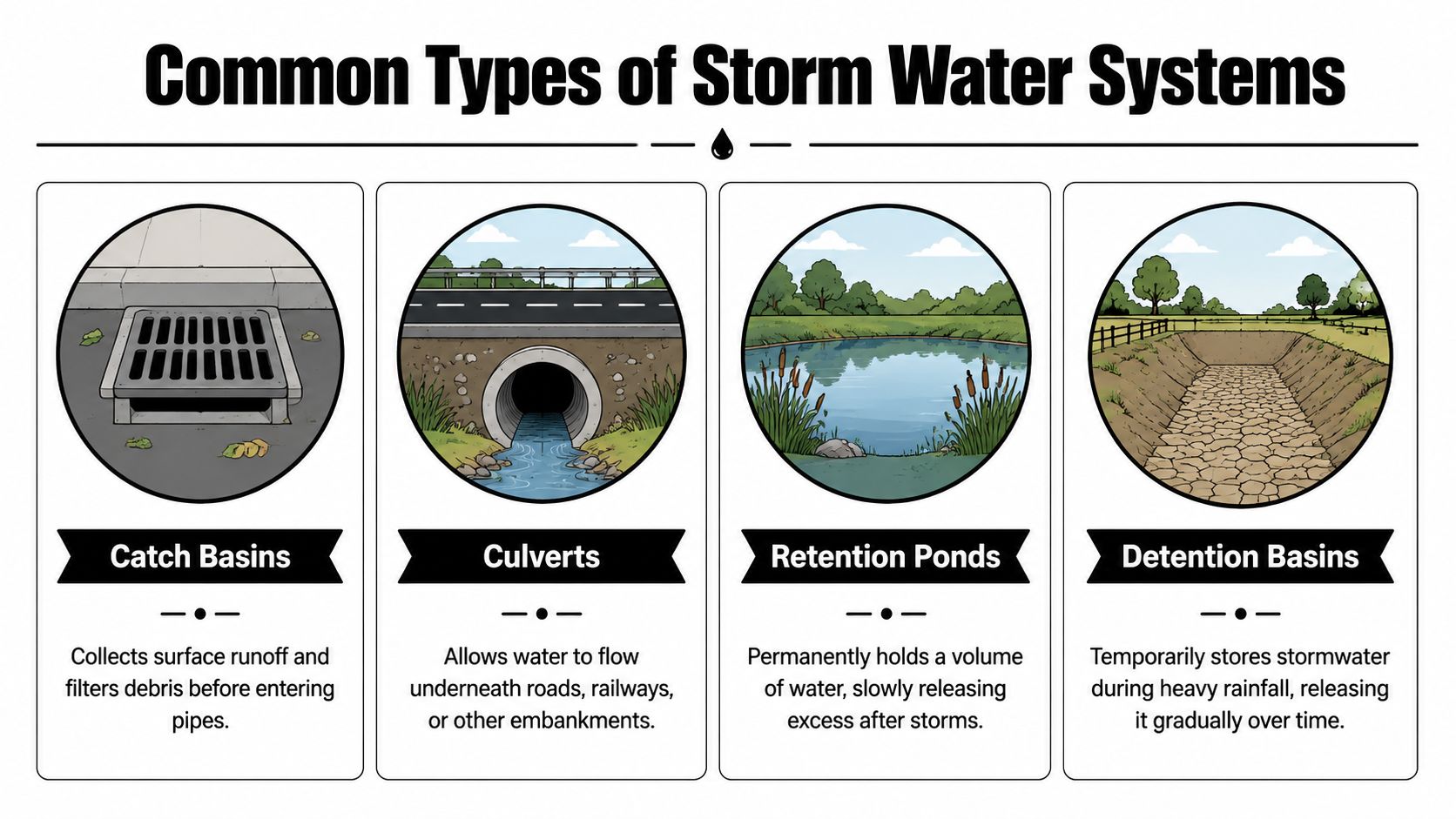
Catch basins and inlet drains
These are the collection points most owners notice first. Water enters through a grate, heavier debris settles, and runoff moves into a pipe network.
They work well in paved areas, around garages, at low spots in courtyards, and where concentrated runoff needs a defined entry point. Their weakness is maintenance. If nobody clears leaves, sediment, or trash, the system loses capacity fast.
Culverts
A culvert carries water under a driveway, private road, embankment, or access crossing. On rural and semi-rural properties, this is often the difference between controlled drainage and a washed-out crossing.
Culverts are useful where natural drainage paths already exist and access has to cross them. If they're undersized, set too high, or allowed to fill with debris, they become a choke point.
Detention basins
A detention basin temporarily stores runoff and releases it slowly. It is usually dry between storms or holds little water most of the time.
This type became an important shift in U.S. stormwater practice when design moved away from building larger conveyance systems and toward controlling runoff from individual development sites, as described in the stormwater management evolution report from MHFD. On the right site, detention helps shave off peak flow and reduce downstream stress.
Retention ponds
A retention pond permanently holds water and releases excess after storms. These can provide storage and treatment benefits, but they need room and ongoing upkeep.
For small residential infill lots, retention ponds usually aren't practical. On larger sites, they can work if grading, access, and maintenance responsibility are clear from the start.
Infiltration trenches
An infiltration trench is a rock-filled trench or subsurface structure that holds runoff long enough for it to soak into the ground. This is a good fit where soils allow infiltration and where you want less visible infrastructure.
The catch is that they need clean inflow. If sediment enters unchecked, the void space clogs and performance drops.
Bioswales
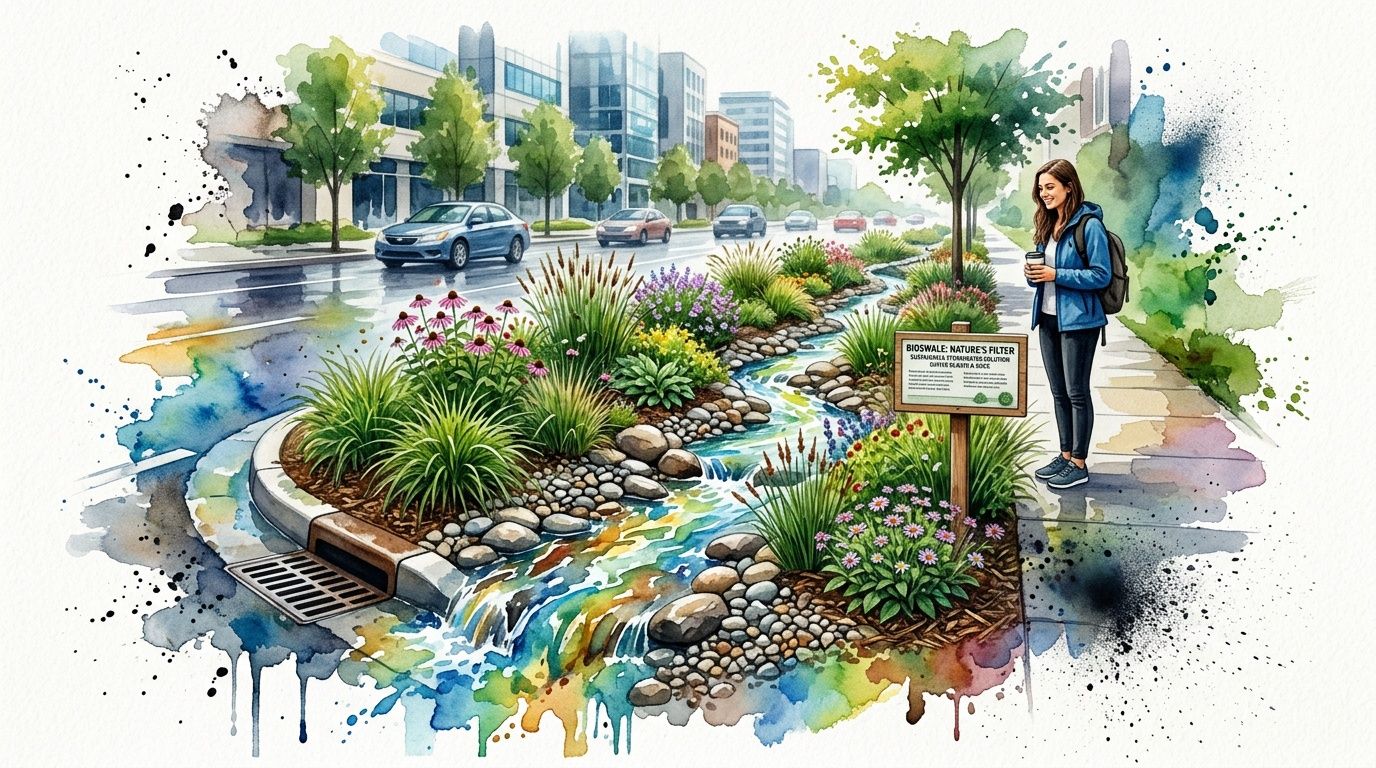
A bioswale is a shallow vegetated channel that slows runoff, spreads it out, and helps trap sediment. On residential and mixed-use sites, they can do a lot of work without looking industrial.
They are a good choice when you have room to shape the terrain and want something that handles water more naturally. They are not a cure-all for steep, confined sites with nowhere to safely discharge overflow.
Permeable pavement
Permeable surfaces allow water to pass through the surface into a prepared base below. They can help where runoff from driveways, paths, or parking areas is part of the problem.
Performance depends on proper base preparation and maintenance. If fines clog the surface, infiltration slows and the benefit drops.
Traditional pipe networks
This is the familiar setup of curb inlets, area drains, catch basins, and underground pipe carrying water to an outlet. For tight sites, steep grades, and developed areas with limited open space, this is often necessary.
Traditional systems are effective when elevations are right and the outlet works. They are less forgiving when installation is sloppy or downstream conditions were not thought through.
Treatment devices
Modern treatment units are used where runoff quality matters and a project needs more than simple conveyance. These devices can remove sediment, trash, and floatables before water enters detention, infiltration, or public systems.
A system that collects water well but ignores debris loading usually creates a maintenance problem you pay for later.
For owners comparing common residential drainage paths before they get into engineered site work, this overview of West TN home drainage options is a useful plain-language comparison of how different drainage approaches solve different problems.
Key Design and Permitting Considerations for Your Storm Water System
A storm water system fails on paper before it fails in the field. Most of the trouble starts with bad assumptions about slope, runoff path, outlet elevation, or what the local agency will allow.
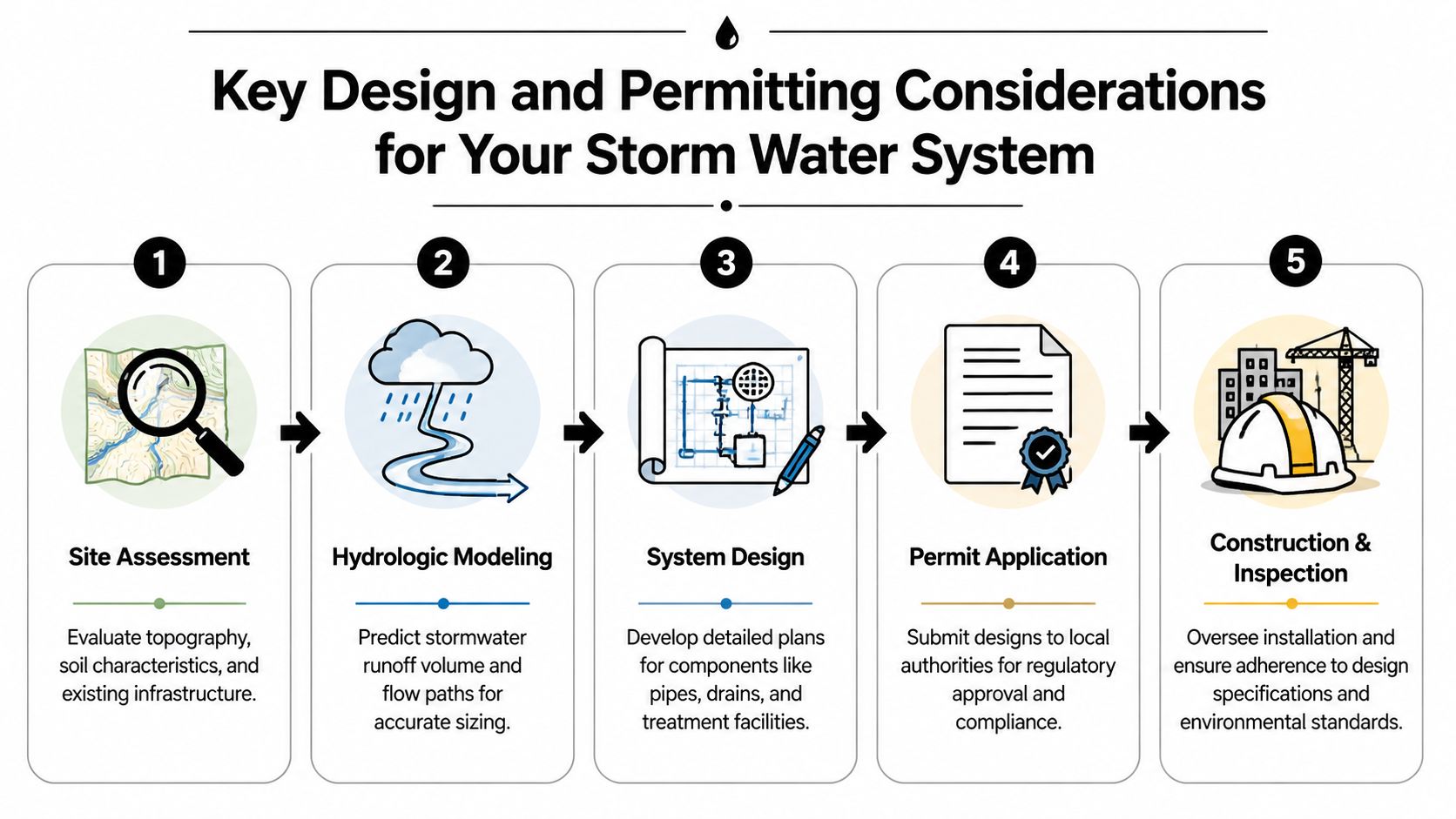
Site conditions decide more than product choice
Before anybody talks about pipe size or basin shape, the site has to be read correctly. That means looking at topography, hardscape, roof drainage, soil behavior, existing utility conflicts, and where water can legally and physically leave the property.
Hillside lots deserve extra attention. On those sites, runoff gains speed quickly, and one mistake at the top can create erosion or saturation lower down near a footing, retaining edge, or neighbor's fence line.
Hydraulic grade line is not just engineer talk
One of the most important design checks is the hydraulic grade line, or HGL. In plain language, it tells you how high water pressure conditions can force water to rise inside a storm drain system.
According to CED Engineering's stormwater drainage and site development guidance, professional storm drainage systems must be engineered so that the hydraulic grade line does not exceed the pipe crown elevation during normal operation. If it does, the system can surcharge, which leads to inefficiency and potential backups.
That matters on real jobs because a line can look fine during dry weather and still fail under storm conditions if tailwater, slope, or outlet elevation were misjudged.
If a system backs up during peak flow, the problem is often not at the grate you can see. It's downstream.
Permits and approvals affect layout
In Sonoma County and Monterey County, drainage work often ties into grading review, utility review, and erosion control requirements. New construction, ADUs, driveway work, major hardscape changes, and repairs tied to existing public connections can all trigger review.
A workable permit path usually includes:
- Clear site information so grades, drainage patterns, and discharge points are not left to guesswork
- A buildable design that crews can install without improvising elevations in the field
- Coordination with other utilities so storm lines don't conflict with sewer, water, power, or foundations
- Inspection readiness because inspectors want to see that installed work matches approved intent
If permit timing is part of your problem, this guide on the fastest way to get permits approved in Sonoma County lays out what usually helps and what causes delays.
What works and what usually doesn't
A few patterns repeat on troubled projects.
| Situation | Usually works | Usually causes trouble |
|---|---|---|
| Tight infill lot | Precise grading, defined collection points, coordinated utility layout | Trying to solve everything with surface pitch alone |
| Hillside build | Controlled intercept drainage and protected outlets | Letting runoff free-fall down exposed slope faces |
| Older property retrofit | Diagnosing existing pipe condition before adding new inlets | Adding drains without checking whether the downstream line can carry flow |
| Permit-sensitive project | Plans that match field conditions | Design changes made after excavation starts |
If you're trying to understand how yard and site water protection fits into the broader picture, this article on how to protect your home from water damage gives a useful homeowner-level perspective.
Maintaining and Troubleshooting Your System
Even a well-built storm water system needs regular attention. The good news is that basic maintenance catches a lot of problems before they turn into excavation, replacement, or interior water damage.
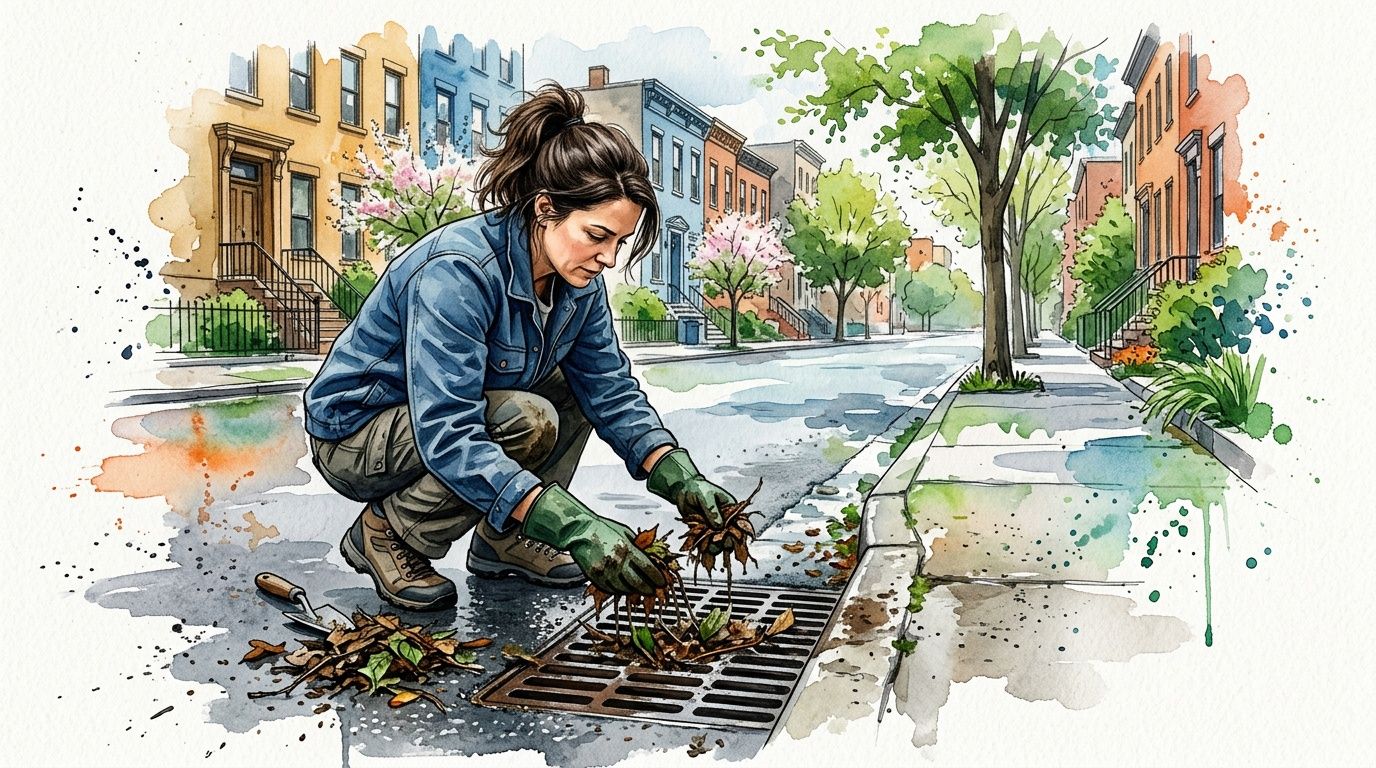
What to check through the year
A simple inspection after major storms and before the rainy season goes a long way.
- Clear grates and inlets so leaves, mulch, and roof debris don't block entry points.
- Walk the flow path and look for new low spots, rills, exposed soil, or gravel washed out of place.
- Check outlet areas for erosion, sediment buildup, or water standing longer than expected.
- Look at hard surfaces for ponding that wasn't there before.
- Watch downspout discharge to make sure water isn't dumping against a foundation or undermining paving.
A lot of drainage complaints start with surface symptoms. This guide to yard drainage troubleshooting is useful if you're trying to narrow down whether the issue is grading, blockage, or a failed underground line.
Signs of a simple fix
Some issues are straightforward. Debris in a catch basin, light sediment in a shallow swale, or vegetation growth that chokes off surface flow can often be handled with routine cleanup and minor reshaping.
Permeable surfaces also need attention. If the surface has accumulated fines, performance drops, and water may start to sheet across the top instead of passing through.
Signs of a bigger system problem
A few warning signs usually mean the problem is not maintenance alone.
- Recurring ponding in the same place after cleanup
- Water backing out of a drain during moderate storms
- Sink areas or soft ground over a buried pipe run
- Erosion at one outlet that keeps returning after repairs
- Water showing up inside a garage, crawlspace, or lower finished area
These problems often point to a crushed line, separated joint, bad slope, undersized piping, or an outlet that no longer functions the way it was supposed to.
Maintenance keeps a good system working. It won't correct a pipe that was installed at the wrong elevation.
When to stop guessing
If you’ve cleaned it, watched it through a storm, and the same failure repeats, it's time for a field diagnosis. At that point, the question is usually not whether water is present. It's where the control point failed.
That can involve locating the line, checking elevations, exposing suspect sections, or deciding whether repair can be done with limited disturbance or needs a more direct rebuild.
Sustainable and Climate-Resilient Stormwater Solutions
Older properties often have a patchwork drainage setup. A little concrete here, an improvised swale there, downspouts tied into whatever line was closest. That usually works until heavier runoff exposes every weak connection at once.
For many California sites, the better long-term answer is not just adding more pipe. It's combining conveyance with features that slow water down, spread it out, and reduce the amount that has to rush into one low point.
Where greener systems make sense
Bioswales, rain gardens, permeable paving, and similar low impact features work best where the site has enough room and the soils support the approach. They are especially useful on residential retrofits where the owner wants drainage improvement without turning the whole yard into hard infrastructure.
These systems also help when runoff is spread across a site rather than concentrated at one point. They can fit well around ADUs, driveway edges, garden setbacks, and rebuilt areas.
Why retrofits can pencil out
There is a practical business case for retrofitting an aging storm water system. Recent 2025 California Water Plan data shows well-designed retrofits such as rain gardens and permeable pavements can yield $3 to $7 in benefits per $1 invested, reduce runoff volumes by 30 to 50 percent, and are often recouped in 5 to 8 years, based on the summary published by Muller Engineering on stormwater drain design principles.
That doesn't mean every green feature belongs on every lot. It means owners should stop assuming that retrofits are purely cosmetic or purely environmental. On the right site, they can reduce repair exposure and improve how the property functions through wet weather.
The trade-offs owners should understand
Green infrastructure still has limits.
- It needs maintenance. Plants, sediment, and surface permeability all need attention.
- It needs proper placement. Putting infiltration too close to the wrong structure can create a different problem.
- It still needs overflow planning. Every system needs a safe way to handle storms beyond normal conditions.
For owners building or upgrading on the coast, seasonal rainfall patterns and site moisture swings matter during grading and drainage planning. This overview of how Central Coast weather affects grading and drainage for new projects gives a good sense of why timing and site conditions matter.
When to Hire DW Excavation for Your Storm Water System
Some drainage issues are small enough to monitor and maintain. Others need a contractor who can tie grading, underground work, and site planning together before more money is lost to repeated repairs.
You should bring in a professional when the drainage problem affects structures, access, permitting, or buildability. That includes water near foundations, repeated flooding at one low point, failed storm piping, erosion on slopes, or a new project that needs a code-compliant drainage plan from the beginning.
Jobs that usually need professional help
New construction and ADU work sit high on that list. Tight lots and hillside sites don't leave much room for field guesswork, and drainage has to be coordinated with foundations, utility trenching, paving prep, and final grade.
Major retrofits also belong in this category. If an older property has buried lines with an unknown path, recurring backups, or drainage tied into outdated work, the site usually needs more than adding another surface drain.
What the field approach should look like
The right contractor should be able to do more than dig. They need to read the site, understand elevations, coordinate with engineering, and install work to the designed intent.
That can include:
- GPS grading where precision matters for slope and drainage control
- Trenchless pipe repair when the line can be restored with less disturbance than full replacement
- Utility excavation and repair where storm, sewer, or water conflicts have to be sorted out carefully
- Permit and site planning support so the work can move through review without avoidable redesign
For property owners comparing options for drainage, erosion control, and runoff management on one project, DW Excavation, LLC provides water management services tied to excavation, grading, underground repair, and site development.
The right time to hire help is before a drainage problem spreads into structural work, paving replacement, or permit trouble.
Situations where waiting usually costs more
If local review has flagged drainage compliance, if a driveway crossing is washing out, or if runoff is affecting a neighbor's property, delay rarely helps. The same is true when a remodel or addition is already planned. That is the point to fix drainage in a coordinated way rather than after finished work is in place.
Frequently Asked Questions About Storm Water Systems
How do I know if my storm water system is too small or just clogged
Watch what happens during a normal storm, not only the biggest one of the year. If water backs up at one inlet, drains slowly, or overflows where debris is visible, clogging is likely part of the issue. If the same area floods even after cleaning, the system may be undersized, poorly sloped, or blocked farther downstream.
Can I fix a storm water system problem without tearing up the whole yard
Sometimes, yes. Surface grading corrections, inlet replacement, swale reshaping, and some pipe repairs can be handled without disturbing the entire site. If the problem is deeper in the line or spread across multiple drainage paths, a contractor usually needs to locate the failure before deciding whether limited repair or broader excavation makes more sense.
Do I need a permit to replace or upgrade drainage on my property
It depends on the scope and where the water goes. Minor maintenance may not trigger review, but new drainage layouts, grading changes, connections affecting public systems, ADU work, or erosion control measures tied to development often do. It’s better to check early than build something that has to be revised later.
What's the difference between a yard drain problem and a full storm water system problem
A yard drain problem is usually one symptom. A full storm water system problem means the issue involves how the whole property handles runoff, including collection, pipe flow, grading, outlet conditions, and overflow routing. If one fix keeps failing, the larger system usually needs to be evaluated.
How long does a storm water system project usually take
The timeline depends on design complexity, access, existing utilities, permit review, and whether the job is new installation or repair. A straightforward drainage correction moves much faster than a permitted system tied to grading, utility work, and inspections. The best way to get a real timeline is to walk the site and define the actual scope.
Is trenchless pipe repair a good option for storm drain lines
It can be, when the pipe condition and alignment allow it. Trenchless work is useful when you want to avoid unnecessary damage to paving, landscaping, or access areas. It isn't the answer for every failed line, especially if the existing pipe has major collapse, bad grade, or alignment issues.
Will a bioswale or permeable pavement solve all my runoff issues
Usually not by itself. Those features can reduce runoff and improve how water moves across a site, but they still need the right grading, overflow path, and placement. On some lots, they work well as part of a broader drainage plan rather than as a stand-alone fix.
What should I do before calling for an estimate
Walk the property after a storm if you can do it safely. Take note of where water starts, where it ponds, where it exits, and whether any area drains or downspouts overflow. Photos and a short list of repeat trouble spots help a contractor understand the pattern faster.
If you need help with a storm water system for a home, ADU site, driveway, or small development project, DW Excavation, LLC can walk the property, assess the drainage conditions, and provide a practical path forward. Call (707) 601-9091, visit 470a Caletti Avenue, Windsor, CA 95492, or reach out through dw-excavation.com to schedule a free estimate or site consultation.