
Effective yard drainage troubleshooting starts with one key question: where is the water coming from, and why isn’t it going away? Before you can find a solution, you must pinpoint the root cause—whether that’s compacted clay soil, a yard that slopes toward your foundation, or overloaded downspouts. This guide will walk you through diagnosing and solving the most common drainage frustrations homeowners face.
Why Does My Yard Stay Wet? Pinpointing The Real Problem
That sinking feeling you get seeing puddles linger long after a storm is a common headache for homeowners, especially here in Sonoma and Monterey counties. Before you can fix that soggy lawn, you need to put on your detective hat. A proper diagnosis is everything, because the fix for compacted soil is a world away from what it takes to correct a negative grade.
The heavy clay soils common across the California Central Coast are a frequent offender. Clay particles are tiny and pack together tightly, which dramatically slows down how fast water can soak in. A study from the Soil Science Society of America found that clay-rich soils can have infiltration rates up to 10 times slower than sandy soils [Soil Science Society of America, 2023]. What does that mean for you? Even with perfect grading, your yard might struggle to keep up with a real downpour.
How Do I Understand My Yard's Water Flow?
Next time it rains, grab a jacket and take a walk around your property. Watch where the water collects, see where it flows, and notice where it stalls out. This simple observation gives you invaluable clues about your property's unique water challenges.
Does water sheet off your driveway and pool up on the lawn? Do your downspouts create little lakes right next to your foundation? Answering these questions helps you build a mental map to guide your yard drainage troubleshooting efforts.
This flowchart can help you trace the symptoms back to the most likely cause.
This visual guide breaks down the diagnostic process, helping you figure out if you're dealing with a surface-level issue like a spongy lawn or something more critical, like water pooling against your home. Once you understand these key differences, you can explore more advanced water management solutions for your property.
What Are Simple DIY Drainage Solutions?
Not every soggy spot in your yard means you need to call in an excavator. Before you start pricing out a major overhaul, remember that some of the most effective fixes are simple, low-cost projects. These first steps often target the most common culprits behind pooling water and can make a surprising difference.
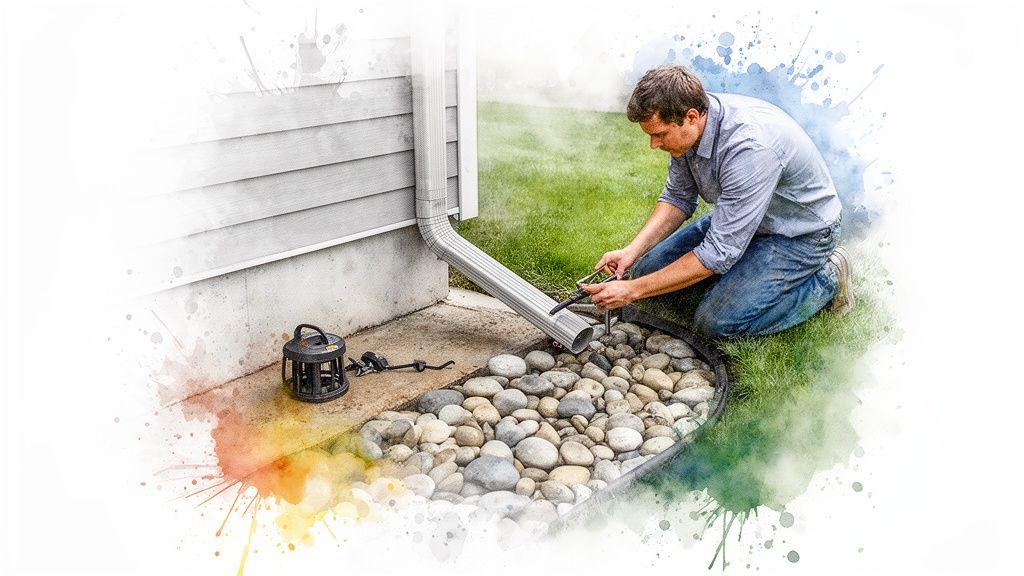
The first, most critical place to look is your roof. It's easy to underestimate the sheer volume of water coming off it. Just a single inch of rain on a 1,000-square-foot roof dumps over 600 gallons of water into your yard. If your downspouts are dumping all that water right next to your foundation, you're practically asking for trouble.
Start With These High-Impact Fixes
These weekend projects are your first—and often most effective—line of defense. Get these right before moving on to anything more complex.
- Clean Your Gutters Thoroughly: Clogged gutters overflow, sending sheets of water down your siding and creating a concentrated muddy mess right below. Clear out all the leaves and debris so water can flow freely to the downspouts.
- Extend Your Downspouts: This is non-negotiable. Your downspouts need to discharge water at least ten feet away from your foundation. Inexpensive corrugated pipe extensions can redirect thousands of gallons of water away from your home's base with little effort.
- Aerate Compacted Soil: Heavy clay soil, like we have all over Sonoma County, can get packed down as hard as concrete. Renting a core aerator pulls up plugs of soil, creating thousands of small channels for air and water to penetrate deeper. This is a crucial step for integrating erosion control and water management solutions.
When Is Re-Grading My Yard The True Solution?
While tools like French drains get a lot of attention, they're often just a bandage for a much bigger problem: the land itself. If your property has a negative grade—sloping toward your foundation instead of away from it—no amount of perforated pipe will ever be a permanent fix.
Time and again, we've seen that proper landscape grading is the most effective, long-term solution for widespread water issues. Re-grading is about carefully reshaping the land to create a subtle, consistent slope, letting gravity do the work. This one change can solve foundation saturation, landscape erosion, and that chronic sogginess across your whole property.
What Are Telltale Signs My Yard Needs Re-Grading?
How do you know if grading is the real answer? Keep an eye out for these clear indicators that your land's contour is the root cause of your water woes.
- Persistent Pooling Near Your House: If water consistently collects in a "moat" around your foundation after every rain, it’s a classic sign of a negative slope.
- Soil and Mulch Washouts: Finding mulch from your garden beds washed out onto your patio or lawn means surface water is flowing with enough force to erode your landscaping.
- Water Seeping into Crawl Spaces: Any dampness or trickles in your basement or crawl space are serious signs that surface water isn't being directed away from your home effectively.
According to landscape professionals, re-grading can solve up to 90% of soggy yard cases without needing complex pipe systems [TLC Incorporated, 2024]. Warning signs like constantly replacing washed-out mulch or seeing standing water after just a light rain almost always point to a grading issue, not a need for more drains. You can discover more insights about the warning signs that your yard needs re-grading on tlcincorporated.com. For a deeper dive, check out our guide with expert grading tips before the rain hits.
Exploring Engineered Solutions: French Drains and Catch Basins
When simple fixes and re-grading aren't enough, it’s time to bring in engineered systems. These are specifically designed to capture and redirect serious volumes of water, giving you a powerful defense against even the most stubborn soggy spots. For complex properties, this is a core part of effective yard drainage troubleshooting.
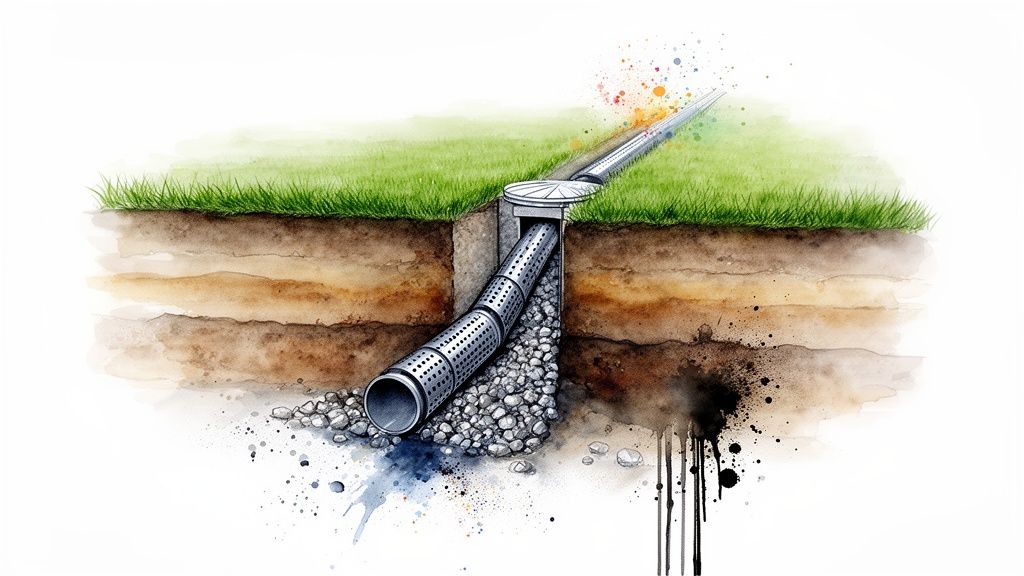
A French drain is a carefully constructed trench with a perforated pipe, wrapped in landscape fabric to prevent clogs, and surrounded by gravel. This system intercepts subsurface water, funnels it into the pipe, and lets gravity carry it safely away.
Which Engineered System Is Right For My Yard?
The key to success is matching the right solution to your specific problem. Each system serves a distinct purpose, and knowing the difference will help you have a productive conversation with a drainage contractor.
- French Drains: Best for collecting groundwater that’s saturating a large area and turning your lawn into a marsh.
- Catch Basins: Perfect for capturing surface water that pools in low-lying spots, like on a patio or at the bottom of a slope. They are collection boxes with a grate on top that tie into a solid drain pipe.
- Vegetated Swales: Broad, shallow channels planted with grass or native plants. They are an excellent, natural-looking option for managing and filtering runoff on sloped properties here on the Central Coast.
Investing in an engineered system requires careful planning. The national average cost for a yard drainage system is around $4,600, and French drains can run anywhere from $10 to $50 per linear foot [Ware Landscaping, 2024]. A poorly designed or installed system isn't just ineffective—it's an expensive mistake. You can find more details on typical drainage system costs on warelandscaping.com.
Getting these systems installed correctly is absolutely critical for them to function for years. This often involves precise excavation and careful connection to other underground utility services in California.
Red Flags: When to Call a Professional Excavation Contractor
The DIY spirit is great for a lot of yard work, but some drainage problems are just symptoms of a much bigger issue brewing underground. Ignoring these critical red flags can turn a soggy lawn into thousands of dollars in structural damage to your home. When your troubleshooting uncovers these signs, it's time to put down the shovel and call a professional.
What Are Signs of Serious Underlying Issues?
Certain symptoms are clear warnings that water is already compromising your home’s stability. If you see any of the following, you need a professional assessment immediately.
- Water in Your Basement or Crawl Space: Any moisture seeping through your foundation walls is a clear sign that your water management has completely failed. This is a non-negotiable call-a-pro moment.
- New Foundation Cracks: Pay close attention to new, widening, or stair-step cracks in your foundation. This is a major red flag that often points to unstable, water-logged soil.
- Soil Erosion and Sinkholes: If the ground is actively washing away from your foundation or you see small sinkholes forming, you could have a significant underground leak.
Here in Sonoma County and across the Central Coast, we deal with a lot of challenging clay soils. When these soils get saturated, they expand, putting immense pressure on foundations. In regions with clay soil, 40% of foundation problems stem from this exact kind of moisture-induced movement [Carolina Terrain, 2023]. This case study on clay soil problems shows just how destructive poor drainage can be.
These situations are well beyond a simple DIY fix. They require an expert who can properly assess soil stability, investigate underground issues, and design an engineered solution. You can learn more about what an excavating contractor does in our detailed guide.
FAQs About Yard Drainage Troubleshooting
1. How much does it cost to fix yard drainage in California?
The cost depends on the solution. Simple DIY fixes like downspout extensions are under $100. Professional solutions like a French drain can range from $2,500 to over $10,000, while full yard re-grading is a more significant investment that provides a permanent fix for widespread water problems.
2. Can I install a French drain myself?
While it seems possible, a DIY French drain often fails within a few years due to common mistakes. Using the wrong fabric, incorrect gravel size, or—most critically—failing to create the precise slope for gravity to work are frequent errors. Professional installation ensures the system is engineered to last for decades.
3. Will planting trees solve my soggy yard problem?
Water-loving plants and trees can help absorb excess moisture in damp spots, but they are not a solution for major drainage issues. They cannot correct a negative grade or handle large volumes of pooling water. Plants should be a complement to a larger strategy involving proper grading or an engineered system.
4. How do I know if my yard slopes the wrong way?
The easiest way to tell is to watch where water flows during a heavy rainstorm. If it pools against your foundation, you likely have a negative grade. For a more precise check, your yard should drop at least six inches for every ten feet moving away from your home's foundation.
5. How long does a professional drainage installation take?
The timeline depends on the project scope. A professional French drain installation on a typical residential lot usually takes 2-4 days, depending on soil conditions and site access. A major re-grading project could take a week or more to carefully move and compact the earth.
If you're facing persistent drainage issues that DIY fixes can't solve, it’s time to bring in the experts. DW Excavation provides engineering-integrated grading and drainage solutions that protect your property for the long term. Contact us for a consultation at https://dw-excavation.com.