Direct Answer: Monterey County soil combines expansive clay, coastal sand, and flood-prone lowlands that shift, drain poorly, and move under load — making foundation excavation far more complex than in most California regions.
If you’ve ever tried to dig a post hole in Monterey County after the first fall rain, you already know something is off. The soil sticks to your boots, clumps on the shovel, and turns into something closer to wet concrete than dirt. Now imagine trying to excavate a foundation in it.
Monterey County sits at the intersection of several soil types that each create their own problems — coastal sand near Marina and Seaside, heavy clay inland toward Salinas and the Pajaro Valley, and rocky decomposed granite in the hillside zones above Carmel Valley. No two lots behave the same way, and that variability is exactly what makes foundation work here harder than in most parts of California.
This article breaks down what’s actually in the ground across Monterey County, why it matters for your foundation, and what a qualified excavation contractor has to do differently here compared to drier, more stable regions inland.
The Soil Profile Underneath Monterey County
Monterey County doesn’t have one soil type — it has several, and they change dramatically within a few miles of each other. Understanding what’s under your specific lot is the first step in any foundation project.
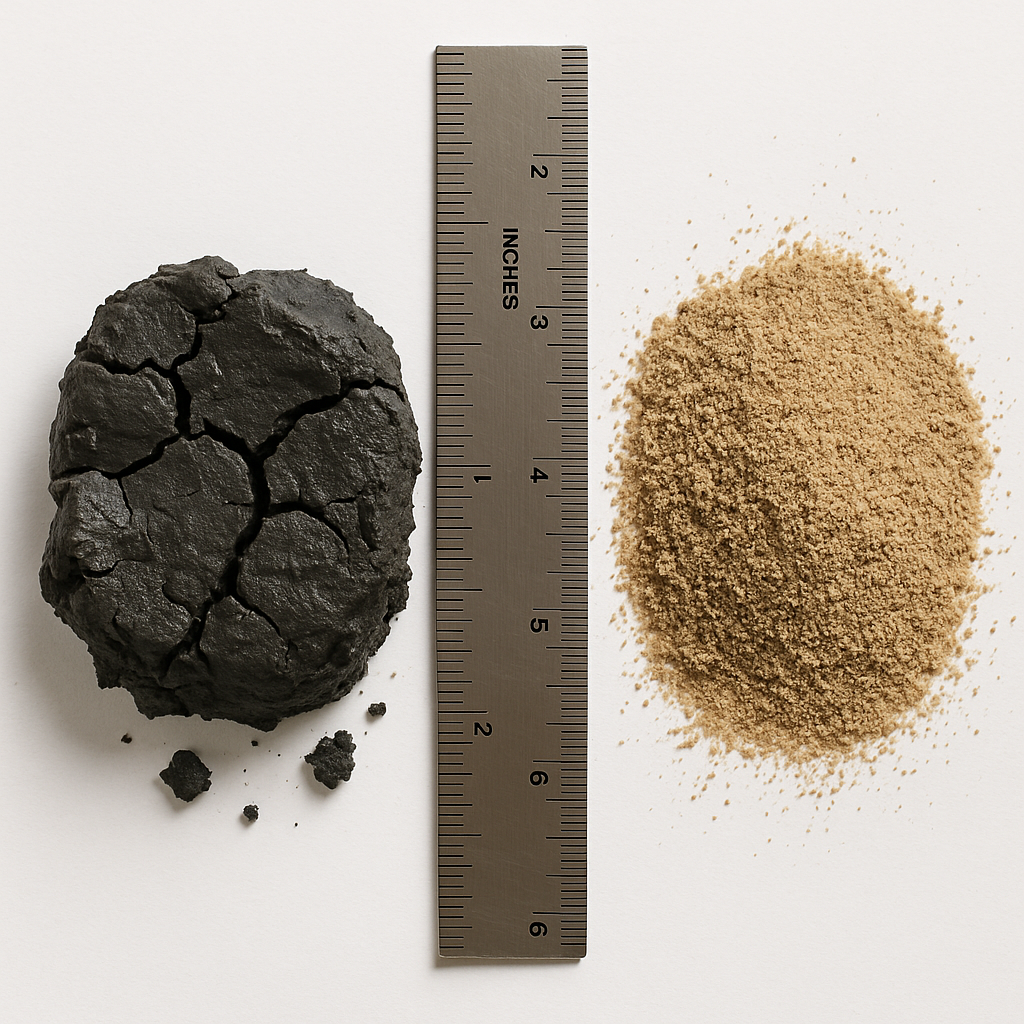
Along the coast from Marina down through Seaside, you’re dealing with aeolian sand — wind-deposited sandy soils that shift easily and don’t hold a trench wall well. These soils drain fast, but they also lack the bearing capacity that a foundation needs to stay put over time.
Move inland toward Salinas or the Pajaro Valley and the soil changes entirely. Here you find heavy Montara and Cropley clay — expansive soils that swell when wet and shrink when dry. That cycle of expansion and contraction is what cracks foundations, buckles slabs, and causes walls to rack out of plumb over years.
In the hills above Carmel Valley and parts of the Santa Lucia Range, you hit decomposed granite and cobble-mixed fill — harder to excavate, but unpredictable in how it drains. Water finds channels through fractured rock that no soil report fully predicts.
Every one of these conditions demands a different excavation approach. That’s not an opinion — it’s basic geotechnical reality.
Why Expansive Clay Is the Biggest Foundation Enemy Here
Expansive clay is the single most common source of foundation failure in Monterey County, particularly in Salinas, Gonzales, and the lower Pajaro Valley. When clay absorbs water, it expands — sometimes with enough force to crack a concrete footing or push a retaining wall off its base.
The 2023 Pajaro flooding was a stark example of what happens when poorly drained clay-heavy sites get saturated. Homeowners saw floors buckle, slabs heave, and footing sections crack open after weeks of standing water. The damage wasn’t just from the water itself — it was from what the water did to the soil underneath.
Proper foundation excavation in clay-heavy areas requires:
- Over-excavating below the final bearing depth to remove the most reactive clay layer
- Importing stable engineered fill — often crushed rock base or Class II aggregate — to replace what was removed
- Installing perimeter drainage before any concrete is poured to keep water from re-saturating the bearing layer
- Compacting fill in lifts (usually 6-inch lifts at 90-95% compaction) rather than dumping and grading in one pass
Skipping any of these steps to save money almost always costs more later. We’ve seen it on job sites across this county.
If you want to understand how drainage plays into this before excavation even starts, our guide on Sonoma and Monterey storm water system solutions explains the drainage side of the equation in plain terms.
Coastal Sand Zones: Fast Drainage Doesn’t Mean Easy Digging
Some homeowners near Marina or Seaside assume sandy soil is easier to work with because it drains quickly. In some ways, that’s true — you won’t deal with the same clay expansion issues. But sandy coastal soils come with their own serious problems for foundation work.
Cohesionless sand doesn’t hold a trench wall on its own. In dry conditions, the walls of an excavation can slough inward within hours, burying equipment or injuring workers. That’s not just a contractor headache — it’s an OSHA-regulated hazard that requires shoring, sloping, or benching the trench walls.
Beyond safety, sandy soils near the coast also tend to have a high water table, especially within a few blocks of Monterey Bay. Hitting groundwater mid-excavation forces the crew to bring in dewatering pumps before work can continue. That adds time and cost that doesn’t show up in a basic bid.
Foundations in these zones often require:
- Deeper bearing depths to get below loose surface sand into more stable native material
- Continuous compaction testing to confirm the bearing layer is actually solid
- Moisture barriers or waterproof membrane systems on foundation walls facing the water table
- Dewatering equipment on standby during the wet season, roughly October through April
Our article on what to look for when hiring a foundation excavation contractor goes deeper on what questions to ask before work begins on any Monterey County lot.
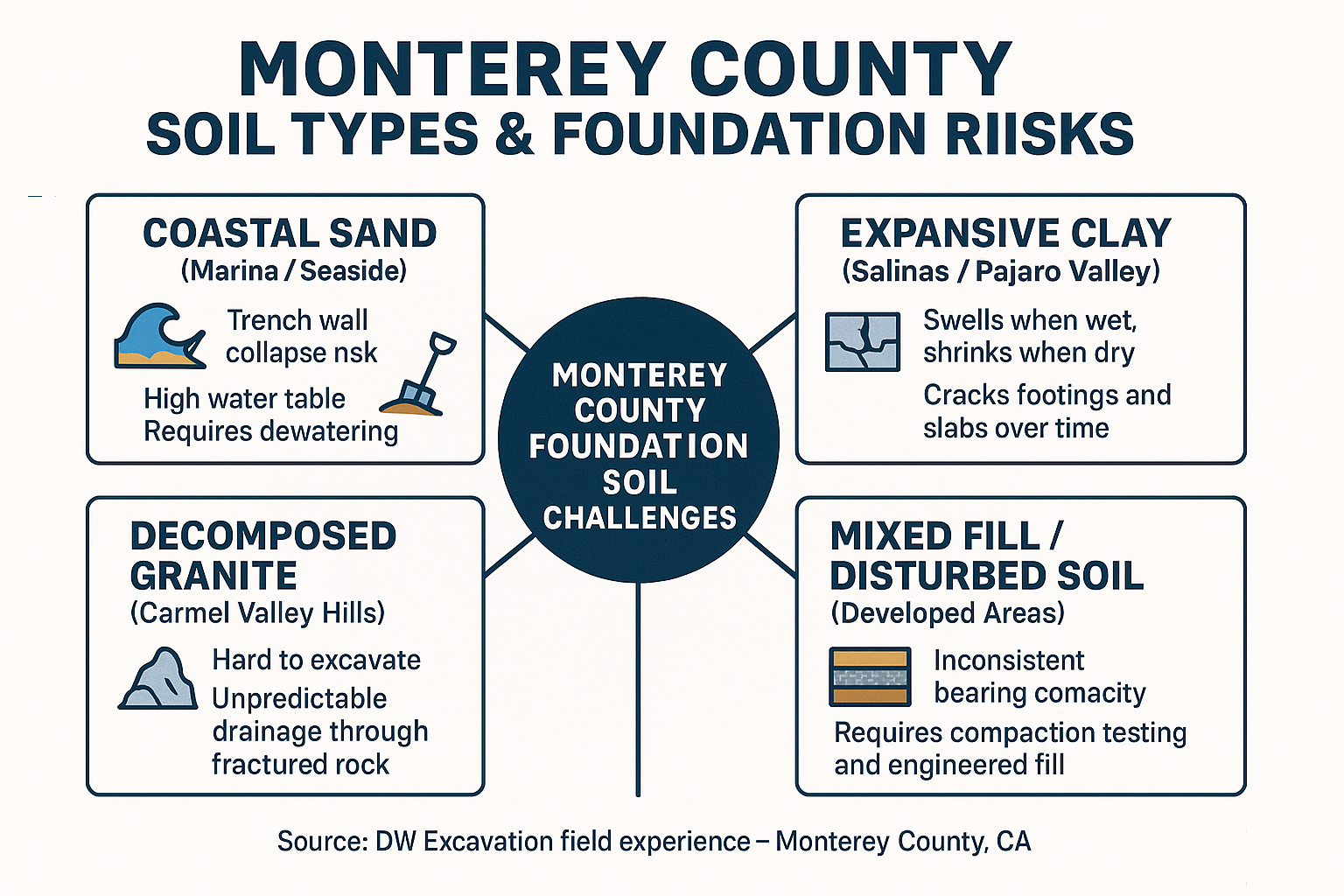
Monterey County Soil Types and Their Foundation Risks
This infographic maps the four primary soil conditions found across Monterey County and the specific foundation challenge each one creates.
What Monterey County Permit Requirements Add to the Process
Monterey County has a grading permit threshold of 100 cubic yards — meaning any cut or fill exceeding that volume on a residential or commercial project requires a grading permit before work begins. For context, a standard house foundation on a sloped lot can easily move 150-300 cubic yards, putting most projects squarely in permit territory.
Beyond the volume threshold, Monterey County also requires:
- A soils report (geotechnical investigation) for most foundation projects in hillside and coastal zones
- Drainage and erosion control plans submitted with the grading permit application
- Inspection sign-offs at specific stages — after excavation, after base preparation, and before concrete is poured
- Compliance with the Monterey County Grading and Drainage Ordinance, which has stricter runoff requirements in areas near the Salinas River and Elkhorn Slough
Missing any of these steps can stop a project cold. We’ve seen homeowners lose weeks because a soils report was ordered after excavation started instead of before. Getting the permit handled correctly upfront isn’t just paperwork — it’s what keeps your project on schedule.
If you’re not sure how to read the site documents your engineer produces, learning how to read blueprints for your site project is a solid starting point before your first contractor meeting.
Soil Type Comparison: Monterey County Foundation Challenges
Here’s a quick reference on what each major Monterey County soil zone means for foundation excavation — from difficulty to what it typically requires.
| Soil Zone | Primary Locations | Main Challenge | Typical Mitigation |
|---|---|---|---|
| Expansive Clay | Salinas, Gonzales, Pajaro Valley | Swells and shrinks with moisture cycles | Over-excavate, import engineered fill, perimeter drainage |
| Coastal Sand | Marina, Seaside, Sand City | Trench wall instability, high water table | Shoring or benching, dewatering pumps, deeper bearing depth |
| Decomposed Granite | Carmel Valley, Santa Lucia hills | Hard excavation, unpredictable drainage | Rock breaking, careful drainage design, compaction testing |
| Mixed / Disturbed Fill | Developed urban lots, Salinas, Monterey | Inconsistent bearing, unknown history | Full removal and recompaction with engineered fill, compaction testing |
How Weather Makes All of This Worse
Monterey County has a relatively mild climate compared to places like Fresno or Sacramento, but that doesn’t mean weather is a minor factor in foundation work here. The wet season is real, and the atmospheric river storms of recent years have made it more unpredictable.
When it rains hard on clay-heavy soil, you can lose a day of excavation progress in a few hours. Water fills the trench, saturates the bearing layer, and makes accurate compaction impossible until the site dries out. Working in saturated clay doesn’t just slow the job — it produces poor compaction results that will show up as settlement problems years later.
In the post-2023 world, where storms like the November 2024 events that hit Northern California dropped 12+ inches in three days, flood-readiness isn’t something you build for later. It’s something that has to be engineered into the foundation drainage plan from day one.
Our team typically recommends that any Monterey County foundation project include a French drain or perimeter drainage system around the footing before backfill — regardless of what the soil report says. It’s not extra. It’s basic protection against the rain patterns this county now sees regularly.
For more on what happens when sites aren’t built to handle that kind of water, this breakdown of weather-driven flood cleanup demand shows exactly where these problems end up.
What a Good Pre-Excavation Process Looks Like
Before any machine touches the ground on a Monterey County foundation project, there’s a sequence of steps that separates contractors who know this market from those who don’t.
Here’s what that process should include:
- Soil investigation first — a geotechnical report from a licensed soils engineer, not just a visual inspection by the contractor
- Review of drainage patterns on the site and on adjacent properties — where does water go when it rains?
- Permit application submission with full grading and drainage plans before mobilization
- Site staking and grade verification so the excavator knows exactly what depth to target and where bearing soil actually begins
- Utility locates — Monterey County has older infrastructure in parts of Salinas and Seaside where utility maps are not always accurate
- A clear plan for spoil removal and disposal, since expansive clay cannot always be used as backfill on the same site
This isn’t overthinking — it’s the minimum a homeowner or builder should expect before a machine is mobilized. Cutting corners at this stage is the leading cause of foundation rework we see on the Central Coast.
If you’ve already had one contractor bid the project and something felt off, getting a second opinion before hiring a foundation contractor is worth the extra few days.
Frequently Asked Questions About Monterey County Foundation Excavation
Do I need a soils report before excavating a foundation in Monterey County?
In most cases, yes. Monterey County requires a geotechnical soils report for foundation projects in hillside zones and many coastal areas. Even where it’s not required by code, skipping the soils report is one of the most expensive mistakes a homeowner can make — especially in clay or sandy coastal zones where the bearing capacity varies widely.
How deep does a foundation excavation typically go in Monterey County?
It depends on the soil type and what the engineer specifies, but 3 to 5 feet is common in clay-heavy areas where the top layer of reactive soil needs to be removed. In coastal sand zones with a high water table, you may need to go deeper to find stable bearing material. No two lots are the same.
Can expansive clay be used as backfill after excavation?
Generally, no. Expansive clay should not be used as structural backfill around a foundation because it will continue to swell and shrink with moisture changes, putting lateral pressure on the foundation wall. Most engineers specify imported granular fill — crushed rock or Class II aggregate — in its place.
What happens if I start excavation before getting a grading permit in Monterey County?
Starting work without a permit can result in a stop-work order, fines, and a requirement to restore the site before re-applying. Monterey County’s grading permit threshold is 100 cubic yards — most foundation projects exceed that. Getting caught without a permit adds weeks to a project timeline and can complicate future property sales.
How does the rainy season affect foundation excavation timing in Monterey County?
The wet season runs roughly October through April, and working in saturated clay or sandy soils during that period creates real problems — trench instability, poor compaction, and dewatering delays. Most experienced contractors on the Central Coast prefer to start excavation between May and September when soil conditions are stable, though well-planned winter projects can still move forward with the right drainage controls in place.
Ready to Know What’s Actually Under Your Monterey County Property?
Foundation excavation in Monterey County isn’t something you want to figure out as you go. The soil variability, permit requirements, and weather patterns here demand a contractor who has actually worked this ground — not one who’s applying a generic approach from a different market. DW Excavation has worked sites from Marina to Salinas to Carmel Valley and knows what each one demands before the first bucket of soil moves. Call 707-601-9091 or visit dw-excavation.com to request a free estimate and get straight answers about what your specific site requires.