
Direct Answer: Monterey County’s expansive clays, coastal sand, and hillside bedrock create unpredictable soil conditions that require extra engineering, deeper excavation, and more careful drainage planning before any foundation goes in.
If you’re planning a new build or addition in Monterey County and someone tells you ‘the soil looks fine,’ that’s when you should slow down and ask more questions. The ground here is not forgiving — and what’s sitting a few feet below your property line can change the entire cost and timeline of a foundation project.
Monterey County covers a wide range of terrain, from the flood-prone lowlands of the Pajaro Valley to the steep hillsides above Carmel and Big Sur. Each zone comes with its own soil challenges. A monterey foundation contractor who hasn’t worked this specific ground before is going to hit surprises — and surprises on a foundation project cost real money.
This guide breaks down the specific soil conditions that make foundation excavation harder in Monterey County, why they matter, and what any property owner here should understand before breaking ground.
Why Monterey County Soil Is Not One-Size-Fits-All
Most people think of soil as dirt. Contractors think of it as a structural material — one that either supports a foundation or fights it. In Monterey County, you get both, sometimes in the same trench.
The county sits at the intersection of several distinct geologic zones. Coastal bluffs have sandy, loose soils with high erosion rates. Inland valleys carry heavy clay deposits that swell and shrink with moisture. Hillside lots near Carmel Valley or the Santa Lucia Range often have shallow soil over fractured rock or decomposed granite.
Each of these conditions requires a different excavation approach. We’ve covered this in more depth in our guide on why Monterey soil makes foundation work so much harder, but the short version is this: you cannot treat Monterey County as a single soil environment. Every parcel needs a real look before a shovel touches the ground.
Expansive Clay: The Most Common Problem in the Salinas Valley
The Salinas Valley and many parts of the Pajaro Valley sit on some of the most productive farmland in California — which also means they sit on deep clay deposits. Clay soil is notorious in the construction world for one reason: it moves.
When clay absorbs water, it expands. When it dries out, it contracts. That cycle of swelling and shrinking puts enormous lateral and vertical pressure on concrete foundations. Over time, it causes cracking, heaving, and settlement — even on structures that were built correctly.
For foundation excavation in clay-heavy areas, we typically need to:
- Over-excavate below the frost line and below the active clay zone
- Bring in imported base material to replace unstable native soil
- Install drainage systems around the perimeter to prevent water from reaching the clay
- Allow proper compaction testing before any concrete is poured
Skipping any of these steps to save money up front almost always leads to much larger repair bills later. The 2023 Pajaro flooding is a good example of what happens when drainage is underbuilt — water sat in that valley for weeks, and foundations in the affected zone paid the price. You can read more about managing water on your site in our Sonoma and Monterey storm water system solutions guide.
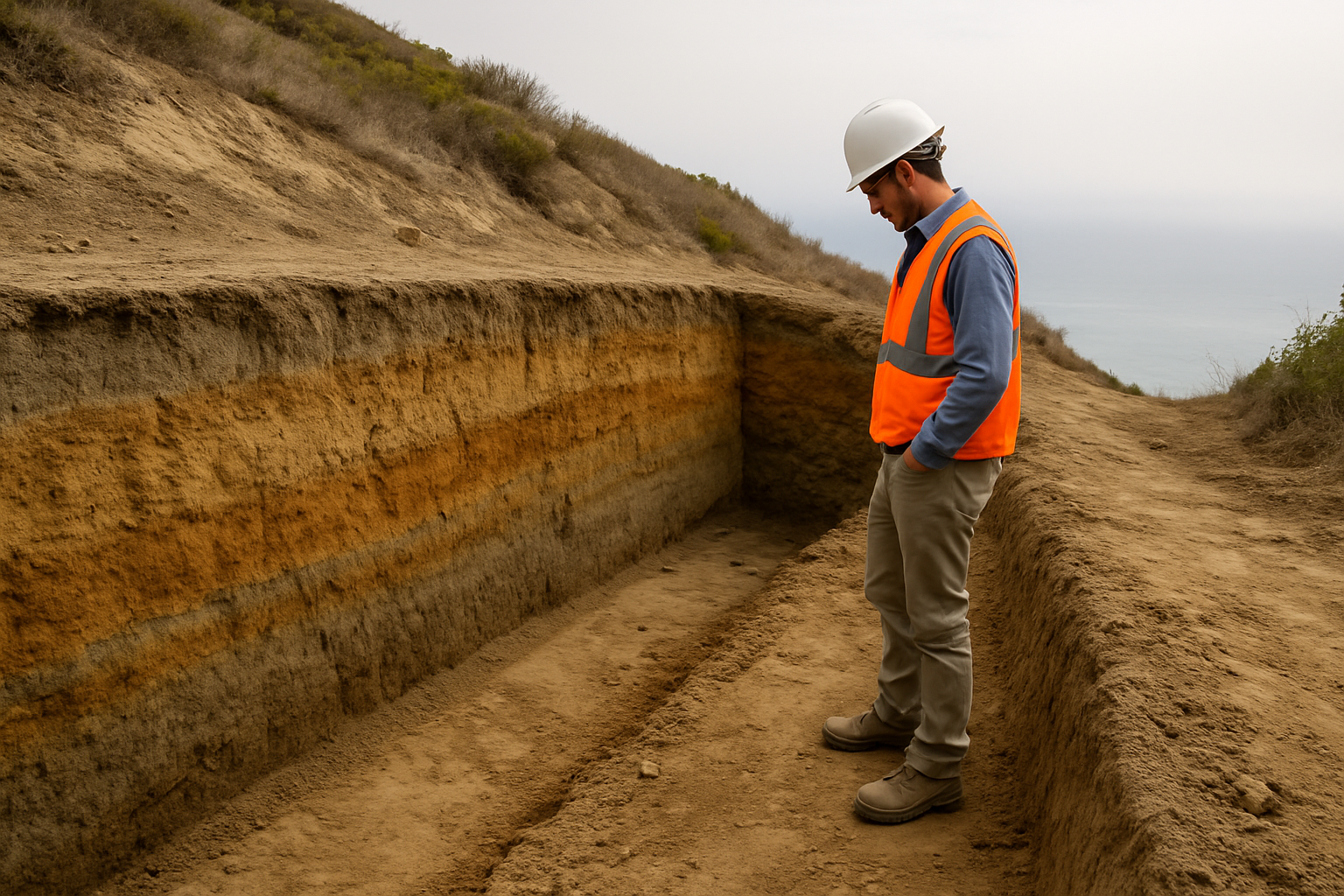
Coastal Sand and Loose Fill: The Problem Near Marina and Seaside
Move closer to the coast — Marina, Seaside, Sand City — and the soil problem flips. Instead of clay that won’t drain, you’re dealing with sandy soils that drain too fast and provide almost no structural support on their own.
Sand compacts poorly unless it’s properly graded and confined. Loose coastal sand can shift under load, especially in seismic events. Monterey County sits within a region of moderate seismic activity, and the combination of sandy soils and earthquake shaking — a condition engineers call liquefaction risk — is taken seriously here.
Foundation excavation in these zones often requires:
- Deeper footings to reach more stable soil below the loose surface layer
- Soil compaction reports before and during excavation
- Engineered fill placed and compacted in lifts to create a stable sub-base
- Coordination with a geotechnical engineer before design finalization
This is not the kind of work you figure out as you go. It needs to be planned from the start, which is why understanding what a foundation excavation contractor actually does before you hire one is time well spent.
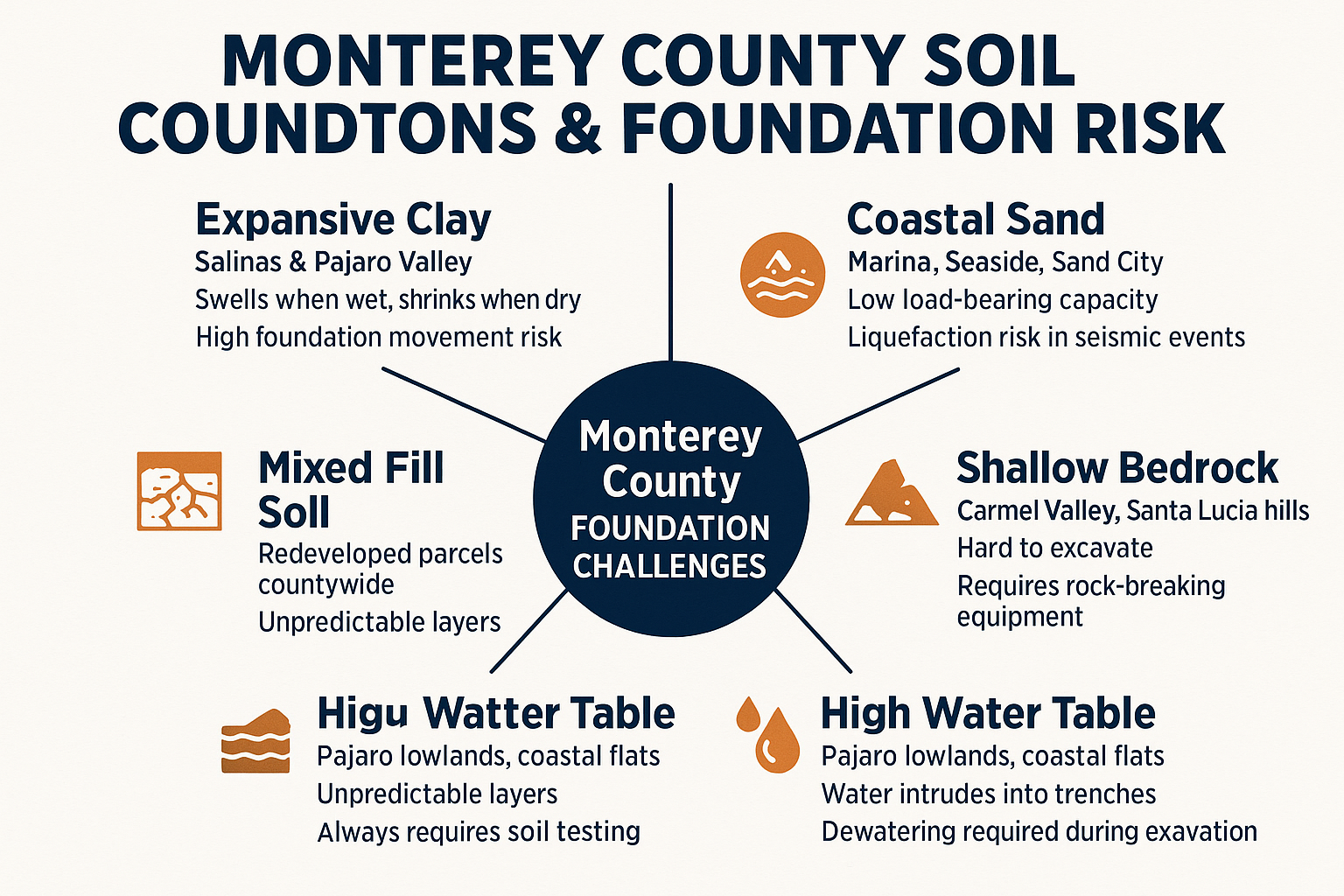
Monterey County Soil Types at a Glance
Here’s a quick visual reference showing how soil type, location, and foundation risk connect across Monterey County.
Shallow Bedrock and Rocky Ground in Carmel Valley
Carmel Valley and the hillsides above it tell a completely different story. Up here, you’re often into solid rock just 2 to 4 feet below grade. That sounds like a good problem to have — rock feels stable, right? But shallow bedrock creates its own complications.
First, you can’t hand-dig or use a standard excavator bucket once you hit solid rock. You need hydraulic hammers, rock-breaking attachments, or even blasting permits in extreme cases. That adds equipment costs, time, and sometimes a whole different permitting conversation with Monterey County.
Second, bedrock doesn’t drain. When rain hits a slope above bedrock and has nowhere to go down, it runs sideways — straight toward your foundation. Hillside drainage becomes the critical piece that holds everything together, and it has to be engineered before the foundation is placed, not after.
If your lot is on a slope in this part of the county, the grading work underneath your foundation matters just as much as the foundation itself. Our guide on how to know if grading was done right walks through the red flags to look for after the work is done.
High Water Tables and What They Mean for Foundation Excavation
In the Pajaro Valley lowlands and near the coast, groundwater sits close to the surface — sometimes less than 3 feet down during wet season. That changes how we excavate and what the foundation design needs to account for.
When a trench hits the water table, water seeps in. That’s not just inconvenient — it destabilizes the trench walls, makes it impossible to pour concrete correctly, and increases the risk of cave-in if the soil is loose. Dewatering — the process of pumping groundwater out of the excavation zone while work continues — is often required.
High water table conditions also affect what kind of foundation is appropriate. Crawl spaces in high-water areas are a liability. Slab-on-grade designs may need a layer of gravel and a vapor barrier system before concrete. Basement foundations in these zones are almost always a bad idea without serious waterproofing engineering.
After the November 2024 atmospheric river events that dropped over 12 inches of rain on parts of the Central Coast in roughly 72 hours, several Monterey County property owners discovered their sites had drainage and water table issues they never knew about. The rains exposed what was already there.
How Soil Type Affects Foundation Excavation in Monterey County
Each soil type creates different conditions underground. This table shows what those differences mean in practical terms for your project.
| Soil Type | Where Found in Monterey County | Main Excavation Challenge | Common Solution |
|---|---|---|---|
| Expansive Clay | Salinas Valley, Pajaro Valley | Swells and shifts under slabs | Over-excavate, import fill, add perimeter drains |
| Coastal Sand | Marina, Seaside, Sand City | Low load-bearing, liquefaction risk | Deep footings, compacted engineered fill |
| Shallow Bedrock | Carmel Valley, hillside parcels | Equipment-intensive removal | Rock hammer attachment, drainage planning |
| High Water Table | Pajaro lowlands, coastal flats | Water intrudes trenches, wall instability | Dewatering during excavation, slab design changes |
| Mixed or Unknown Fill | Redeveloped sites countywide | Unpredictable load capacity | Soil testing required before any design is final |
What Monterey County Permit Requirements Add to the Process
Monterey County requires a grading permit for any cut or fill that moves 100 cubic yards or more of soil. That sounds like a lot — but on a foundation excavation for a standard home, you can hit that number faster than most homeowners expect, especially on a sloped lot.
Permit applications require a grading plan, and many projects also need a soils report from a licensed geotechnical engineer. That report documents what’s actually in the ground and gives the structural engineer the data needed to design the right foundation system.
Waiting until your plans are done to order a soils report is a common mistake. If the report comes back showing conditions that weren’t accounted for in the design, you’re looking at redesign costs and permit delays. Getting the soils work done early — before design is finalized — keeps the project moving.
If you’re not sure how to move through the permit process, our guide on how to get your site plan approved faster covers the steps that actually save time at the county level.
What to Ask a Foundation Excavation Contractor Before You Hire
Not every excavation contractor has real experience with Monterey County’s specific soil conditions. Asking the right questions before you hire can save you from a bad outcome.
Here’s what to ask:
- Have you worked on projects in this specific area of Monterey County? Carmel Valley and Salinas have completely different ground conditions. Local experience matters at the parcel level.
- Do you coordinate with geotechnical engineers? A good contractor doesn’t guess about soil — they work with the soils report and adjust accordingly.
- How do you handle unexpected conditions mid-excavation? The right answer involves communication, documentation, and a clear change-order process.
- What equipment do you have for hard-rock excavation? If your site has bedrock, you need a contractor who owns or has access to the right tools.
- Can you assist with the grading permit application? Permit assistance is a real service that saves time — not every contractor offers it.
And if something doesn’t feel right, getting a second opinion before hiring a foundation contractor is always a smart move. A second set of eyes rarely costs much and can catch things the first contractor missed or didn’t disclose.
Frequently Asked Questions About Foundation Soil Conditions in Monterey County
How do I find out what kind of soil is on my Monterey County property?
The most reliable way is a geotechnical soil investigation, where a licensed geotechnical engineer drills test borings or digs test pits and analyzes what’s there. Monterey County has some publicly available soil survey data through the USDA Web Soil Survey, but that data is not precise enough for structural design. A site-specific soils report is required for most permitted foundation projects.
Does clay soil mean I can’t build a foundation there?
Not at all — but it does mean the foundation has to be designed for those conditions. That typically means deeper footings, imported base material, and perimeter drainage. Plenty of buildings stand successfully on clay soil in the Salinas Valley. The key is that the excavation and foundation design account for how that clay behaves through wet and dry seasons.
What is liquefaction and should I be worried about it in Monterey County?
Liquefaction happens when loose, saturated soil loses its structural strength during an earthquake — it essentially acts like a liquid for a short time. Coastal areas near Marina and Seaside have loose sandy soils and proximity to seismic faults, which puts them in a higher liquefaction concern zone. A geotechnical report will flag this if it’s relevant to your parcel.
How long does foundation excavation take in Monterey County?
For a standard single-family home, excavation typically takes 3 to 7 working days depending on soil conditions, site access, and whether any unexpected material — rock, old fill, groundwater — is encountered. Sites with bedrock or high water tables can take longer. Weather delays during the rainy season also factor in.
Do I need a soil report before applying for a Monterey County grading permit?
For most projects involving 100 or more cubic yards of cut or fill — which is Monterey County’s grading permit threshold — a soils report is required as part of the permit package. Your geotechnical engineer produces the report, your structural engineer uses it to design the foundation, and the county reviews both before issuing the permit. Skipping or delaying the soils report almost always slows the permit approval.
Ready to Get Clear Answers About Your Monterey County Site?
If you’re planning a foundation project in Monterey County — whether in Salinas, Marina, Carmel Valley, or anywhere in between — DW Excavation has worked this ground and knows what it takes to do the job right. Call us at 707-601-9091 or visit dw-excavation.com to request a free estimate and talk through what’s actually under your property.