
Direct Answer: Culvert size depends on the drainage area, slope, soil, and design storm above the crossing, not your neighbor’s pipe. Placement depends on invert elevation and protecting the outlet from scour.
A homeowner in Monterey County wrote to us with a clear picture of their problem. An open drainage ditch ran across the front of their property, and they wanted it filled with rock and a culvert pipe set under part of the driveway.
They were upfront that they were not sure that was the right fix. I appreciate that, because culvert sizing and placement are engineering decisions, not a pick off the shelf at the pipe yard.
Below I will walk through what actually drives those decisions on private property, what the outlet has to do, and what the permit side looks like before anyone digs.
What Actually Determines Culvert Size on a Private Driveway
The pipe has to carry the water that shows up in a real storm, not the trickle in the ditch on the day I walk the site. To figure that out, I need to know what sits upstream of the crossing.
Four things move the number more than anything else:
- Drainage area: how many acres of ground shed water toward that ditch
- Slope: steeper ground moves water faster and stacks flow up at the crossing
- Soil type: hard clay and compacted hillside soil shed water instead of soaking it up
- Design storm: the rain intensity the pipe is meant to handle, usually a county standard
- Debris and sediment: leaves, gravel, and silt cut real capacity well below paper capacity
Go too small on diameter and the culvert acts like a plug in heavy rain. Water backs up behind the driveway, spills across the surface, and you have built the exact flooding you paid to prevent.
In March 2026, Monterey County supervisors reviewed a study on flooding in the Bolsa Knolls neighborhood near Little Bear Creek, where between 60 and 80 residential properties flood in most years. The recommendations included enlarging culverts, pulling sediment out of crossings, and adding detention basins upstream.
That is public infrastructure at a much larger scale. But one undersized driveway pipe fails the same way, just on your property instead of your neighborhood.
On bigger parcels there is a regulatory layer too. County floodplain management guidance generally calls for post-development stormwater discharge to stay at or below pre-development levels once a land disturbance passes one acre.
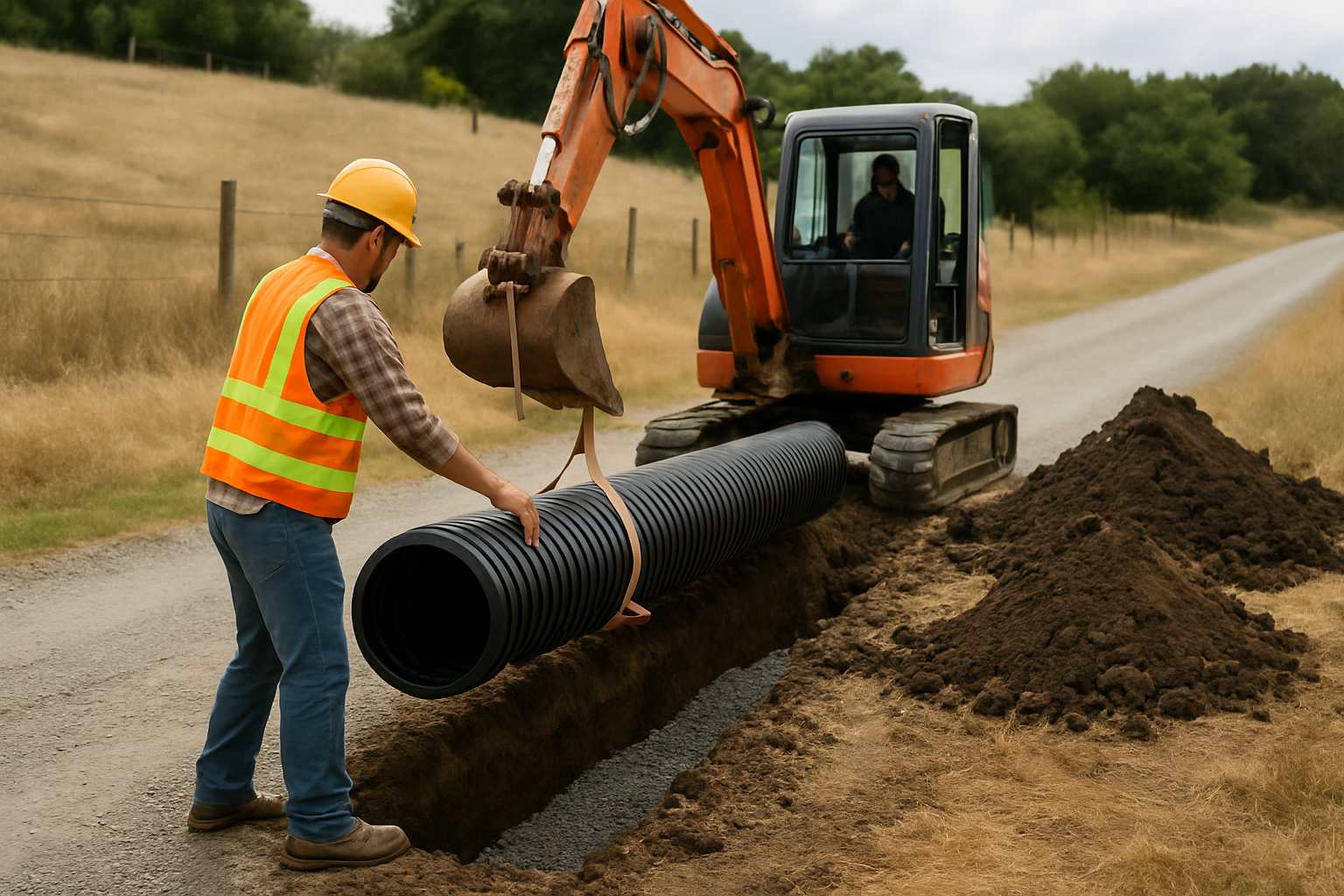
Placement Matters as Much as Diameter
The invert is the bottom inside surface of the pipe. Where that elevation sits relative to the ditch flowline decides whether the culvert works with the water or fights it.
- Invert set too high: water ponds upstream, silt drops out, and the pipe silts closed over a couple of winters
- Invert set too low: the outlet becomes a drop, flow speeds up, and the bank below scours out
- Pipe out of alignment with the ditch: flow hits the inlet sideways and loses capacity before it ever gets in
The outlet is where I see the most damage on private property. Water leaves the pipe carrying energy and lands on bare ground.
Monterey County’s erosion control requirements call for energy dissipaters at discharge points where runoff exits onto natural ground or a channel. In practical terms, that usually means a rock apron sized to the flow, set flush or slightly below the pipe, sometimes with a concrete headwall, so the water spreads out instead of digging a hole.
Under a driveway, the pipe also needs cover and proper bedding. Crushed rock under and around the pipe, compacted in lifts, keeps the pipe round and keeps the driveway from settling into a dip a year later.
This is the same discipline behind knowing whether a property was graded right in the first place. Water follows elevation, and elevation is set on purpose or it is set by accident.
Common Culvert Failures and What They Point To
When a homeowner sends me photos of a struggling driveway culvert, the symptom usually points straight at one of these.
| What you see | Likely cause | What the fix usually involves |
|---|---|---|
| Water ponding on the uphill side during storms | Pipe diameter too small, or inlet silted in | Resizing the pipe, or cleaning and regrading the ditch to the inlet |
| Standing water and mud inside the pipe in summer | Invert set too high or laid without fall | Pulling the pipe and resetting it to grade on new bedding |
| A widening hole at the outlet end | No energy dissipation at the discharge point | Rock apron sized to the flow, sometimes a headwall |
| A dip or crack in the driveway over the pipe | Poor bedding or backfill not compacted in lifts | Excavating, rebedding, and compacting the trench properly |
| Sediment fans spreading onto the neighbor’s ground | Uncontrolled discharge and bare disturbed soil | Erosion control at the outlet and along the ditch |
How a Private Culvert Job Actually Gets Sequenced
Here is the order I work in on a residential driveway culvert, from the first site walk to the last bucket of rock.
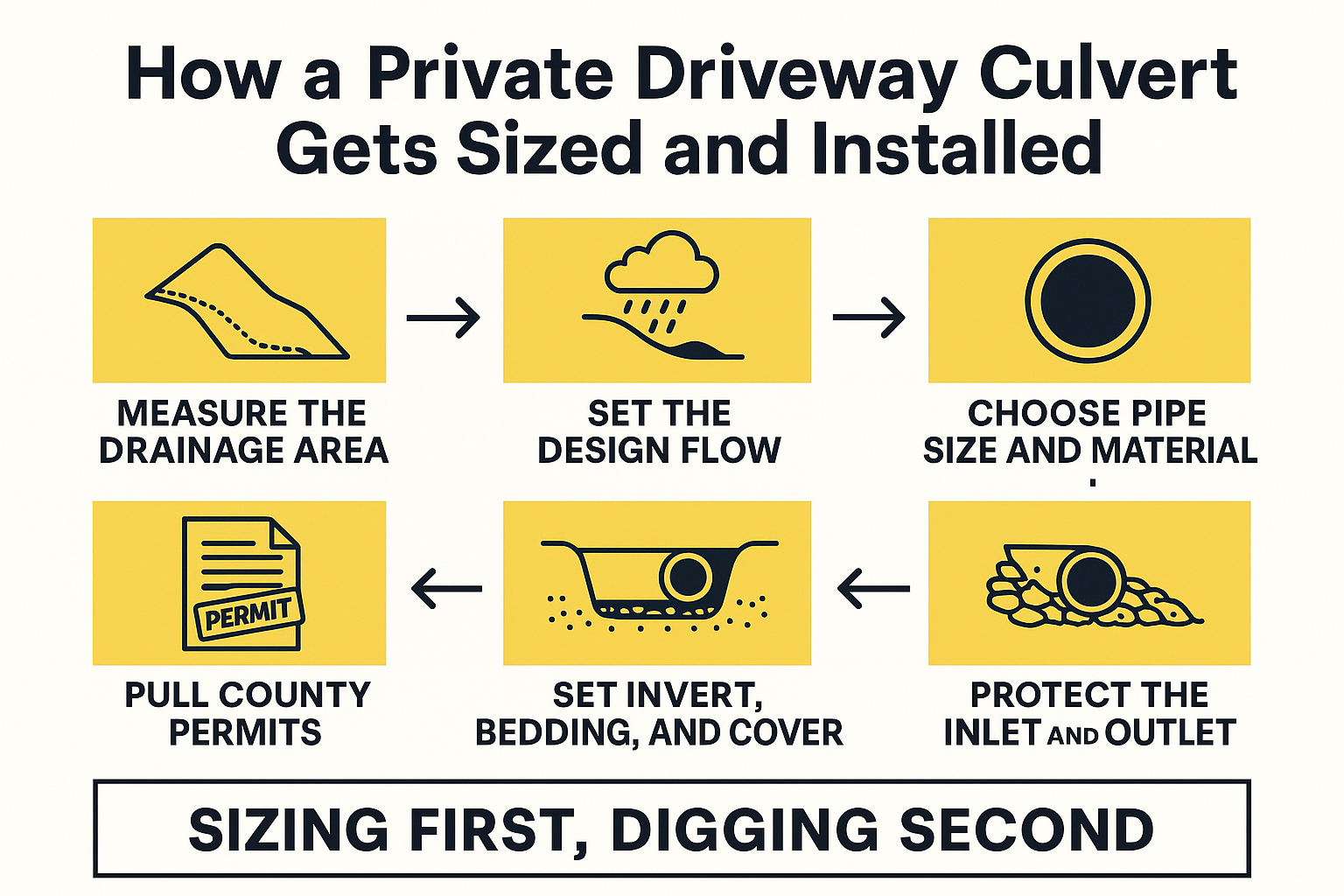
The Permit Side, Before the First Shovel
Drainage work is permitted work in both counties I spend the most time in. A contractor who trenches a pipe in without paperwork is leaving you holding an unpermitted improvement.
Here is the general lay of it:
- Sonoma County: drainage improvements typically require a drainage permit under county code, and that permit expects a drainage report showing how the improvement handles runoff
- Grading thresholds: Sonoma County generally triggers a grading permit at cuts or fills over 50 cubic yards, while Monterey County’s threshold is generally 100 cubic yards
- Erosion control plan: Monterey County expects disturbed ground to be protected, with measures in place before rain exposure
- Road right of way: if the ditch sits in the county right of way at your driveway approach, that portion is usually handled through an encroachment permit with public works
- USA 811 locates: any trench across a frontage gets utility locates before the bucket goes in the ground
One homeowner reached out to us after their city flagged backyard grading and retaining walls that had been in place for nine years. Nothing had failed. The paperwork just caught up, and suddenly a soils engineer was part of the conversation.
Unpermitted drainage work has the same shape. It sits quietly until a property sale, a neighbor complaint, or a flood claim brings someone out to look.
For a straightforward private driveway culvert, the permit path often runs a few weeks. It stretches longer when an engineered drainage report is required, which is why I would rather start that conversation in August than in November.
What Drives the Cost of a Culvert Installation
Almost every property owner asks for a ballpark on the first call, and that is a fair question. Numbers swing widely by site, so what I can give honestly are the things that move them.
- Pipe diameter and material, since corrugated plastic and reinforced concrete price out differently
- Length of the run and how much driveway has to come out and go back
- Trench depth and the volume of crushed rock bedding and backfill
- Condition of the ditch above and below the crossing, and whether it needs regrading
- Energy dissipation at the outlet, from a simple rock apron up to a headwall
- Permit fees and whether an engineer has to produce a drainage report
- Equipment access, which matters a lot on tight coastal lots and steep frontages
A short pipe under a rural gravel drive and a long run under a paved approach with a headwall both get called a culvert. They are not the same job or the same number.
That is also why I push for a site visit before quoting. Standing in the ditch tells me more in ten minutes than photos do in a week, and it keeps the annual road and drainage maintenance budget honest for the years after.
Frequently Asked Questions About Culvert Installation on Private Property
Can I just match the culvert size my neighbor has?
Not reliably. Their pipe may be catching a smaller drainage area, sitting on a different slope, or it may already be undersized and backing up in every real storm. Sizing follows the water above your crossing, not the pipe next door.
Do I need a permit for a driveway culvert in Monterey County?
Usually yes, in some form. If the ditch is in the county road right of way, expect an encroachment permit through public works. If the work disturbs soil, an erosion control plan generally comes with it, and grading permits typically kick in around 100 cubic yards of cut or fill in Monterey County.
What size pipe is typical for a residential driveway?
Many jurisdictions set a minimum diameter for driveway crossings, and small residential culverts often land in the 12 to 18 inch range. But that is a floor, not an answer. On a parcel collecting runoff from several acres of hillside, the right pipe can be much larger.
Plastic or concrete pipe?
Corrugated HDPE is lighter, easier to place, and holds up well when it is bedded and covered correctly. Reinforced concrete pipe gets used where loads are heavier or where a long service life under a paved surface matters. The bedding and compaction around the pipe affect longevity more than the material argument does.
How long does a private culvert install take?
The dig itself is often a one to three day job once permits are in hand and the driveway is planned out. Permitting is the part that sets the calendar, especially if a drainage report is required.
Can this be done in the middle of winter?
Sometimes, but it is harder and messier. Saturated clay does not compact well, and open trenches near a flowing ditch create sediment problems fast. Dry season work with erosion control installed before the rains is the better plan.
Thinking Through a Culvert on Your Property?
If you have an open ditch, a soft spot in the driveway, or a pipe that backs up every winter, the sizing and placement questions are worth working through before anyone starts digging. Our team walks sites across Monterey County and Sonoma County and can talk through what your crossing actually needs and what the county will expect on paper. You can reach DW Excavation at 707-601-9091 or through the contact page at dw-excavation.com when you are ready to have that conversation.