
Direct Answer: A proper private road grading job after a wet winter addresses base failure, crown and drainage correction, and gravel replacement, not just surface smoothing.
Every spring, I talk to property managers and landowners who describe the same problem. The winter rains beat up their private road, left ruts in the access lanes, and now they need it smoothed out before summer traffic picks up again. A winery manager in the Healdsburg area submitted a contact form in March 2026 describing exactly that: annual road grading, gravel added to storm-damaged spots, and surface prep before dust-control application. That pattern repeats all across Sonoma wine country and rural Monterey County.
The part that gets skipped over in most of these conversations is what a real grading job actually involves. Owners often picture a blade pass that knocks the surface back flat. That works for two months, maybe three. Then the ruts come back, in the same spots, because the underlying problem was never fixed.
This article breaks down what distinguishes surface smoothing from proper road repair, and why getting it right before fall matters more than most people realize.
What a Wet Winter Actually Does to a Private Road Base
Sonoma and Monterey County roads that aren’t paved are usually built on a base of compacted native soil, decomposed granite, or crushed aggregate. When heavy rain saturates that base for weeks at a time, something specific happens: the material loses its load-bearing capacity and starts moving under traffic.
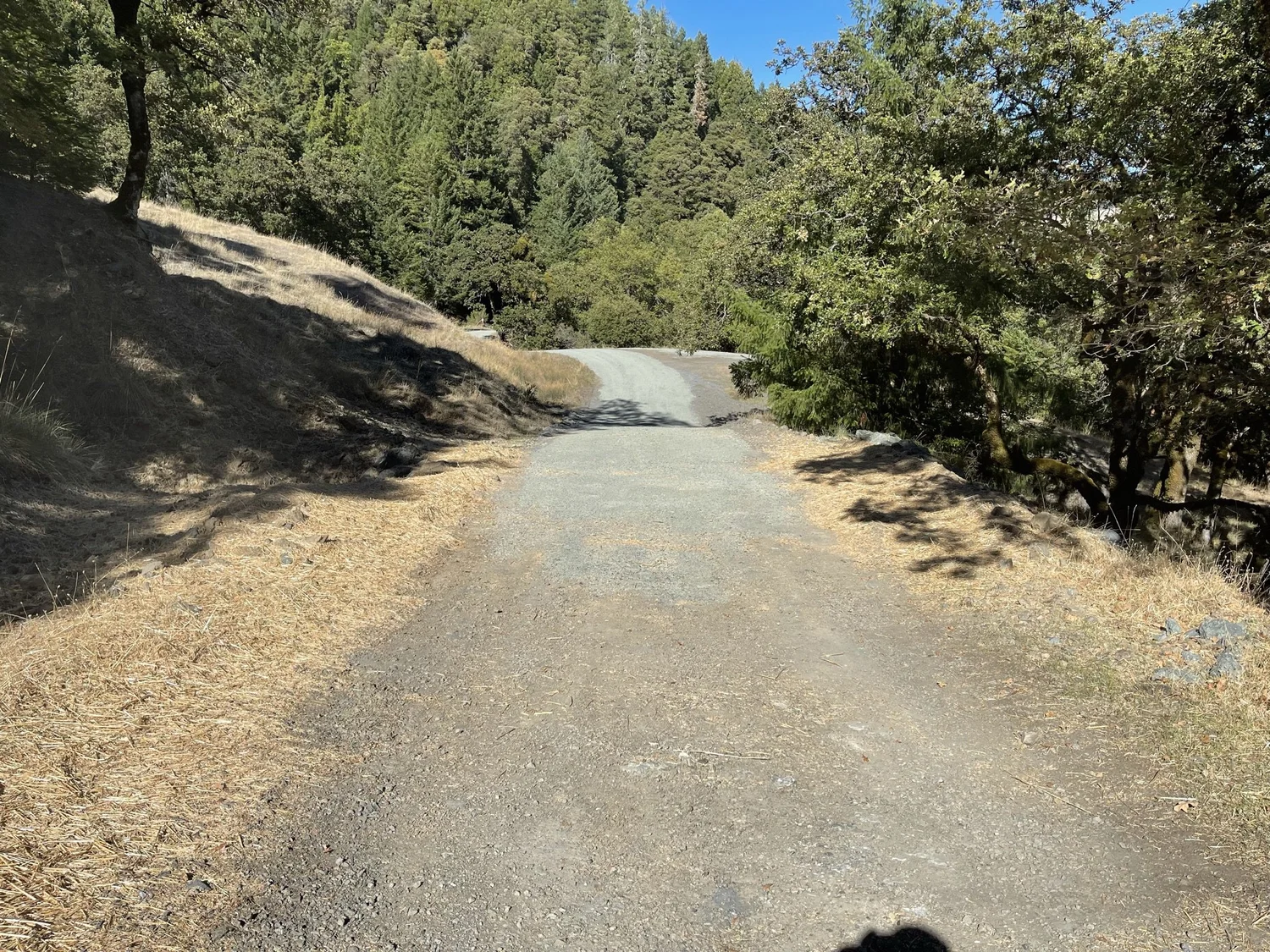
By the time I walk a road that’s taken a full season of rainfall and ranch truck or tractor traffic, the ruts aren’t just surface impressions. They’re 3 to 6 inches deep in many cases, and the base material beneath them is soft, displaced, or missing entirely. The road didn’t just get rough. It failed structurally in sections.
On clay-heavy soils common in northern Sonoma County, that failure is more pronounced because clay holds moisture long after rain stops. A road that looks dry on the surface in April may still be saturated 8 to 10 inches down. Running heavy equipment or repeated vehicle traffic over a saturated clay base accelerates the breakdown significantly.
Monterre County roads face a different version of the same problem. Coastal properties near Marina and Seaside deal with sandy soils that migrate under load, while hillside roads in the Santa Lucia Range lose base material to lateral washout during high-volume runoff events. The mechanism is different, but the result is the same: base failure that can’t be fixed by blading the surface alone. For more context on how grading affects what happens below the surface, see what actually happens under pavement when the ground shifts.
What a Proper Grading Job Actually Involves
When we assess a private road after a wet season, I’m not just looking at where the surface is rough. I’m reading the road for signs of base failure, drainage breakdown, and crown loss. All three need to be addressed for the repair to hold through next winter.
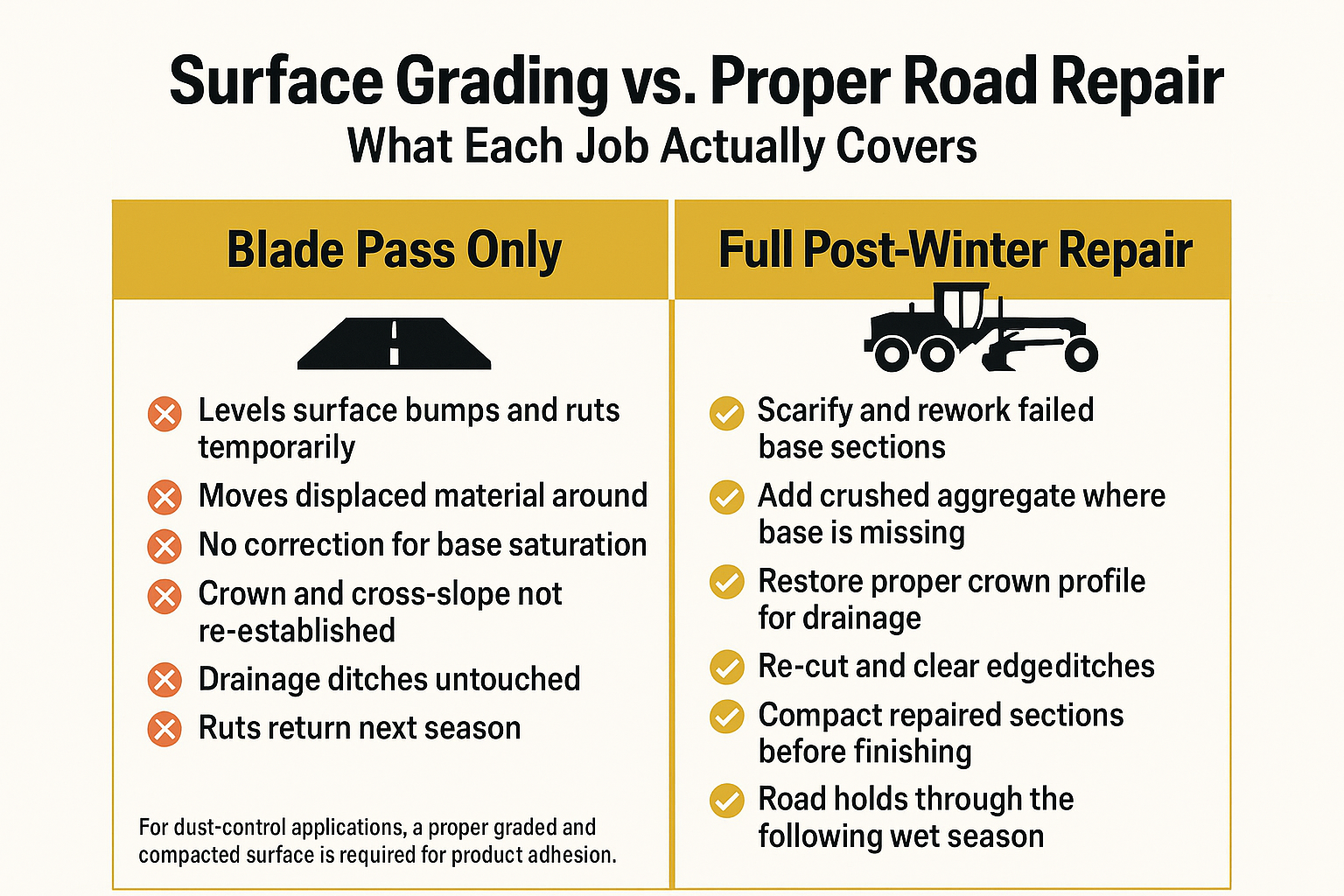
Base repair is where most of the real work happens. Soft or displaced sections need to be scarified, meaning the surface is broken up and reworked rather than just bladed over. In badly failed spots, we bring in new base material. In Monterey County, that’s typically 3/4-inch crushed aggregate base, sometimes called class 2 base, which compacts well and resists saturation better than native soil alone. The California Department of Transportation Caltrans Greenbook specifications define aggregate base requirements that quality contractors follow for this kind of structural road repair.
Crown and cross-slope restoration is the second piece. Roads are supposed to shed water to the sides. When a road loses its crown from traffic and weathering, water sits in the travel lane and accelerates the deterioration cycle. We re-establish the correct crown profile during grading so surface water runs off rather than soaks in.
Drainage correction often gets overlooked. Ditch lines on the road edges need to be cleared and re-cut so water has somewhere to go after it leaves the road surface. When those ditches fill with sediment and debris over the winter, water backs up and finds its way under the road instead. That’s often what causes the worst base failures in the first place.
For anyone planning dust-control application after grading, whether that’s a product like calcium chloride or a polymer-based stabilizer, the road surface has to be properly graded and compacted first. Those products bond to a stable surface. Applied over loose or improperly graded material, they don’t adhere correctly and the investment is largely wasted.
The Difference Between a Blade Pass and a Proper Repair
This breakdown shows exactly what separates a surface grading pass from a full post-winter road repair.
Why Summer Is the Right Window to Do This Work
Dry conditions matter for road repair in ways that aren’t obvious until you’ve tried to do this work on a wet road. I’ve seen base repair attempted in February that had to be redone in July because the material couldn’t compact properly in saturated ground.
Summer gives us a few real advantages:
- Base failures are visible. When a road is wet, soft spots and washouts blend together. Dry conditions reveal exactly where the base has failed and where it’s still solid.
- Equipment access is better. Heavy grading equipment and material delivery trucks don’t tear up a dry road the way they do a wet one. We’re not creating new damage while fixing existing damage.
- New material has time to bind. Crushed aggregate added in summer has weeks to compact under normal traffic before fall rains hit. That’s how it becomes structural rather than just a patch.
For property owners across Monterey County and Sonoma wine country planning this for summer 2026, the window is open now. Waiting until September shrinks the compaction window considerably, and if the atmospheric river pattern from November 2024 repeats, there won’t be a second chance before the road takes another full season of abuse.
If your road connects to a graded or paved surface, the condition of the road base affects that too. See how to tell if your property was graded right for a broader look at what proper grading should look like when it’s done.
For properties near Sonoma County waterways or with roads adjacent to creek channels, erosion control on the road edges is often part of the same project. Our article on creek bank erosion control on riparian lots in Santa Rosa covers how that work connects to drainage repair.
Common Road Conditions and What They Signal
These are the conditions I look for when walking a private road after a wet winter, and what each one tells me about the repair scope.
| What You See | What It Means | Repair Scope |
|---|---|---|
| Shallow surface ruts, firm when walked | Surface displacement only, base intact | Grade and compact surface, restore crown |
| Deep ruts, soft underfoot when dry | Base failure in affected sections | Scarify, add aggregate base, compact, regrade |
| Ruts refill with water after rain stops | Crown lost, drainage not shedding | Regrade crown profile, clear edge ditches |
| Road edges eroding or undercutting | Ditch lines blocked, water running under road | Re-cut ditches, repair edge, add base where lost |
| Same spots fail every year | Base never repaired, only surfaced | Full base repair required in recurring failure zones |
What This Work Typically Costs, and What Drives the Number
I get asked about cost on almost every road grading call, and the honest answer is that it varies significantly based on a few specific factors.
Road length and width are the obvious ones. A half-mile access road is a different job than a 300-foot driveway approach. Base failure extent matters just as much. A road where only two or three sections have failed costs less to repair than one where the base has broken down along the entire length.
Material hauled in is often the biggest variable. If significant amounts of crushed aggregate need to be brought to the site, that adds material and trucking cost on top of the grading work itself. Remote properties in rural Monterey County or along Sonoma’s hillsides may have access limitations that affect delivery logistics.
For rural properties in these markets, rough estimates from contractors in this region can range broadly depending on the factors above. Many Sonoma and Monterey County property owners with mid-length private roads see quotes in ranges that reflect multiple days of equipment time plus materials. The only way to get a number that actually means something is a site walk. Gravel specs, soil conditions, and access all change the math.
For anyone considering whether a road qualifies as a grading permit project in Sonoma County, cuts or fills over 50 cubic yards require a county grading permit. Monterey County’s threshold is 100 cubic yards. Most private road grading jobs don’t reach those thresholds, but larger base repair projects with significant material import or export sometimes do.
Frequently Asked Questions About Private Road Grading
Can I just add gravel to the ruts and call it done?
You can, and it will smooth things over temporarily. But if the base under those ruts has failed, the gravel will migrate into the soft material and the rut will reappear within a season. Adding gravel without fixing the base is a recurring cost, not a repair.
Do I need a permit for private road grading in Monterey or Sonoma County?
Most routine grading and base repair jobs don’t hit the permit threshold. Sonoma County requires a grading permit for cuts or fills over 50 cubic yards, and Monterey County’s threshold is 100 cubic yards. If your road project involves significant earthmoving, a contractor can help you determine whether a permit applies.
How long does proper road grading take compared to a simple blade pass?
A blade pass on a half-mile road might take a few hours. A proper repair with base work, material import, and compaction typically runs one to several days depending on road length and how much of the base needs attention. The extra time is what makes the repair hold.
We apply DustOff every summer. Should we grade before or after?
Always grade and compact first, then apply dust-control product. Products like calcium chloride or polymer stabilizers need a stable, compacted surface to bond correctly. Applied over loose or improperly graded material, they don’t perform and the application cost is largely lost.
What’s the best way to know if my road needs base repair versus just surface grading?
Walk the road in dry conditions and press down on the rut areas with your foot. If the surface feels firm, the base is probably intact and surface grading may be enough. If it feels soft or spongy even when dry, the base has failed and needs more than a blade pass. A contractor site walk will confirm the extent.
Ready to Get Your Road Assessed Before Fall?
If your private road took a beating this past winter and you’re planning to grade, add gravel, or prep for dust-control this summer, now is the time to get a site walk scheduled. We work with property owners, winery managers, ranchers, and developers across Monterey County and Sonoma County on exactly this kind of annual and post-storm road repair. Call DW Excavation at 707-601-9091 or submit a request through the contact page at dw-excavation.com to set up a site assessment.