
Direct Answer: When the ground shifts under pavement, the base layers separate, voids form, and the surface above cracks or sinks — often months before you see any visible damage.
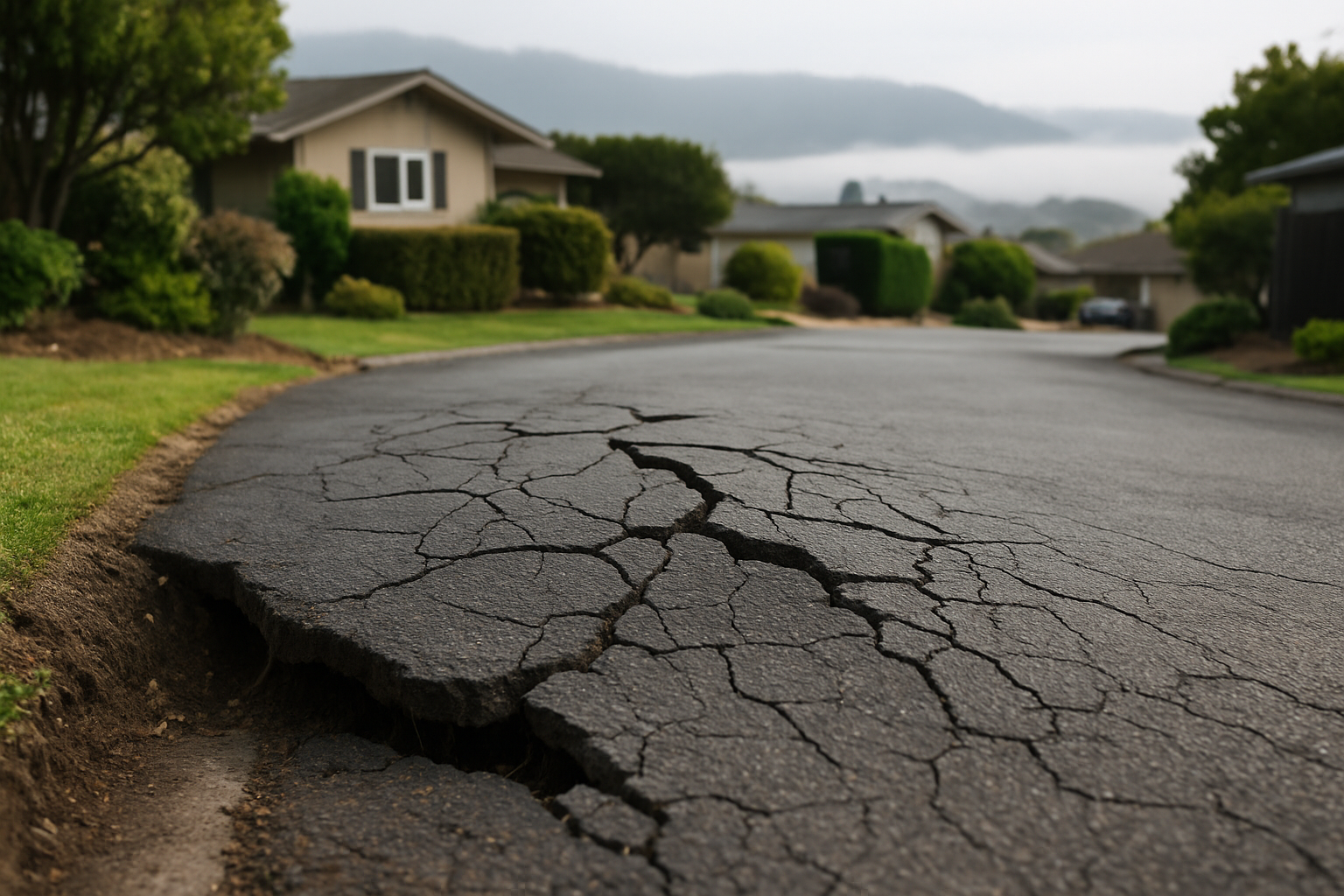
You see a crack in your driveway or a soft spot in your parking lot and you figure it’s just surface wear. But most pavement failures in Monterey County don’t start at the surface — they start several inches underground, where nobody’s looking.
Monterey’s soils are some of the most movement-prone in California. Between the expansive clays in the Salinas Valley, the saturated lowlands near the Pajaro River, and the sandy marine sediments along the coast, the ground here does not stay put. When it moves, your pavement moves with it — whether the surface shows it yet or not.
Understanding what’s actually happening beneath the pavement is the difference between patching a symptom and actually fixing the problem. This article breaks down the underground mechanics so you can make smarter decisions before the damage gets expensive.
How Pavement Is Supposed to Work — and Where It Breaks Down
Pavement isn’t just a hard surface poured on top of dirt. A properly built driveway, road, or parking area is a layered system. Each layer has a specific job.
From bottom to top, a standard asphalt section looks like this:
- Subgrade — the native soil at the bottom, compacted and graded to carry load
- Subbase — crushed aggregate (usually 4 to 8 inches thick) that distributes weight and drains water
- Base course — a denser compacted aggregate directly beneath the asphalt
- Surface course — the asphalt or concrete layer you actually drive on
When the subgrade shifts, everything above it shifts too. The layers don’t flex in unison — they separate. And once that bonded system breaks apart, water gets in through every gap it can find.
In Monterey County, the subgrade is often the weak link. The clay-heavy soils in areas like Salinas and Gonzales shrink during dry summers and swell when the rains return. That cycle — shrink, swell, shrink, swell — gradually destroys the compaction below your pavement without anything visible happening at the surface. By the time you see a crack, the base has usually been compromised for a season or two already. If you’ve already seen surface damage, why your pavement keeps failing digs into what those patterns tell you.
What Ground Movement Actually Does to the Layers Below
Ground movement under pavement happens in a few specific ways, and each one causes a different kind of damage pattern at the surface.
Soil settlement happens when the subgrade was never fully compacted before paving — or when fill soil placed on top of native ground compresses over time under load. You’ll see this as a gradual depression, often in the middle of a driveway or near where a trench was cut for a utility line.
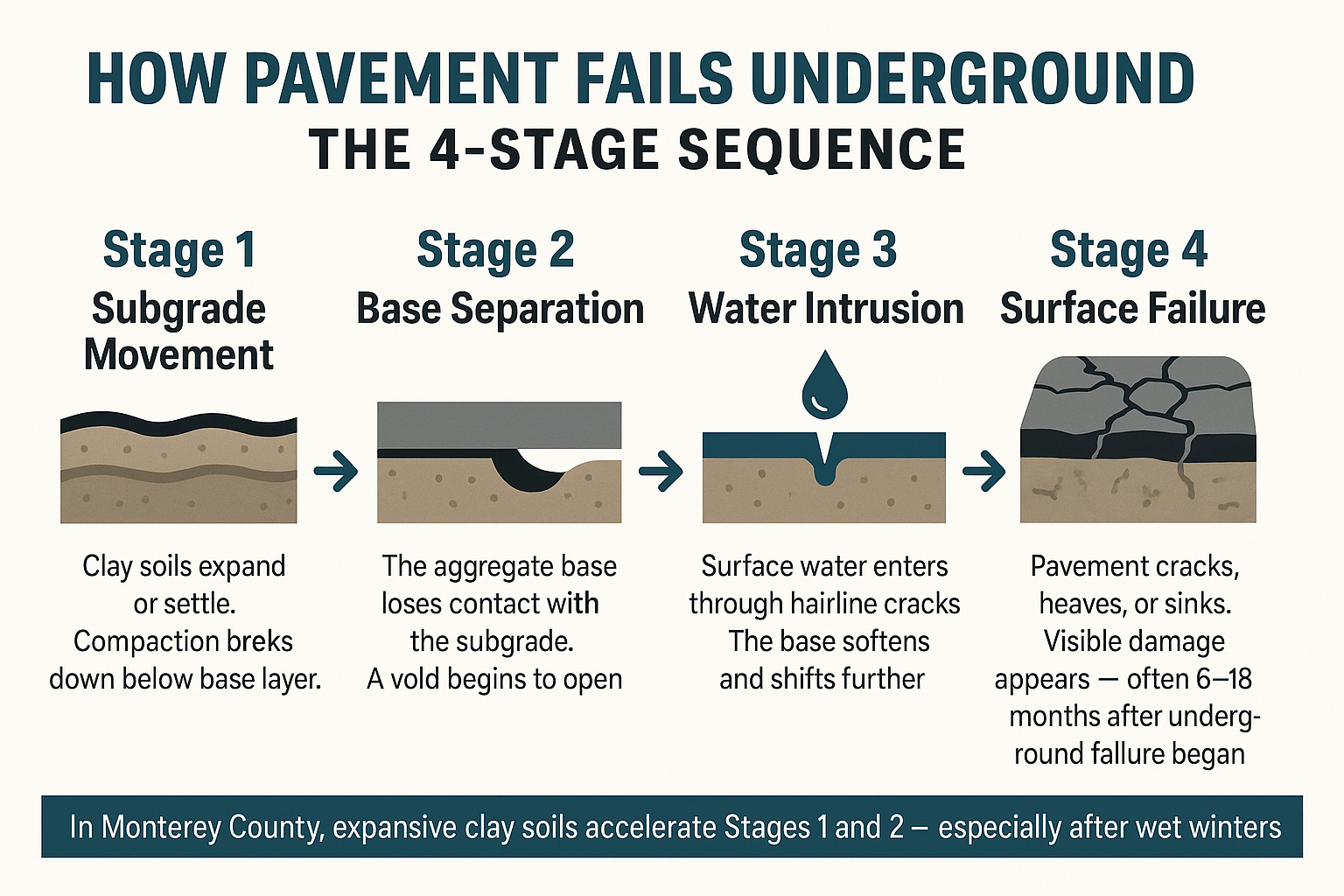
Expansive soil movement is what Monterey County’s clay soils do every year. When soil absorbs water, it expands. When it dries out, it contracts. That vertical movement — sometimes 1 to 3 inches in a single season in heavy clay — pushes and pulls at the base layer from below. The base starts to separate from the subgrade, and voids open up.
Void formation is the most dangerous stage. Once a void opens beneath the base, there’s nothing supporting that section of pavement from below. Traffic load concentrates across a smaller area, and the surface cracks or punches through. In Monterey and Seaside, we’ve seen voids open under commercial driveways within 18 months of new paving when the subgrade prep wasn’t done right.
Water makes all of this worse. Once a crack opens at the surface, water enters, softens the base, and accelerates the separation. That’s why a small surface crack in October can turn into a full pavement failure by March — especially after the kind of atmospheric river events that hit the Central Coast in late 2024. Why Monterey driveways crack faster than you’d expect covers the seasonal timing of this in more detail.
The Underground Failure Sequence: What Happens Before You See a Crack
This shows the four-stage progression of pavement failure — from initial soil movement underground to visible surface collapse.
Why Repairs Keep Failing If the Base Isn’t Addressed
This is the part most property owners don’t hear until they’ve already paid for the same repair twice. Patching the surface without addressing the base is like replacing a roof without fixing the rafter that’s rotted through.
When a contractor fills a crack with sealant or throws down a cold-patch overlay, they’re covering the visible symptom. But the void, the separated base, or the soft subgrade below is still there. Load continues to concentrate. Water continues to get in through gaps the patch didn’t seal. Within one to two rainy seasons, the same area fails again — sometimes worse.
A real repair starts with understanding what caused the movement in the first place:
- Was it poor compaction during original construction?
- Was there a utility trench nearby that settled after backfill?
- Is there a drainage problem directing water toward this area of the base?
- Is the subgrade soil itself expansive clay that wasn’t stabilized before paving?
Each of those causes has a different fix. A drainage issue requires regrading the surrounding area or installing a subsurface drain before repaving. Settled trench backfill requires excavating down, recompacting in 6-inch lifts, and rebuilding the base before the surface goes back. Expansive clay may require soil stabilization with lime or aggregate importation before any base work begins.
If you’re not sure whether grading was done correctly before existing pavement went down, how to know if grading was done right walks through what to look for.
Common Failure Causes and What the Fix Actually Involves
The surface symptom often looks similar regardless of the cause. But the actual repair depends entirely on what’s happening underground.
| Surface Symptom | Likely Underground Cause | What the Real Fix Requires |
|---|---|---|
| Longitudinal crack along pavement center | Subgrade settlement or soil shrinkage | Excavate, recompact subgrade, rebuild base, repave |
| Alligator cracking across a wide area | Base failure from water intrusion or void formation | Remove surface, replace base material, address drainage source |
| Localized depression or soft spot | Settled utility trench backfill or organic subgrade | Dig out affected area, recompact in lifts, new base and surface |
| Heaved or raised section | Expansive clay pushing upward from below | Subgrade stabilization or soil replacement before repaving |
| Edge cracking along driveway border | Base erosion from surface water running off edge | Regrade surrounding area, install edge drain, rebuild border base |
What a Proper Site Assessment Looks Like Before Repaving
Before any repaving work starts, someone needs to understand what’s happening underground. That means more than walking the surface and counting cracks.
A thorough assessment for a Monterey County property typically includes:
- Probing soft spots — a steel rod pushed into the soil through existing cracks can tell you in seconds whether there’s a void or soft zone below
- Checking drainage patterns — where does water flow during a rain event? Is it running under the pavement edge or pooling near a low point in the base?
- Reviewing the project history — was there a utility cut in this area? When was it backfilled, and by whom?
- Evaluating the surrounding grade — is water being directed away from the pavement, or toward it?
In areas near the Salinas River corridor or the Pajaro Valley — where the 2023 Pajaro flooding saturated soils for weeks — subgrades may still be compromised in ways that don’t show at the surface. We’ve assessed sites in that area where the base looked intact from above but had shifted 2 to 4 inches laterally after prolonged saturation.
If there’s a drainage problem feeding the failure, that has to be solved first. Why water pools in the same spot every time it rains explains how to trace the source before you commit to any repair plan.
Frequently Asked Questions About Pavement and Ground Movement
How long does ground movement take to show up at the surface?
It depends on the cause, but in Monterey County’s clay-heavy soils, you can see surface cracking within one rainy season of initial subgrade movement. Void formation from poor compaction or a settled utility trench may take 12 to 24 months to work its way up to visible damage. The underground failure almost always starts before anything is visible at the surface.
Can I just patch the cracks and seal the surface to stop the damage?
Sealing helps slow water intrusion at the surface, but it won’t fix a compromised base or a soft subgrade. If the underlying cause isn’t addressed, the patch will fail — usually within a season or two. Sealing is a maintenance tool for pavement that’s still structurally sound, not a repair for pavement that’s already failing from below.
Does Monterey County require a permit to repave a driveway?
A simple resurfacing of an existing driveway typically doesn’t require a permit. But if the work involves significant regrading, drainage modifications, or cuts and fills over 100 cubic yards, Monterey County’s grading permit threshold kicks in. Any work near a creek, drainage easement, or in a mapped flood zone may also require additional review. When in doubt, check with the county before work starts.
Why does my driveway keep failing in the same spot?
A recurring failure in the same location almost always points to a localized underground cause — a utility trench that wasn’t properly compacted when it was backfilled, a drainage problem directing water into that section of base, or an area of expansive clay that was never stabilized. Until that specific cause is diagnosed and fixed, any surface repair is temporary. Why your new driveway started cracking so fast covers the most common causes of this pattern.
How deep does the excavation need to go to actually fix a failed base?
For most residential driveways, fixing a failed base means removing the existing pavement and excavating down 12 to 18 inches to reach stable subgrade. If the subgrade itself is soft or saturated, you may need to go deeper or import engineered fill to replace unsuitable material. There’s no single depth that applies everywhere — it depends on what the probe and visual inspection reveal on that specific site.
Not Sure What’s Happening Under Your Pavement?
If you’re seeing cracks, soft spots, or recurring pavement failures on your Monterey County property, the underground picture matters more than the surface. DW Excavation has been diagnosing and correcting base failures, drainage problems, and subgrade issues throughout Monterey and Salinas since 2013 — and we’re not guessing when we look at a site. Call us at 707-601-9091 or reach out through the contact page at dw-excavation.com to talk through what you’re seeing and get a free estimate.