
Direct Answer: A french drain needs a sloped trench, clean crushed rock, the right geotextile fabric, perforated pipe, and a working outlet. Skip any one of those and it clogs within a few seasons.
Water pooling against a foundation is one of the most common calls I get, and the fix people ask for by name is almost always a french drain. A homeowner up in Rio Nido reached out recently about roughly 50 feet of new drain along an existing house, which is about as typical a request as it gets.
Here is what surprises most people: the trench and the gravel are the easy part. What separates a drain that still works in twenty years from one that plugs solid in two or three wet seasons is the stuff nobody sees once the ground is backfilled.
I want to walk through the parts that actually decide whether the system lives or dies. Grade, materials, and where the water goes at the end. Those three things carry the whole job, whether the property is on a Monterey County, CA hillside or a flat lot in the Salinas Valley.
What a French Drain Does, and Why Grade Decides Everything
A french drain is a sloped trench with perforated pipe in it. Its job is to catch water moving through the soil before it reaches a foundation wall, a crawl space, or a low spot in the yard, and carry it somewhere safe.
The word that matters there is sloped. A drain that runs dead level, or dips uphill anywhere along the run, holds water in the trench instead of moving it. That trapped water saturates the surrounding soil, and now the drain is feeding the problem it was built to solve.
On a residential run, I want at least 1% fall, which is about 1 inch of drop for every 8 feet of pipe. More is better when the site allows it. Less than that and silt settles inside the pipe instead of flushing through.
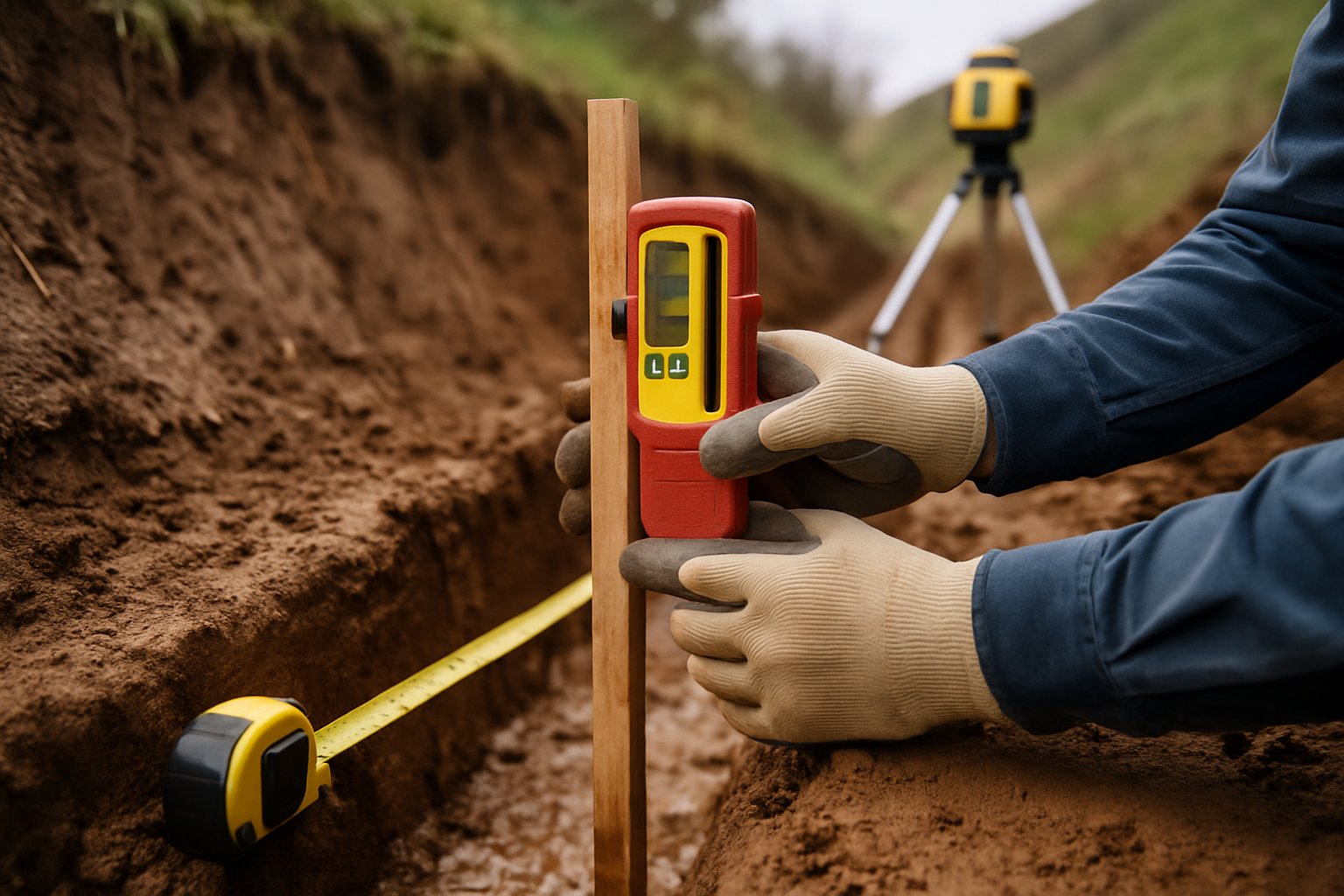
And here is the part people skip: you find the outlet elevation first, then dig backward from it. If the discharge point sits 18 inches below grade and the drain needs to start 30 inches deep at the house to get below the footing, the math either works or it does not. I shoot that with a laser level before a single bucket of dirt moves.
When the numbers do not work by gravity, the options change entirely. That usually means a sump and pump, a redesigned route, or a different drainage approach altogether.
Fabric and Rock: The Two Specs That Decide How Long It Lasts
Fines migration is what kills most french drains. Tiny soil particles work their way into the rock and then into the pipe, and over time the whole system silts up from the inside.
In the clay-heavy soils we deal with around Santa Rosa and Windsor, that happens fast. Clay particles are small enough to move with water and stubborn enough to pack tight once they settle. Monterey County, CA sites vary more, with sandier coastal soils in some spots and heavy stuff up in the hills, but neither one is forgiving of the wrong materials.
Here is what a correct material spec looks like on a residential job:
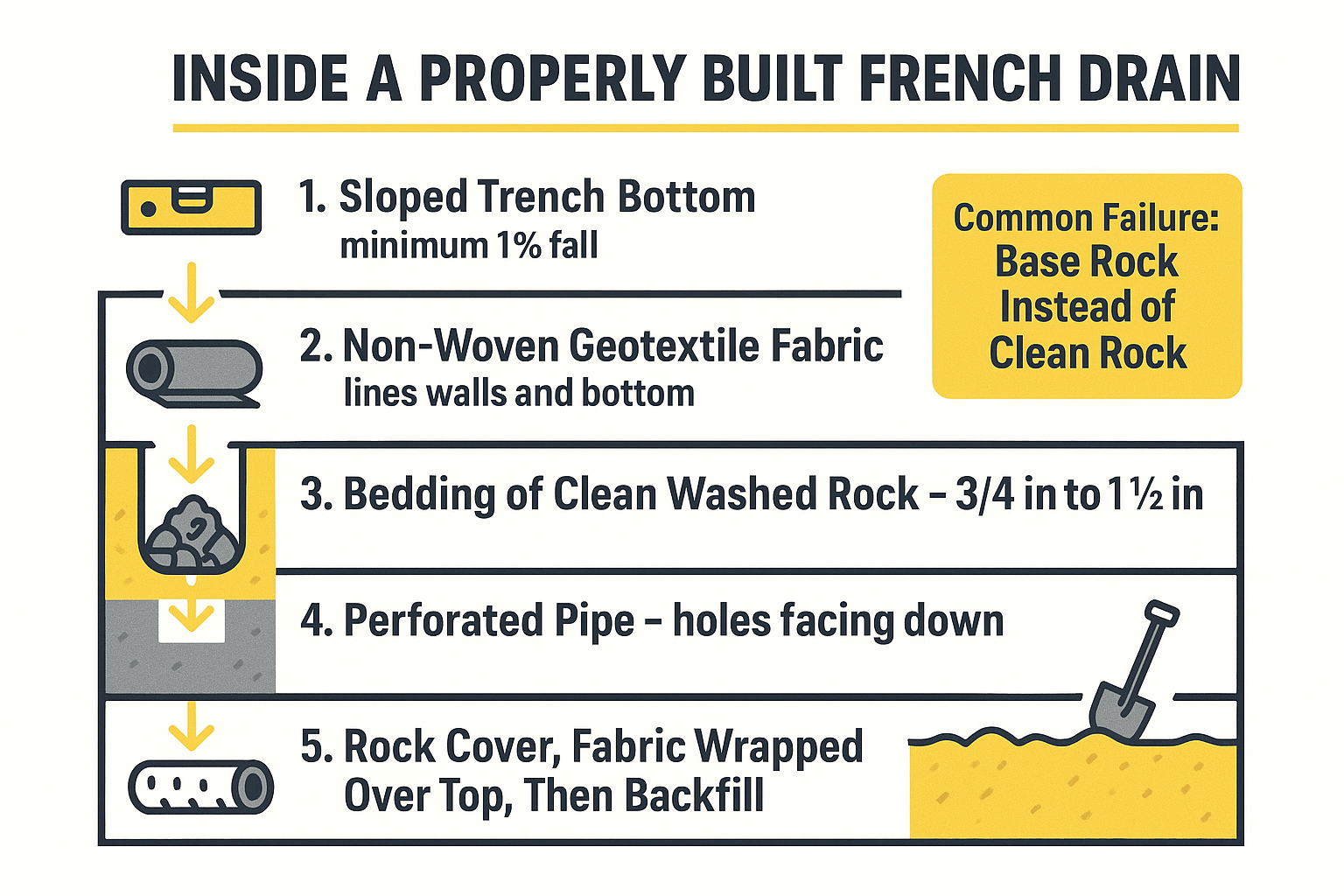
- Non-woven geotextile fabric lining the full trench, walls and bottom, then folded over the top of the rock before backfill. This is the filter between native soil and the drain.
- Clean, washed drain rock, usually 3/4 inch to 1 1/2 inch, with the fines screened out. Not road base. Not pit run. Base rock has fines in it by design because it is meant to compact, and compacted rock does not drain.
- Perforated pipe with the holes facing down, so water enters at the bottom of the pipe and the invert stays low.
- A cleanout riser at the upstream end so the line can be flushed later.
One more thing on fabric. A pipe sock alone is not a substitute for lining the trench. The sock protects the pipe but does nothing for the rock around it, and once the rock plugs, the sock is irrelevant. I have opened up five-year-old drains where the rock had turned into a solid block of clay and gravel.
The Layers of a Properly Built French Drain
This breaks down what goes into the trench, in order, from the bottom up.
Where the Water Actually Goes: Outlet Design
This is the piece that gets skipped most often, and it is where I see the worst outcomes. A drain with no real outlet, or an outlet that silts shut, backs up under pressure during a heavy storm and can push water toward the foundation.
Think about what we saw in November 2024, when Santa Rosa took over 12 inches of rain in three days. That kind of event finds every weak outlet on a property.
The right outlet depends on the site, not on preference. Slope, soil percolation, property lines, and where the neighbor’s water already goes all factor in. Some properties need the drain tied into a broader storm water system rather than a standalone line.
French Drain Outlet Options Compared
Here are the three outlets I use most on residential jobs and when each one makes sense.
| Outlet Type | Works Best When | What Can Go Wrong |
|---|---|---|
| Daylight outlet on a slope face | There is enough fall to exit above grade downhill of the house | Rodent entry, silt buildup, and erosion at the discharge point if it is not armored |
| Tie-in to catch basin or storm drain | A legal connection point exists and the jurisdiction allows it | Backflow during heavy storms if the receiving system surcharges |
| Dry well or infiltration pit | Soil percs well and there is no gravity outlet available | Fails quickly in clay soils that will not accept water |
Before Anyone Digs: The 811 Call Is Not Optional
Even a short 50-foot trench on an existing property runs through crowded ground. On older lots I regularly find irrigation lines, buried electrical conduit, gas service, sewer laterals, and abandoned pipe nobody remembers installing.
In California, calling 811 before excavation is required by law, including on private property. You can read the requirements directly from the national 811 program. The locate marks come back showing utility owners’ facilities, and those marks shape where the trench can run.
Two things about scheduling:
- The notice requirement is two business days before digging starts, so it affects the project calendar.
- 811 marks public utility lines, not private ones. Private irrigation, landscape lighting, and a line running out to a detached shop are usually the homeowner’s to identify.
This is the same discipline that applies to any underground work, whether it is a drain, an electrical trench to a hot tub or detached structure, or a sewer connection.
On cost, I will not throw a number at a job I have not seen. What drives the price is trench depth, machine access, soil type, how much spoil has to be hauled off, and how much work the outlet requires. A drain that daylights 20 feet downhill is a different job than one that needs a dry well and a hand-dug section between a fence and a foundation.
Frequently Asked Questions About French Drain Installation
How deep does a french drain need to be?
It depends on what you are protecting. To keep water off a foundation, the pipe invert generally needs to sit below the bottom of the footing, which often puts the trench in the 24 to 36 inch range. A yard drain catching surface water can be shallower. The controlling factor is usually the outlet elevation, not a standard depth.
Can I just use landscape fabric instead of geotextile?
No. Landscape fabric is made to block weeds, not to filter soil while passing water at volume. It blinds over with clay and stops flow. Non-woven geotextile is a different material with a specified flow rate and particle retention.
Do I need a permit for a french drain in Monterey County?
A short residential drain usually does not trigger a grading permit on its own. Monterey County’s grading permit threshold sits at 100 cubic yards of cut or fill, and Sonoma County’s is 50 cubic yards. But if the drain is part of a larger site project, or discharges near a creek or drainage channel, additional review can apply. Worth confirming with the county before work starts.
How long should a french drain last?
Built right, with clean rock, proper fabric, real fall, and a maintained outlet, twenty years or more is reasonable. Built wrong in clay soil, I have seen them stop working in a single wet season.
Will a french drain fix water in my crawl space?
Sometimes, and sometimes not. If water is entering because saturated soil is pushing against the foundation, an exterior drain intercepting that water often helps a lot. If the source is surface runoff coming off a roof or a driveway, the fix is grading and surface drainage instead. That is why the site walk matters more than the product.
Thinking Through a Drainage Problem on Your Property?
If you are weighing a french drain on a property in Monterey County, CA or anywhere from Salinas to the Sonoma County line, we are happy to look at the site and talk through what the grade and soil will actually allow. Our team can be reached at 707-601-9091 or through the contact page at dw-excavation.com. Free estimates, and no pressure either way.