
Direct Answer: In most years, foundation excavation in Santa Rosa runs into late October or early November if the ground is still dry and permits are in hand. The first soaking storm usually ends it.
Nobody brings up the calendar at the bid stage. You get a number, you get a start date, and everybody assumes the dirt will behave the same in November as it did in July.
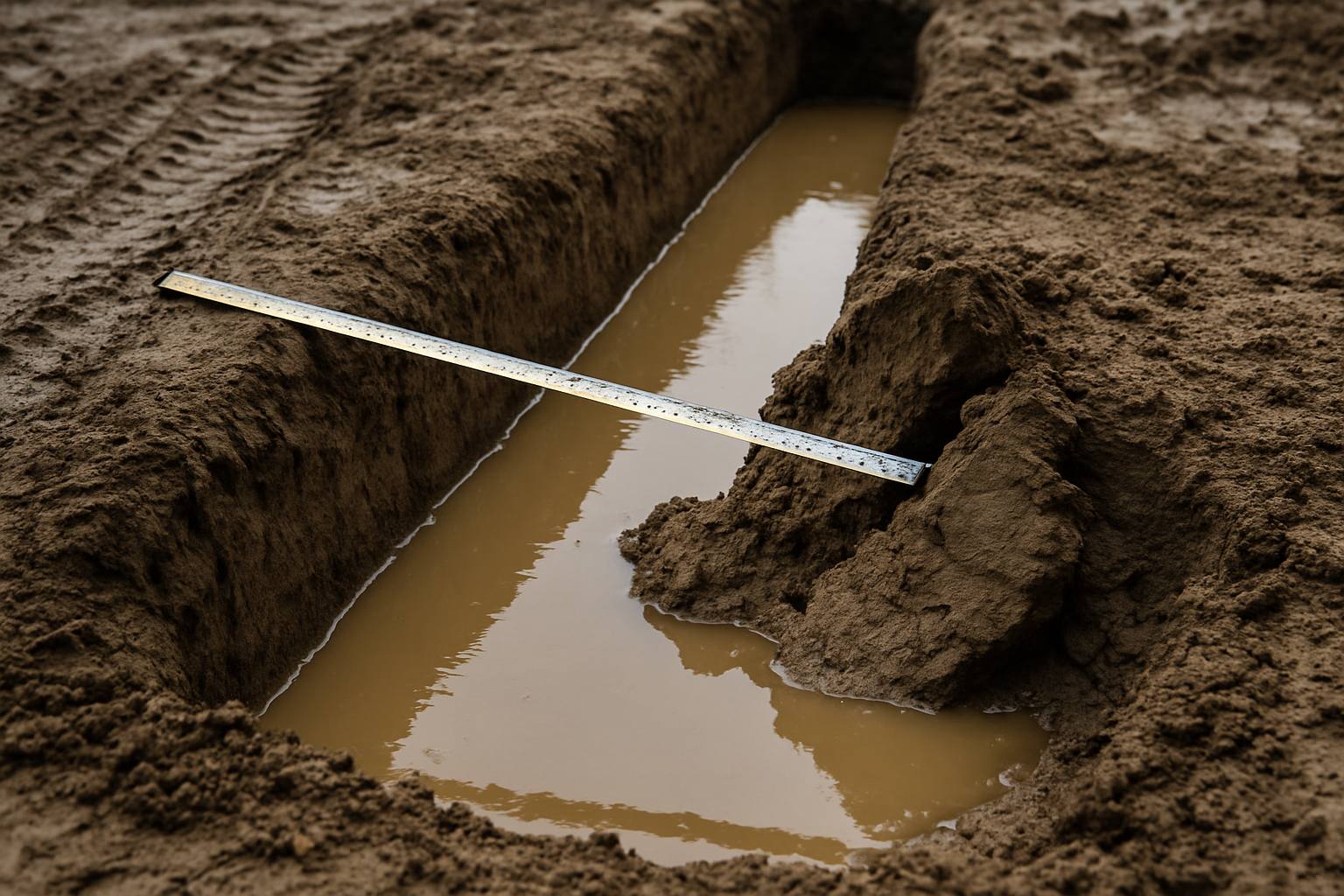
It will not. Santa Rosa sits on clay-heavy soil that acts like two completely different materials depending on how much water is in it. Dry clay cuts clean and holds a wall. Wet clay smears, swells, and turns a straightforward dig into a slow, expensive mess.
I have stood on plenty of Sonoma County pads in late fall watching a homeowner realize their window just closed. So here is the honest answer to how late you can go, what actually goes wrong when you push it, and what still moves forward once the rains start.
The Short Answer: The First Big Storm Sets Your Deadline
In a typical year, foundation excavation around Santa Rosa runs comfortably from late spring through October. Some years we get into the first or second week of November without trouble. Some years we do not.
The deadline is not a date on a calendar. It is the first storm that soaks the ground deep enough that the clay stops draining and starts holding.
November 2024 is the example I bring up most. Santa Rosa took roughly 12.47 inches of rain in three days during that atmospheric river. That is not a delay, that is the end of a dig. Open excavations filled, spoil piles turned to paste, and pads that had been graded and compacted needed to be reworked from scratch.
The practical rule I give people: if your foundation is not poured and backfilled by the time the first multi-day storm system lines up offshore, plan on being paused. Down in Monterey County the timing runs similar, though the sandier coastal soils there drain faster and the bigger risk is runoff and slope movement rather than clay swelling.
What Actually Goes Wrong When Sonoma Clay Gets Wet
This is the part that surprises homeowners. They picture rain as an inconvenience, like a couple of lost days. What actually happens is more structural than that.
Here is what I watch for once a site takes real water:
- Sidewalls stop holding. Dry clay stands up in a clean vertical cut. Saturated clay sloughs, bulges, and caves. Now you are either over-excavating and hauling more dirt or shoring a trench that did not need shoring in August.
- Spoil will not compact back. Wet clay balls up. You cannot get proper compaction out of material that is above optimum moisture, which means the fill you were counting on becomes unusable and has to be hauled off and replaced.
- Equipment ruins the subgrade it sits on. A tracked machine working saturated clay kneads and pumps the soil under it. The bearing surface you just paid to prepare gets destroyed by the machine preparing it.
- Inspections stall. An excavation has to be reasonably clean and dry to pass. If water is standing in the footings or the bottom is churned to mud, the inspector is not signing it, and you are back in the queue.
- Erosion becomes your liability. Bare disturbed soil next to a storm drain or creek channel moves fast in heavy rain, and sediment leaving your property is a compliance problem, not just a cleanup problem.
I wrote more about why this soil behaves the way it does in what makes foundation excavation hard in Sonoma County, and the short version is that the ground here does not forgive bad timing.
Work Backward From Your Pour Date, Not Forward From Today
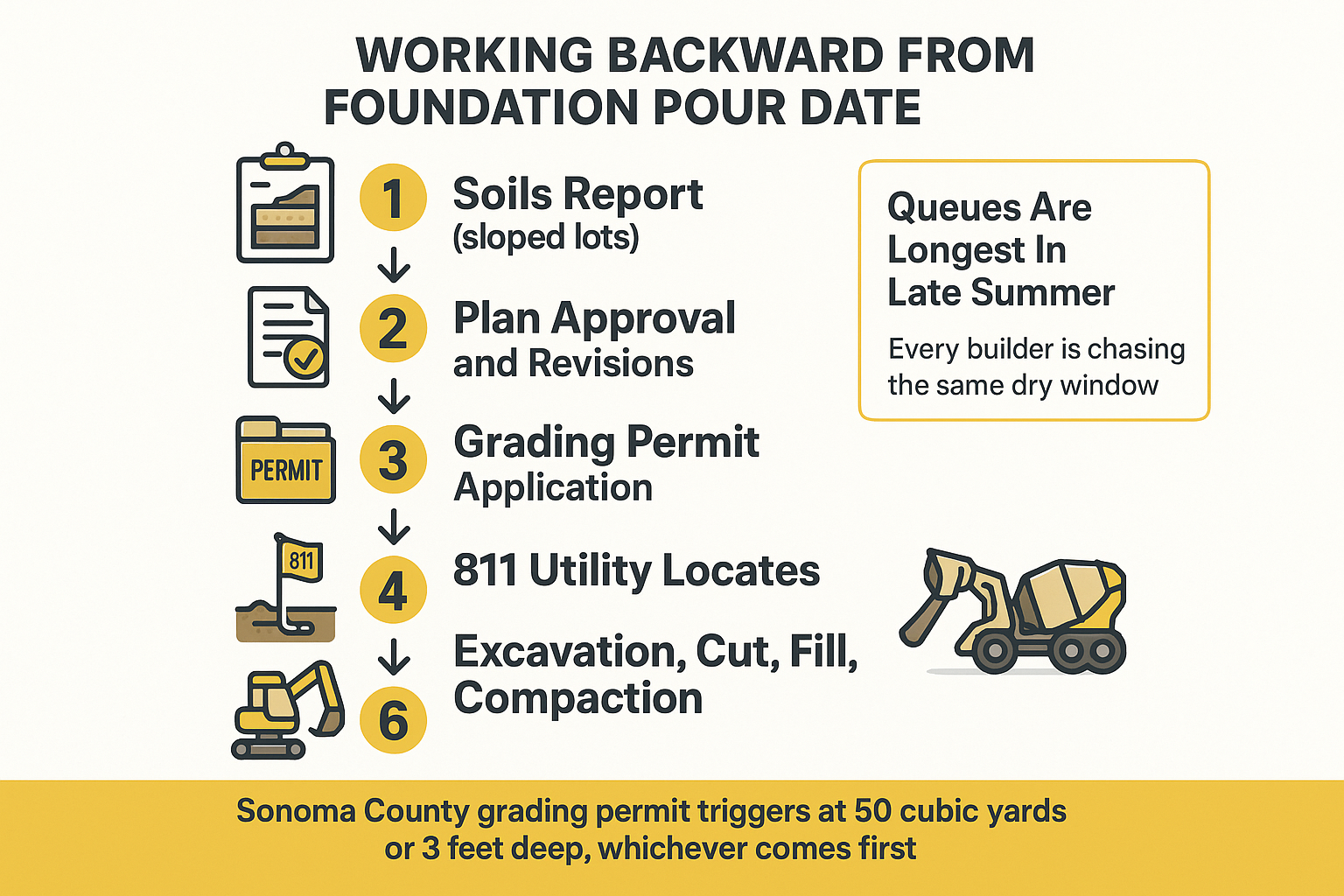
Most people plan forward. They call in September and ask if there is time. The better move is to pick the date you want concrete in the ground and count backward, because every step ahead of the dig has a line to stand in.
A rough sequence for a new foundation on a Santa Rosa lot:
- Soils report if the lot is sloped or the county wants one. Geotechnical firms get booked, and turnaround on the report itself takes time after the field work.
- Plan approval. Your drawings have to reflect what the soils report says, which sometimes means a revision loop.
- Grading permit through the county or city, depending on your parcel.
- Utility locates. The 811 call has a required wait before anyone puts a bucket in the ground.
- Excavation and pad prep. Cut, fill, compaction, and grading to plan.
- Forming, steel, and inspection before the pour.
Each of those has a queue, and the queues are longest in late summer because every builder in the county is trying to beat the same weather. A permit that moves in two weeks in March can sit much longer in August.
If you want your foundation poured in October, the honest starting point is usually early to mid summer, not September. That is the math nobody does until it is too late.
Counting Backward From Your Pour Date
This is the sequence I walk homeowners through when they ask whether there is still time this year.
The Permit Threshold Most Homeowners Cross Without Knowing It
This is where late-season projects die at the counter instead of in the mud.
In unincorporated Sonoma County, a grading permit is generally required once your cut or fill passes 50 cubic yards or goes deeper than 3 feet, whichever comes first. Fifty cubic yards sounds like a lot until you realize it is roughly five dump truck loads. A modest building pad on a sloped lot clears it easily.
MonterCounty County sets its own bar, with a threshold commonly cited around 100 cubic yards, and city parcels inside Santa Rosa follow city rules rather than county rules. Thresholds and review requirements change, so confirm what applies to your specific parcel with Permit Sonoma before you assume you are under the line.
I hear from people after the fact more often than before it. One homeowner reached out about grading and retaining walls done years earlier on a slope, with the city now requiring a permit after the fact and asking for a soils engineer. Legalizing finished work is slower and more expensive than permitting planned work.
The scheduling point matters here: a permit you have not applied for is not a delay, it is a stop. If it is already October and you have not filed, the dig is probably a next-year job, and I would rather tell you that in the driveway than three weeks in.
Month by Month: What the Ground Usually Allows Around Santa Rosa
This is general guidance based on typical years, not a promise. A wet October or a dry January changes everything.
| Time of Year | Typical Clay Condition | What Usually Moves Forward |
|---|---|---|
| May through August | Dry and firm, cuts clean | Full site prep, pad grading, foundation excavation, paving prep |
| September through mid October | Still dry, drying deeper | Best remaining window for new pads if permits are already in hand |
| Late October into November | First storms decide it | Race to pour and backfill; erosion control goes in before rain |
| December through February | Saturated, low bearing capacity | Drainage repairs, emergency work, pier or repair scopes, storm response |
| March through April | Draining but variable | Road grading and gravel repair, drainage corrections, early planning |
If the Window Has Closed, Some Work Still Goes
Losing the season does not mean the whole property goes quiet until spring. It means the type of work changes.
What can often proceed in wetter conditions:
- Deep pier work. Drilled piers that reach down to competent material or bedrock behave differently than a shallow building pad, because you are not depending on surface soil for bearing.
- Foundation repair and stabilization on existing structures, including work on ground that has already moved.
- Drainage corrections. Winter is when you actually see where the water goes, and that is useful information.
- Utility and sewer line repairs where the trench is narrow, short, and backfilled the same day.
- Storm and flood site recovery, which by definition happens in bad conditions.
What changes is the sequencing and the cost structure. Wet-weather work means more haul-off, imported base rock instead of reusing native spoil, mats or road plates to protect the subgrade, dewatering, and more erosion control. Those are real line items, and they should be on the table before the job starts rather than showing up as a surprise mid-project.
I would rather have that conversation in October than in January. Homeowners handle added cost fine when they understood it going in. They do not handle it well when it arrives as a change order.
If you are on a hillside lot, retaining wall excavation and site prep has its own timing rules worth reading before you commit to a winter start.
What Late-Season Timing Does to Your Budget
I will not quote a number for your lot without seeing it, and anyone who does over the phone is guessing. But it helps to understand what drives the cost difference between an August dig and a January one.
The factors that move the price:
- Haul-off volume. Native clay you could have reused dry becomes waste wet. Trucking is charged by the load, and loads add up fast.
- Imported material. Base rock and drain rock have to come in to replace unusable spoil.
- Machine time. Working soft ground is slower. Slower means more hours.
- Ground protection and dewatering. Mats, plates, pumps, and sumps are equipment and labor that a dry-season job does not need.
- Rework. A pad that gets rained on before it is protected may have to be recut and recompacted.
Costs vary widely by parcel, but many Sonoma County homeowners find that a wet-season foundation dig runs meaningfully higher than the same scope in summer, sometimes by a large margin once haul-off and import are counted. The only way to know your number is to have someone walk the site and price the actual conditions.
One more thing worth knowing: the good crews book out well ahead. Being told a schedule is full months out is not a brush-off, it is what a busy dry season looks like in this county.
Why Local Ground Knowledge Decides the Schedule
A crew that works clay every season reads a site differently than one passing through. They know which Santa Rosa neighborhoods hold water, which slopes creep after a wet week, and how fast a lot near a creek changes character.
They also know the counter. Filing the grading permit and the stormwater paperwork alongside the excavation is what keeps a schedule from stalling in review while the weather closes in.
We have worked Sonoma clay and Monterey County coastal terrain since 2013 as a licensed California General Engineering Contractor, License #1060838. The reason I push people to plan the calendar backward is simple: I have seen how much a lost season costs, and it is almost always more than the planning would have.
Frequently Asked Questions About Late-Season Foundation Excavation
What is the absolute latest you can dig a foundation in Santa Rosa?
There is no fixed date. In many years the practical cutoff lands in late October or early November, but it is really set by the first storm system that soaks the ground deep. Some years that comes in mid October, some years not until December.
Can you dig in the rain if the excavation is small?
Sometimes, yes. Narrow trenches for a utility or sewer repair that get backfilled the same day are a different animal than an open building pad. The problem with a pad is that it has to stay clean and dry long enough to be formed, inspected, and poured.
Do I need a grading permit for a house pad in Sonoma County?
Usually. The county threshold generally triggers at 50 cubic yards of cut or fill or 3 feet of depth, whichever comes first, and most building pads on any slope pass that. Requirements differ inside city limits and change over time, so confirm with the permit agency for your parcel.
If I wait until spring, when should I start the paperwork?
Winter. Soils reports, plan approval, and grading permits all move faster in the off season, and having permits in hand in March means you own the whole dry window instead of the tail end of it.
What happens to a foundation excavation that sits open through a storm?
Water collects in the footings, sidewalls slough, and the bottom softens to the point that it no longer provides the bearing the design assumed. The usual fix is to over-excavate the ruined material and replace it with compacted import, which is added time and added cost.
Is Monterey County timing the same as Santa Rosa?
Similar season, different problems. Coastal and sandy soils drain faster, so the ground can recover sooner after a storm, but hillside erosion and runoff become the bigger scheduling risk. Grading permit thresholds there are commonly cited around 100 cubic yards, so verify before you plan.
Still deciding whether there is time this year?
If you have a foundation, pad, or site prep project on the table in Sonoma County or Monterey County, CA, a short conversation about your permit status and pour date will tell you more than another bid will. Our team walks sites year round and can give you a straight read on whether the calendar still works. You can reach us at 707-601-9091 or through the contact page at dw-excavation.com when you are ready to talk it through.