
Direct Answer: In most cases, yes. Sonoma County requires an engineered grading plan for cuts or fills over 50 cubic yards. Monterey County’s threshold is 100 cubic yards. Below those thresholds, a simpler site plan may still be required depending on project type.
This question comes up constantly — usually from someone who’s already a few weeks into planning a new build, an ADU, or a major drainage fix, and just realized they haven’t figured out the permit side yet. They want to know: do I need a full civil engineering site plan before I can even apply for a grading permit, or can I just show up at the counter with a sketch?
The honest answer is: it depends on the county, the scope of the grading, and sometimes which department is reviewing the application. What I can tell you is that getting this wrong costs weeks — not days — because the permit review queues in both Sonoma and Monterey counties typically run four to eight weeks once your application is accepted. And if you submit without the right documentation, the clock doesn’t start at all.
We work on sites across Sonoma and Monterey counties, and I’ve seen too many projects stall because the site plan question wasn’t answered early. This article maps out the decision clearly — what a civil site plan actually contains, when each county requires one, and how it differs from a soils report, which is a completely separate document that causes its own confusion.
What a Civil Engineering Site Plan Actually Contains
A civil engineering site plan is a scaled drawing of a property that shows existing and proposed conditions — where the ground sits now, where it will sit after grading, how drainage will be managed, and how structures relate to property lines and setbacks.
For a residential grading project, a site plan typically includes:
- Existing topography with contour lines
- Proposed finished grades and slopes
- Cut and fill calculations (in cubic yards)
- Drainage patterns and drainage structures
- Retaining wall locations and heights
- Erosion and sediment control measures
- Property boundaries and setback dimensions
- Access points and any utility locations affected by grading
A licensed civil engineer prepares and stamps the plan. That stamp matters — it’s what tells the county that a qualified professional has reviewed the design and stands behind the calculations.
For a project like the one a Carmel developer described to us — cutting and grading a site, hauling off roughly 500 cubic yards of excess soil, building a driveway approach, a retaining wall, a drainage system, and possibly a foundation — the site plan isn’t just a permit requirement. It’s the coordination document. It tells every trade what the finished grades are, where the drainage exits the site, and how the retaining wall relates to the foundation. Without it, each contractor is guessing at what the others have committed to. That’s how conflicts and cost overruns happen. You can see how that kind of foundation excavation work depends on agreed finished grades before a single cubic yard gets moved.

What Sonoma and Monterey Counties Each Require
The thresholds aren’t the same, and the application requirements aren’t either. Here’s where most people get tripped up.
Sonoma County requires a grading permit for any cut or fill that moves more than 50 cubic yards of material. At that threshold, the application must include a grading plan prepared or stamped by a licensed civil engineer. For projects involving slopes, drainage structures, or retaining walls, Sonoma County’s Permit Sonoma office will typically want the plan to address those elements specifically — not just the earthwork volumes.
Monterey County sets the grading permit threshold at 100 cubic yards. But here’s what catches people: even below that threshold, if your project touches Planning or Environmental Health — say, a septic system replacement or a new accessory dwelling unit — those departments may each require their own documentation before they’ll sign off. A grading plan approved by Building may not satisfy the Planning Department’s separate checklist. That’s two review queues, not one.
For projects in Monterey County’s coastal zone, the requirements get layered further with Coastal Development Permit considerations. I’ve worked on hillside sites near Pebble Beach and in the Carmel Valley where the grading scope alone triggered three separate department reviews before the first shovel touched the ground.
If you’re in an unincorporated area — which covers a large share of both counties — you’re dealing with county jurisdiction, not city jurisdiction. The rules above apply. But if you’re inside a city like Santa Rosa or Salinas, check with that city’s building department directly because local ordinances can tighten the thresholds further.
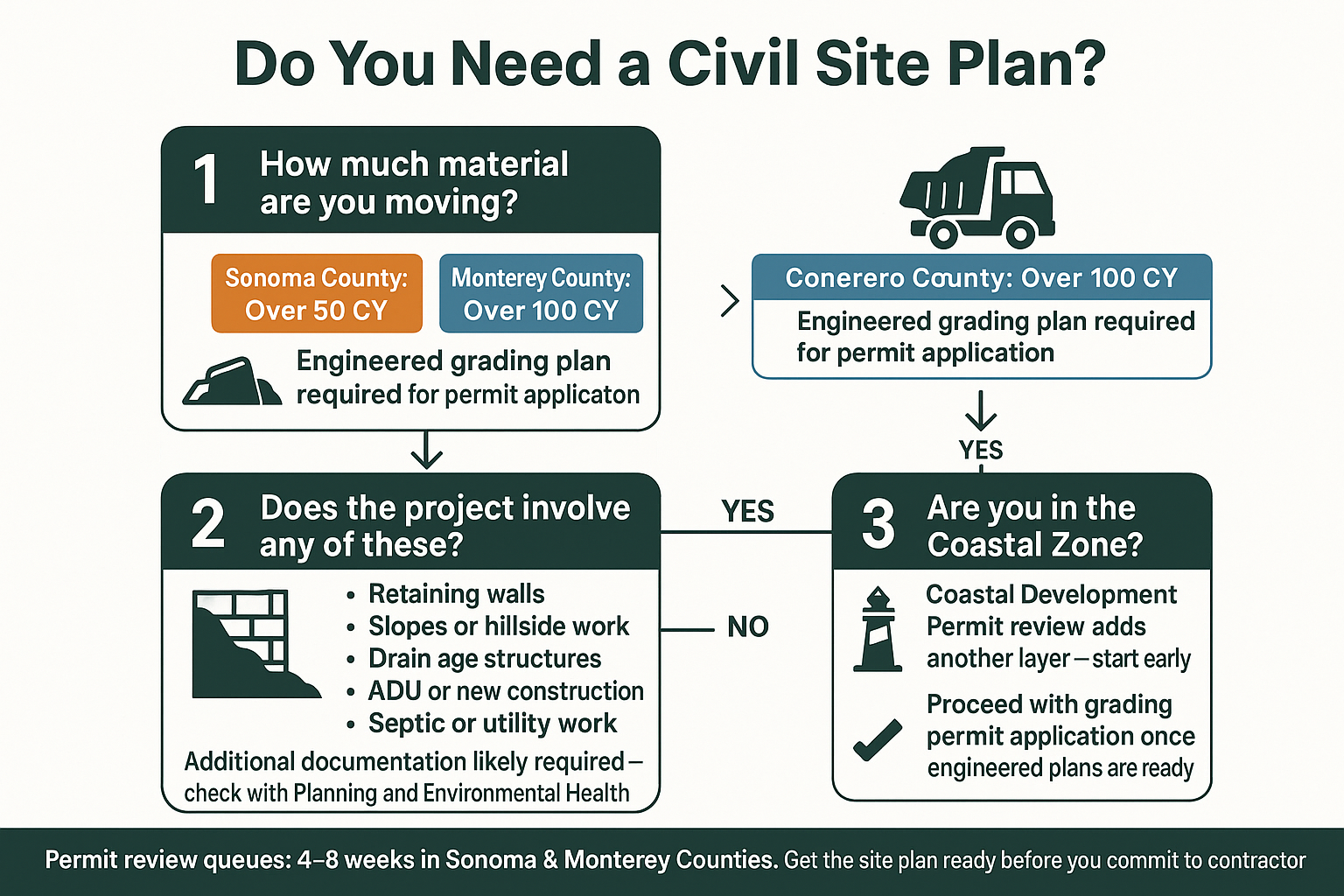
When Do You Need a Civil Site Plan? A Quick Decision Map
This decision map walks through the key questions that determine whether your project requires an engineered civil site plan before a grading permit application will be accepted.
Site Plan vs. Soils Report — These Are Not the Same Document
This is the part that causes the most confusion, and I want to be direct about it because conflating these two documents can send you to the wrong professional at the wrong time.
A civil engineering site plan is a design document. It shows what the property will look like after the work is done.
A soils report — more accurately called a geotechnical report — is an investigation document. A geotechnical engineer drills or digs test borings, analyzes the soil composition and bearing capacity, and tells you whether the ground can support what you’re planning to build. It answers questions like: Will this foundation settle? Can this slope be cut safely? What compaction standards apply to this fill?
A homeowner reached out to us recently in a situation that made this distinction very clear. They’d had retaining walls and terracing done years ago — work that was never permitted — and the city had just notified them that they needed to retroactively legalize the grading. The city told them they might need a soils engineer because the work was on a slope. That’s a geotechnical report requirement, not a site plan requirement. They’re separate professionals, separate fees, and separate timelines.
For most flat or gently sloped sites with straightforward grading, a soils report isn’t required. But on hillside projects — the kind we see regularly in the Santa Cruz Mountains, in Carmel, and in the hillside neighborhoods around Glen Ellen — both documents may be required before the permit counter will accept your application.
If your site has any of these conditions, budget for both:
- Slopes over 15%
- Expansive or unstable soils (Sonoma County’s clay soils are a common trigger)
- Cut depths greater than 5 feet
- Proximity to a creek, drainage channel, or mapped landslide zone
- Existing unpermitted grading or structures on the parcel
For hillside erosion context that’s directly relevant to why these reports matter, take a look at what happens to a hillside if erosion goes unfixed for one winter — it gives a clear picture of what poor grading design allows to happen over time.
Grading Permit Requirements at a Glance: Sonoma vs. Monterey County
These are the core thresholds and documentation requirements as we understand them for standard residential grading projects. Always confirm current requirements directly with the county building department before submitting.
| Requirement | Sonoma County | Monterey County |
|---|---|---|
| Grading permit threshold | Over 50 cubic yards | Over 100 cubic yards |
| Engineered grading plan required | Yes, at or above threshold | Yes, at or above threshold |
| Soils / geotechnical report | Required on slopes and unstable soils | Required on slopes and certain project types |
| Separate Planning Dept. review | Possible depending on project scope | Yes — often required for ADUs, septic, coastal projects |
| Coastal zone added requirements | Applicable in coastal areas | Coastal Development Permit may be required |
| Typical permit review time | 4–8 weeks after accepted application | 4–8 weeks after accepted application |
Why the Timing of This Decision Matters More Than Most People Expect
Here’s what I’ve watched happen on projects that started without resolving the site plan question early: the property owner locks in a contractor, sets a start date, then finds out the grading permit application can’t be submitted yet because the civil engineer hasn’t finished the plans. The civil engineer needs two to four weeks to complete the drawings. Then the county needs four to eight weeks to review the application. That’s potentially twelve weeks of delay — after the contractor is already on the schedule.
In both Sonoma and Monterey counties, the permit review queue does not start until a complete application is accepted. An incomplete submittal gets rejected and sent back, which restarts that clock. I’ve seen this add a full month to a project that could have broken ground in spring, pushing it into the rainy season.
The practical move is to answer the site plan question before you call contractors for bids. Get clarity on whether your project scope crosses the permit threshold, find out which departments need to review, and give a civil engineer enough lead time to prepare the drawings while you’re still in the planning phase.
For a project like a full site prep and foundation build in Carmel — where you’re coordinating grading, drainage, a retaining wall, and foundation excavation across multiple trades — the grading and drainage design decisions made on that site plan directly affect how stormwater is managed once construction is complete. Getting those decisions made early, on paper, with a licensed engineer’s stamp — that’s what keeps a multi-phase project from unraveling between scopes.
If you’re planning an ADU and need to locate existing underground utilities as part of that process, that coordination also needs to happen before grading begins — the same way an ADU sewer connection needs to be understood before the site plan is finalized, not after.
Frequently Asked Questions About Civil Site Plans and Grading Permits
Who prepares a civil engineering site plan — do I hire them separately from my excavation contractor?
Yes, typically. A licensed civil engineer prepares and stamps the site plan. Your excavation contractor builds to it. Some larger contractors have relationships with civil engineers they work with regularly and can make introductions, but the engineer is a separate hire. In Monterey County, depending on project scope, you may also need a geotechnical engineer for the soils report — again, a separate professional.
What if my project is under the 50 or 100 cubic yard threshold — do I still need any documentation?
Possibly. Below the threshold, you may not need a full engineered grading plan, but some counties still require a basic site plan showing existing and proposed grades, drainage direction, and erosion control measures. If the project involves a new structure, an ADU, or a septic system, the Planning or Environmental Health departments may have their own documentation requirements regardless of how much earth moves. Always confirm with the building department before assuming no plan is needed.
How much does a civil engineering site plan cost?
It varies quite a bit based on site complexity, slope, project scope, and how much survey work the engineer needs to do first. Many Sonoma and Monterey County homeowners working on residential grading projects find that civil engineering fees for a grading plan can range somewhere in the low thousands to well above that for complex hillside or multi-phase projects. For a specific project, the civil engineer you hire will be your best source for a real number.
Can I submit a grading permit application while the civil engineer is still finishing the plan?
No. The county won’t accept an incomplete application. The engineered plans need to be finished, stamped, and included with the submission package. Submitting early without them just results in a rejection and a reset of the timeline — which is exactly the delay you’re trying to avoid.
If my property already has unpermitted grading, do I need a site plan to legalize it?
In most cases, yes. Retroactive permit legalization typically requires the same documentation as a new permit — which means a licensed engineer needs to assess what was built, prepare drawings showing the existing conditions, and determine whether the work meets current standards. If the work involves slopes or retaining walls, a geotechnical review may also be required. This is more involved than a standard grading permit process, and it’s worth calling the county building department directly to understand exactly what they’ll require for your specific situation.
How early in my project timeline should I be thinking about the site plan?
Before you call excavation contractors for bids — that’s the honest answer. The site plan drives the scope, and the scope drives the bids. If contractors are quoting off a concept rather than a finalized plan, the numbers can shift significantly once the actual grades and drainage design are locked in. Getting the civil engineer engaged while you’re still in early planning is the move that keeps everything downstream on schedule.
Have a Grading Project in Monterey or Sonoma County?
If you’re planning a build, an ADU, or any grading work in Monterey County, Sonoma County, or the broader Central Coast and you’re not sure where the permit process starts, DW Excavation can help you work through the scope and point you toward the right next steps. Call us at 707-601-9091 or reach out through the contact page at dw-excavation.com to talk through your project.