
Direct Answer: Replacing a septic system in Monterey County requires permits from Environmental Health under the county’s LAMP framework — not just the building department. Site conditions, soil type, and setbacks all shape the scope before any excavation starts.
When a homeowner calls about replacing a septic system in Monterey County, the first question is almost never about the tank itself — it’s ‘who do I even call about the permit?’ That confusion is completely understandable, because the permit process here is more layered than most people expect, and it doesn’t run through the same channel as a typical building permit.
Monterey County operates under its own Local Agency Management Program (LAMP) for onsite wastewater treatment systems. That framework, approved by the Central Coast Regional Water Quality Control Board, sets its own site evaluation requirements, design standards, and qualified professional standards that go beyond California’s baseline rules. What that means practically is that Monterey County Environmental Health is the agency driving the process — not the general building department.
I’ve seen projects get delayed by weeks simply because a property owner didn’t know which agency owned which approval. This article breaks down what the permit process actually looks like on the ground, what the excavation side involves, and why summer is the smartest time to get started.
Two Permit Tracks Running at the Same Time
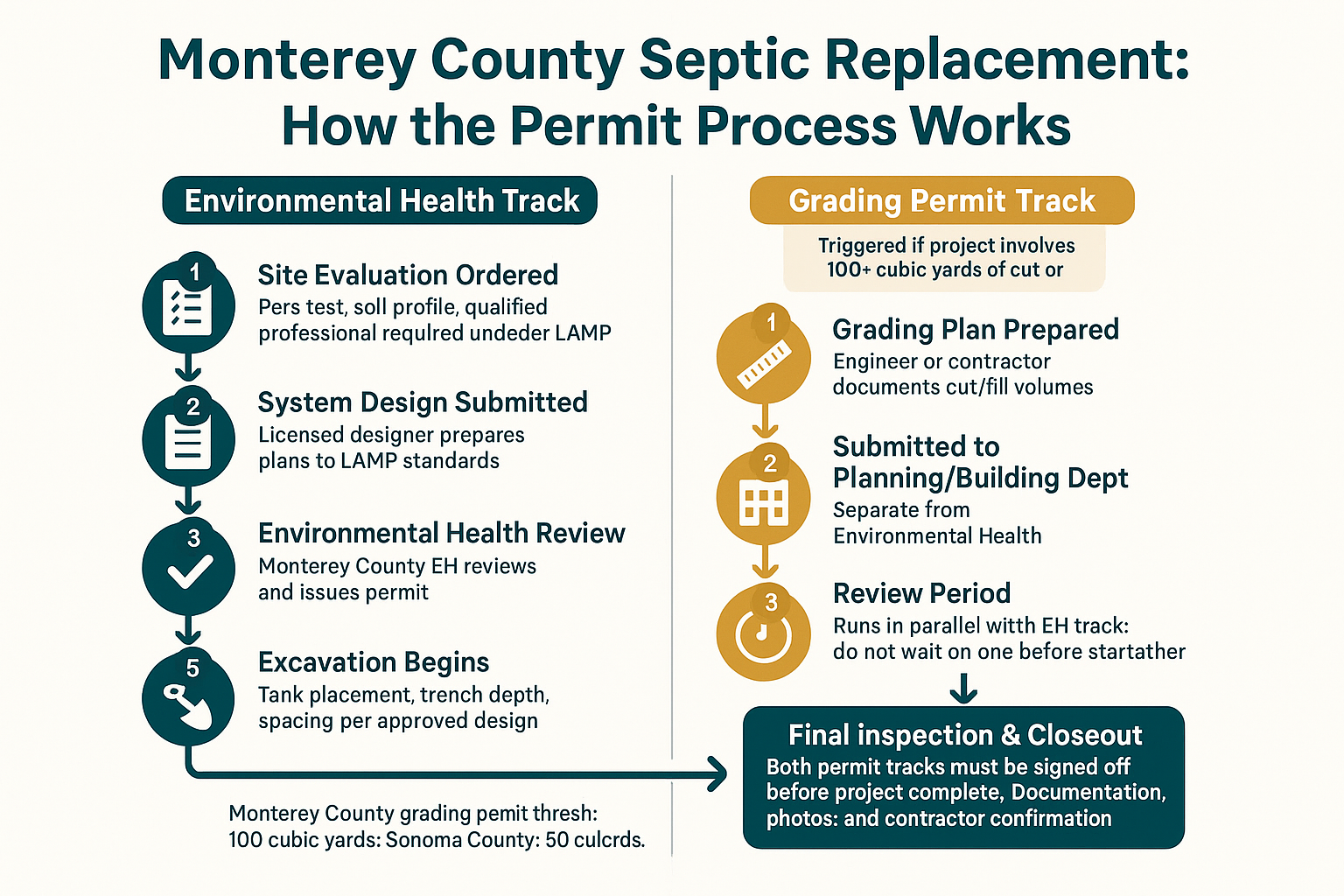
One thing that trips people up early: in Monterey County, a septic replacement can trigger two separate permit tracks at the same time, and they don’t always move together.
The first track is through Monterey County Environmental Health, which governs the onsite wastewater system itself under LAMP. This is where your system design gets reviewed, your site evaluation gets submitted, and your qualified professional documentation gets approved.
The second track is the grading permit side, which kicks in if your project involves significant earth movement. Monterey County’s threshold is 100 cubic yards of cut or fill before a grading permit is required — higher than Sonoma County’s 50-cubic-yard threshold, but still reachable on a full leach field replacement, especially on hillside or coastal lots.
These two tracks can run in parallel, but you need to understand which agency owns which approval before scheduling any excavation work. I’ve seen projects stall because a contractor showed up ready to dig while the Environmental Health permit was still pending. Getting clear on the sequencing upfront saves real time — and real money.
The Sonoma and Monterey Storm Water System Solutions page covers some of the drainage-side permit considerations that can also come into play on properties with existing drainage infrastructure.
What the Excavation Side Actually Involves
The permit process tells you what’s approved. The site conditions tell you what the job actually is.
When someone calls asking for a septic replacement estimate, we schedule a site visit before we quote anything — and that’s not a sales tactic, it’s the only honest way to approach it. I can’t tell you what the excavation scope looks like without standing on the property. The variables that drive scope and cost include:
- Perc test results — leach field trench depth and spacing are determined by how fast the soil drains, and that varies significantly across Monterey County
- Soil type — sandy coastal soils near Marina and Seaside behave very differently from the clay-heavy lowland soils in parts of the Salinas Valley
- Tank setbacks — the replacement tank location must account for setbacks from property lines, water features, and structures, which can be tight on coastal or hillside lots
- Equipment access — on narrow coastal lots or steep parcels, getting excavation equipment in and out safely is its own planning problem
A recent inquiry from a homeowner with a small two-bedroom property illustrated exactly this — the caller wanted a phone estimate, and we immediately scheduled a site visit because the scope genuinely couldn’t be quoted without seeing what we were working with. That’s the honest answer almost every time.
For context on what soil conditions do to underground work in this county, What Soil Conditions Make Foundation Work Harder in Monterey County? covers a lot of the same terrain variability that affects septic excavation.

The Monterey County Septic Replacement Permit Flow
This shows the typical sequence from initial planning through final inspection — two tracks running in parallel with key decision points along the way.
When You’re Decommissioning Instead of Replacing
A situation I want to specifically flag because it confuses a lot of property owners: what happens when you’re not replacing the septic system at all — you’re abandoning it because the property connected to city sewer?
This is a real scenario I’ve seen create paperwork problems that surface years later, often during a property sale. A homeowner recently contacted us after they had already hooked up to city sewer and had their encroachment permit signed off — but they didn’t realize a separate demolition permit was required for the septic tank abandonment itself.
The county requires documentation of how the tank was decommissioned. That typically means:
- Photos of the decommissioning process — the tank being cut open, holes punched in the bottom, the fill and compaction
- Contractor confirmation in writing that the work was done to county standards
- A formal inspection closeout before the permit is cleared
Demolishing a tank without the right permit sequence doesn’t just create a current problem — it creates a future one. If the documentation isn’t on file with the county, a title search or property disclosure during a sale can surface the gap, and resolving it after the fact is significantly more complicated than doing it right the first time.
If you’re already in this situation, the first call is to Monterey County Environmental Health to understand exactly what documentation they need to close out the inspection. The answer varies by circumstance.
Monterey County Septic Permit Quick Reference
This is a general reference for the two main permit tracks involved in septic system work in Monterey County. Specific requirements vary by project — Environmental Health is the authoritative source.
| Permit Type | Governing Agency | When It Applies |
|---|---|---|
| Onsite Wastewater (LAMP) | Monterey County Environmental Health | Any septic system installation, replacement, or repair |
| Septic Tank Demolition | Monterey County Environmental Health | Abandoning a tank when connecting to city sewer |
| Grading Permit | Monterey County Planning / Building | Projects involving 100+ cubic yards of cut or fill |
| Encroachment Permit | City or County Public Works | Work affecting public ROW — sewer lateral connections to street |
Why Summer Is the Right Time to Start This Process
There’s a practical reason I recommend getting the permit process started in June or July if you’re planning a septic replacement in Monterey County — and it comes down to soil conditions.
Leach field installation in saturated or high-water-table conditions complicates everything. In coastal areas near Marina and Seaside, and in the Salinas Valley lowlands, winter and spring soil moisture can affect how a leach field is sized and how well it performs over time. Working in water-laden soil also makes excavation harder, more expensive, and harder to inspect accurately.
Getting the permit process started in early summer means:
- Perc tests run in dry, stable conditions — which typically yields more accurate and favorable results
- Excavation can proceed without fighting saturated ground
- Inspection scheduling is easier — Environmental Health’s schedule tends to be less compressed in summer than in the post-storm season
- You avoid the rain window — Monterey County’s coastal rainfall typically picks back up in October; finishing excavation before then eliminates weather risk
The November 2024 atmospheric river events dropped significant rainfall across the Central Coast region in a short window. Projects that were mid-permit when that hit faced real delays. Getting a full permit cycle ahead of the rain season is worth the planning effort.
For more on how water moves through Monterey County soil and what it does to site work, Why Does Water Pool in the Same Spot Every Time It Rains? is a useful read.
What It Costs and Why the Range Is Wide
I won’t give you a flat number here, because the honest answer is that septic replacement costs in Monterey County vary significantly based on real project variables — and quoting before a site visit does everyone a disservice.
That said, the factors that most directly drive cost on the excavation side include:
- Leach field size — determined by perc results, soil type, and the number of bedrooms the system will serve
- Depth and access — deeper trenches and difficult equipment access both add time and cost
- Soil conditions — clay or rocky substrate requires different equipment and more labor than sandy coastal soil
- Tank size and material — concrete tanks are heavier and require different handling than alternative materials
- Permit fees — Monterey County Environmental Health permit fees vary by system type and project scope; budget for them as a real line item
Many Monterey County homeowners find that a full septic replacement — including design, permitting, excavation, tank, and leach field — runs somewhere in the range of what you’d expect for a significant site improvement project, not a simple repair. But that range is genuinely wide depending on the conditions above.
The only way to give you an accurate number is to see the site. That’s how we do it, and it’s the only approach I trust.
If you’re also dealing with underground pipe concerns beyond the septic system itself, Signs Your Underground Pipe Is Failing Before It Becomes a Crisis covers the early warning signs worth knowing.
Frequently Asked Questions About Septic Replacement in Monterey County
Do I need to hire a licensed engineer to replace my septic system in Monterey County?
Under Monterey County’s LAMP framework, the system design must be prepared by a qualified professional — typically a registered civil engineer or licensed environmental health specialist. The specific credential requirement depends on the system type and site complexity. Monterey County Environmental Health can confirm exactly what’s required for your parcel before you hire anyone.
How long does the Monterey County septic permit process typically take?
It varies. From initial site evaluation through permit issuance, three to six months is a realistic range for a straightforward replacement on a standard residential lot. More complex sites, or projects that require additional engineering review, can take longer. Starting in early summer gives you the best chance of completing excavation in dry conditions before the fall rain season.
Can I get a permit to abandon my septic tank if I already connected to city sewer?
Yes, but the process is a separate permit track from the encroachment permit you got for the sewer connection. Monterey County Environmental Health requires documentation that the tank was properly decommissioned — photos, contractor confirmation, and a final inspection closeout. If the tank was already demolished without a permit, the county will tell you what documentation they need to retroactively close out the record. Don’t skip this step — it can create real problems during a future property sale.
Does my septic replacement project require a grading permit in addition to the Environmental Health permit?
It depends on volume. Monterey County’s grading permit threshold is 100 cubic yards of cut or fill. A leach field replacement on a flat residential lot may fall under that threshold. A hillside installation, large system, or project involving significant site regrading may exceed it. The two permit tracks — Environmental Health and grading — can run in parallel, so you don’t have to wait for one to start the other.
Why can’t I get an estimate over the phone?
Because the scope genuinely depends on what the site looks like. Soil type, trench depth, equipment access, field sizing based on perc results, setback constraints — these all determine how much work is involved, and none of them are visible from an address. A site visit is the only honest way to give you an accurate number.
Is summer really better for septic excavation in Monterey County?
For most of the county, yes. High water table conditions in coastal areas near Marina and Seaside, and in the Salinas Valley lowlands, can complicate leach field installation in winter and spring. Saturated soil affects perc test results, trench stability, and field performance. Dry summer conditions give you more predictable soil behavior and easier excavation.
Ready to Get Clear on Your Monterey County Septic Project?
If you’re planning a septic replacement — or trying to sort out a decommissioning permit — we’re familiar with the Monterey County Environmental Health process and the site conditions across the county. The best starting point is a site visit, because no two projects look the same from the ground up. Reach out to DW Excavation at 707-601-9091 or through the contact page at dw-excavation.com to get the conversation started.