
Direct Answer: Before a foundation is poured, an excavation contractor reads the soil, confirms bearing depth, manages groundwater, and shapes the subgrade — all before a single form board goes in.
Most people picture foundation work as concrete trucks and form boards. But by the time any of that happens, the real work has already been done — underground, out of sight, and weeks earlier.
In Santa Rosa and across Sonoma County, the ground underneath a future foundation tells a story before the first bucket of soil moves. Expansive clay, old fill from prior grading, buried organic material, or a seasonal water table that shifts with the first November rain — all of it shapes what the excavation actually looks like. A foundation contractor who doesn’t read that story before digging is guessing.
This article walks through what happens below grade from the first machine pass to the point where a foundation is ready to receive concrete. If you’re planning a new build, an ADU, or any structure with a poured foundation in Sonoma or Monterey County, this is what you’re actually paying for — and why it’s worth understanding.
Why Soil Conditions Change Everything for a Foundation Contractor in Santa Rosa
Sonoma County’s valley floor — through Windsor, Rohnert Park, Healdsburg, and much of Santa Rosa — sits on expansive clay that behaves very differently depending on moisture. In August, that clay is hard and stable. After the first significant rain, it swells. After a dry summer followed by a wet winter, it does both in sequence.
That cycle matters enormously for foundation excavation. A trench cut in late summer may look perfectly clean and square. That same trench left open for three or four weeks into the rainy season can slough at the walls, heave at the bottom, and shift the dimensions that your engineer specified. We saw this firsthand during and after the November 2024 atmospheric river, when over 12 inches of rain fell on Santa Rosa over three days. Sites with active foundation excavations that hadn’t been properly staged for drainage saw significant erosion and sidewall failure — not because the digging was wrong, but because no one planned for what the ground would do when conditions changed.
This is why soil assessment happens before excavation dimensions get confirmed — not after. Key questions the excavation contractor needs answered before breaking ground:
- How deep does bearing soil begin, and is there old fill from prior grading that needs to be removed?
- Is there a seasonal water table, and at what depth does it appear in wet months?
- How far does the expansive clay layer extend, and does the foundation design account for it?
- Are there signs of prior grading or disturbance that would affect compaction?
For reference on how soil conditions drive foundation decisions differently along the coast, what soil conditions make foundation work harder in Monterey County covers the variables that show up specifically in coastal and valley terrain.
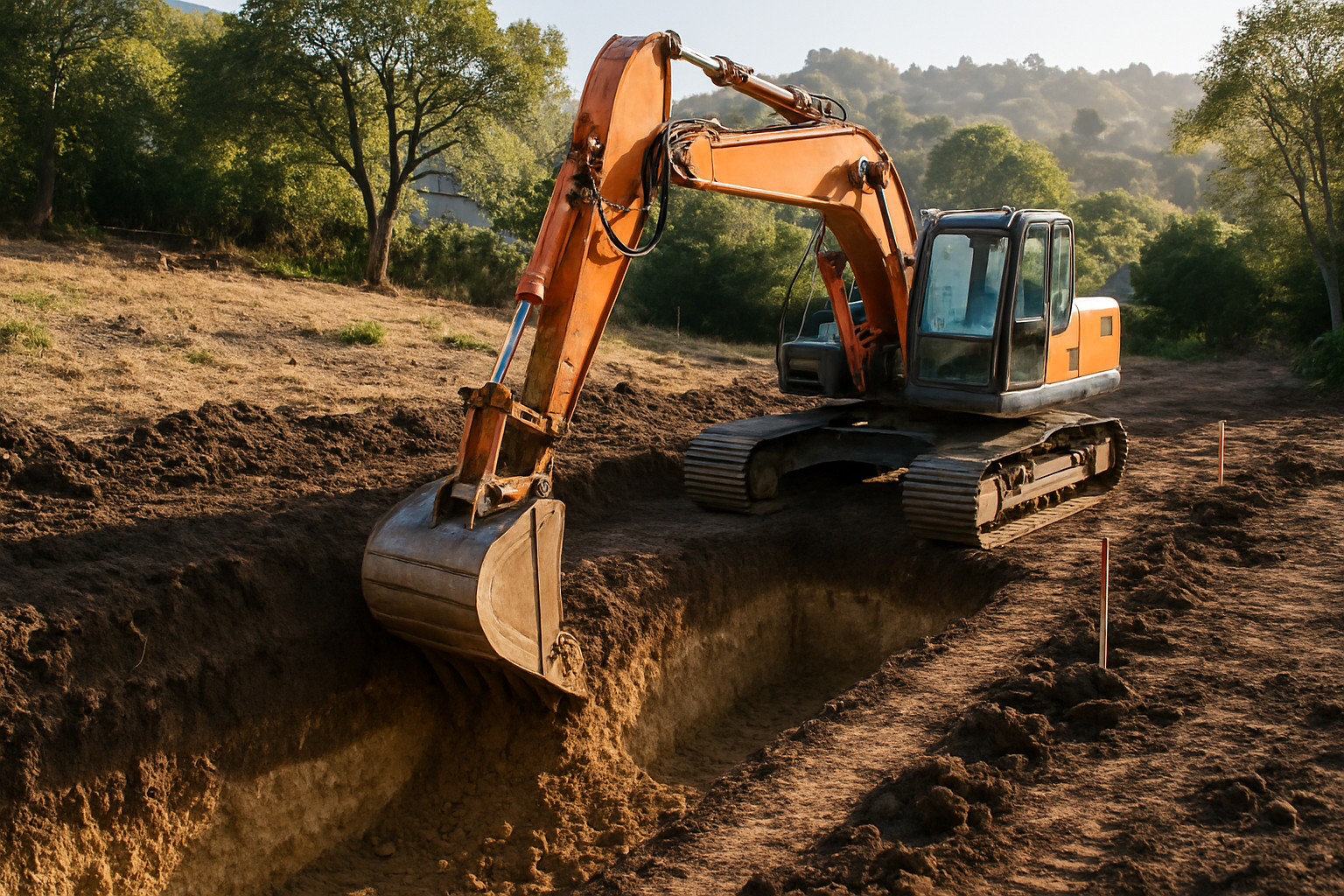
What the Excavation Phase Actually Involves — Step by Step
Foundation excavation isn’t a single task. It’s a sequence of decisions and physical work that happens in a specific order, and each step depends on what the previous one revealed.
Step 1: Site clearing and stripping
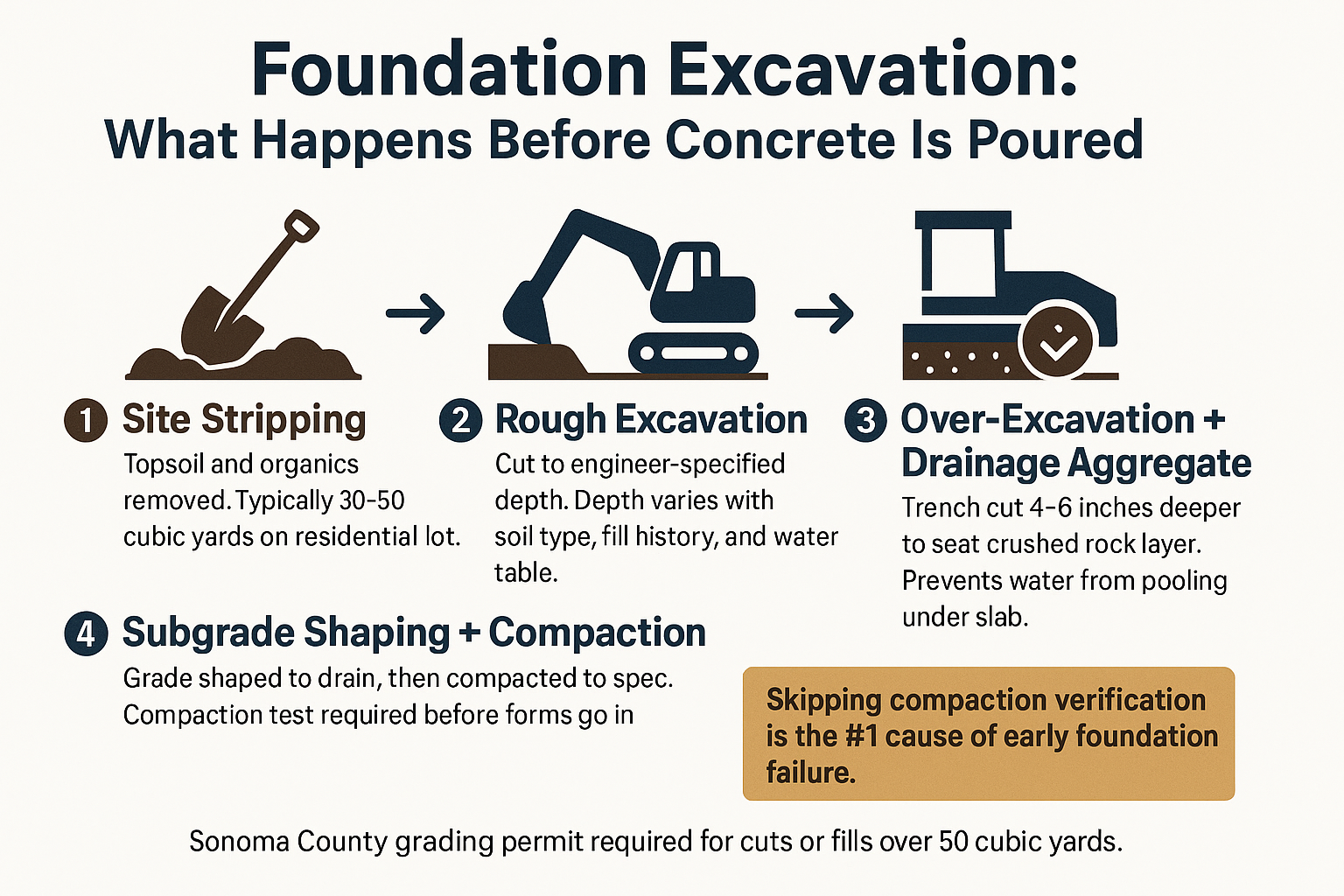
Before any depth work starts, topsoil and organic material get stripped from the footprint. That material can’t stay under a foundation — it compresses, decomposes, and moves. On most Sonoma County residential lots, stripping alone can move 30 to 50 cubic yards of material before a single trench gets cut.
Step 2: Rough excavation to design depth
The excavator cuts to the depth specified by the structural engineer or soils report. On flat valley lots, this may be a straightforward cut. On hillside lots or sites with variable fill, the depth can shift mid-dig as the operator encounters unexpected conditions. A new build on the Monterey Peninsula — a coastal bluff property near Pebble Beach submitted by a homeowner to our team — required pier drilling to bedrock at depths ranging from 10 to 18 feet across roughly 50 individual pier locations, alongside conventional foundation grading. That’s not unusual for hillside coastal terrain, but it’s also not something a rented excavator and a general laborer can execute correctly.
Step 3: Over-excavation for drainage aggregate
Most foundation systems require a layer of crushed aggregate — typically 4 to 6 inches — below the slab or footings. That means the trench gets cut deeper than the finished foundation grade to make room for it. This layer is what keeps water from pooling directly under your foundation, and getting it wrong at this stage means fixing it later at significant cost.
Step 4: Subgrade shaping and compaction
Once the excavation reaches the right depth and profile, the subgrade has to be shaped to drain and then compacted to the density the engineer specifies. This usually gets verified with a compaction test before forms go in. Skipping this step — or doing it without verification — is one of the most common reasons foundations develop problems before a home is even finished. For more detail on the real reason foundations fail before a home is finished, that pattern of skipped compaction steps comes up repeatedly in the field.
The Foundation Excavation Sequence: What Happens Below Grade
This visual walks through the four stages of foundation excavation in order — from site clearing to compaction verification — and shows what each phase involves and why it matters.
Permits and the Cost of Getting Them Wrong
Most foundation excavations in Sonoma County trigger a grading permit requirement before the first machine fires up. Sonoma County requires a grading permit for any cut or fill exceeding 50 cubic yards — a threshold that even a modest single-story home will almost certainly cross during site prep and foundation work.
That permit isn’t just paperwork. It requires:
- A grading plan prepared or reviewed by a licensed engineer
- Soils data sufficient to demonstrate bearing capacity and drainage design
- A description of erosion control measures during active grading
- County review and approval before grading begins
The permit process slows some projects down, but skipping it or submitting an incomplete package slows projects down far more. A stop-work order mid-excavation — when the trench is open, equipment is on-site, and weather is closing in — costs significantly more to resolve than the permit process itself would have. We’ve seen it happen.
Monterey County’s threshold is 100 cubic yards, which gives coastal projects slightly more flexibility, but the same principle applies: a correct, complete submission keeps the project moving. An incorrect one stops it.
For property owners dealing with grading that happened years ago without permits — a situation we hear about regularly — the process to legalize unpermitted grading typically involves a soils engineer, as-built plans, and county review. One homeowner contacted us after receiving a notice requiring them to legalize retaining walls and associated grading done nearly a decade earlier. The city flagged it and required a soils engineer review because the work was on a slope. That process is more involved than pulling a permit before the work, which is exactly why doing it correctly the first time matters.
Sonoma vs. Monterey County: Foundation Excavation Permit Basics
Permit thresholds and requirements differ between Sonoma and Monterey counties. Here’s a side-by-side reference for property owners planning foundation work in either area.
| Requirement | Sonoma County | Monterey County |
|---|---|---|
| Grading permit threshold | Cuts or fills over 50 cubic yards | Cuts or fills over 100 cubic yards |
| Soils report often required? | Yes — especially on slopes and clay-heavy lots | Yes — particularly coastal and hillside sites |
| Erosion control plan required? | Yes, submitted with grading permit application | Yes, especially on disturbed sites near drainage features |
| Who reviews the permit? | Sonoma County Permit and Resource Management Department (PRMD) | Monterey County Resource Management Agency (RMA) |
| Stop-work risk if skipped? | High — active grading without permit can trigger immediate stop-work order | High — same enforcement risk applies |
Why Timing the Excavation Matters as Much as Doing It Right
There’s a real window for foundation excavation in Sonoma County — roughly late spring through early October — when clay soils are stable enough to hold trench walls cleanly and the risk of rain interrupting an open site is lowest.
That doesn’t mean foundation work can’t happen in winter. It means the site management has to account for what will happen when rain arrives. Drainage staging, erosion controls, and sometimes temporary shoring become part of the scope in a way they wouldn’t be on a dry August start.
Projects that start excavation in September without accounting for the November rain window are the ones that end up with sloughed trenches and compaction failures that push the pour date out by weeks. The 5 signs your property isn’t ready for a major El Niño season article covers how disturbed soil behaves differently than undisturbed ground when storms arrive — which is directly relevant to any site with active foundation excavation.
And for sites where water management is already a concern before breaking ground, understanding why water pools in the same spot every time it rains is worth reading before finalizing a foundation drainage plan.
Frequently Asked Questions About Foundation Excavation
How long does foundation excavation take on a typical residential lot?
On a standard single-family lot in Santa Rosa or Windsor, rough excavation and subgrade prep typically take 2 to 5 days depending on lot size, soil conditions, and whether unexpected fill or water is encountered. Sites with hillside grading, pier drilling, or difficult clay layers run longer. Weather and permit timing affect the overall schedule more than the digging itself.
What’s the difference between a foundation contractor and a general excavation contractor?
In California, foundation excavation requires a licensed general engineering contractor — not a general laborer with a rented machine. The work involves reading soils, hitting specified depths and grades, staging drainage aggregate, and verifying compaction to engineer standards. A general engineering contractor license (like CA License #1060838) covers this scope. A standard contractor’s license does not.
Do I need a separate soils report for my foundation excavation, or does my architect handle that?
Your architect designs the foundation. But whether a soils report is required — and who orders it — depends on your county, your lot’s slope, and the soil type. In Sonoma County, most new builds on clay-heavy or sloped lots will require a geotechnical report as part of the grading permit package. Your excavation contractor and engineer should both weigh in before you assume your architect’s drawings are enough to submit.
What happens if the excavation reveals unexpected conditions — like buried fill or groundwater?
The excavation stops, and the project engineer gets involved. Buried fill that wasn’t shown on any prior survey has to be removed and replaced with compacted structural fill. Groundwater at an unexpected depth may require a drainage design change or dewatering before the trench can be properly prepped. These discoveries add cost and time, but they’re far better found during excavation than after the slab is poured.
Can foundation excavation happen during the rainy season in Sonoma County?
Yes, but the scope expands. Open trenches in active rain need erosion controls, and clay soils that slough or heave after saturation need to be re-evaluated for compaction before forms go in. Sites started in fall or winter need a drainage staging plan built into the excavation scope from day one — not added after the first storm hits.
What does ‘over-excavation’ mean, and why does it add to the cost?
Over-excavation means cutting the trench deeper than the finished foundation grade to make room for a drainage aggregate layer — usually 4 to 6 inches of crushed rock — beneath the footing or slab. It’s standard practice on well-built foundations, and it’s why your excavation bill reflects more cubic yardage than just the foundation footprint. Skipping it to save cost is one of the most common shortcuts that leads to foundation moisture problems later.
Planning a New Build or Foundation Project in Sonoma or Monterey County?
If you’re in the early stages of a new build, an ADU, or any project that involves foundation excavation in Santa Rosa, Windsor, Healdsburg, or the Monterey area, the excavation phase deserves the same attention as the structure going up. DW Excavation has been handling foundation site prep, grading permits, and below-grade work across Sonoma and Monterey counties since 2013 — including the hillside and clay-soil conditions that make this region different from anywhere else in California. Call 707-601-9091 or visit dw-excavation.com to request a free estimate and talk through what your site actually needs before anything gets dug.