
Direct Answer: One unchecked winter can strip feet of topsoil, undermine foundations, collapse drainage systems, and trigger slope failures that cost tens of thousands of dollars to fix.
Most homeowners look at a small wash on their hillside and think they have time to deal with it later. That decision gets expensive fast, especially along the Central Coast where Monterey County’s wet season isn’t a slow drizzle — it’s weeks of atmospheric rivers dumping rain onto steep, clay-mixed slopes that were already thirsty for trouble.
One winter is all it takes. A shallow rill turns into a gully. A gully undercuts a retaining wall. And before spring, what looked like a maintenance item is now a structural repair job. We’ve seen it happen after events like the November 2024 storms that dropped significant rainfall across the region in just a few days.
This article walks through exactly what happens to a hillside when erosion goes ignored through a single rainy season — and what it takes to put things right afterward.
Why Monterey County Hillsides Are Especially Vulnerable
Monterey County’s terrain isn’t forgiving. Hillside neighborhoods in areas like Corral de Tierra, the Carmel Valley corridor, and the slopes above Salinas sit on soils that shift between sandy loam near the coast and heavier clay mixes further inland. When those soils get saturated, they stop draining and start moving.
The county also sees concentrated rainfall patterns. Rather than steady rain spread across months, Monterey often gets its annual precipitation dumped in a handful of storm events. That kind of intensity overwhelms ground that isn’t properly graded or protected.
If you’ve ever had water pooling in the same low spot after every storm, a poorly graded hillside is usually part of the reason. The water has to go somewhere — and when it concentrates, it cuts.
Some of the specific factors that make Monterey slopes high-risk:
- Steep grades above 15% that accelerate surface water velocity
- Thin topsoil layers over compacted subsoil that reject infiltration
- Limited native vegetation on disturbed or recently cleared land
- Coastal wind that dries and loosens surface material between storms
- Undersized or blocked drainage channels that overflow during peak flow
The First Storm: What Starts Small and Moves Fast
When the first significant storm of the season hits a slope with unaddressed erosion, the damage sequence is pretty predictable. It doesn’t require a catastrophic event — a few inches of rain over two days is enough to start the process.
Here’s what typically happens in order:
- Surface water concentrates in low points, ruts, or existing channels instead of spreading evenly
- Rills form — those narrow channels that look minor but each one is a future gully
- Topsoil displacement begins, often moving 2–4 inches of material in a single event
- Vegetation roots get exposed, which accelerates soil loss around them
- Sediment deposits at the slope base, which can block drainage inlets or create new stormwater management problems
The first storm doesn’t destroy a hillside. But it sets up every storm after it to do more damage than it would have on an intact slope. That’s the part most people don’t account for — erosion isn’t linear. It accelerates.
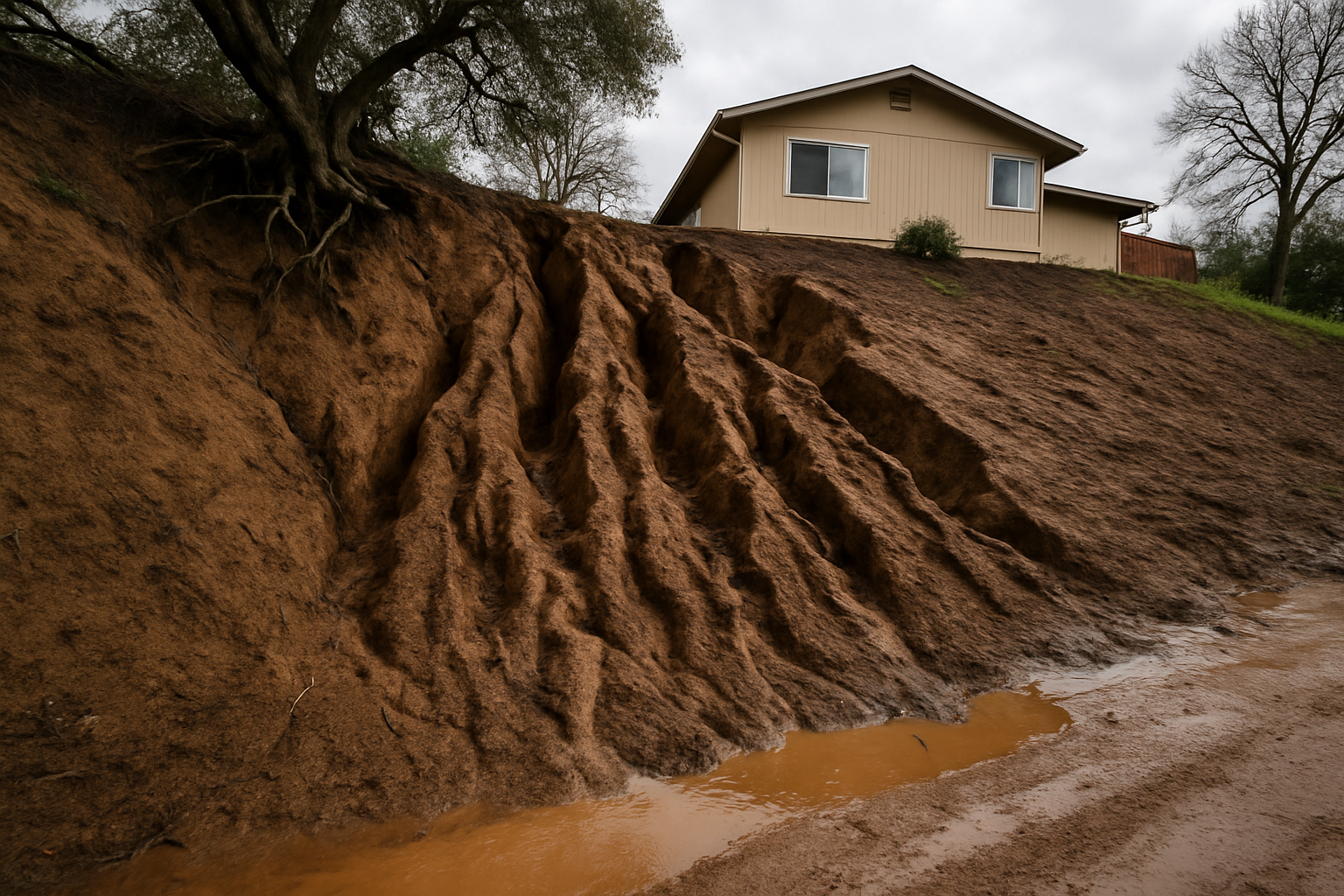
By Mid-Winter: Rills Become Gullies, Gullies Become Crises
After two or three significant rain events, those small rills are now gullies — channels that are 1 to 3 feet deep, sometimes more. At this stage, the slope isn’t losing surface material anymore. It’s losing structural mass.
Gullies reroute water in unpredictable ways. They cut around retaining walls instead of being managed by them. They direct flow toward foundations, driveways, and utility trenches. If your property has older underground infrastructure, this is when things get serious — saturated, shifting soil puts lateral pressure on pipes and lines that weren’t designed to handle it.
In Monterey County’s hillside communities, we’ve responded to situations where a single winter’s worth of unchecked gully erosion has:
- Undermined footing soil beneath an existing structure by 18 inches or more
- Collapsed a section of retaining wall that was functioning fine the prior spring
- Buried or crushed drainage pipes under redirected sediment loads
- Deposited several cubic yards of material into a neighbor’s lower lot — which creates its own legal complications
Once a gully reaches this scale, it can’t be fixed with a bag of seed and some straw waddles. It requires regrading, compaction, and often structural drainage work to address the root cause.
What a Full Winter Does to Slope Stability
By the end of a wet season, an unmanaged eroding hillside has often changed shape in ways that aren’t obvious from the surface. The most dangerous outcomes aren’t always visible — they’re underground.
Saturation causes soil to lose shear strength. That’s the property that keeps a slope standing rather than sliding. When clay-heavy soils in Monterey’s inland foothills absorb water past a certain point, they behave less like solid ground and more like a slow-moving paste.
Slope failures — ranging from shallow surface slumps to deeper rotational slides — become a real possibility. And when a slope fails, it doesn’t politely stop at a property line.
The cumulative damage list after one full winter of unchecked erosion often includes:
- 2–6 feet of grade change at the gully head through headcutting
- Foundation exposure or undermining on structures near the top or mid-slope
- Cracked or offset retaining walls from soil movement behind them
- Permanent loss of topsoil that can’t be recovered without importing material
- Permit-triggering remediation work — Monterey County requires grading permits for fills or cuts exceeding 100 cubic yards, and slope repairs often cross that threshold quickly
Understanding how proper grading is supposed to work helps explain why getting the slope geometry right during repair matters so much. A hill graded wrong will erode again.
The Erosion Progression: One Winter on an Unprotected Hillside
This infographic shows the typical progression of hillside erosion damage across a single rainy season, from first storm to end-of-season failure.
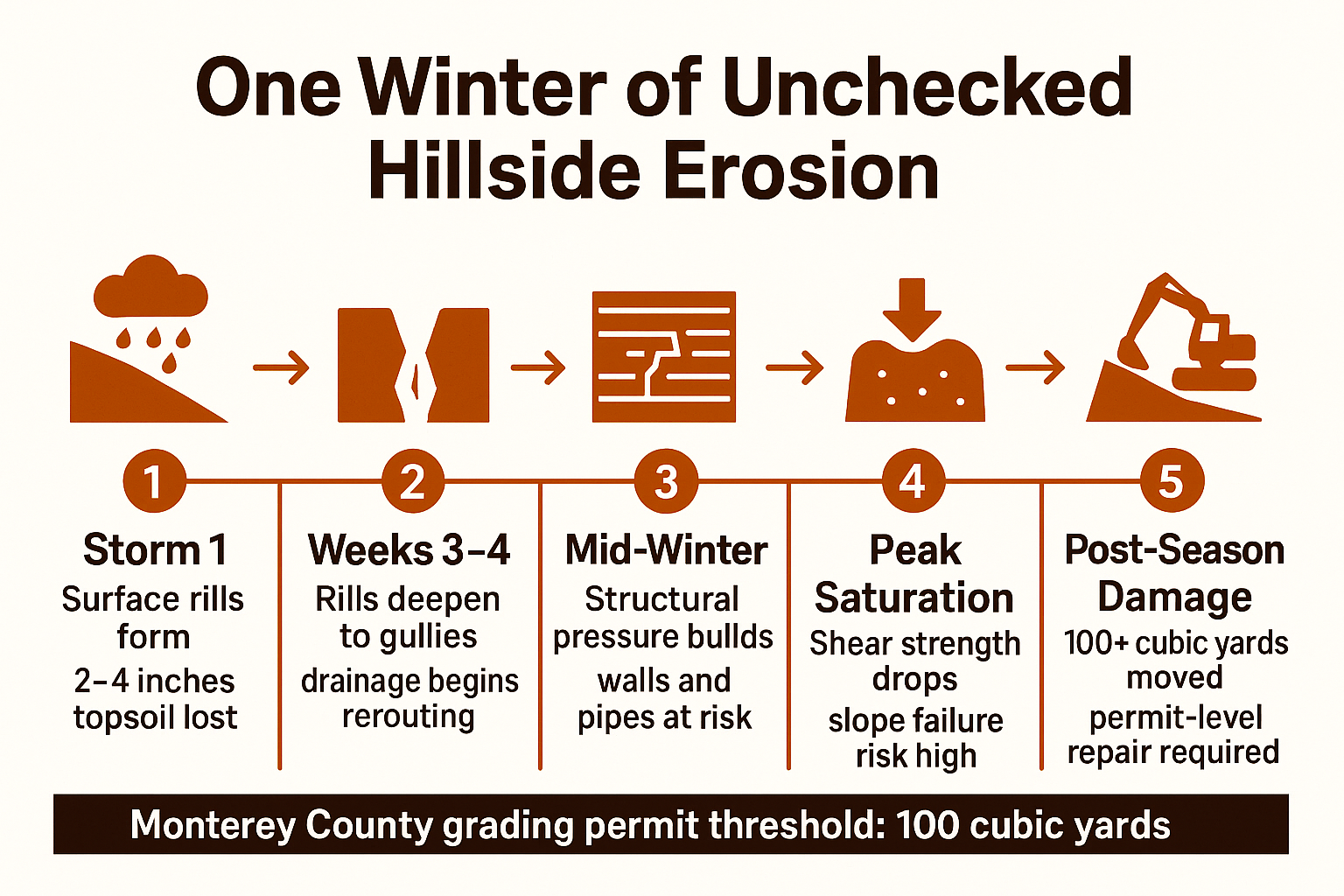
Erosion Damage Severity by Stage
Here’s a plain-language breakdown of what each erosion stage looks like on the ground, what’s at risk, and what kind of repair it typically demands.
| Stage | What You See | What’s Actually at Risk | Repair Complexity |
|---|---|---|---|
| Early — First Storm | Shallow rills, soft surface | Topsoil layer only | Low — erosion blankets, reseeding, minor regrading |
| Developing — 2–3 Storms | Gullies 6–18 inches deep | Drainage paths, vegetation root zone | Moderate — channel repair, inlet clearing, slope reshaping |
| Advanced — Mid-Winter | Gullies 1–3 feet deep, wall cracking | Retaining walls, buried utilities, foundations | High — structural regrading, drainage system repair |
| Critical — Peak Saturation | Slope slumping, visible movement | Foundation bearing soil, slope stability | Very High — geotechnical assessment, full slope remediation |
| Post-Season | Grade change, permanent topsoil loss | Entire site usability and adjacent properties | Permit-level — likely exceeds 100 cubic yard threshold in Monterey County |
What Repairs Actually Look Like After a Bad Winter
Spring site visits after a rough winter tell the story pretty clearly. The repair scope is almost always larger than what the homeowner expected — not because contractors are padding the job, but because erosion damage compounds in ways that aren’t visible until you’re working the soil.
A typical post-erosion repair on a Monterey County hillside might include:
- Gully filling and compaction — you can’t just push dirt back in; it needs to be placed in lifts and compacted to match the surrounding soil density
- Regrading the slope face to restore positive drainage away from structures
- Installing or repairing subsurface drainage — French drains, perforated pipe, or catch basins depending on what the slope needs
- Erosion control measures like fiber rolls, erosion blankets, or hydroseeding to stabilize the repaired surface through the next season
- Retaining wall inspection and repair where movement has occurred
If the repair volume crosses 100 cubic yards — which is easy to hit on a mid-size hillside — you’re into grading permit territory with Monterey County. That means submitting plans, getting approval, and potentially working with a licensed general engineering contractor who understands the local permit process.
For property owners in the Santa Rosa area dealing with similar post-storm damage, working with an experienced santa rosa erosion repair contractor who knows Sonoma County’s permit thresholds (cuts or fills over 50 cubic yards require a grading permit there) matters just as much.
How to Know If Your Hillside Is in the Early Warning Stage Right Now
Not every erosion problem looks dramatic. The early signs are easy to miss if you don’t know what you’re looking for — and the fall is exactly the right time to catch them before the first storms arrive.
Walk your slope and look for these indicators:
- Bare soil patches where vegetation has thinned or died back
- Small channels or grooves running downhill that weren’t there before
- Exposed roots on trees or shrubs near the slope face
- Soft or spongy ground that doesn’t drain well after moderate rain
- Sediment deposits at the base of the slope or near drainage inlets
- Cracks in retaining walls that have appeared or widened recently
- Settled or sunken areas above buried utility lines or drainage pipes
If you’re seeing two or more of these, the slope already has an erosion problem — it just hasn’t become a crisis yet. That window is worth acting in.
For a deeper look at what proactive erosion prevention involves, these methods to prevent soil erosion cover the practical options available before damage escalates.
And if you’re uncertain whether your current land clearing or vegetation management is part of the problem, this guide to land clearing services explains how site disturbance and erosion connect.
Frequently Asked Questions About Hillside Erosion in Monterey County
How much topsoil can one wet winter actually remove from a hillside?
On an unprotected slope in Monterey County, a single wet season can strip 2 to 6 inches of topsoil across a wide area — and much more than that in concentrated gully channels. Topsoil lost to erosion cannot simply be replaced by waiting; it has to be imported and stabilized.
Does Monterey County require a permit to repair erosion damage on my property?
Yes, if the repair involves grading cuts or fills that exceed 100 cubic yards, a grading permit is required by Monterey County. Post-erosion slope repairs often hit that threshold faster than homeowners expect, especially when gully filling and regrading are combined.
Can I fix hillside erosion myself with erosion control blankets and seed?
For very early-stage surface erosion, erosion blankets and reseeding can slow further loss — but they don’t fix the underlying grading or drainage problem. If gullies have formed or soil movement has started, surface treatments alone will fail by the next storm season.
How do I know if my retaining wall was damaged by erosion or just age?
Erosion-related retaining wall damage usually appears as cracking or outward bulging on the face of the wall, combined with soil loss or settlement behind it. Age-related deterioration tends to be more uniform. Either way, a wall that’s moved needs to be assessed before the next wet season — the soil behind it may already be compromised.
What time of year is best to address hillside erosion in Monterey County?
Late summer and early fall — before October — is the ideal window. The ground is workable, permits can be processed without weather pressure, and you have time to establish vegetation before winter rain arrives. Waiting until after the first storms typically means doing more expensive repair work instead of prevention.
Ready to Get Your Hillside Assessed Before Winter Hits?
If your Monterey County property has a slope that’s showing early signs of erosion — or if last winter already did damage you haven’t addressed — now is the right time to get eyes on it. DW Excavation works throughout Monterey County and Sonoma County on exactly these kinds of site problems, from pre-storm assessments to full post-season slope remediation. Call 707-601-9091 or visit dw-excavation.com to request a free estimate.