
Quick Answer
The best methods to prevent soil erosion depend on your slope, soil, drainage, and how much ground is exposed. On most properties, the right fix is a combination of grading, drainage control, surface protection, and vegetation. Temporary measures buy time. Permanent measures keep the site stable long term.
After a heavy winter rain in Sonoma County or Monterey County, erosion usually shows up fast. You see muddy runoff, fresh rills on a slope, gravel washed out of place, or sediment collecting where it shouldn't. Once that starts, the problem rarely fixes itself.
The good news is that there are reliable methods to prevent soil erosion if you match the method to the site. Some are simple and temporary. Others need excavation, engineering, or drainage work to hold up through repeated storms.
1. Erosion Control Blankets and Erosion Control Matting
Freshly graded soil is vulnerable right away. If you've cut a slope, prepped a pad, or exposed bare earth for an ADU foundation, one hard rain can start carving channels before plants have any chance to root.
Erosion control blankets work well in that gap. They hold soil in place, soften the impact of rain, and let water pass through instead of racing across the surface. On many hillside jobs, they're one of the first things worth installing after grading.
Where blankets work and where they don't
These products are most useful on exposed slopes, drainage swales, and disturbed ground that will be seeded or planted. They are not a cure for bad drainage or unstable grading. If water is concentrated and moving hard, a blanket alone won't stop washouts.
Practical rule: Install blankets as soon as grading is complete, not after the first storm exposes the weak spots.
A few details matter more than people think:
- Ground contact matters: If the blanket bridges over the soil instead of sitting tight to it, runoff gets underneath and lifts it.
- Edge overlap matters: Seams need proper overlap so water doesn't find the joint and peel the material back.
- Stapling matters: Loose anchoring is one of the most common failure points on windy or steep sites.
On new residential work, blankets are often paired with seed, mulch, or hydroseeding. If you're trying to connect erosion control with site drainage, integrating erosion control and water management solutions for sustainable landscaping is usually the right way to think about it.
2. Terracing and Bench Grading
A long, uninterrupted slope gives runoff time to build speed. Once water starts cutting a track, each storm tends to deepen it and carry more soil downhill.
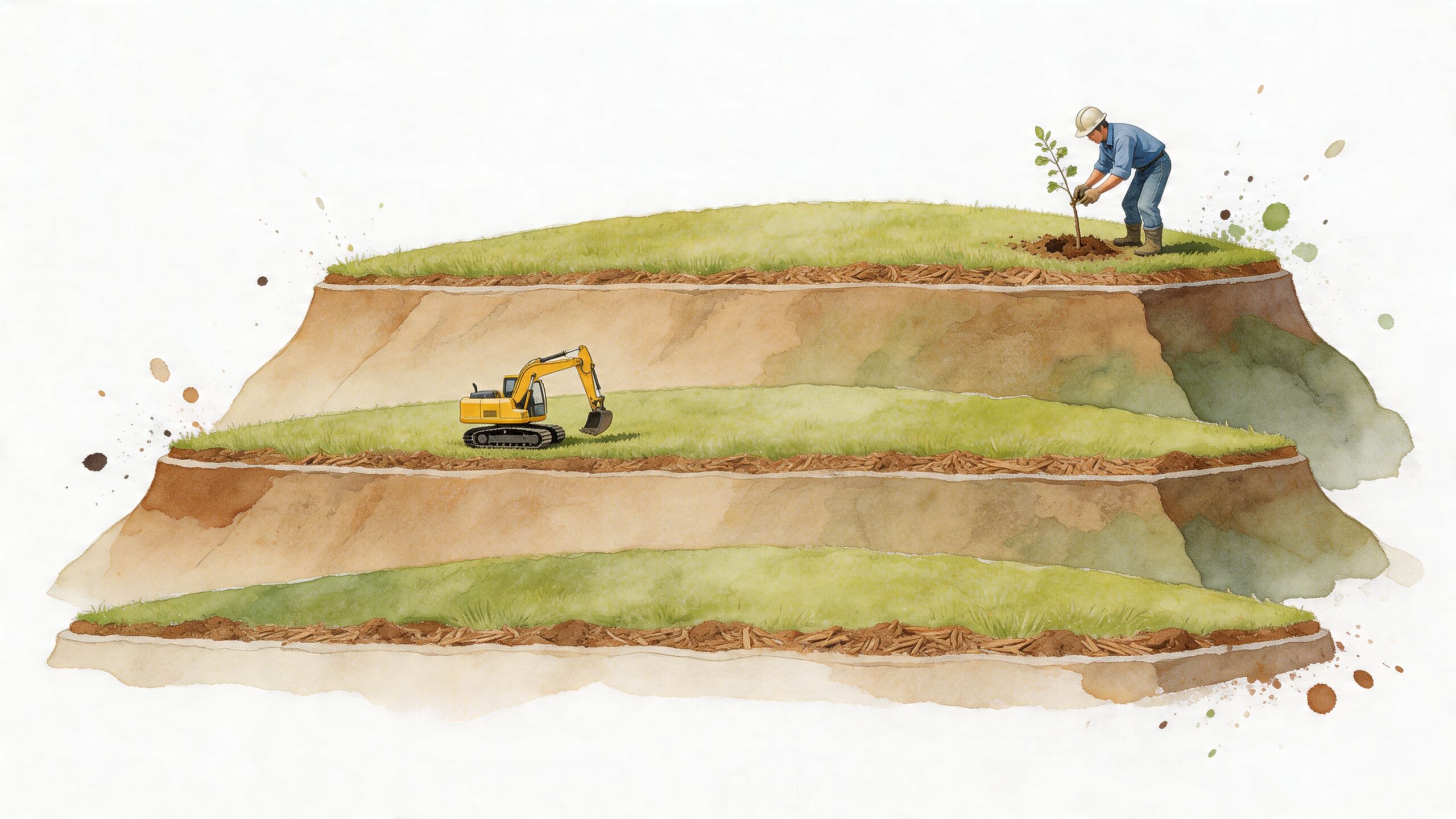
Terracing and bench grading change that geometry. The slope gets broken into shorter runs with flatter catch areas, which slows water, reduces sheet flow, and gives seed, mulch, or plantings a better chance to hold. On Central Coast hillside lots, this method often makes the difference between a slope you can maintain and one that keeps unraveling every rainy season.
When bench grading is worth doing
Bench grading makes sense where the slope is long enough that blankets or planting alone will struggle to keep up. I look at it for hillside home sites, large cut banks, orchard and rural access areas, and lots where the owner wants both erosion control and usable tiers for planting, paths, or maintenance access.
The trade-off is cost and precision. Cutting benches means moving more soil, managing spoils, and setting grades carefully so water does not pond against a house pad or spill over one weak point. If the slope ties into a footing, driveway, or hardscape, the grading plan has to work with the structure. Homeowners dealing with that kind of site condition should review why Monterey homeowners need weather-ready foundations before changing drainage patterns uphill of the home.
Good benches also need an outlet. Water still has to go somewhere, and sending it over the edge of a terrace without a controlled path creates a new erosion problem below. That is why bench grading is usually paired with swales, subsurface drainage, planting, or a retaining element at selected points, not just cut-and-walk-away grading.
Some owners ask whether a small retaining feature can be worked into a terraced layout. It can, but material choice matters, and timber systems have limits on lifespan and structural use. If you're comparing options, building a retaining wall with railroad ties gives a basic look at one approach, though steep California slopes often need a stronger and better-drained solution than a simple timber wall.
Bench grading is rarely a casual DIY project. On steep or complex lots, one wrong cut can redirect runoff toward the house, undercut the toe of the slope, or create permit issues. If the property has a sharp grade break, drainage concentration, or signs of past movement, bring in an excavation contractor or engineer before the first bucket of dirt gets moved.
On sloped lots, grading tips for sloped lots in Santa Cruz gives a useful picture of how these sites need to be approached.
3. Retaining Walls and Slope Reinforcement
A slope can look stable all summer, then a winter storm loads it with water and the hillside starts moving. That is when a retaining wall stops being a decorative element and becomes a structural job.
Retaining walls and other slope reinforcement methods are used when the soil needs real support, not just surface protection. They make sense around cut pads, driveways, foundation zones, and steep backyard grades where there is no room to flatten the slope. On Central Coast sites, they also help control how runoff behaves on tight lots with little margin for error.
What fails most often
Water pressure causes more wall failures than the facing material itself. I see the same pattern over and over. The wall may look fine from the front, but poor drainage behind it saturates the backfill, adds weight, and pushes the structure outward. The warning signs are familiar. Leaning, stair-step cracks, bulging, wet spots, and soil washing out at the base.
The National Association of Home Builders explains the basic problem well in its overview of retaining wall basics. Walls need drainage, filter fabric, proper backfill, and an outlet for collected water. Skip those details and the wall is carrying more load than it was built for.
A retaining wall without drainage is a water problem waiting to show up.
There are trade-offs. A properly built wall can save usable space and protect improvements uphill or downhill, but it costs more than planting or matting and usually needs engineering once height, surcharge loads, or poor soil conditions enter the picture. On hillside lots, I would not treat wall work as a casual DIY project if the wall is near a house, supports a driveway, or sits below a slope that already shows movement.
Material choice matters too. Timber may pencil out on a small decorative project, but lifespan, drainage tolerance, and structural capacity are limited compared with engineered block, concrete, or reinforced systems. If you're comparing options, building a retaining wall with railroad ties gives a basic look at one material, though many steep California sites need a stronger system.
If the wall sits near the home, the slope, footing area, and drainage plan need to work together. That is the same reason weather-ready foundations for Monterey homes matter before changing grade or adding a retaining structure. On steep or complicated lots, bring in an excavation contractor and, where needed, an engineer before the first cut starts.
4. Vegetative Stabilization and Native Plant Establishment
A bare slope after grading can look stable in dry weather, then start rilling after the first hard rain. Planting is often the method that turns that slope from exposed soil into something that can hold together through a wet season, but only if the planting plan matches the site.
Plants help in three ways. Roots bind the upper soil layer, foliage softens rainfall impact, and dense cover slows sheet flow before it cuts channels. The USDA Natural Resources Conservation Service explains why plant selection and establishment matter so much in California conditions, especially where dry summers follow winter storms.
What good planting actually looks like
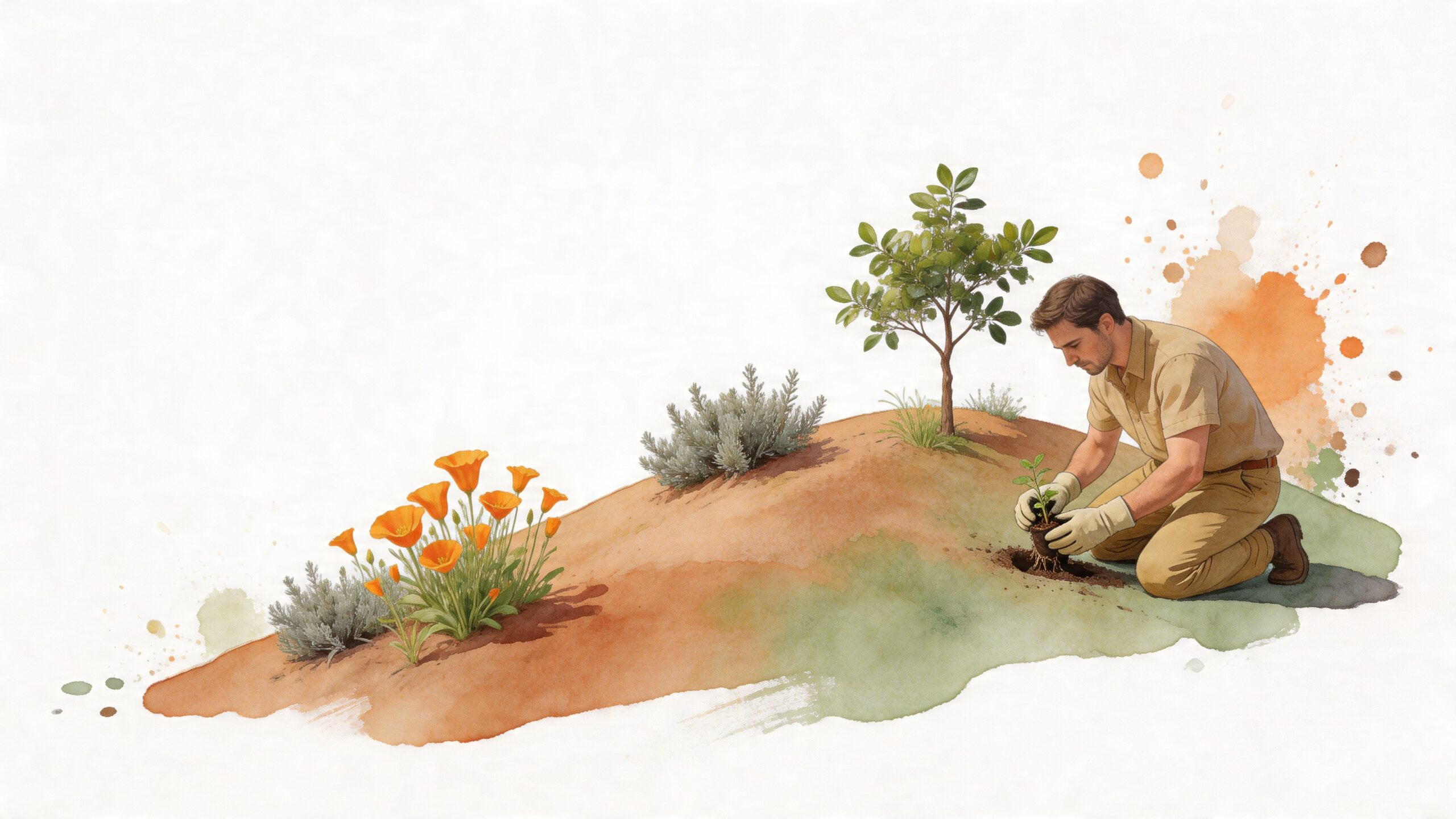
Good slope planting is planned for coverage, root structure, irrigation, and survival rate, not looks alone.
On residential hillside work, I see the same mistake often. A property owner installs a few attractive shrubs, leaves wide bare gaps between them, and expects the roots to solve the problem. They usually do not. Until plants fill in and establish, the exposed soil between them is still vulnerable.
A planting plan that stabilizes soil usually includes:
- Native or site-suited species: Plants adapted to local wind, rain, and summer dry periods usually establish with less intervention.
- Dense enough coverage: The goal is to reduce exposed soil, not decorate it.
- Fall or early winter installation: That timing gives roots a chance to establish while moisture is available.
- Temporary surface protection: Mulch, straw, blankets, or light matting protect the slope during the establishment period.
- Follow-up maintenance: Irrigation, weed control, and replacement planting matter during the first season.
There are trade-offs here. Vegetation is usually less expensive than a wall or major regrading, and it can look far better once it fills in. It also takes time. If the slope is steep, actively sloughing, or sending runoff toward a structure, planting alone is usually too slow and too uncertain to be the only answer.
That is especially true on parts of the California Central Coast where shallow soils, steep grades, and concentrated winter runoff show up on the same lot. In those cases, vegetation is often one part of the system, paired with drainage improvements, matting, or slope reshaping. If water is already carving channels or the slope shows movement, bring in an excavation contractor before relying on plants to fix it.
5. Sediment Control Fences and Silt Barriers
Silt fence doesn't stop erosion at the source. It catches sediment after runoff has already started moving. That's an important difference.
These barriers belong at the downslope edge of disturbed areas, around inlets, and along perimeter lines where muddy water could leave the property. On active grading work, they are basic protection, not an upgrade.
Why they matter on active construction
If you're excavating, trenching, or reshaping grade, disturbed soil has to be contained. Sediment control fences, wattles, and similar barriers help trap what breaks loose before it reaches pavement, drains, or neighboring property.
They work best when installed before disturbance begins and maintained through the whole job. Once sediment piles too high against them or water starts flowing around the ends, they stop doing much.
Sediment barriers are backup. They don't replace proper grading, cover, or drainage.
For residential jobs, this is often where permit compliance and practical site protection overlap. A clean perimeter can prevent a manageable problem from becoming a cleanup, neighbor, or inspection problem.
6. Permeable Paving and Infiltration Systems
Hard surfaces create runoff. The more roof, driveway, patio, or parking area you add, the less opportunity water has to soak in naturally. That extra runoff often ends up cutting soil at the edge of pavement, along slope transitions, or near discharge points.
Permeable paving can help by letting water pass through the surface into a prepared base below. On the right site, that reduces runoff volume and takes pressure off nearby soils.
Where this method fits best
This isn't the answer everywhere. Soil conditions, slope, and maintenance all matter. A permeable driveway installed on the wrong subgrade or pointed at an unstable downhill edge can create a different problem than the one you started with.
The method shines on flatter or moderately sloped areas where runoff from conventional paving would add stress to the site. It can also support broader drainage planning. If you're seeing runoff collect around paved areas, why repaving alone doesn't stop water pooling gets into the bigger issue.
Maintenance is the trade-off. Permeable surfaces need to stay open to keep infiltrating. If sediment clogs them, performance drops and water starts acting like it would on standard pavement.
7. Swales, Bioretention Areas, and Vegetated Drainage Channels
When runoff needs a place to go, giving it a controlled path is often better than trying to stop it everywhere. Swales and bioretention areas collect, slow, spread, and filter water before it becomes erosive.
This method works well where roofs, driveways, yards, or graded areas all send water toward the same low spot. Instead of allowing a narrow fast-moving flow, you shape a broader, slower drainage path.
Why shape matters more than depth
A well-built swale isn't just a ditch. If it's too steep, too narrow, or poorly lined, it becomes an erosion feature itself. The shape needs to slow flow, not accelerate it.
Vegetated buffers around these features can make them much more effective. Verified data states that field buffers of deep-rooted grasses and shrubs along drainage edges can filter 60 to 90 percent of sediments under EPA guidelines (soil and water conservation practice adoption study).
A practical setup often includes shallow grading, planted sides, inlet protection where water enters, and overflow planning for bigger storms. On a residential property, these systems are often far more attractive and easier to maintain than a scarred channel that keeps re-forming every winter.
8. Hydraulic Erosion Control and Dust Suppression
A freshly graded slope can start moving before the permanent fix is even scheduled. On Central Coast jobs, I see that most often after rough grading, trenching, or demolition, when loose fines are exposed and the wind or a light rain gets to them first.
Hydraulic erosion control is a short-term hold. Water trucks, hydromulch, tackifiers, and other sprayed soil binders help keep dust down and keep surface soil in place until the site is ready for final stabilization.
When temporary stabilization makes sense
Temporary hydraulic treatment fits active work zones. If crews are still crossing the area, installing blankets too early usually means tearing them up, and planting before final grade often wastes seed and labor.
The trade-off is timing. Apply too little water or binder and the surface stays dusty and loose. Apply too much and you can create runoff, rutting, or muddy working conditions that slow the job down. On steep ground, that balance gets harder fast.
Hydroseeding usually makes more sense once rough grading is complete and equipment traffic is mostly done. At that stage, you are no longer just suppressing dust. You are starting the shift to longer-term cover. If runoff is already concentrating near the house, hardscape, or pad, temporary surface treatment should be paired with drainage solutions for homes so the water is controlled as well as the soil.
One more practical point. Dust problems and erosion problems often show up together, but they do not always come from the same source. If a slope stays wet in one strip, or fines keep pumping up from below, surface treatment alone will not fix it. In some cases, hidden utility leaks or subsurface water are part of the problem, which is why underground water leak detection can become part of the troubleshooting before more money is spent on repeated surface applications.
For a small flat lot, temporary hydraulic treatment can be a reasonable DIY stopgap. For a steep cut, a long exposed slope, or a site above a driveway, structure, or neighbor, it is worth bringing in a contractor. The method is only as good as the slope prep, application rate, and follow-up plan.
9. Drainage System Installation and Subsurface Water Management
A slope can look stable on top and still be failing from the inside. I see this on Central Coast properties after the first hard rains. The surface gets patched, seed goes down, and the wet spot keeps coming back because water is moving through the soil, not just across it.
Drainage work handles the pressure that surface treatments cannot. When soil stays saturated, it loses strength. That is when you start seeing seepage, soft zones, cracking near the crest, wall staining, or a downhill bulge that was not there last season.
What drainage fixes that surface work can't
French drains, interceptor drains, curtain drains, outlet lines, and wall backdrain systems all do different jobs. The right choice depends on where the water starts, how deep it is moving, what the slope is made of, and where you can discharge it safely. A cheap drain in the wrong place usually turns into an expensive repair.
This matters most around retaining walls, cut banks, foundation edges, hillside pads, and driveways where runoff and subsurface water meet. If the problem is showing up near a house or hardscape, residential drainage solutions for homes are often part of the fix, not an add-on.
Subsurface water problems are easy to misread. What looks like slope runoff can come from a broken irrigation line, a failed storm pipe, or a utility leak feeding the soil from below. When the source is unclear, underground water leak detection can help identify whether the problem is drainage design, an active leak, or both.
There is a real trade-off here. Proper drainage adds cost up front, and some systems need cleanouts, outlet protection, and periodic inspection to keep working. But on steep or developed lots, skipping that work often means paying twice. Once for the cosmetic repair, and again when the slope moves again.
For a small area with a clear surface runoff issue, a property owner may be able to install a basic swale or outlet improvement. For recurring seepage, saturated fill, movement near a retaining wall, or any slope above a structure or neighbor, bring in an excavation contractor or geotechnical professional. Water inside a slope is where DIY mistakes get expensive fast.
10. Slope Reduction and Re-Grading
Some slopes are just too steep in their current form. You can cover them, fence them, and drain them, but if the geometry is wrong, erosion tends to keep coming back.
Re-grading changes the geometry. By cutting high areas, filling low areas where appropriate, and reshaping transitions, you reduce runoff speed and create a slope that can hold cover and drainage improvements.
When re-grading is the real fix
This is often the right answer when a property has repeated washouts, failed patch repairs, or an old slope that was never shaped for long-term stability. It also matters before foundation work, driveway prep, and utility placement on difficult lots.
Verified data links reduced-disturbance methods to major erosion benefits. The FAO data in the verified set states erosion rates on no-till soils are 90 percent lower than on conventionally tilled soils, which points to the same principle contractors deal with on sites every day. Limit disturbance where you can, and when you must disturb soil, reshape it so water doesn't keep attacking it (5 essential steps to preventing soil erosion in agriculture).
A few signs that spot fixes aren't enough:
- Recurring channels: If rills and gullies keep returning in the same line, the grade is usually directing water there.
- Slope breaks that dump water: Hard transitions often concentrate runoff.
- Patchwork repairs: Repeated mulch, rock, or matting replacement usually means the underlying shape still needs correction.
10 Soil Erosion Prevention Methods Compared
| Method | Implementation Complexity 🔄 | Resource Requirements ⚡ | Expected Outcomes ⭐📊 | Ideal Use Cases 💡 | Key Advantages ⭐ |
|---|---|---|---|---|---|
| Erosion Control Blankets (ECBs) and Matting | Low–Moderate, quick to install, temporary anchoring required 🔄 | Low material + moderate labor; biodegradable or synthetic options; low cost per yd² ⚡ | Short-term stabilization; reduces sediment 70–99%; supports seed germination for 6–24 months ⭐📊 | Newly graded slopes, active construction, short-term protection before vegetation establishes 💡 | Fast deployment, cost-effective, aids vegetation establishment ⭐ |
| Terracing and Bench Grading | High, engineering and precise earthwork; phased construction 🔄🔄 | Heavy equipment, survey/engineering, moderate–high cost ⚡ | Permanent slope reduction; greatly reduced runoff velocity and erosion; creates buildable benches ⭐📊 | Steep hillsides needing usable, buildable area; large redevelopment sites 💡 | Long-term stability, creates usable land, reduces stormwater velocity ⭐ |
| Retaining Walls & Slope Reinforcement | High, engineered design, permitting, specialised construction 🔄🔄🔄 | High material and skilled labor costs; geogrid/drainage systems; permits required ⚡ | Immediate, long-lasting stabilization (50+ years if designed/maintained); shortens slope height ⭐📊 | Tight lots, tall cuts/fills, where immediate slope support is required 💡 | Permanent stabilization, increased usable land, aesthetic finishes ⭐ |
| Vegetative Stabilization & Native Planting | Moderate, planning and phased planting; long establishment period 🔄 | Low–moderate: plants, irrigation early years, maintenance labor ⚡ | Long-term natural stabilization; reduces runoff 50–80% once established; ecological benefits ⭐📊 | Post-grading long-term stabilization, habitat restoration, drought-adapted slopes 💡 | Lowest long-term cost, ecological co-benefits, self-maintaining after establishment ⭐ |
| Sediment Control Fences & Silt Barriers | Low, simple install but needs regular inspections 🔄 | Low material and labor cost; frequent maintenance and sediment disposal ⚡ | Immediate sediment trapping; captures ~50–85% of sediment; temporary lifespan 6–12 months ⭐📊 | Downslope perimeters of construction sites, SWPPP compliance, phased grading areas 💡 | Low cost, rapid deployment, flexible and movable for active sites ⭐ |
| Permeable Paving & Infiltration Systems | Moderate, requires geotechnical testing and careful base design 🔄🔄 | Higher initial material and base prep costs; periodic vacuum maintenance ⚡ | Eliminates/reduces runoff 80–100%; recharges groundwater; reduces downstream erosion ⭐📊 | Driveways, parking, LID-compliant projects, sites needing stormwater treatment 💡 | Reduces runoff volume, supports groundwater recharge, regulatory compliance ⭐ |
| Swales, Bioretention & Vegetated Channels | Moderate, engineered design and appropriate planting required 🔄🔄 | Space, planting media, underdrain/underlying soil prep; moderate cost ⚡ | Stores/filters runoff, removes 50–95% sediment/pollutants; slows water velocity ⭐📊 | Sites with available space to treat roof/road runoff, LID applications, landscape-integrated drainage 💡 | Improves water quality, habitat value, aesthetically pleasing, reduces downstream erosion ⭐ |
| Hydraulic Erosion Control & Dust Suppression | Low, rapid application; repeat treatments needed 🔄 | Water trucks, tackifiers or stabilizers; low per-area cost but recurring ⚡ | Immediate dust reduction (80–95%); temporary surface stabilization for weeks ⭐📊 | Active grading/excavation phases, air-quality compliance, dust-sensitive areas 💡 | Instant control, low upfront cost, improves site safety and compliance ⭐ |
| Drainage System Installation & Subsurface Management | High, requires engineering, deep excavation and precise grading 🔄🔄🔄 | High-cost pipes/gravel/fabric, excavation equipment, long-term design investment ⚡ | Addresses root cause of erosion; prevents saturation-driven failures; long lifespan ⭐📊 | Sites with groundwater issues, near foundations, slopes prone to instability or landslides 💡 | Permanent mitigation of hydrostatic pressure, prevents catastrophic slope failure ⭐ |
| Slope Reduction & Re‑Grading (Cut-and-Fill) | High, large-scale earthmoving, surveying, compaction control 🔄🔄🔄 | Heavy equipment, GPS grading, compaction testing, engineering and permits ⚡ | Permanent recontouring; reduces erosion 50–80+%; creates stable, buildable grades ⭐📊 | Projects requiring overall site reconfiguration for buildability or safety 💡 | Fundamental long-term solution, creates buildable pads, reduces ongoing maintenance ⭐ |
Final Thoughts
The right methods to prevent soil erosion usually work in layers. A property might need grading first, drainage second, temporary protection third, and vegetation after that. Another site may only need better runoff control and surface cover. The mistake is looking for one product or one quick fix to handle every cause.
On flatter ground, basic measures can go a long way. On hillside lots, long slopes, clay soils, and sites with concentrated runoff, erosion gets more serious fast. That's where the trade-offs matter. Blankets help, but they don't fix subsurface water. Plants are valuable, but they take time to establish. Retaining walls can solve a grade problem, but they need engineering and drainage behind them. Silt fence is important, but only as perimeter control.
There are also clear signs when it makes sense to bring in a contractor or engineer instead of trying to patch things yourself. If you're seeing active slope movement, repeated washouts, water collecting near a foundation, runoff crossing a driveway, or soil leaving the property, you need more than surface treatment. The same goes for ADU work, steep cuts, retaining systems, utility trenching, and projects that need permit compliance.
In practice, the best erosion control plans are built around water behavior. Where does runoff start, where does it concentrate, where can it safely slow down, and where is the soil weakest once it's wet. Once those questions are answered, the method becomes much easier to choose.
For property owners in Santa Rosa, Sonoma County, Monterey County, and across the California Central Coast, that often means looking at the whole site instead of just the damaged spot. DW Excavation, LLC handles grading, drainage solutions, hillside work, stormwater management, soil stabilization, foundation excavation, and related site planning support, which are often the core pieces of a lasting erosion control fix.
If your property is washing out after storms, don't wait for the next rain to show you the same problem again. The earlier you correct grade, drainage, and exposed soil conditions, the simpler the repair usually is.
Frequently Asked Questions
What is the best method to prevent soil erosion on a residential property?
There isn't one best method for every property. The right approach depends on slope, soil type, runoff patterns, and whether the area is already graded or built on. Most residential sites do best with a combination of drainage control, surface protection, and vegetation.
Can I fix soil erosion myself or do I need a contractor?
Minor surface erosion in a small area may be manageable with mulch, planting, or light matting. If the site is steep, close to a foundation, losing soil during storms, or sending runoff onto neighboring property, it's smart to bring in a contractor. Once drainage and grading are involved, guesswork gets expensive.
Do retaining walls stop erosion by themselves?
Not by themselves. A retaining wall can hold back soil, but it still needs proper backfill, drainage, and grade control around it. Without that, water pressure builds and the wall can fail or allow erosion around the edges.
How fast should erosion control be installed after grading?
Immediately. Freshly disturbed soil is most vulnerable right after grading, especially if rain is coming. Waiting until erosion starts usually means extra cleanup, repair, and a harder time getting the slope stabilized.
Will plants alone hold a slope in place?
Sometimes, on mild to moderate slopes with manageable runoff. On steeper or wetter sites, plants are usually one part of the fix, not the whole fix. They work best after the slope is shaped correctly and drainage is under control.
What causes erosion to keep coming back in the same spot?
Usually concentrated water, poor grade transitions, weak outlet points, or hidden drainage issues. If the same line keeps washing out, the site is directing water there. Covering the scar without changing the water path rarely lasts.
Does gravel stop soil erosion?
Gravel can help protect the surface in the right place, especially in drainage channels or splash zones. It won't fix slope instability or bad runoff patterns on its own. If water is moving fast under or around the gravel, the soil can still erode.
When should I worry about erosion near a foundation or driveway?
Right away. Soil loss near a structure or driveway can lead to settlement, undermining, drainage problems, and repeat repairs. If you see voids, cracking, runoff crossing pavement, or exposed footing areas, have the site evaluated before the next wet season.
Sources
American Farm Bureau Federation. "Sustainability Markets Part 2 Common Land Use Practices Under Consideration for Conservation Adoption." 2024. https://www.fb.org/market-intel/sustainability-markets-part-2-common-land-use-practices-under-consideration-for-conservation-adoption
BMPSupplies. "Understanding Effective Methods for Preventing Soil Erosion." 2024. https://www.bmpsupplies.com/post/understanding-effective-methods-for-preventing-soil-erosion
CropLife. "5 Essential Steps to Preventing Soil Erosion in Agriculture." 2024. https://www.croplife.com/management/sustainability/5-essential-steps-to-preventing-soil-erosion-in-agriculture/
National Library of Medicine PMC. "Mixed-methods study on drivers and barriers to soil and water conservation practice adoption." 2025. https://pmc.ncbi.nlm.nih.gov/articles/PMC12473740/
World Resources Institute. "Causes and Effects of Soil Erosion and How to Prevent It." 2025. https://www.wri.org/insights/causes-and-effects-soil-erosion-and-how-prevent-it
If you need help choosing practical methods to prevent soil erosion on your property, DW Excavation, LLC can look at the slope, drainage, and grading conditions and talk through the next step. For a free estimate or site consultation, call (707) 601-9091, visit 470a Caletti Avenue, Windsor, CA 95492, or go to dw-excavation.com.