
Direct Answer: Look for water pooling near your foundation, soil migrating downhill, or spongy ground that never fully dries out. These are the most reliable signs that your property wasn’t graded correctly.
Poor grading is one of those problems that stays quiet for years — until one wet January it announces itself all at once. By then, you’re looking at water against your foundation, soil that’s moved somewhere it shouldn’t be, or an access road that’s been chewed apart by runoff for the third winter running.
For homeowners on Sonoma County’s clay-heavy soils, the window between “looks fine” and “this is a real problem” can close faster than you’d expect. We’ve heard from property owners in Santa Rosa, Healdsburg, and the unincorporated areas who didn’t know anything was wrong until they noticed the damage was already done.
This article walks through what properly graded land actually looks like, what the warning signs of bad grading are, and why Sonoma’s clay soils make this a more complicated question than it is anywhere else in the state.
The Visual Signs of a Grading Problem Most Homeowners Miss
You don’t need a laser level to spot a grading problem. You need to pay attention after the next rain and look for a few specific things.
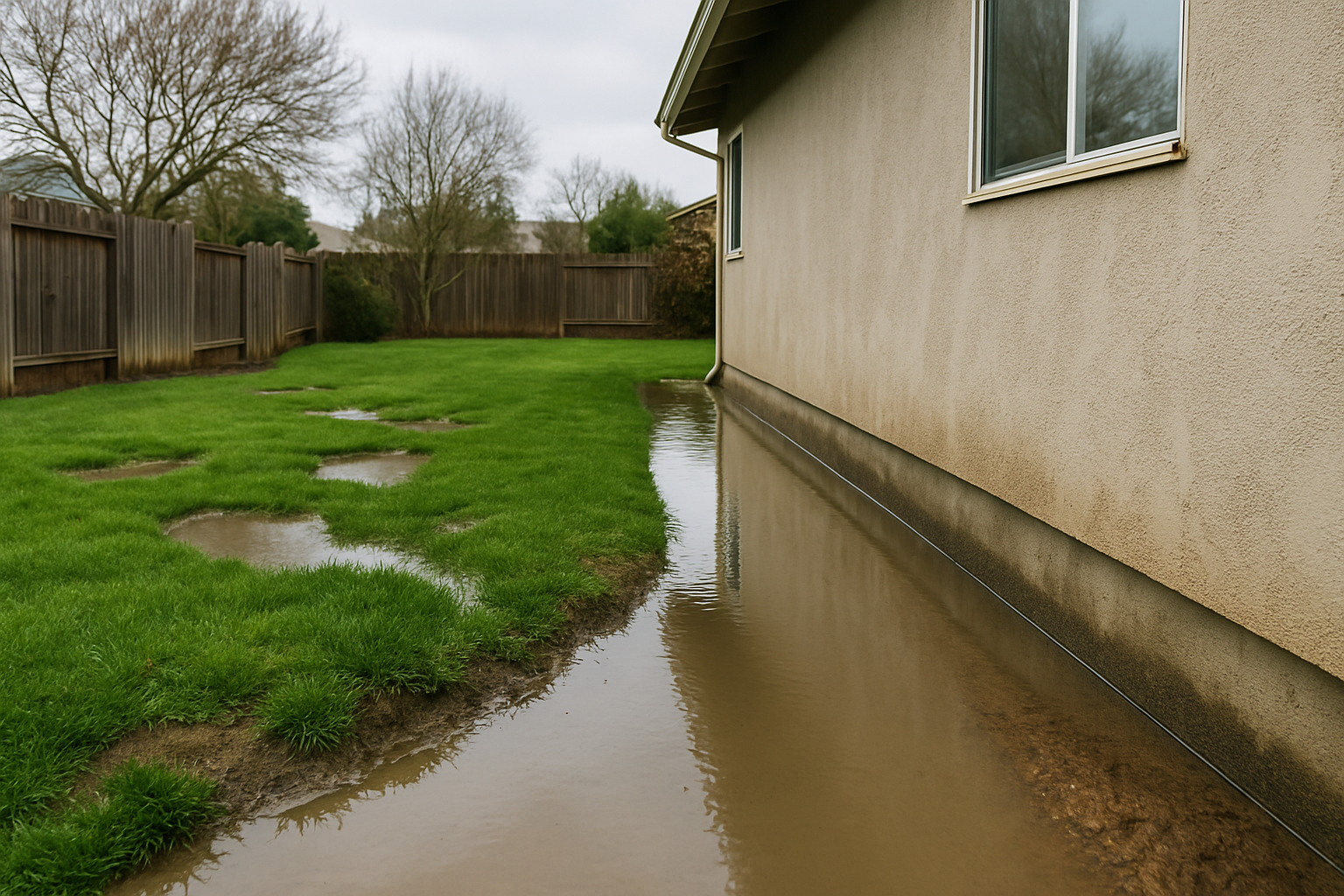
The most common sign is standing water that pools in the same low spot every single time it rains. One spot that stays wet long after everything else has dried out is almost never a coincidence — it’s the lowest point on a poorly sloped surface, and water is doing exactly what physics tells it to.
A few other signs worth watching for:
- Water within 10 feet of your foundation — any surface runoff traveling toward the house rather than away from it is a grading failure by definition
- Soil migrating downhill — if you can see topsoil or mulch accumulating against your foundation, slab edge, or lower retaining wall face, your finish grade is working against you
- Spongy or soft ground in areas that should drain freely — especially in summer, when saturated subsoil from winter can stay trapped under a surface that looks dry
- Uneven settling near a driveway edge or retaining wall — this usually means water has been undermining the soil underneath for at least one full season
- Erosion channels forming in the same path — especially on slopes, where runoff carves the same gully year after year
A homeowner near Mark West Creek in Santa Rosa reached out after watching their yard slowly disappear over several winters. Every heavy rain moved more soil downstream. What started as a soggy backyard had become a legitimate threat to the structure above it. That kind of damage doesn’t happen overnight — it’s the product of inadequate slope management compounding season after season. What happens to a hillside if erosion goes unfixed is a question more homeowners should be asking before the damage gets ahead of them.
Why Sonoma County Clay Soil Makes Grading More Complicated
If you learned anything about grading from flat-country construction standards, set it aside for a minute. Sonoma County’s clay soils follow different rules.
Clay expands when it absorbs water and contracts when it dries out. The practical effect: a finish grade that drained correctly in October — before the rains started — can trap water against a foundation by January, because the soil has swollen enough to close off the drainage path that was working three months earlier.
This is why slope minimums on clay properties need to account for seasonal soil movement, not just the static condition right after grading is done. A grade that reads correctly on the day work is completed is not the same as a grade that performs correctly through a Sonoma winter.
For context: when the November 2024 atmospheric river dropped over 12 inches of rain on Santa Rosa in three days, properties with marginal drainage didn’t just get wet — they failed. Clay that was already approaching saturation had nowhere for that volume of water to go. Foundations absorbed it, slopes moved, and access roads that had survived light storms for years collapsed under the load.
The practical implication for any homeowner evaluating their site: a finish grade on clay soil should slope at minimum 6 inches drop over the first 10 feet away from a structure, and more on hillside lots where seasonal soil movement is greater. If you don’t know what your current grade looks like, that’s the first thing worth finding out.
For more on how soil conditions affect below-grade work in this region, what soil conditions make foundation work harder in Monterey County covers the related issues on the coast.
Grading Problems by Symptom: What You’re Seeing and What It Means
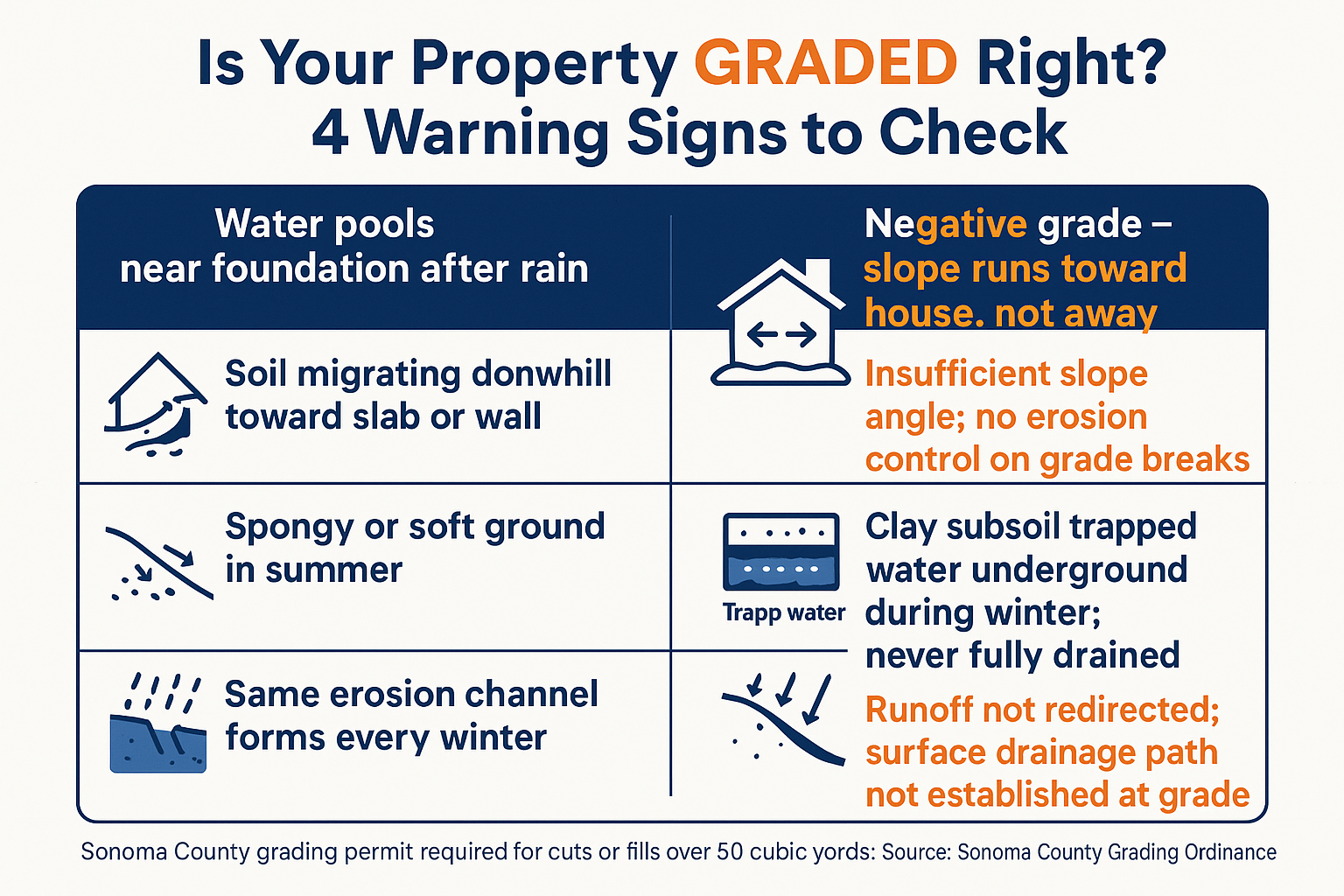
These four symptoms are the most common signs of a grading problem on Central Coast properties. Each one points to a specific underlying cause.
When Grading Corrections Trigger a Permit — What Sonoma County Requires
This is the part homeowners often don’t see coming. You notice a grading problem, you decide to fix it, and then you find out the fix itself requires a permit.
In Sonoma County, any cut or fill over 50 cubic yards triggers a grading permit. That threshold sounds like a lot until you realize that corrective regrading on a slope — moving soil to redirect drainage, building up a swale, or re-establishing a road base — can reach 50 cubic yards on a project that covers only a few thousand square feet.
For comparison, Monterey County’s threshold is 100 cubic yards, which gives property owners a bit more room before permit requirements kick in. But the principle is the same: fix a grading problem of any real size, and the county will want to know about it.
A Healdsburg wine country property owner reached out after dealing with the same storm damage every winter — sections of their main access road carved out repeatedly by runoff, requiring regrading after every significant storm. That’s not just a maintenance cost. It’s evidence that the road was never graded to handle the drainage load, and that annual patching was treating the symptom without addressing the cause.
If you’re correcting work that was done without a permit — something we hear about more often than you’d expect — the process for permit legalization involves documenting existing conditions and working with the county to bring the site into compliance. Getting ahead of it is always cheaper than waiting for a city or county inspector to require it.
Sonoma vs. Monterey County: Key Grading Permit Thresholds
Permit requirements vary between the two counties DW Excavation serves most frequently. Knowing where your project falls can save time and prevent costly stop-work orders.
| County | Grading Permit Threshold | Slope Work Considerations |
|---|---|---|
| Sonoma County | Cut or fill over 50 cubic yards | Clay soils, wildfire defensible space, seasonal drainage requirements |
| Monterey County | Cut or fill over 100 cubic yards | Coastal runoff, flood-prone lowlands, hillside erosion risk |
| Both Counties | Retaining walls over certain heights | Soils engineer may be required on slopes — verify with county before work begins |
Why a Shovel and a Good Eye Aren’t Enough — The Equipment Behind Accurate Grading
The difference between a graded property that drains and one that floods is often measured in fractions of an inch per foot of slope. That’s not a figure of speech — it’s what determines whether water runs toward your foundation or away from it.
Achieving that kind of precision requires laser-grade equipment and an operator who understands the full drainage relationship across the site — not just the section directly in front of the machine. A contractor who grades the back slope correctly but doesn’t account for how that runoff connects to the side yard swale has only solved part of the problem.
This is the technical reason why eyeballing a grade, or having a landscaper move some soil around, often produces a finish that looks right but doesn’t perform right once the rains start. Why water pools in the same spot every time it rains is often the result of finish grading that was close but not precise — and on clay soil, “close” becomes a problem by January.
The equipment matters. The site read matters. And on Sonoma County slopes, the understanding of how clay soil behaves from October through March matters just as much as the grade itself.
Frequently Asked Questions About Property Grading in Sonoma County
How do I know if my grading problem is bad enough to fix, or if I can just monitor it?
If water is pooling within 10 feet of your foundation after a moderate rain, or if you can see soil migrating toward your house or down a slope, it’s already past the monitoring stage. Grading problems compound — they don’t stabilize on their own. One wet winter can do more damage than several dry years of neglect.
My property was graded when the house was built 15 years ago. Can it have changed since then?
Yes, and this is common on clay soils. Repeated wet-dry cycles cause clay to expand and contract, which gradually shifts the finish grade. Add in settlement around foundations, soil compaction under driveways, and any landscaping changes, and the drainage path you had at construction may look completely different today. A site that drained correctly in 2009 may not drain the same way now.
Does fixing a grading problem around my house require a permit in Sonoma County?
It depends on how much soil moves. Sonoma County requires a grading permit for any cut or fill over 50 cubic yards. Small-scale corrections — filling a low spot, adjusting a swale — may fall under that threshold. But corrective regrading on a slope, or anything involving significant earthwork near a foundation or retaining wall, can reach that limit faster than most homeowners expect. It’s worth confirming with the county before work begins.
What’s the difference between rough grading and finish grading, and which one matters more for drainage?
Rough grading establishes the overall elevation and contour of a site — the big moves. Finish grading is the final, precise layer that determines exactly how water flows across the surface. Both matter, but finish grading is where drainage is won or lost. A site can be rough-graded correctly and still fail at drainage if the finish grade isn’t done to the right tolerances.
A previous contractor graded our property and now we have flooding. What are our options?
The first step is understanding what’s actually happening on the site — where water is entering, how it’s moving, and where it’s ending up. From there, corrections might include regrading specific areas, installing a drainage swale or French drain, or addressing subsoil conditions that are trapping water underground. The scope and cost depend on how the original work was done and what the site looks like now. A site visit is the only reliable way to assess it.
Not Sure What’s Happening on Your Property?
If you’re seeing water in the wrong places after a rain, or if your soil has been moving in ways you can’t explain, the best starting point is a conversation with someone who’s stood on these soils before. DW Excavation serves Sonoma County, Monterey County, and the broader Central Coast — and we’re familiar with exactly the kind of clay-soil drainage problems that tend to show up on local properties. Call us at 707-601-9091 or reach out through the contact page at dw-excavation.com to request a free estimate.