
Direct Answer: Clear your drainage outlets, check your grading slope, inspect slopes for instability, and verify your French drains still work — before the first storm, not during it.
When the November 2024 atmospheric river dropped over 12 inches of rain on Santa Rosa in three days, a lot of Sonoma County homeowners found out exactly where their drainage failed — and the hard way. Flooded crawl spaces, eroded hillside edges, and pooling water that sat for days weren’t just inconveniences. They were the result of problems that had been quietly building for years.
El Niño patterns bring extended, heavy rain cycles that test everything your property’s drainage is supposed to do. Sonoma County’s heavy clay soils make that worse — water doesn’t soak in fast here. When the ground saturates, it moves, and whatever is in the way either handles the load or fails.
These seven steps won’t waterproof your property overnight. But if you work through them before the season starts, you’ll be in a much stronger position than the neighbors who wait until the first storm to figure out they have a problem.
1. Clear and Extend Your Drainage Outlets
Blocked culverts and clogged downspout outlets are the single most common cause of localized flooding during heavy rain events. And “clear” doesn’t just mean pulling out a handful of leaves — it means actually tracing each outlet to where it daylight and confirming water can move freely through the entire path.
In practice, that means:
– Flushing downspout extensions with a garden hose and watching where the water comes out
– Checking that roadside culverts aren’t buried under accumulated soil or debris
– Looking for vegetation that has grown over outlet openings on the downhill side of the property
– Verifying outlet pipes haven’t been crushed or offset by root pressure
If water can’t exit the property, it backs up. Once it backs up, it finds the next available path — which is often your foundation or your neighbor’s yard. For more on how underground drainage systems can fail without obvious warning signs, check for signs your underground pipe is failing before assuming everything is fine just because you can’t see it.
2. Check Your Grading Slope Away From the Foundation
Grading is one of those things most homeowners never think about after move-in — until water starts finding its way toward the house instead of away from it. The ground around your foundation should slope at least 6 inches over the first 10 feet away from the structure. That’s not a lot of drop, and it gets lost easily over years of settling, landscaping work, or added fill.
Even a slight reverse slope — where the grade runs back toward the slab — can funnel hundreds of gallons of water against your foundation during a multi-day storm. Clay soil doesn’t help. When Sonoma’s clay is saturated, it holds water right against the foundation wall rather than letting it pass through.
If you’re not sure whether your grading is working correctly, this breakdown on how to know if grading was done right walks through the signs to look for. Correcting a reverse slope before the rains hit is a relatively simple fix. Correcting it after water has been sitting against your foundation for a season is a much bigger conversation.
3. Inspect and Reinforce Hillside and Slope Areas
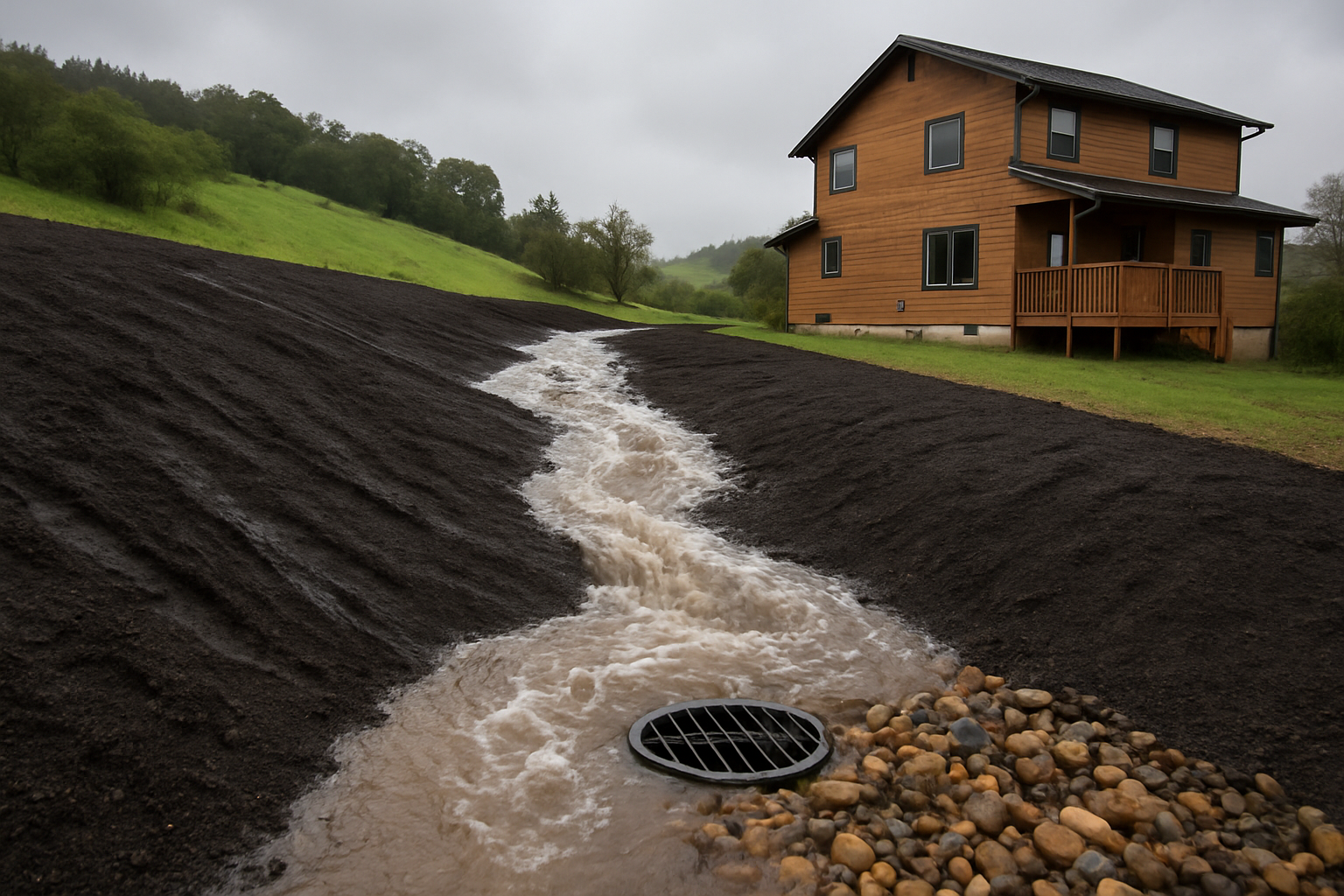
Sonoma County clay is deceptive. It looks stable when it’s dry and it moves fast once it’s saturated. If you have any slope on your property — even a modest 15 or 20 percent grade — you need to walk that slope before storm season and look for early signs of movement.
Watch for:
– Small cracks running parallel to the slope face
– Areas where the soil has already started to slump or step downhill
– Exposed tree roots that weren’t visible last year
– Bare soil patches where vegetation has pulled out or thinned
If you have an existing retaining wall on or near the slope, check it for leaning, cracking at the base, or any gaps opening between sections. A wall that was holding fine last spring may not be holding fine after a dry summer with no moisture movement.
Erosion blankets — the rolled biodegradable netting you see on graded hillsides — work well on bare slopes but need to be anchored properly and replaced when they’ve degraded. What happens to a hillside when erosion goes unfixed for one winter covers the progression in detail, including what a single wet season can cost you if slope work keeps getting pushed.
4. Check Your French Drains and Dry Creek Beds
French drains are installed and forgotten. That’s just the reality. Most homeowners don’t think about them until a flood event makes it obvious they stopped working years ago — and by then, it’s too late to do anything about it before the next storm.
French drains fail in two ways: compaction and collapse. The gravel bed that surrounds the perforated pipe can compact under foot traffic or heavy equipment, cutting off infiltration. The pipe itself can collapse or get offset by root intrusion or soil settlement. Either way, the drain looks fine from the surface and does nothing during a storm.
Dry creek beds — the decorative rock channels some properties use to direct sheet flow — can also get compacted, silted in, or blocked by debris over time. A dry creek bed that hasn’t been cleared in a few years may not move water efficiently when you actually need it to.
The best test: run a sustained water source — a hose at full pressure — at the inlet and watch the outlet. If you’re not seeing strong, clear discharge within a few minutes, something is restricting flow.
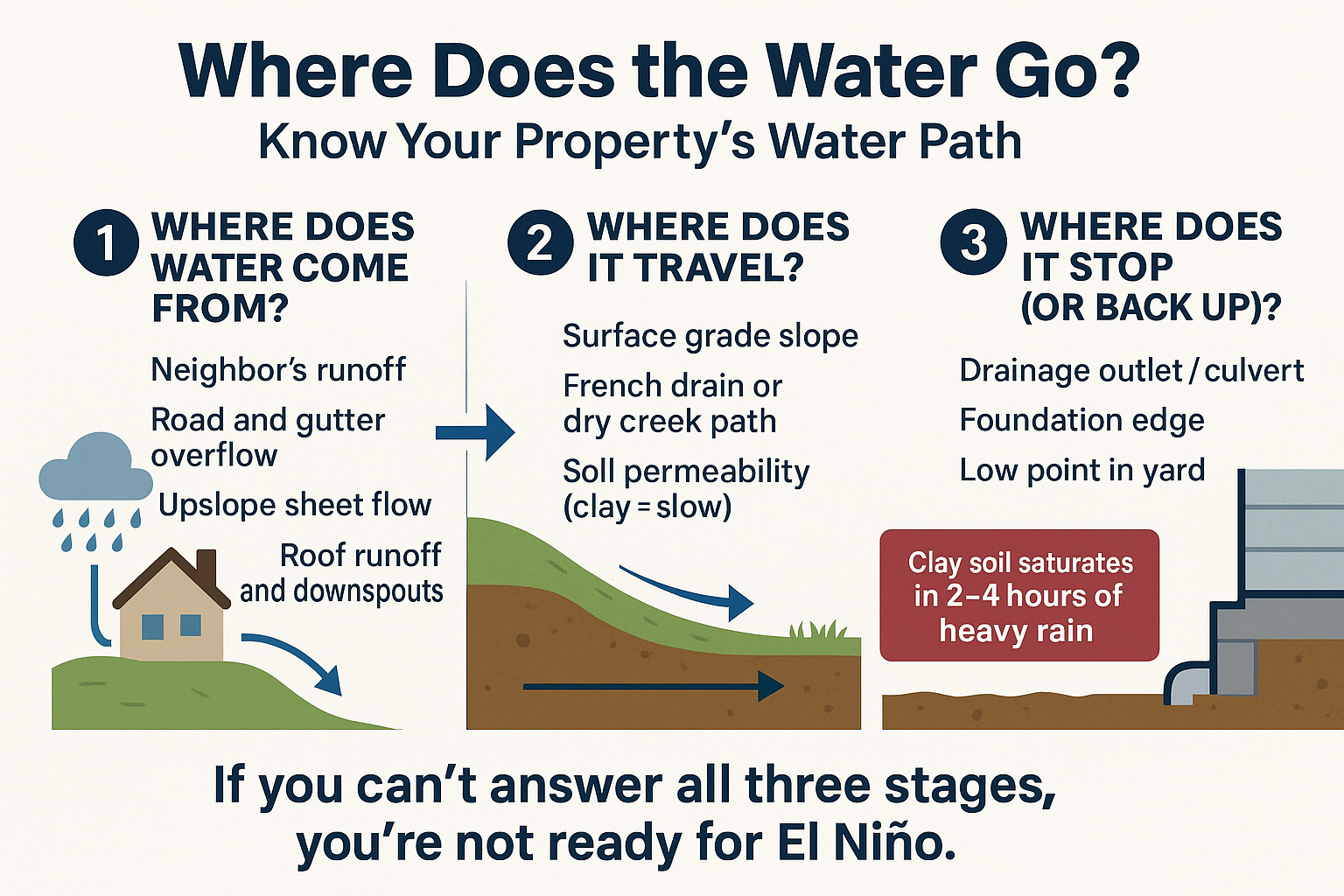
Know Your Property’s Water Path Before El Niño Arrives
Most homeowners have never mapped where water enters, travels across, and exits their property. This overview breaks down the three questions every Sonoma County homeowner should be able to answer before storm season.
5. Know Your Lot’s Water Path — The Whole Thing
Most homeowners know roughly where their yard drains. But there’s a difference between knowing your yard slopes toward the back fence and actually understanding your property’s full water path — where water comes from, where it travels, and where it either exits cleanly or gets stuck.
Think through three stages:
- Where does water enter your property? Road runoff from an uphill street, sheet flow off a neighbor’s graded lot, or hillside drainage that cuts across your upper boundary all count. You might be managing not just your own rainfall, but theirs too.
- Where does it travel? Trace the likely path across your site — over the lawn, along the fence line, through a planted area, across the driveway. If you’ve never thought about it, walk the property during or right after a moderate rain.
- Where does it stop or slow down? That low point in the southeast corner of your yard where water always pools? That’s not bad luck — that’s a drainage problem with a specific cause. Why water pools in the same spot every time it rains explains the most common reasons and what it takes to fix them.
6. Walk Your Property After the First Rain of the Season
Don’t wait for a full storm. The first moderate rain of fall — even just an inch — is the best diagnostic tool you have. Walk your entire property within a few hours of it stopping and look for things that weren’t there in September.
Look for:
– Pooling zones in low areas, near the foundation, or at the base of any slope
– Erosion channels — even small rills just a few inches wide are a sign that water is moving with enough force to carry soil
– Soft or spongy ground near the foundation, near retaining walls, or at the top of any slope (that softness means saturation is already occurring underground)
– New staining or sediment deposits on hardscape surfaces, which show you where sheet flow has been running
The goal is to catch small problems before they become big ones. A two-inch erosion channel in October can be a foot-wide gully by January. A soft spot near the foundation in November can be a flooded crawl space in February. Catching it early keeps your options open.
El Niño Prep: What to Check and When
Use this as a quick reference for when each prep task should happen. Getting the timing right matters — some tasks need dry conditions to do properly.
| Task | Best Time to Do It | Why Timing Matters |
|---|---|---|
| Clear drainage outlets | September – October | Needs dry ground access; hard to access during rain |
| Check foundation grading slope | Late September | Ground still firm enough to assess and correct before rain |
| Inspect slopes and retaining walls | September | Best visibility before vegetation fills back in |
| Test French drains with a hose | October | Confirms function before you need to rely on it |
| Walk property after first rain | First rain of October/November | Reveals drainage patterns that aren’t visible when dry |
| Map your lot’s water path | Before first rain | Requires clear conditions and a dry walkthrough |
| Call a contractor for site assessment | August – September | Scheduling fills fast; October availability is limited |
7. Have a Contractor On Call Before the Season Starts
This one gets skipped more than any other. Homeowners see the storm forecasts, plan to call someone, and then don’t — until water is already in the garage.
By the time a major rain event hits Sonoma County, emergency scheduling is nearly impossible. Experienced site contractors are already committed to flood recovery and drainage work booked weeks out. If you call in the middle of a storm, you’re likely looking at a 2 to 4 week wait just for an assessment, let alone any actual work.
The window for meaningful prep work — grading corrections, French drain repairs, slope reinforcement — closes fast once the ground saturates. Clay soils can’t be regraded when wet. Erosion blankets can’t be anchored on a slope that’s already moving.
The best version of El Niño preparation is having a contractor walk your property in August or September, identify the two or three things that need attention, and get the work done before the first storm. That’s a very different conversation than calling during the rain and asking what can still be done. For a broader look at what site drainage work actually involves, the Sonoma and Monterey stormwater system solutions page covers the full range of drainage approaches used on residential and commercial properties in both counties.
Frequently Asked Questions About El Niño Property Prep in Sonoma County
Does Sonoma County require a permit to fix drainage or regrade my yard?
It depends on the scope of work. Grading permits in Sonoma County are required for cuts or fills exceeding 50 cubic yards. Smaller corrections — like adjusting slope near a foundation or clearing and re-routing a drainage swale — often don’t hit that threshold. But if you’re doing significant hillside work or installing a retaining wall over a certain height, permits come into play. A site contractor familiar with county requirements can tell you quickly whether your project needs one.
What’s the difference between a French drain and a dry creek bed?
A French drain is a buried perforated pipe surrounded by gravel that collects and redirects groundwater or subsurface runoff underground. A dry creek bed is an above-grade channel lined with rock that moves surface water across or off your property. Both serve drainage purposes, but they handle different types of water flow. Many properties use both — the French drain for subsurface saturation, the dry creek for sheet flow during storms.
How do I know if my slope is actually at risk of moving, or just looks rough?
Cracks running parallel to the slope face, small steps where soil has already shifted downhill, and exposed roots that weren’t visible before are the clearest signs. If the slope has no vegetation, bare clay, and faces the direction of your prevailing storm wind, that’s a higher-risk profile even without visible cracking. Slopes that moved at all during the 2023 or 2024 rain events should be treated as high priority — clay soil that has moved once tends to move again.
Can I fix reverse grading myself, or does it need a contractor?
Small corrections — adding a few inches of fill along a foundation edge and grading it away from the slab — can be done with a wheelbarrow and some topsoil if the area is small and accessible. But if the reverse slope runs along a significant length of foundation, or if the soil conditions are complicated (which they often are with Sonoma County clay), you’re better off having someone assess it first. Getting it wrong or using the wrong fill material can make the drainage problem worse.
Is El Niño actually going to be bad for Sonoma County this year?
El Niño years increase the probability of above-average rainfall in Northern California, but the specific impact varies. What we know from recent history — the November 2024 events, the 2023 Pajaro Valley flooding — is that when atmospheric rivers do hit, they hit hard and fast. The question isn’t whether to prepare, it’s whether you’ll have time to prepare after the forecast confirms it. By then, contractors are booked and the ground is already wet.
What happens if I ignore drainage problems through one more winter?
Drainage problems don’t stay the same — they compound. A French drain that was 60 percent functional last winter may be completely blocked by this one. A slope that held in 2023 may have moved just enough that one more wet season tips it. And foundation issues that develop from repeated water exposure get expensive fast. The methods to prevent soil erosion page covers what one unchecked season can actually cost in soil loss and slope damage.
Ready to Walk Your Property Before the Rain Gets Here?
DW Excavation serves homeowners and property owners throughout Sonoma County — from Santa Rosa and Windsor to Healdsburg, Petaluma, and the unincorporated areas where drainage problems and clay slopes have a way of getting expensive fast. If you want a contractor to walk your site and tell you honestly what needs attention before El Niño season, call 707-601-9091 or reach out through the contact page at dw-excavation.com. August and September are the right time to do this — not October, and definitely not during a storm.