
Direct Answer: Sonoma County requires a drainage permit before any drainage improvement or related work starts, including site clearing and soil disturbance. Each site needs its own permit, and new drainage features require a drainage report.
A homeowner reached out to me after a county reviewer flagged yard work that had been done years earlier. The dirt had been moved, the water had been rerouted, and nobody had pulled anything. Now it had to be legalized after the fact, which costs more and takes longer than doing it in order the first time.
That story repeats more than it should. Most property owners around Santa Rosa, Windsor, and the unincorporated stretches west of town have at least heard of a grading permit. Almost none of them have heard of a drainage permit, and the two are not the same thing.
Below I walk through what actually triggers a Sonoma County drainage permit, how it differs from a grading permit, and what the county wants to see in the drainage report. I also cover how the new FEMA flood mapping work changes the math for creek-adjacent parcels.
What a Sonoma County Drainage Permit Requires, and What Triggers One
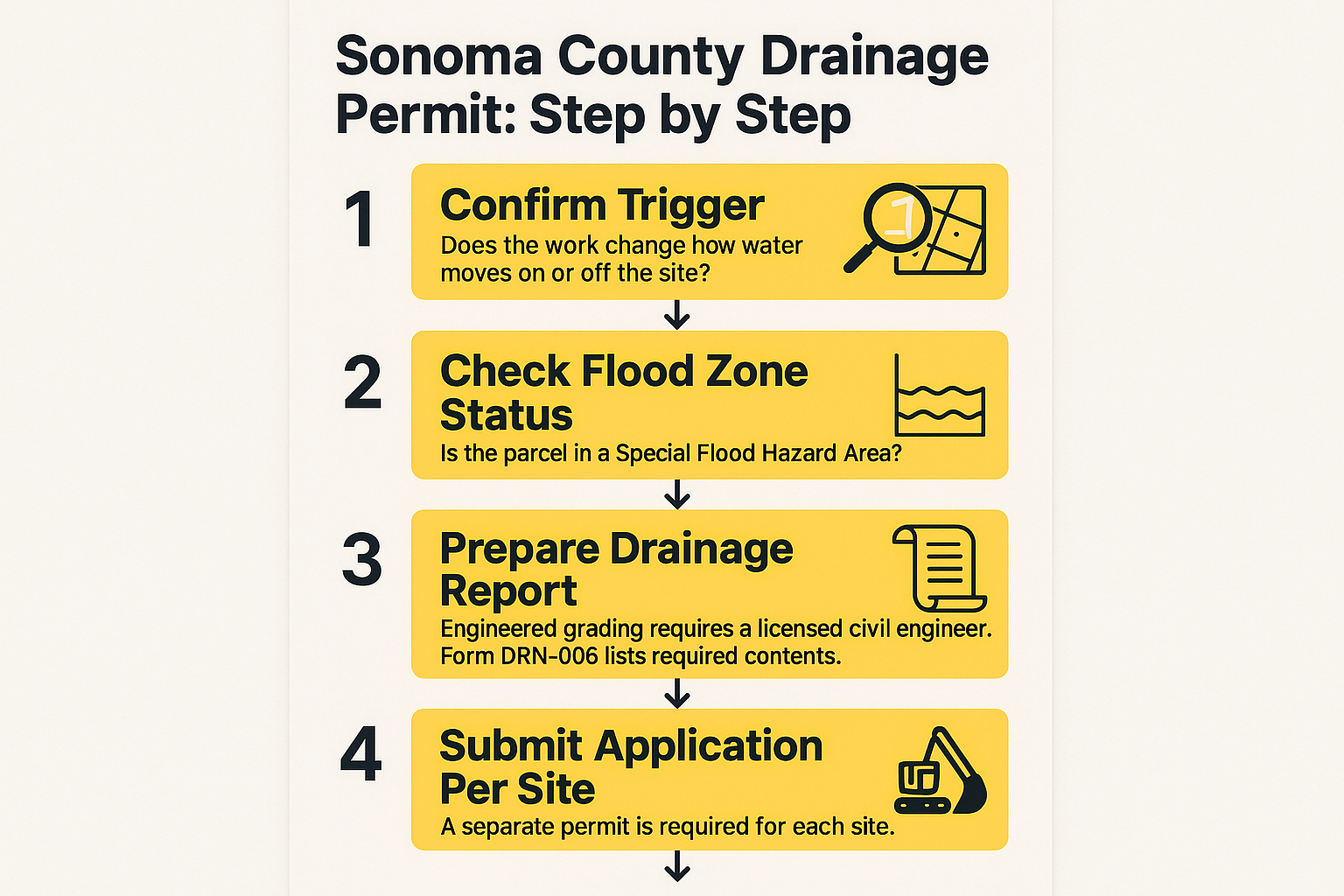
Sonoma County requires a drainage permit before any drainage improvement or related work begins. That includes preparatory site clearing and soil disturbance, under county code section 11.04.010. A separate permit is required for each site.
The scope is wider than most people assume. There is no comfortable cubic yard cushion here the way there is with grading.
Work that can trigger the requirement includes:
- Installing a french drain or subsurface collection system
- Regrading a low spot so water runs somewhere new
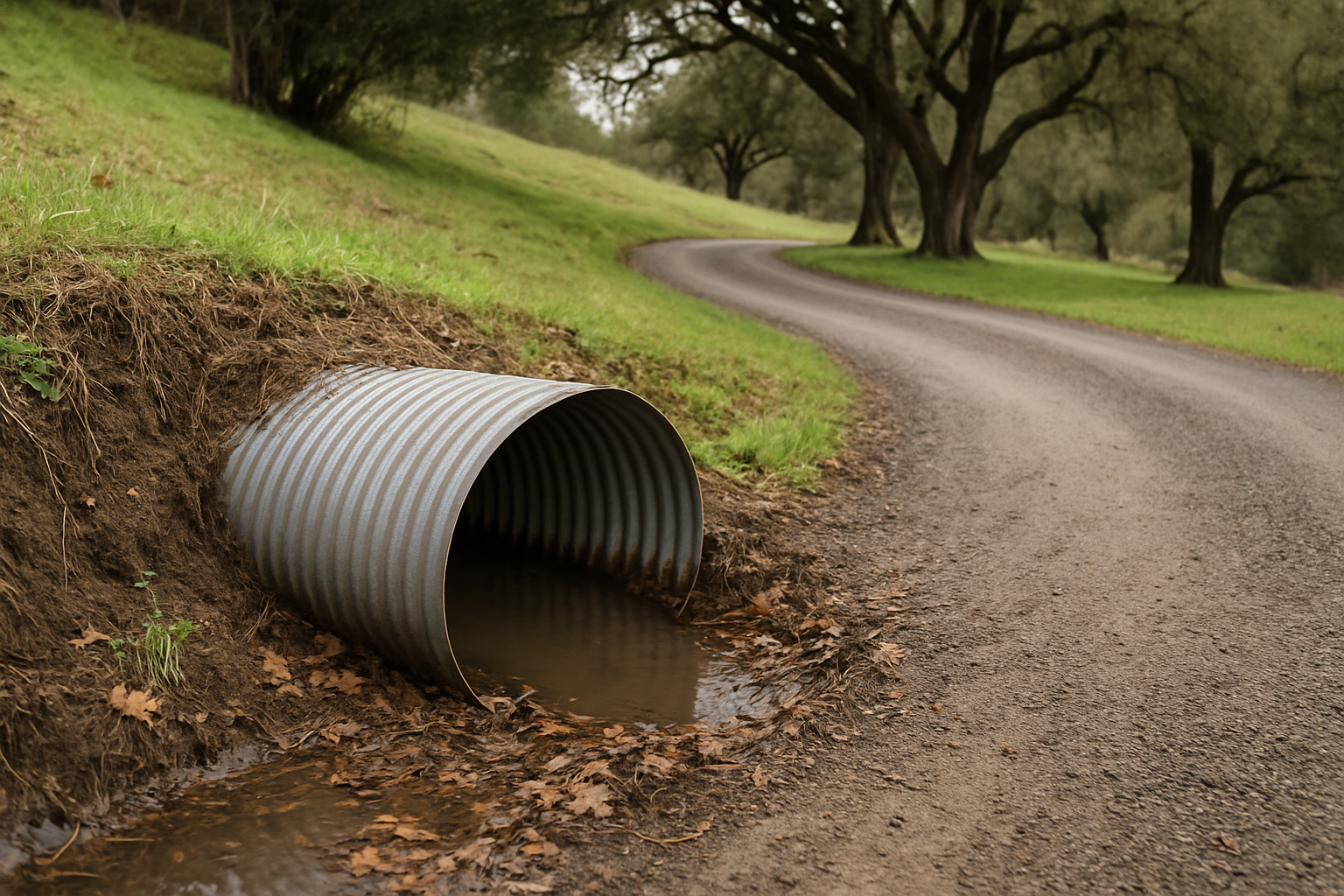
- Adding or replacing a culvert under a driveway approach
- Cutting a swale or ditch to move surface flow
- Clearing vegetation in a way that changes drainage patterns
That last one surprises people. Brush and root mass slow water down. Strip it off a slope above a neighbor’s fence line and you have changed where the runoff goes.
The county lays out the requirement on its stormwater permits page at Permit Sonoma. If you are planning any work that touches how water leaves your property, that is the page to read before the first bucket of dirt moves.
Grading Permit vs Drainage Permit: The Difference Is Scope, Not Size
A grading permit covers cuts and fills. In unincorporated Sonoma County, the common trigger is 50 cubic yards of cut or fill. Monterey County’s threshold sits at 100 cubic yards, which trips up owners who work on both sides of the region.
A drainage permit covers how water moves across or off the site. Different question entirely.
So a project can need:
- Both, if you are benching a hillside and installing a new outfall
- Grading only, if you are cutting a building pad with no change to drainage patterns
- Drainage only, if you are trenching in a small collection system that moves little dirt
- Neither, if the work is minor and does not alter runoff
Here is where it bites. Someone hires a crew to fix a wet yard, the crew does not pull anything, and two years later the owner applies for a building permit for an ADU. The reviewer looks at the site, sees drainage work that was never permitted, and the whole application stalls until it gets sorted out.
Sonoma County also changed how grading permits work recently, so do not assume the process you remember from a project five years ago still applies.
Grading Permit vs Drainage Permit at a Glance
This is the comparison I end up drawing on the back of a site plan almost every week.
| Question | Grading Permit | Drainage Permit |
|---|---|---|
| What it covers | Cuts and fills, moving and placing soil | Changes to how water moves across or off the site |
| Common trigger | Over 50 cubic yards in unincorporated Sonoma County | Any drainage improvement or related work, including clearing and soil disturbance |
| Typical projects | Building pad, driveway cut, hillside bench, fill placement | French drain, culvert, swale, regrading a low spot, new outfall |
| Volume threshold | Yes, tied to cubic yards | No comparable volume cushion |
| Per site | Issued per project scope | A separate permit is required for each site |
The Drainage Report: What It Has to Prove
If your project adds new drainage features, the county wants a drainage report with the application. This is the piece that catches people off guard, because it is an engineering document, not a sketch.
The report has to show that post-development stormwater levels will not adversely affect adjacent properties. In plain terms: you cannot solve your wet yard by sending the water to your neighbor.
For parcels inside a Special Flood Hazard Area, the report also has to demonstrate no reduction in flood-carrying capacity. Fill placed in the wrong spot along a creek corridor can fail that test fast.
Who can prepare it depends on the permit type:
- Engineered grading: the report must be prepared by a licensed civil engineer
- Regular grading and other permits: the property owner may prepare the report themselves
In practice, almost every owner-prepared report I have seen ends up getting redone by a contractor or civil engineer, because the county’s required contents list is specific. Permit Sonoma publishes that list as form DRN-006, Drainage Report Required Contents. Pull it before you write a word.
Costs here vary widely by parcel. A flat quarter-acre lot with an obvious discharge point is a different animal than a creek-adjacent slope needing survey work and hydrology calcs, and the engineering piece alone can run from a modest fee to several thousand dollars depending on complexity. Get a scope-specific number before you budget.
If you want a sense of what actually gets built after the paperwork clears, what a properly installed french drain requires covers the physical side.
The Drainage Permit Path, Start to Finish
This is the order the work has to happen in, and the step most owners skip is the first one.
Why the FEMA Remap Raises the Stakes Right Now
FEMA released a preliminary flood map update for Sonoma County in January 2026. It identified roughly 2,500 Santa Rosa properties as being in high-risk flood zones along 12 streams. Final maps are expected to take effect in spring 2027.
If your parcel gets pulled into a Special Flood Hazard Area, drainage plan review gets stricter for new construction and substantial improvements. That flood-carrying capacity requirement in the drainage report becomes the center of the whole application.
So if you own a creek-adjacent parcel near Santa Rosa, in Bennett Valley, or in the unincorporated areas west of the city, check your mapping status before you scope any drainage work. Designing to the old map and building into the new one is an expensive way to learn this.
I wrote more about the mapping change in what the FEMA remap means for your site. And if you are dealing with active bank loss along a creek, which several property owners have described to us in almost identical terms, what happens to a hillside when erosion goes unfixed covers how fast one winter compounds the problem.
The Paperwork Changed Recently, and That Is a Common Rejection Reason
Two updates matter if you are applying now. Sonoma County updated its stormwater quality requirements for construction sites in February 2026, and its grading and drainage activity notes were revised in April 2025.
Both reflect the county’s push to cut pollutant discharge into local creeks, which feed storm drains and then area waterways. Practical effect: the application checklist changed.
Submitting outdated forms is one of the more common reasons a drainage permit application gets sent back for revision. That is not a dramatic failure, but it costs you weeks, and weeks matter when the rainy season is closing in.
A few habits that keep applications moving:
- Download forms fresh the week you submit, not from a folder saved last year
- Confirm your discharge point is real, legal, and shown on the plan
- Address neighboring properties directly in the report instead of hoping the reviewer skips it
- Line up the drainage permit and any grading permit together so reviews run in parallel
And if drainage work was already done on your property without permits, that is fixable. The path looks a lot like the one for unpermitted retaining walls in Sonoma County, which means documentation, engineering, and an after-the-fact application.
Frequently Asked Questions About Sonoma County Drainage Permits
Do I need a drainage permit for a small french drain in my backyard?
Very likely yes. Sonoma County ties the drainage permit to the nature of the work, not the volume of dirt, so a modest french drain that changes where water collects and discharges falls under the requirement. Confirm with Permit Sonoma for your specific parcel before you start.
Can I get one drainage permit for two parcels I own next to each other?
No. A separate drainage permit is required for each site. Owners with adjacent lots ask this often, and the answer has been consistent.
Does Monterey County work the same way?
Not exactly. The grading threshold in Monterey County is 100 cubic yards versus Sonoma’s 50, and coastal review layers can apply that Sonoma parcels never see. If you own property in both counties, treat them as separate rulebooks.
What happens if the work was already done without a permit?
It usually surfaces during a later building permit review, and then you are legalizing after the fact. That means documenting what was built, often bringing in a civil engineer, and submitting an after-the-fact application. It is more work than permitting up front, but it is a normal process and reviewers deal with it regularly.
How long does the drainage permit process take?
It depends on parcel complexity, flood zone status, and whether your submittal is complete on the first pass. The single biggest time saver is a clean drainage report using current forms. Incomplete submittals are what stretch timelines, not the county’s review speed.
Thinking Through a Drainage Project This Season?
Whether the parcel is a clay slope in Sonoma County or a coastal lot in Monterey County, CA, the permit questions are worth sorting out before the design is locked in. Our team handles site planning, drainage work, and permit coordination across both counties, and we are happy to talk through where a project stands. Reach us at 707-601-9091 or through the contact page at dw-excavation.com.