
Direct Answer: Sonoma County can require you to retroactively permit old retaining walls and grading through an as-built permit process, which typically involves engineering reports, inspections, and sometimes remediation before the county signs off.
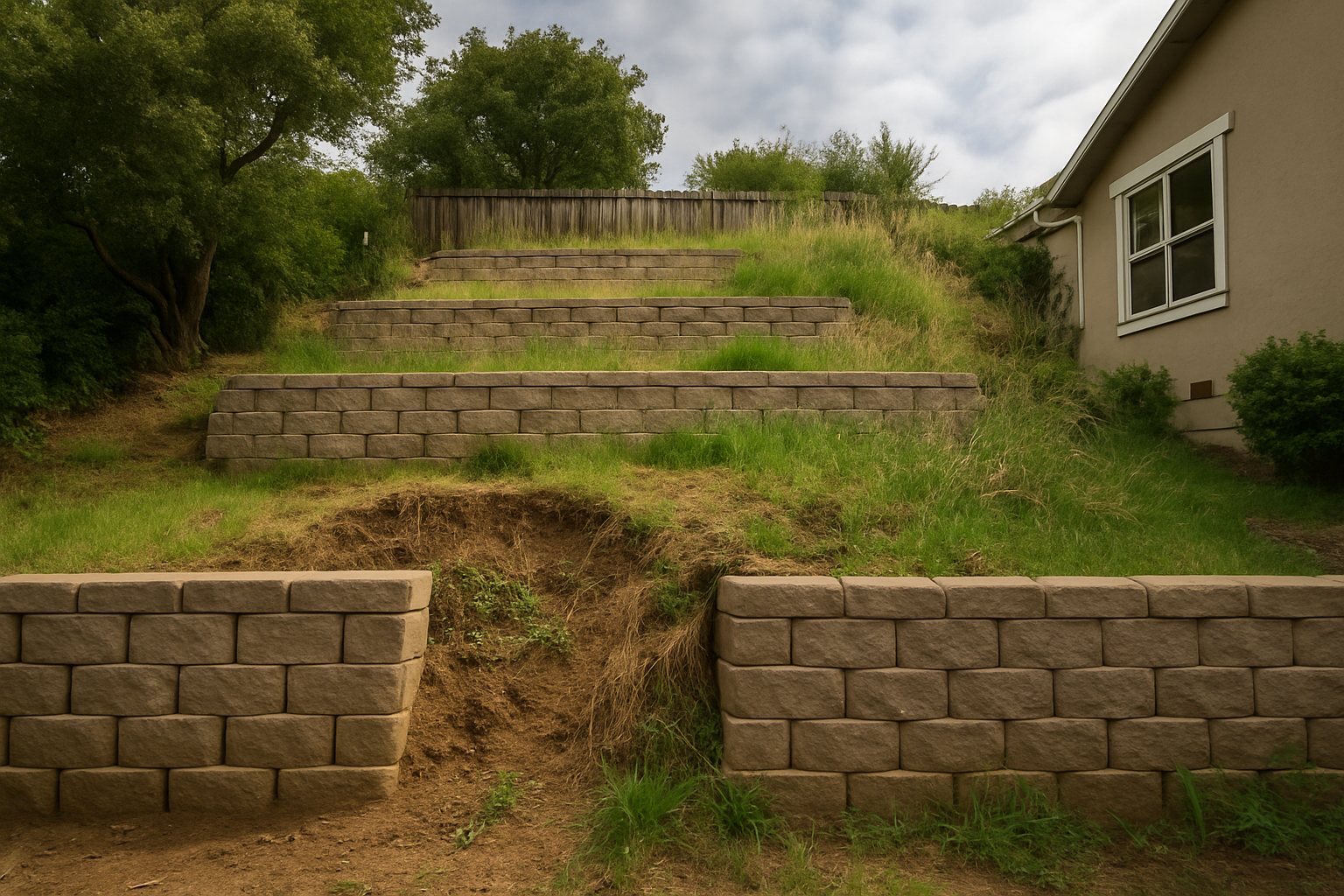
A homeowner reached out to us recently with a situation I’ve seen come up more and more often. He had retaining walls built and dirt terraced nine years ago so his family could use the backyard. No problems, no complaints, no notice of any kind. Then the city knocked. His words: “I’m in a corner and don’t know what to do.”
That feeling is real, and it’s not rare. Thousands of properties across Sonoma County have unpermitted grading and retaining walls sitting under the surface of a routine real estate search or a neighbor’s complaint. The work looked fine for years. Now suddenly it’s a code violation that has to be fixed on paper before anything else moves forward.
This article is about what actually happens when you get to that point. Not the walls themselves, but the as-built permit process, what it involves, why it’s more complicated than filing paperwork, and what the county may ask you to prove before they sign off.
What Triggered the Problem in the First Place
In Sonoma County, Permit Sonoma requires a grading permit for any cut or fill that moves more than 50 cubic yards of soil. Work that involves cuts deeper than 3 feet, or fill placed to support a structure on a slope steeper than 15 percent, also requires a permit regardless of volume.
Ninety cubic yards sounds like a lot until you picture a modest terraced backyard on a Windsor hillside. A few walls, a flat pad for a play area, a couple of berms to redirect drainage, that adds up fast. And because most homeowners have no idea what 50 cubic yards looks like in practice, the contractor who did the work in 2015 may have simply started without a permit and finished without one.
The work gets flagged through a few common paths:
- A neighbor files a complaint with code enforcement
- The property comes up for sale and an escrow inspection reveals unpermitted work
- A Permit Sonoma code sweep covers the neighborhood
- You pull a new permit for unrelated work and the county sees the old grading during site review
Once it’s flagged, you can’t just leave it. The county will require you to legalize the work retroactively, and that process has a name most homeowners have never heard: an as-built permit.
For more context on how grading permit rules have changed recently, Sonoma County Just Changed How Grading Permits Work is worth reading before you talk to anyone at Permit Sonoma.
What an As-Built Permit Actually Is
An as-built permit is exactly what it sounds like: a permit issued after the work was already completed. The county isn’t approving plans for future construction. They’re reviewing what already exists in the ground and deciding whether it meets current code standards.
The core challenge is documentation. When a standard grading permit is pulled before work begins, the county has engineered plans, compaction reports, and inspections at each stage. With an as-built, none of that exists. You have to reconstruct it.
Depending on the scope of the original work, Permit Sonoma may require:
- A civil engineer’s stamp on grading plans drawn to reflect the existing conditions
- A soils engineer’s report evaluating whether the soil, compaction, and wall design are structurally adequate
- As-built survey documents showing elevations, wall heights, and drainage patterns as they sit today
- Multiple county inspections before final sign-off
The civil engineer has to document what was built. The soils engineer has to tell the county whether it was built correctly enough to stay. Those are two different professionals with two different scopes, and both may be required on sloped sites.
For a broader look at how a site plan fits into permit processes like this, What a Site Plan Actually Controls, and Why Getting One Wrong Delays Everything explains the relationship well.
The Soils Engineer Requirement: What Homeowners Need to Hear
This is the part I find myself explaining most often, and it’s the part that catches people off guard.
When unpermitted grading happened on a slope, Permit Sonoma will very likely require a licensed geotechnical or soils engineer to evaluate whether the existing walls and fill are structurally sound. The engineer isn’t just doing paperwork, they’re assessing the actual risk. That includes looking at the soil type, the wall construction, drainage behind the walls, and how the slope behaves under load.
Sonoma County’s clay soils add a real variable here. Clay expands when wet and contracts when dry, which puts lateral pressure on retaining walls that weren’t designed for it. A wall that’s held for nine years in a dry year can fail in a wet one. The atmospheric river that dropped over 12 inches of rain on Santa Rosa in three days in November 2024 is the kind of event that tests whether old walls were built with enough drainage and footings to survive.
If the soils engineer finds problems, inadequate footing depth, missing drainage aggregate behind the wall, poor compaction in the fill, the county will not sign off on the as-built permit until those problems are corrected. That means remediation work happens before legalization is possible, not after.
I want to be direct about this: some homeowners go into the as-built process expecting a rubber stamp. In straightforward cases on gentle slopes with well-built walls, it can move relatively smoothly. But on steeper terrain or with structural concerns, remediation can add meaningful time and cost before you get to sign-off. How to Tell If Your Property Was Graded Right, Before It Costs You walks through some early warning signs.
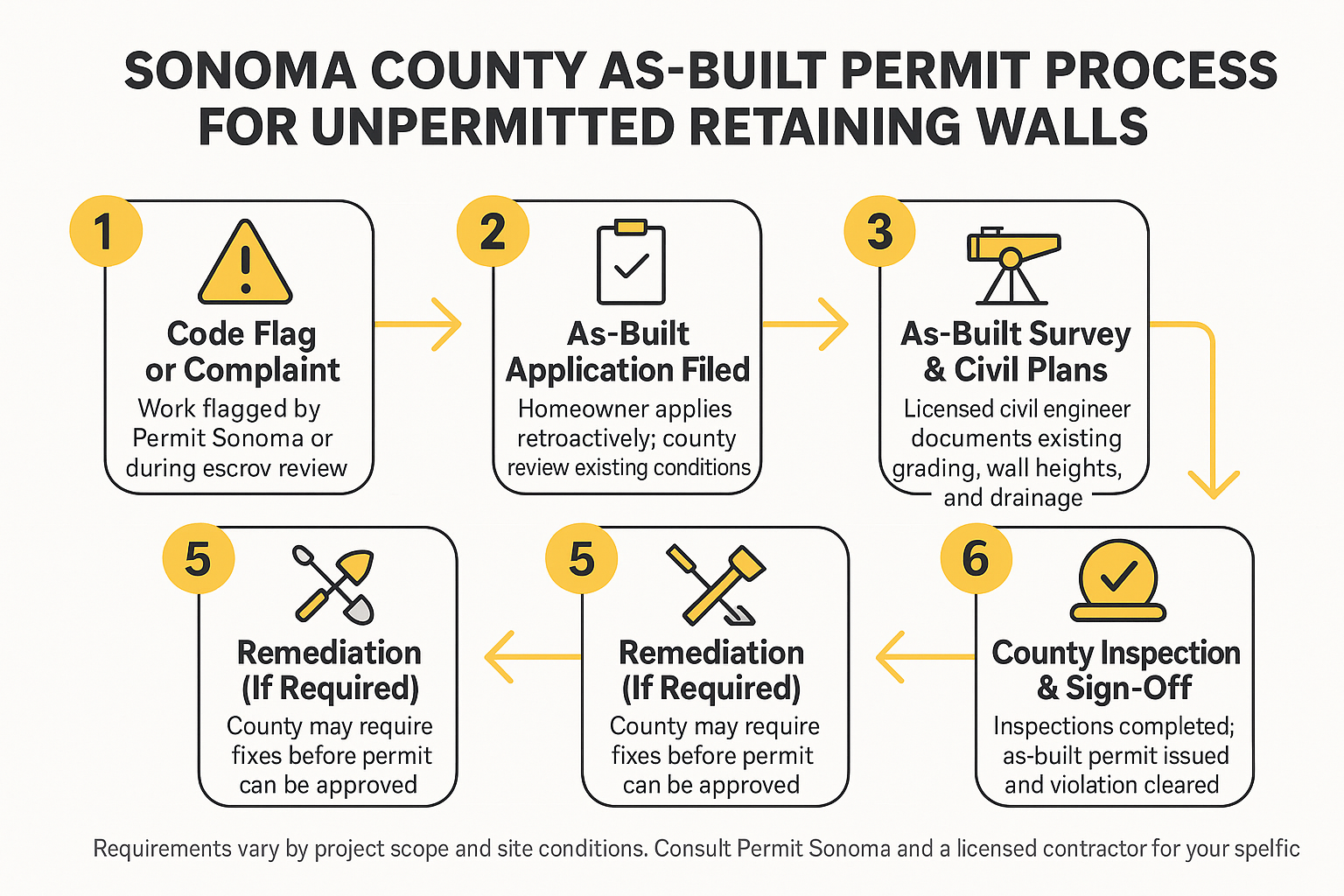
The As-Built Permit Process at a Glance
Here is how the legalization process typically moves from code flag to county sign-off in Sonoma County.
When a Creek or Drainage Channel Is Nearby
One layer that surprises a lot of homeowners is what happens when the unpermitted grading occurred near water. Sonoma County updated its waterway setback rules in February 2026, and those rules apply even when you’re trying to legalize old work.
If the original grading was done within the setback distance of any creek, seasonal drainage channel, or wetland, the most protective setback governs, not the rule that was in place when the work was done. For properties along Mark West Creek, the Laguna de Santa Rosa, or the seasonal drainages that cut through neighborhoods in Healdsburg and Petaluma, this can trigger an additional environmental review as part of the as-built process.
Neither the homeowner nor the original contractor planned for that. But that’s how it works. The as-built review opens the door to a full look at the site under current regulations, not the regulations from nine years ago.
This is one reason I always tell people: the as-built permit process is not simply filing some paperwork. It’s a regulatory review of existing work under today’s standards. How long that review takes and what it surfaces depends heavily on where the work is, how it was done, and who’s doing the documentation now.
If your property backs up to a creek and erosion is also part of the picture, When a Creek Eats Your Property: What Erosion Control on a Riparian Lot Actually Takes covers that side of the situation in detail.
What Permit Sonoma Typically Requires by Site Condition
Requirements for as-built permits vary based on slope, volume, and proximity to water. This is a general reference, Permit Sonoma determines actual requirements case by case.
| Site Condition | Likely Requirement | Who Provides It |
|---|---|---|
| Flat lot, under 50 CY fill | As-built grading plan, basic inspection | Civil engineer |
| Sloped lot, over 50 CY cut or fill | Civil plans + soils engineer report | Civil engineer + geotechnical engineer |
| Cut deeper than 3 feet | Soils engineer evaluation required | Licensed geotechnical engineer |
| Fill on slope steeper than 15% | Full soils report, possible remediation | Geotechnical engineer + contractor |
| Work within creek or wetland setback | Environmental review added to process | Civil engineer + county environmental staff |
Frequently Asked Questions About Unpermitted Retaining Walls in Sonoma County
What happens if I just ignore the code violation notice?
Ignoring it is not a realistic option. Permit Sonoma can place a lien on the property, issue daily fines, and the violation will appear in title searches. If you try to sell the property, it will surface in escrow and either kill the deal or require the work to be legalized before close. The violation doesn’t disappear on its own.
How long does the as-built permit process take in Sonoma County?
It varies widely depending on the scope of the work and whether remediation is required. Simple cases on flat lots can move in a few months. More complex situations involving slopes, soils reports, and environmental review can run six months to a year or more. Getting your civil and soils engineers engaged early is the best way to avoid delays.
Will I have to tear out the existing walls if the soils engineer finds problems?
Not necessarily. In many cases, remediation means adding drainage aggregate behind the wall, reinforcing a footing, or regrading a section, not demolishing everything. But if a wall is structurally unsafe, the county won’t sign off on it as-is. The soils engineer’s report will spell out exactly what has to change.
The walls have been there for nine years with no problems. Does that count for anything?
Practically speaking, no. Permit Sonoma evaluates whether the work meets current code, not how long it has been standing. Nine years without a visible failure doesn’t tell the county whether the walls will hold during a wet year or a seismic event. That’s what the soils engineer determines.
Can an excavation contractor handle the permit side, or do I need to hire engineers separately?
A licensed excavation and general engineering contractor can assist with the site work side of the process, grading corrections, drainage improvements, remediation, but the engineering reports and stamped plans have to come from licensed civil and geotechnical engineers. The contractor and engineers work together on a project like this, but they’re separate relationships.
Does any of this apply to Monterey County properties too?
Yes, though the thresholds differ. Monterey County’s grading permit threshold is 100 cubic yards, double Sonoma County’s 50-cubic-yard limit. The as-built permit concept applies there as well, and the county similarly requires engineering documentation for unpermitted work on slopes. Local regulations and setback rules vary, so the specific requirements depend on which jurisdiction your property falls under.
Facing a Permit Sonoma Flag on Old Grading or Retaining Walls?
If you’ve received a code violation notice or a requirement to legalize unpermitted grading, in Sonoma County, Monterey County, or anywhere on the Central Coast, we’re familiar with the as-built permit process and the site work that often goes alongside it. Reach out to DW Excavation at 707-601-9091 or through the contact page at dw-excavation.com to talk through your situation and figure out what the next step actually looks like for your property.