
Direct Answer: Grading and drainage work in Monterey County generally has to be permitted, built, and protected before October 15, because county rules restrict earthwork until April 15 once the wet season starts.
Every August I start getting the same call from Monterey County property owners. Water sat somewhere it shouldn’t have last winter, and now they want to know how fast something can get fixed.
The honest answer usually surprises them. The limiting factor is almost never the excavator or the crew. It is the October 15 cutoff written into county code, and the permit paperwork that has to clear before that date means anything.
Below is how I walk owners through it: what the El Niño forecast really tells us, why mid-October is a hard line, and the order this work has to happen in so you are not paying twice.
What the El Niño Forecast Actually Tells Us About This Winter
NOAA’s Climate Prediction Center has an El Niño Advisory in effect. Its August 13, 2026 discussion put the odds of a very strong event during fall and winter 2026-27 above 90 percent, with roughly a 97 percent chance the pattern holds into early spring 2027. You can read the current status yourself in the ENSO Diagnostic Discussion.
CPC is also clear that even the strongest events do not hit everywhere the same way. The historical signal is stronger from Santa Barbara south than it is up here in Sonoma or across the Salinas Valley.
So I do not treat this as a rainfall prediction. I treat it as loaded dice, and I plan the way I would any year with a wetter than normal lean:
- Assume the ground could be saturated early rather than late
- Assume at least one long duration system, not just short bursts
- Assume runoff arrives faster on bare, disturbed, or recently burned ground
And here is the part that matters more than the forecast. Whether we get 12 inches in three days or a quiet December, the window to move dirt closes on a fixed date. The sky does not vote on that.
The Real Deadline Is the Calendar, Not the Weather
Monterey County Code Chapter 16.12 is specific. In water supply watersheds and high erosion hazard areas, it prohibits grading over 100 cubic yards between October 15 and April 15 unless the HCD Director specifically authorizes it. It also caps land clearing at one acre per year per site, and it requires erosion protection to be installed and maintained through at least one winter until permanent protection is established.
Sonoma County works the same way in practice. Project conditions routinely require grading to happen in the dry season, April 1 through October 15, with work suspended during unseasonable rainfall greater than half an inch in 24 hours.
Spell that out in plain terms and it lands hard. Earthwork that misses mid-October generally waits until April 15. That is a six month delay, not a six week one.
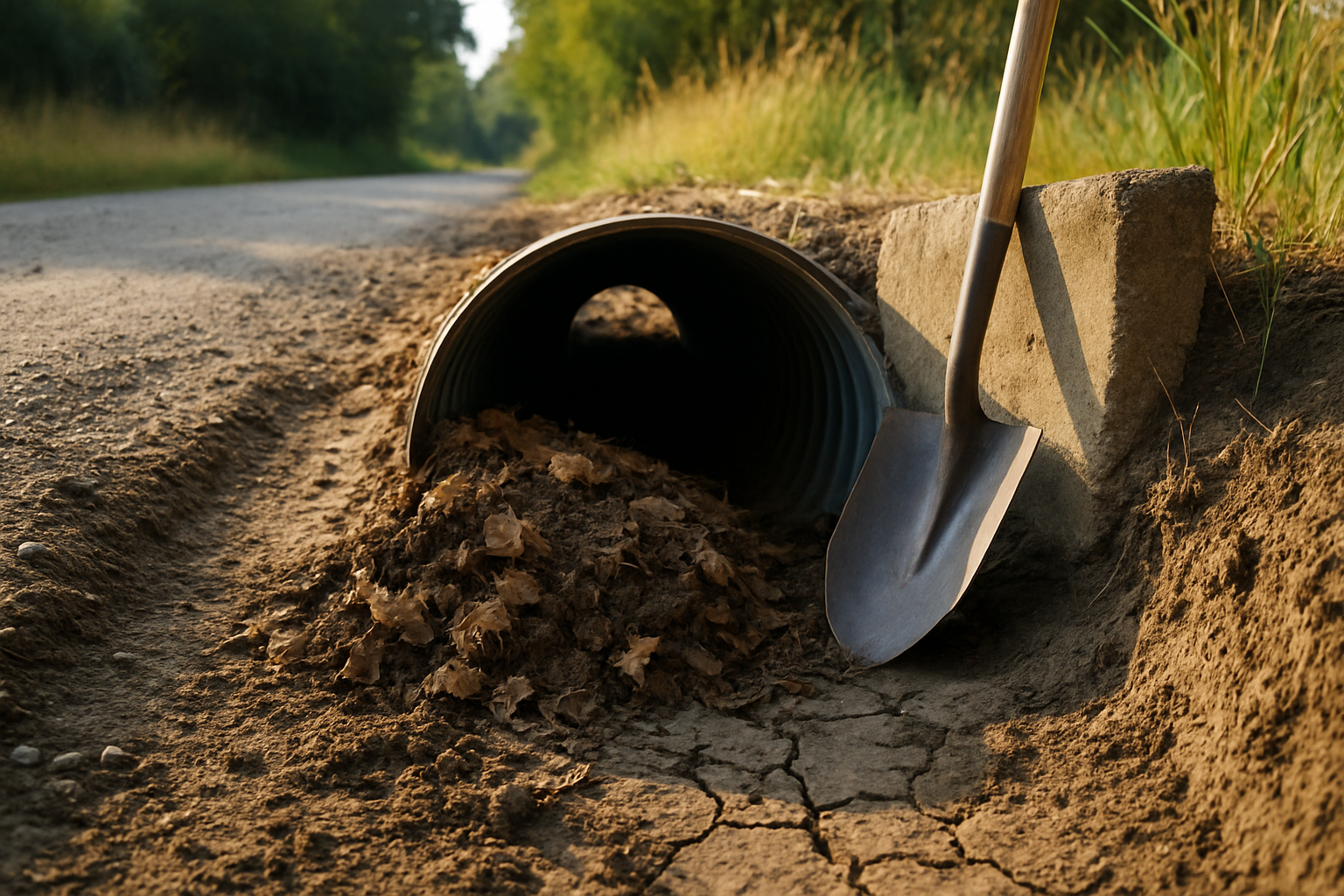
I have had owners call me in late November about a pad that needs cutting, fully expecting to break ground before Christmas. What they are actually looking at is a spring start, a winter of watching the problem get worse, and a repair bill that grew in the meantime. If you want to see how that plays out on a slope, we wrote about what one unfixed winter does to a hillside.
Walk Backward From October 15 So You Can See Where the Time Goes
Most owners picture a start date. I picture a permit calendar working backward from mid-October, because the paperwork is the long pole, not the machine.
In unincorporated Sonoma County a grading permit gets triggered by any of these:
- Cut or fill over 50 cubic yards
- Cut or fill deeper than 3 feet
- A cut slope over 5 feet high and steeper than 2:1
- Fill over 1 foot deep supporting a structure on terrain steeper than 15 percent
Monterey County’s threshold sits at 100 combined cubic yards. Different number, same effect: cross it and you are in a review process, not a scheduling conversation.
A few things eat more time than people budget for:
- Drainage work in Sonoma can require a separate drainage permit with a drainage report showing no adverse impact on neighboring parcels
- Engineered grading plans have to be drawn and stamped by a civil engineer
- Permit Sonoma requires a pre-construction consultation before any approved work begins
Add a soils report on a slope and you can lose weeks before anyone touches soil. If you are not sure whether your project needs engineered plans, start with how a civil site plan connects to a grading permit. A September phone call is often really an August decision.
Sonoma and Monterey County Grading Rules Side by Side
Two counties, two sets of numbers. Here is the short reference I give owners who work on both sides of the line.
| What Applies | Sonoma County (Unincorporated) | Monterey County |
|---|---|---|
| Grading permit threshold | Cut or fill over 50 cubic yards | 100 combined cubic yards |
| Other permit triggers | Cut or fill deeper than 3 ft; cut slope over 5 ft at steeper than 2:1; fill over 1 ft under a structure on 15 percent terrain | Land clearing capped at one acre per year per site |
| Dry season window | Grading conditioned to April 1 through October 15 | Grading over 100 cubic yards restricted October 15 to April 15 in water supply watersheds and high erosion hazard areas |
| Rain shutdown rule | Work suspended during unseasonable rain over 0.5 inch in 24 hours | Erosion protection maintained through at least one winter until permanent protection is established |
| Extra steps that add time | Possible separate drainage permit with drainage report; pre-construction consultation required | HCD Director authorization needed for wet season grading |
The Order This Work Has to Happen In
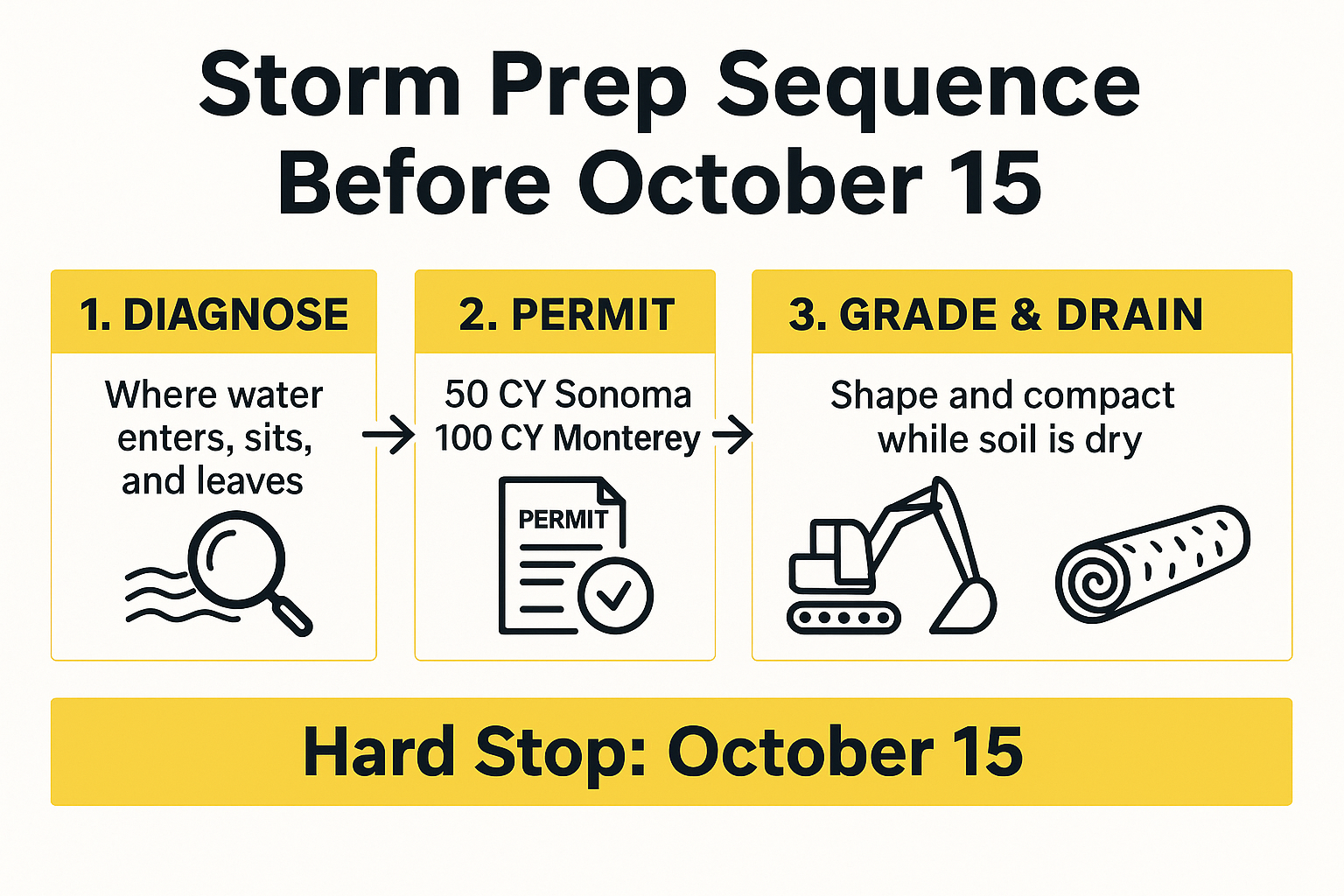
Storm prep done out of order wastes money. This is the sequence I follow on nearly every property, from a Salinas Valley ranch road to a hillside lot above Carmel.
Diagnosis First, Dirt Second, Cover Last
The most expensive mistake I see is buying a fix before anyone figured out the cause. Water pooling because a pad is flat is a completely different repair from water pooling because a culvert failed or a creek bank walked off.
So I start by tracing three things on the property:
- Where water enters the site, including flow coming off a neighbor or an uphill road
- Where it sits, and how long it stays there after a storm
- Where it is supposed to leave, and whether that outlet still works
Grading and drainage structures come next, while the ground is still dry enough to compact properly. Erosion protection goes on last, so bare soil is not sitting exposed for weeks waiting on the next phase.
One homeowner along a Santa Rosa creek described losing many cubic yards of usable land every winter and worried the house itself could eventually be at risk. Their ask was simple and I hear a version of it constantly: “We want to mitigate this erosion in the most cost effective way possible.” A Healdsburg vineyard I know regrades and re-gravels its main roads every single year with the goal of storm proofing before the dust suppressant goes down.
Worth knowing: the median Sonoma County home was built around 1979, and plenty of Monterey County drainage is older than that. Most of it was designed under half century old assumptions about how much rain shows up at once. That is a factual reason to re-check a property, not a scare tactic. The 2023 Pajaro flooding is a reminder of what happens when old infrastructure meets a modern storm.
What Drives the Cost, and Why September Is Cheaper Than February
Owners here are usually land rich and cash conscious, and almost everyone wants a ballpark before they will commit to a site walk. I understand that, so instead of dodging, I explain what actually moves the number:
- Equipment access. A machine that can drive to the work costs less than one that has to be walked in or worked around structures.
- Haul distance. Excess soil has to go somewhere, and the miles add up. We covered where dirt from a site cut ends up if you want the details.
- Soil type. Sonoma clay and Monterey sand behave differently for cut, compaction, and trench stability.
- Permit exposure. How much of the work sits above the 50 or 100 cubic yard thresholds.
- Engineering. Whether a soils report or a civil engineer’s stamp is required.
Then there is the seasonal wrinkle that matters most right now. Trenching and grading in saturated ground costs more and takes longer than the same job in September. You get shoring requirements, compaction that will not hold, and weather delays that stack up.
A real number still comes from standing on the property. Photos and satellite views hide the exact things that change the price.
What Still Gets Done After the Window Closes
Missing October 15 does not mean nothing can happen. It means the menu shrinks:
- Small work that stays below permit thresholds
- Cleaning and clearing existing culverts, inlets, and ditches
- Maintaining erosion measures already in place
Anything larger becomes a conversation with the county rather than a scheduling question, and in Monterey that means asking HCD for authorization you may not get.
January 2026 showed how this market behaves under stress. King tides and storm surge pushed San Francisco’s tide 2.56 feet above normal, Highway 37 closed at the Highway 121 interchange in Sonoma County, and portions of Highway 68 and Highway 1 closed in Monterey. Search demand for excavation contractors in the Monterey-Salinas area jumped roughly nine times its normal monthly level that month.
Every crew in two counties gets the same phone calls in the same week. That is just what happens after a storm, and it is worth knowing while you are picking between a September start and hoping for a dry January.
Frequently Asked Questions About the October 15 Grading Deadline
Does the October 15 rule apply to my property, or only to big projects?
In Monterey County it bites hardest on grading over 100 cubic yards in water supply watersheds and high erosion hazard areas. Smaller work and maintenance often continue, but if your project crosses a permit threshold, assume the wet season restriction applies until someone confirms otherwise.
How much lead time do I need if I want work done this fall?
It depends on whether engineered plans are required. A straightforward job below permit thresholds can move quickly. Anything needing a civil engineer’s stamp, a soils report, or a drainage report should be started weeks ahead, because the review clock is not something a contractor controls.
Can I just install drainage after the rain starts, when I can see the problem?
Watching where water goes during a storm is genuinely useful information. Building in that same saturated ground is the expensive part, because compaction fails and permits get restricted. The better plan is to document what happens this winter and schedule the fix for after April 15.
What does a super El Niño actually mean for Monterey County specifically?
CPC’s own language is that strong events do not deliver the same impact everywhere, and the historical signal is stronger south of Santa Barbara. For us it tilts the odds toward a wetter winter without guaranteeing one. Prepare the property the way you would for any wet year and the forecast stops mattering much.
Is erosion control alone enough if I cannot get grading done in time?
Sometimes, for one season. Straw wattles, fabric, and cleared culverts buy time on a site that is close to stable. They do not fix a pad that drains toward a foundation or a creek bank that is actively retreating, and Monterey code expects protection to be maintained through at least one winter either way.
Planning Site Work Before the Mid-October Window Closes?
We are a licensed California General Engineering Contractor, CA LIC #1060838, based in Windsor and working since 2013 across Sonoma’s clay hillsides and Monterey County’s coastal slopes, with permit coordination through Permit Sonoma and Monterey County HCD handled as part of the job rather than left on the owner’s desk. If you want a site walk or a straight conversation about whether your project crosses a permit threshold this season, we have availability ahead of the mid-October date. Reach us at 707-601-9091 or through the contact page at dw-excavation.com.