Direct Answer: Neighborhood utility undergrounding requires coordinated trenching to specific depths, utility separation standards, 811 locates, and proper backfill, all managed separately from the utility company’s own installation crew.
A neighborhood association in Carmel recently submitted a form to our team after receiving approval for a full street undergrounding project. Their message was short: they had program approval, they had a utility company involved, and they needed someone to quote the trenching. What they didn’t yet know was how much work lives on the excavation side of that project, work that the utility company doesn’t touch.
Neighborhood utility undergrounding is one of the most coordination-heavy jobs in the excavation trade. You’re not digging a single trench for a single property. You’re sequencing multiple runs across an entire right-of-way, working around existing utilities, and handing off a finished surface that has to perform for decades.
This article walks through what that excavation scope actually looks like from the field, what the pre-dig coordination requires, what physical conditions make Carmel-area undergrounding especially complex, and why backfill and surface restoration matter as much as the trench itself.
Who Does What When a Utility Company Is Already Involved
This is the question I hear first on almost every undergrounding inquiry. If PG&E or a similar provider is already assigned to the project, why does the neighborhood still need to hire an excavation contractor?
The short answer: the utility company manages their equipment, their conduit, and their connections. They don’t dig your street.
Programs like PG&E Rule 20 provide funding or coordination for converting overhead lines to underground systems in qualifying areas. But Rule 20 assigns a utility project manager who handles the electrical infrastructure side. The trenching scope, cutting the road, digging to depth, maintaining required separation between conduit runs, backfilling, compacting, and restoring the surface, falls on a licensed general engineering contractor hired by the association or improvement district.
For a homeowners association that has never managed a civil construction project, this division catches people off guard. The utility approval is real and the program funding is real, but none of it digs the trench. That part needs a separate contractor with the right license and the right equipment.
In California, that contractor license is a General Engineering Contractor (Class A), not a general building contractor and not an unlicensed crew. Underground utility work on public or shared right-of-way requires it.
Why the Pre-Dig Phase Takes as Long as the Digging
Before a single bucket of soil moves on a neighborhood undergrounding job, there’s a coordination phase that most property owners don’t budget time for. In California, Government Code 4216 requires excavators to notify all underground utility operators through DigAlert (811) before any digging begins. On a single-property job, that’s a straightforward process. On a neighborhood project with multiple trench runs and concurrent excavation sequences, it becomes a real project management challenge.
Here’s what that phase involves on a job like the Carmel street undergrounding inquiry we received:
- 811 notifications must be submitted for every planned excavation area, triggering locate requests from each affected utility operator
- Each operator has up to two working days to respond and mark their lines, but that clock runs per notification, not per project
- On a multi-block project, notifications are typically staged in sequences to avoid conflicts between locating crews and active excavation
- Any utility line discovered outside its marked location during digging stops work until the discrepancy is resolved
- Potholing, digging small exploratory holes to visually confirm buried line locations, is often required before full trenching begins in congested areas
On an established Carmel coastal block, there may be decades-old irrigation systems, private utility runs, and unmarked improvements that don’t show up on any record. I’ve seen pre-dig coordination on a job like this take three to four weeks before the main excavation can start. That timeline isn’t a contractor being slow, it’s the process working correctly.
What Makes Coastal Neighborhood Trenching Physically Harder Than a Raw Site
A greenfield development site gives you room to work. An established neighborhood in Carmel or Pacific Grove does not.
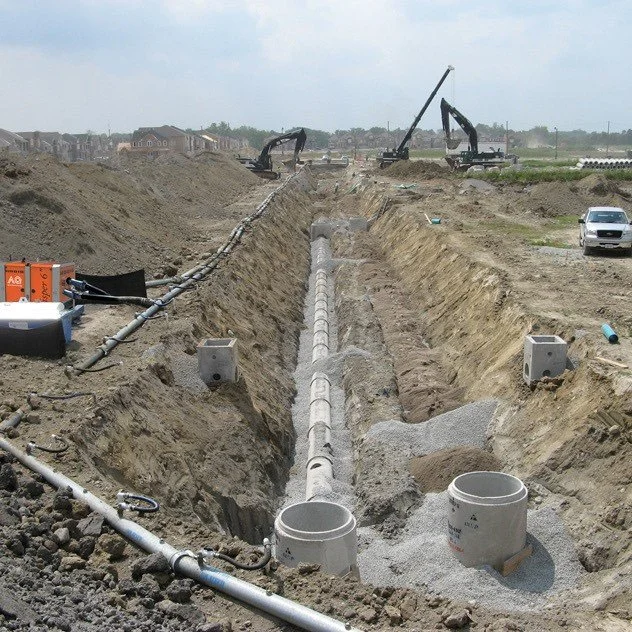
The physical constraints on a coastal block undergrounding job are stacked in ways that a raw site job never is. Right-of-way widths in older Carmel streets can be narrow enough that the trench, the spoil pile, equipment access, and pedestrian clearance are all competing for the same few feet. Add existing mature landscaping, ornamental hardscape, private irrigation runs, and driveways crossing the right-of-way, and every hundred feet of trench line carries its own set of obstacles.
Depth and separation requirements add another layer. Electrical conduit, gas lines, and communications conduit all run at different minimum depths, and they must maintain required horizontal and vertical separation from each other. On a project installing multiple utility types in the same corridor, the trench profile has to accommodate all of them without violating any of those standards. Getting that geometry wrong means rework.
For context on what this kind of work demands in Monterey County terrain more broadly, our article on coastal lot site prep in Monterey County covers how coastal conditions change excavation decisions from the ground up. The short version: coastal soils, tight access, and older infrastructure require more planning, not less.
The Carmel community near Martin and Bayview that reached out to us sits in exactly this kind of environment, narrow streets, established plantings, and a coastal ground profile that doesn’t behave like a flat inland site.
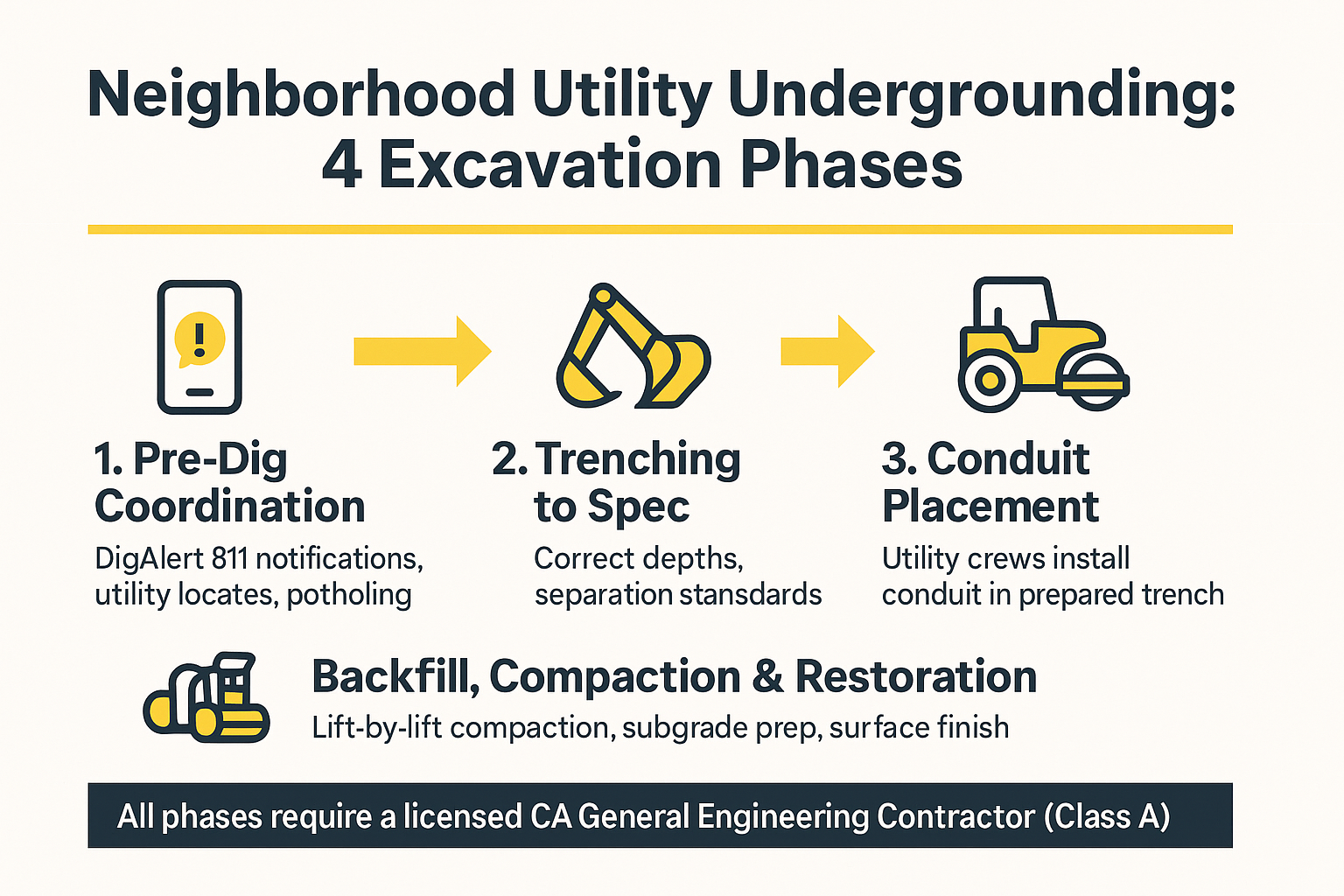
The Four Phases of Neighborhood Undergrounding Excavation
This breakdown shows the four sequential phases a licensed excavation contractor manages on a neighborhood utility undergrounding project, from pre-dig coordination through surface restoration.
Backfill and Compaction Are Not the Easy Part
I want to spend real time on this because it’s the piece that gets treated as an afterthought on a lot of undergrounding jobs, and it’s where failures show up two years later.
Once conduit is placed and inspected, the trench gets backfilled. How that backfill is placed and compacted determines whether the road surface above it holds up or starts to settle and crack within a season or two. Under a paved road or a concrete driveway approach, poorly compacted trench backfill creates voids that compress under traffic load. That settlement can crack the pavement, damage the conduit below, and require the street to be opened again. The cost of that rework is almost always more than doing it right the first time.
Proper backfill on a street-level undergrounding project involves:
- Select fill or engineered backfill material placed in controlled lifts, not dumped and pushed in one pass
- Compaction testing at each lift to verify density before the next layer goes down
- Subgrade preparation that matches the specifications of whatever surface finish, asphalt, concrete, or decomposed granite, is going back on top
- Coordination between the excavation contractor and the paving or concrete crew so the transition layers are consistent across the entire trench run
This is why the excavation contractor and the surface restoration work need to come from the same plan. When those scopes are handed off to separate crews without a shared compaction standard, the results are inconsistent. I’ve seen roads repaved over under-compacted trench lines that started showing settlement ruts within eight to ten months of completion.
For a related look at what happens to pavement when subsurface work isn’t done right, our article on what actually happens under pavement when the ground shifts gets into the mechanics of why surface failures trace back to what’s below.
What the Excavation Contractor Handles vs. the Utility Company
On a neighborhood undergrounding project, the division of work between the utility provider and the excavation contractor is often misunderstood. This table shows how responsibilities typically break down.
| Scope Item | Utility Company (e.g. PG&E) | Licensed Excavation Contractor |
|---|---|---|
| 811 utility locates for excavation areas | Responds to locate requests | Submits notifications, manages sequencing |
| Trench excavation and earthmoving | Not involved | Full responsibility |
| Conduit and cable installation | Full responsibility | Not involved |
| Trench depth and separation compliance | Specifies requirements | Executes and verifies in field |
| Backfill and compaction | Not involved | Full responsibility |
| Road surface restoration | Not involved | Coordinates with paving crew or self-performs |
| Permit coordination (grading, encroachment) | Not involved | Manages with county/municipality |
| Potholing and conflict resolution | Marks existing lines | Performs exploratory digging |
Permits and County Coordination on a Carmel-Area Undergrounding Project
Work within a public right-of-way in Monterey County requires an encroachment permit from the county or the city, depending on jurisdiction. For a neighborhood street undergrounding project in Carmel, that typically means coordinating with the City of Carmel-by-the-Sea or Monterey County Public Works, depending on whether the street is city or county maintained.
If the total earthmoving volume on the project exceeds 100 cubic yards, Monterey County’s threshold for a grading permit, a grading permit is also required. On a full-block undergrounding project, it’s worth calculating that number early rather than assuming you fall under it.
The permit coordination piece is something our team handles as part of the project scope, not as a separate service line. Getting these applications filed correctly, with the right plans and the right agency, is how you avoid work stoppages mid-project. For a deeper look at what civil site planning and permit coordination involve before excavation starts, our article on what a site plan actually controls walks through why this step matters more than most owners expect.
Frequently Asked Questions About Neighborhood Utility Undergrounding Excavation
Our HOA has PG&E Rule 20 approval. Do we still need to hire a separate excavation contractor?
Yes. Rule 20 approval covers the utility side of the project, the electrical infrastructure and the utility company’s own installation work. The trenching, backfill, compaction, and surface restoration are civil construction scope that a licensed Class A General Engineering Contractor performs under a separate contract. The utility project manager won’t be managing that work.
How long does the 811 locate process take on a neighborhood-scale project?
Longer than most people expect. Each utility operator has up to two working days to respond after notification, but on a multi-block project with staged trench sequences, notifications are submitted in waves to keep locating crews and active excavation from conflicting. From first notification to full clearance on a neighborhood undergrounding job, the pre-dig coordination phase commonly runs three to four weeks.
What depth do the conduit runs need to be?
Minimum depths vary by utility type. As a general reference, electrical conduit under a road typically requires 24 inches of cover, communications conduit runs shallower, and gas lines have their own depth and separation requirements. The utility provider specifies the installation standards for their conduit, and the excavation contractor digs to meet them. Actual depth requirements on your project will depend on the utility types involved and the local jurisdiction.
What happens if the trench hits an unmarked utility line?
Work stops until the conflict is resolved. The excavation contractor notifies the relevant utility operator, and potholing or hand-digging is used to expose and identify the line before mechanical excavation resumes. This is one reason the pre-dig coordination phase matters, finding conflicts before the full trench is open is much less disruptive than discovering them mid-dig.
Can the road surface be restored to match the existing pavement after the trench is backfilled?
In most cases, yes, but the quality of the match depends on how well the subgrade and compaction work was done before paving. Asphalt trench patches that start settling or cracking within the first year almost always trace back to under-compacted backfill, not the paving material itself. Coordinating the excavation scope and the surface restoration scope under one plan produces a more consistent result.
How much does neighborhood undergrounding excavation cost?
There’s no honest single-number answer for a project like this. Cost depends on the linear footage of trench, soil conditions, right-of-way constraints, the number of utility types being installed, existing conflicts to work around, and the surface restoration required. A Monterey County undergrounding job on a narrow coastal street with established hardscape and mature landscaping will cost more per linear foot than a straightforward suburban block. The right starting point is a site visit and a detailed scope review, contact our team for a project-specific estimate.
Planning a Neighborhood Undergrounding Project in Monterey County?
If your HOA or street improvement district has received undergrounding approval and you’re trying to understand the excavation scope, we’re available to walk through it with you. Our team has worked on utility trenching projects throughout Monterey County and the Central Coast, and we understand both the coordination requirements and the physical conditions that make coastal neighborhood jobs different from a standard site. Call us at 707-601-9091 or visit the contact page at dw-excavation.com to request a project review.