Direct Answer: A building pad is a precisely graded and compacted earth platform that supports a foundation or slab. It requires engineered soil preparation, proper drainage slope, and stable subsoil — not just a level-looking piece of ground.
Most homeowners I talk to hear the term building pad from their engineer or contractor and nod along without really knowing what it means. That’s understandable — it sounds simple enough. But what happens beneath that pad is the difference between a foundation that performs for decades and one that starts cracking within a few years.
In Monterey County, the stakes are higher than most people expect. Coastal moisture, steep grades in places like the Pebble Beach and Carmel corridor, and the kind of heavy rainfall events we saw during the atmospheric river season of late 2024 put real pressure on any site that wasn’t prepared correctly from the ground up. If the pad isn’t built right before the concrete crew shows up, nobody can fix it cheaply later.
I want to walk through what building pad construction actually involves, where the process tends to go wrong on local residential projects, and what the permit picture looks like in this county — because all three of those things are connected in ways that catch homeowners off guard.
What a Building Pad Actually Is (and What It Is Not)
A building pad is the engineered, compacted earth platform that a foundation or slab gets built on top of. The word “pad” makes it sound like something you just smooth out. It isn’t.
Building a proper pad starts with removing everything that doesn’t belong under a structure:
- All topsoil, vegetation, and root systems
- Organic matter of any kind — it decompresses over time and causes the ground to settle unevenly
- Any loose or soft subsoil that can’t support the load above it
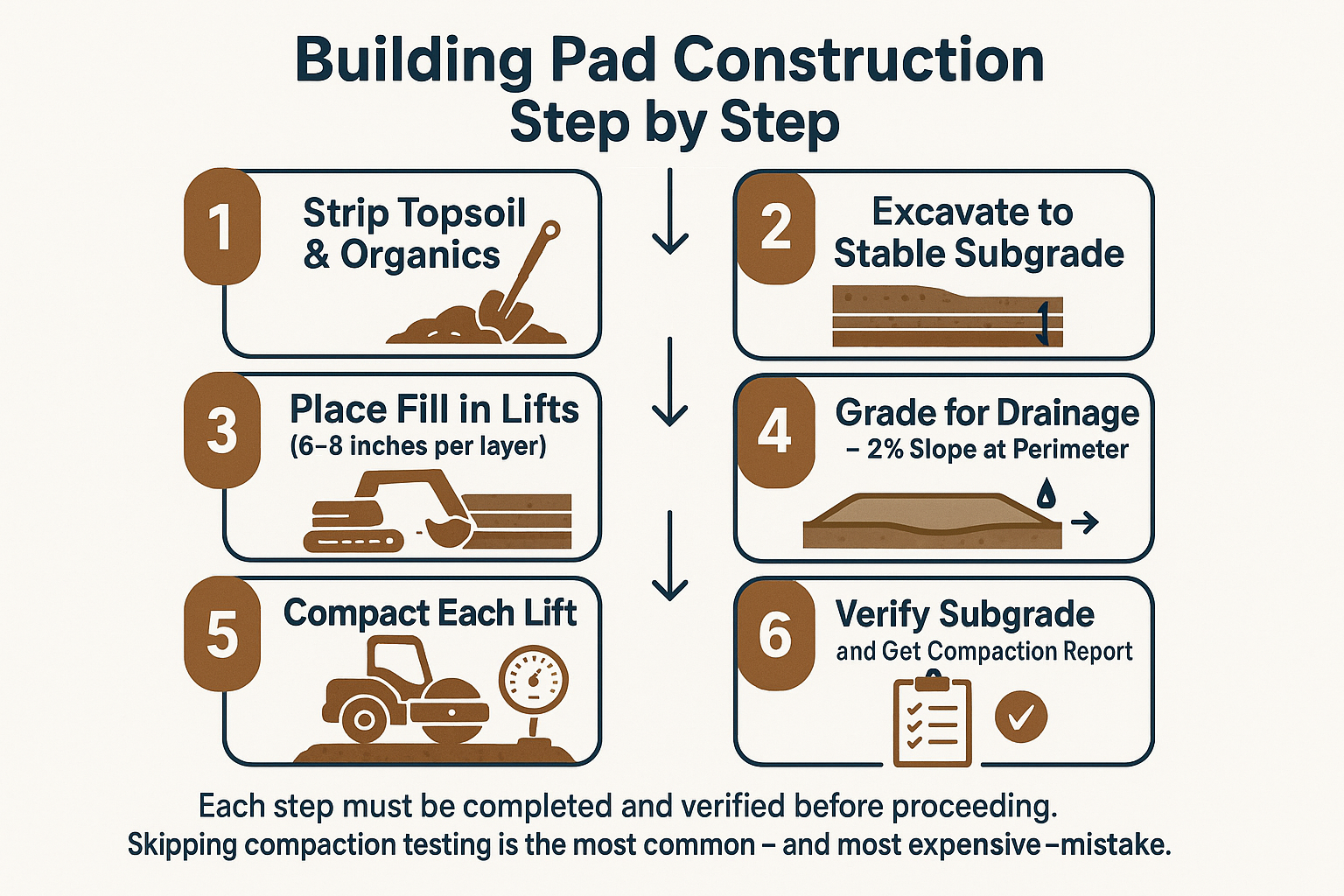
Once that material is stripped, the ground either gets excavated down to stable subgrade or built up with compacted fill. If fill is needed, it goes in measured layers called lifts — typically 6 to 8 inches at a time — with compaction testing between each one. What actually happens underground before a foundation gets poured covers this sequence in more detail, but the short version is: the process is slow and deliberate on purpose.
The reason I emphasize this with customers is that a pad built on unverified fill is one of the most common sources of foundation failure before a home is even finished. It doesn’t show up at inspection. It shows up three years later when the slab starts to move.
The Drainage Problem That Looks Like a Grading Problem
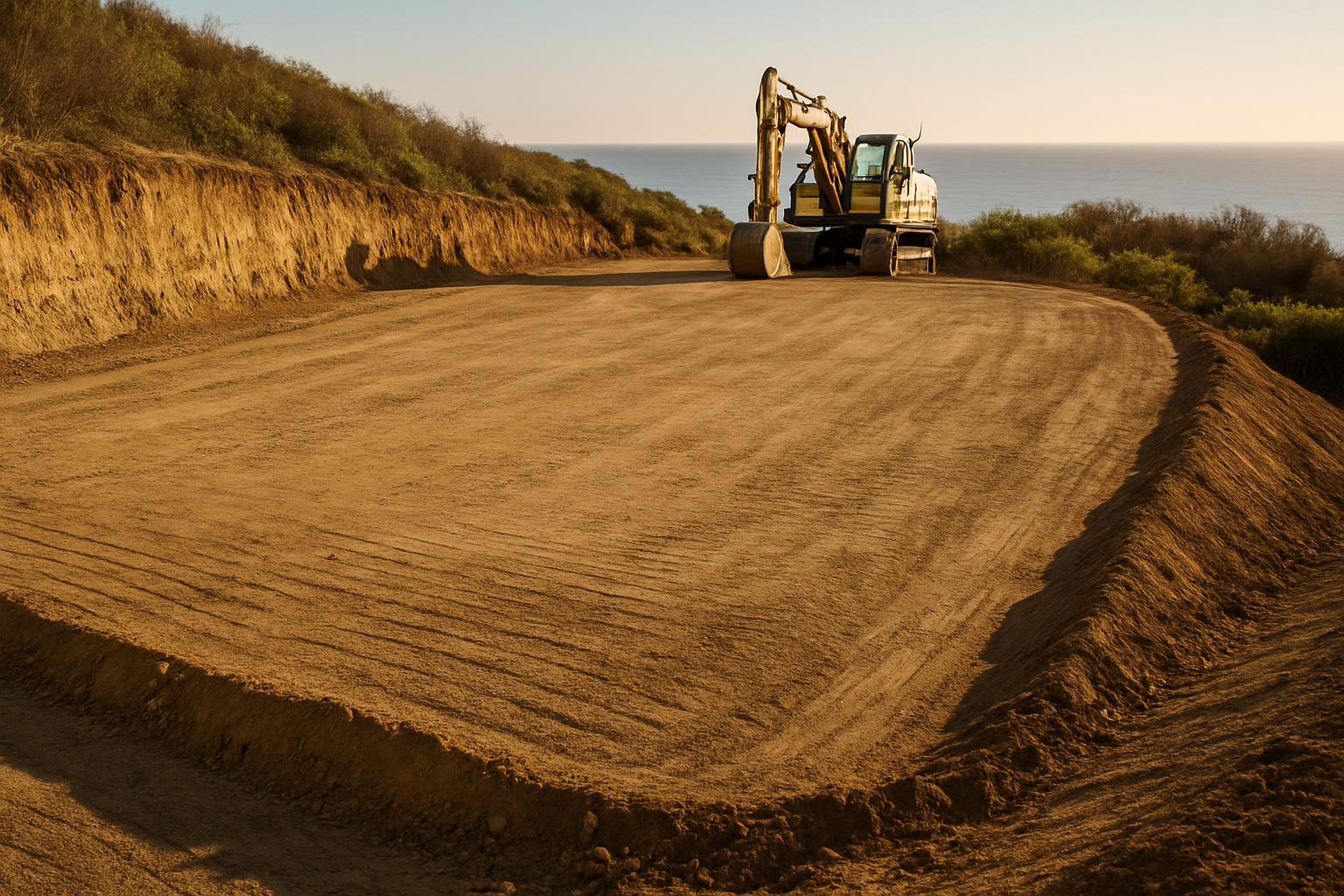
One of the most common mistakes I see on residential projects in this area is confusing looks flat with properly graded. They are not the same thing.
A finished building pad has to do two things at once that sound contradictory:
1. Present a level base for the foundation crew to work from
2. Shed water away from the structure at the perimeter
The standard minimum is a 2% slope away from the building footprint at the edges, while the interior of the pad remains level. That 2% is not visible to the naked eye — you need a grade rod and a level to confirm it. When that outward slope is missing or reversed, water moves toward the foundation instead of away from it.
In Monterey County, this matters from day one of the design. The Pebble Beach and Carmel coastal corridor — where grades are steeper and coastal moisture is constant — requires drainage to be baked into the pad design before anyone pours concrete. We’ve seen projects in that area where drainage was treated as an afterthought, and the repair costs years later ran well into the tens of thousands. Why drainage trenching fails and what a proper install actually requires gets into the details of what happens when water has nowhere to go.
If your property sits in a low area or has any grade toward the building footprint, that issue has to be solved at the pad stage — not after the slab is in place.
How a Building Pad Gets Built: The Sequence That Matters
The order of operations on a building pad isn’t flexible — each step depends on the one before it being done correctly.
Sloped Lots Change Everything — Especially the Permit Picture
A flat lot in Salinas and a sloped parcel near Carmel Valley Village are two completely different problems, even if the structure going on top is identical. I get calls regularly from homeowners planning ADUs or new builds on hillside properties who didn’t realize that a slope fundamentally changes the scope of the work — and what the county requires before it starts.
On a sloped lot, building a pad requires a cut-and-fill plan: you excavate material from the high side and place it on the low side to reach the target elevation. When that balance is off — when too much fill goes on the low side without adequate compaction — the fill side settles. Sometimes slowly, sometimes faster than anyone expects after a wet winter.
In Monterey County, grading permits are required for any cut or fill exceeding 100 cubic yards. Depending on slope and soil conditions, the county may also require a drainage report as part of the application. A sloped lot with a cut-and-fill pad can hit those thresholds faster than property owners expect — especially when you account for haul-off of excess material.
When the engineered grading category applies, a licensed civil engineer has to stamp the plans. That changes both the timeline and the cost picture significantly. Understanding when a civil site plan is required before you can pull a grading permit walks through how that process works in California.
In Sonoma County, where we also work extensively, the threshold is lower — 50 cubic yards before a grading permit is required from Permit Sonoma. Either way, starting earthwork without the permit in hand is a code violation. It can result in stop-work orders, fines, and in some cases a requirement to undo the completed work. We’ve seen that happen, and it is not a recoverable situation cheaply.
Monterey County vs. Sonoma County: Grading Permit Thresholds at a Glance
Permit requirements vary by county and project type. Here’s a quick comparison of the two markets we work in most often.
| Factor | Monterey County | Sonoma County |
|---|---|---|
| Grading permit threshold | 100 cubic yards (cut or fill) | 50 cubic yards (cut or fill), or any cut deeper than 3 feet |
| Drainage report required? | Often yes, especially on sloped sites | Depends on project classification |
| Engineered grading category | Required above threshold or on complex slopes | Required above threshold — licensed civil engineer must stamp plans |
| Permit authority | Monterey County Resource Management Agency | Permit Sonoma |
| Consequence of unpermitted work | Stop-work order, fines, possible reversal of completed work | Stop-work order, fines, possible reversal of completed work |
What Soil Conditions in This Region Actually Do to a Building Pad
Monterey County soil is not uniform, and that matters more than most homeowners realize when they’re planning a new build.
In the Salinas Valley, agricultural soils are deep and relatively stable — but the water table in low-lying areas can be high, which affects how deep you have to go to reach a reliable subgrade. In the Carmel and Big Sur corridor, you’re often working on steeper grades with soil that has a higher clay and rock content, requiring more precise compaction work and drainage planning.
The soil conditions that make foundation work harder in Monterey County are worth understanding before you break ground. Expansive clay in particular — the kind that swells when wet and shrinks when dry — can shift a pad seasonally in ways that show up as foundation cracks years later. The fix at that stage costs far more than getting the compaction right the first time.
According to the USDA Natural Resources Conservation Service, much of coastal California contains soils with moderate to high shrink-swell potential — a factor that directly affects how building pads need to be engineered and tested before a foundation crew arrives.
What Building Pad Work Tends to Cost — and What Drives It
I won’t put a specific number on this because it varies too much to be honest about in a general article. But I can explain what actually drives the cost, so you know what questions to ask.
The factors that push the price up on a building pad include:
- Slope of the lot — a cut-and-fill job on a hillside is more work and more equipment time than grading a flat parcel
- Soil conditions — hard rock or high clay content requires more passes, slower compaction, and sometimes soil amendment
- Volume of material — both how much gets excavated and how far it needs to be hauled off the site
- Drainage infrastructure — whether the pad design requires French drains, swales, or other drainage systems built in from the start
- Permit and engineering fees — if the project requires engineered grading, the civil engineer’s work adds to the overall cost picture before our equipment ever moves
On a modest residential lot in the Monterey area, the site prep and pad work alone — not including foundation work — can vary widely depending on those factors. Getting a site-specific estimate from a licensed contractor is the only way to get a number that’s actually accurate for your property. How to tell if your property was graded right before it costs you is worth reading if you’ve already had work done and want to know whether it was done correctly.
Frequently Asked Questions About Building Pad Construction
Can I just have the lot leveled and skip the compaction testing?
No — and this is the mistake I see most often. A pad that looks flat isn’t necessarily stable. Compaction testing confirms that the soil can actually support the load above it. Without it, you have no way of knowing whether the fill was placed correctly, and no documentation for your building department or foundation contractor. Skipping it saves a small amount upfront and costs a large amount later.
How do I know if my lot needs a grading permit before we start?
In Monterey County, any cut or fill over 100 cubic yards requires a permit from the county’s Resource Management Agency. A modest building pad on a sloped lot can exceed that threshold. The safest approach is to have a contractor or civil engineer estimate the earthwork volume before you start — not after. Sonoma County’s grading permit rules are different if you’re working in that market.
What’s the difference between regular grading and engineered grading?
Regular grading follows standard cut-and-fill practices and may not require a licensed engineer to stamp the plans, depending on scope. Engineered grading applies when the project exceeds permit thresholds, involves complex slopes, or falls into a category the county designates as higher risk. When engineered grading applies, a licensed civil engineer has to design and stamp the grading plan before the permit gets issued. That adds time and cost to the front end of the project.
We’re building an ADU on a sloped lot in Carmel Valley. Does any of this apply?
Yes, very directly. A sloped lot requires a cut-and-fill plan, and ADU projects are subject to the same grading permit thresholds as any other construction. If the earthwork exceeds 100 cubic yards in Monterey County, a permit is required. The good news is that getting the pad right from the start on a sloped ADU project protects the structure for decades — it’s not overhead, it’s the foundation of the whole investment.
How long does building pad work take before the foundation crew can come in?
It depends on site conditions and the permit process, but the earthwork itself on a typical residential pad — stripping, excavating, placing and compacting fill in lifts, and final grading — can take anywhere from a few days to a few weeks depending on slope, soil, and volume. If engineered grading is required, add the time needed for civil plan preparation and permit review before equipment can move. Planning around those timelines from the start avoids schedule problems later.
Planning a New Build or ADU in Monterey County?
If you’re at the planning stage — or you’ve already broken ground and something doesn’t look right — we’re glad to take a look. DW Excavation works throughout Monterey County, Sonoma County, and the broader Central Coast on exactly this kind of site prep work, and we know how to move through the local permit process without losing time. Call us at 707-601-9091 or reach out through the contact page at dw-excavation.com to request a free estimate.