
Direct Answer: If water pools near your foundation, erosion channels are forming on slopes, or your yard drains toward the house, your property is not ready for a major El Niño season.
Most Monterey County homeowners don’t find out their property has a drainage problem until they’re watching water creep toward the back door. By then, the damage is already happening underground — where you can’t see it and can’t stop it.
El Niño years don’t give you a gradual warm-up. The Pajaro Valley flooding in March 2023 showed exactly what happens when saturated ground meets a back-to-back storm system — levees failed, roads washed out, and properties that had drained fine in a normal year became disaster zones overnight. Coastal Monterey and Salinas-area properties are especially exposed because the combination of clay-heavy soils, shallow water tables, and compressed flood plains leaves almost no margin for error.
Walk your property with these five warning signs in mind. If any of them match what you’re seeing, you have time to fix it before the season turns — but that window closes fast.
1. Water Pools in the Same Spots After Light Rain
If you’re seeing standing water after a half-inch of rain, pay attention. That’s not a quirk of the storm — it’s your property telling you where the drainage system has failed. What happens after five inches is not a bigger version of the same puddle. It’s a flood.
Pooling near a foundation is the most serious version of this problem. Water that sits against a stem wall or slab is actively working on your foundation — softening the base layer, increasing hydrostatic pressure against the wall, and setting up the kind of long-term structural damage that’s expensive to fix. Pooling along a driveway edge usually means the base layer is already compromised. Once water gets underneath, it doesn’t leave — it migrates.
In Monterey County, the combination of clay-heavy soils and coastal fog moisture means the ground stays saturated longer than it would in inland areas. That extends how long your drainage system has to perform under load. If it’s already backing up at light rain volumes, it won’t survive a sustained storm system.
If you want to understand what’s actually happening below the surface when water starts moving through weak spots, why water pools in the same spot every time it rains explains the most common causes.
2. You Can See Erosion Channels Forming on Any Slope
Walk your property after any rain event and look at every slope, hillside, or exposed soil area. You’re looking for linear grooves — small channels where water has found a consistent path and started cutting into the ground. Those grooves are not cosmetic.
Small ruts today become major washouts under sustained rainfall. Monterey County hillsides and bluff properties see this happen fast. When a two-inch-per-hour rain event hits already-saturated ground, those small channels act as guides — they concentrate flow instead of spreading it, which accelerates erosion exponentially. A groove that’s a quarter-inch deep in October can be a two-foot gully by February.
The most vulnerable areas to check:
- Bare or recently disturbed soil on any grade
- Areas near cut slopes from past grading or road work
- Around the perimeter of retaining walls
- Downhill from driveways or hardscape edges
- Any slope greater than 2:1 (two feet of run per one foot of rise)
Once a channel establishes itself, it doesn’t naturally heal — it deepens. A slope that loses its topsoil also loses its ability to hold vegetation, which removes the root structure that was helping slow water in the first place. What happens to a hillside if erosion goes unfixed for one winter breaks down exactly how quickly that cycle accelerates.
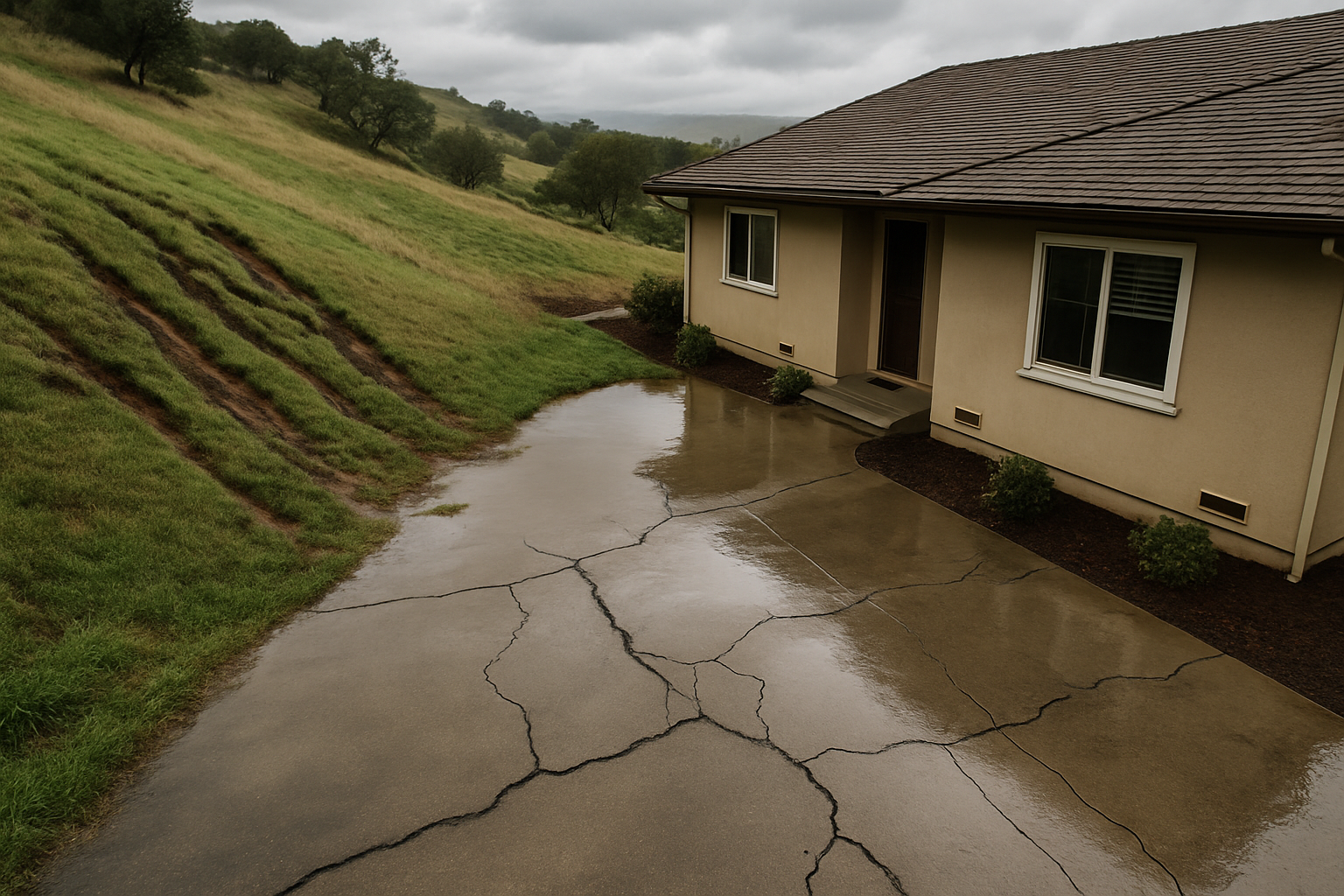
3. Your Driveway or Hardscape Has Cracks You’ve Been Ignoring
Cracks in asphalt or concrete look like a surface problem. They’re not. Every crack is an entry point for water, and once water gets into the base layer, the real damage begins.
Central Coast soils — especially the expansive clays common in Monterey and Salinas — shift significantly when they get wet. That movement creates voids under the pavement, and those voids cause the surface to flex and crack further. It’s a compounding problem. One ignored crack becomes a network of them over a single wet season. What actually happens under pavement when the ground shifts covers that cycle in detail.
Before El Niño season, look for:
- Alligator cracking — a pattern of interconnected cracks that signals base failure
- Cracks wider than a quarter inch running lengthwise down the driveway
- Any area where the pavement surface has visibly dipped or raised
- Cracks along the expansion joint between the driveway and garage slab
These aren’t just cosmetic issues to seal over. If the base layer has been compromised, sealing the surface is temporary. The right fix starts below the pavement.
4. You Don’t Know Where Your Drainage Infrastructure Is — or When It Was Last Cleaned
If you’ve owned the property for more than a few years and you’ve never had your drainage lines inspected or cleaned, there’s a reasonable chance they’re partially blocked. Sediment, root intrusion, and debris accumulation happen slowly — you won’t notice it until a heavy rain event overwhelms the system’s reduced capacity.
This is especially common in older Salinas and Seaside neighborhoods where original drainage infrastructure is 30 to 50 years old and has never been touched. Monterey County’s coastal fog and marine layer conditions keep soil moisture elevated even in dry months, which accelerates root intrusion into any pipe with even a hairline crack at a joint.
What to locate and evaluate before the season:
- French drains and their outlet points — are they draining freely or blocked with sediment?
- Downspout connections — do they tie into a line, and where does that line daylight?
- Area drains in low spots — when did you last see them flow without backup?
- Catch basins — are they full of debris going into the rainy season?
If you’re not sure what’s underground or how it’s performing, signs your underground pipe is failing before it becomes a crisis gives you a starting checklist.
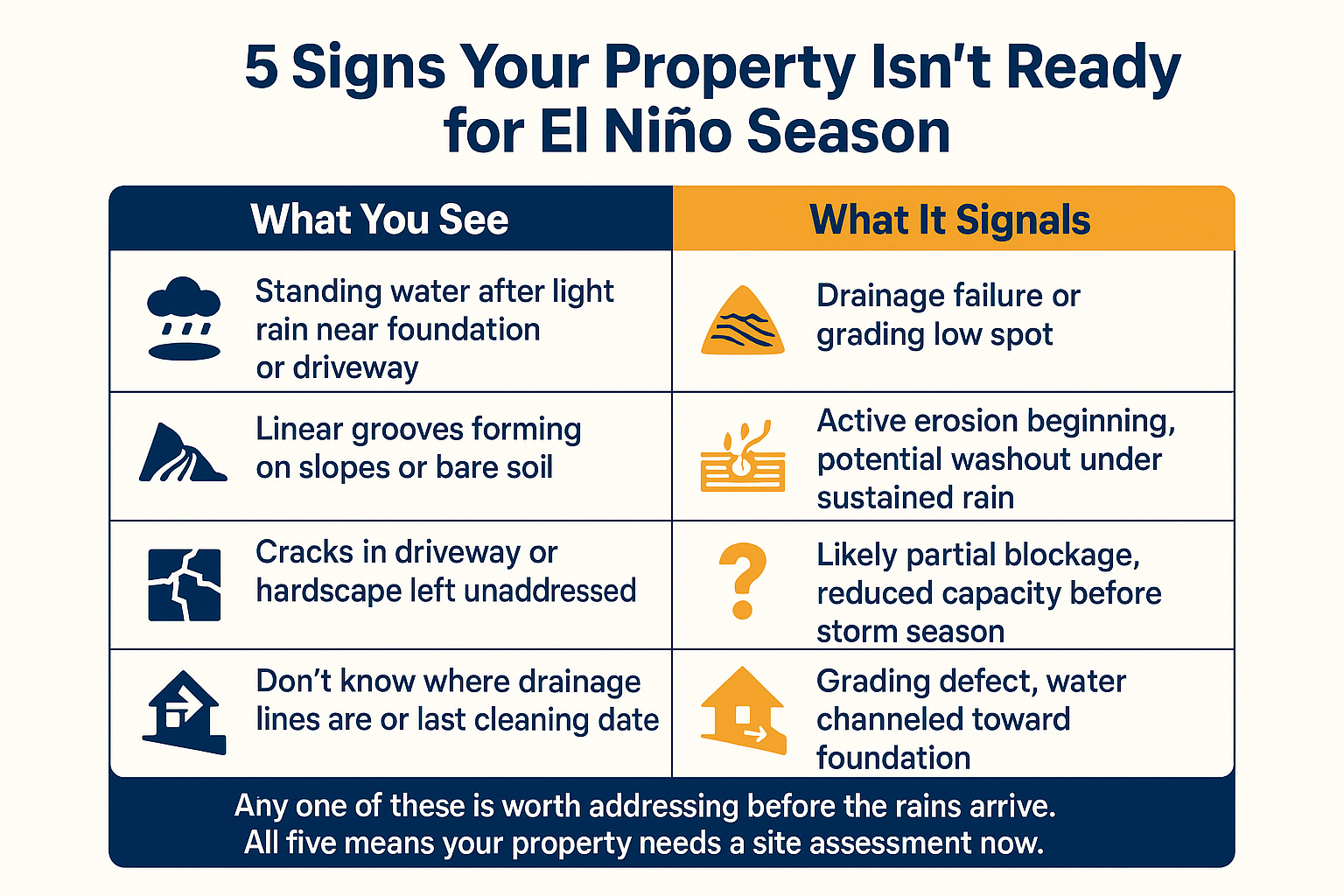
Quick Reference: What Each Warning Sign Looks Like
Use this as a fast reference to match what you’re seeing on your property to the underlying drainage or grading problem it signals.
5. Your Yard Drains Toward the House, Not Away From It
This is the most common problem we find during site assessments — and the one homeowners are most surprised by, because it’s invisible until you measure it.
Proper grading requires a minimum 6-inch drop over the first 10 feet away from your foundation in every direction. That slope is what moves surface water away from your home and toward a collection point or street. When the grade is flat or — worse — pitched back toward the foundation, every rain event sends water directly to the one place it can do the most damage.
In Monterey County, grading problems show up in a few predictable ways:
- Settled soil around the perimeter of older foundations that has compressed over time, creating a bowl effect
- Landscaping changes that added berms or raised beds without accounting for drainage direction
- Past additions or hardscape — patios, sheds, or concrete pads poured without proper grade planning
- Fill placed during construction that wasn’t compacted correctly and has since settled unevenly
The fix is a grading correction — resloping the soil around the foundation so water moves the right direction. It’s not a complicated project, but it requires equipment and the right soil work to hold its shape over time. How do you know if grading was done right explains what correct grading looks like and how to spot when it’s off.
El Niño Property Readiness: Problem vs. Fix vs. Urgency
Use this table to prioritize which issues to address first based on how much damage each one can do if left alone through a wet season.
| Warning Sign | What It Can Lead To | Fix Urgency Before El Niño |
|---|---|---|
| Standing water near foundation | Foundation movement, hydrostatic wall pressure, mold | High — address immediately |
| Erosion channels on slopes | Major washout, slope failure, sediment loss | High — especially on slopes over 15% |
| Cracked driveway or hardscape | Base layer failure, accelerating surface damage | Medium — seal or repair before first major rain |
| Unknown/blocked drainage lines | System backup, surface flooding, pipe failure | High — inspect and clear before storm season |
| Negative grade toward foundation | Chronic foundation moisture, structural damage over time | High — every rain event makes it worse |
Frequently Asked Questions About El Niño Property Readiness
How do I know if my yard is graded wrong without hiring someone?
Watch where water goes during the first quarter inch of rain. If it moves toward your house, pools against the foundation, or sits flat without moving at all, the grade is off. You can also use a long level and measuring tape — place one end against the foundation and check the slope at 10 feet out. You want to see at least a 6-inch drop. If it’s less than that, or if the ground is rising toward the house at any point, it needs correction.
Do I need a permit to fix drainage or regrade my yard in Monterey County?
It depends on the scope. Monterey County requires a grading permit for any cut or fill exceeding 100 cubic yards. Minor drainage corrections and small regrade work typically fall below that threshold and don’t require a permit. But if you’re doing significant slope work, installing a new drainage system, or moving large volumes of soil, you’ll want to confirm with the county before starting.
Is it too late to fix these problems once the rainy season starts?
Some fixes can still happen once rain begins — clearing drainage lines, for example, or addressing minor erosion. But grading and major drainage work should be done on dry ground. Saturated soil doesn’t compact correctly, and working on wet slopes creates its own erosion risks. If the season has already started, focus on temporary measures and plan the permanent fix for spring.
How serious was the 2023 Pajaro Valley flooding, and could something like that happen in Monterey County again?
The Pajaro levee failure in March 2023 inundated hundreds of homes and displaced thousands of residents in the Pajaro Valley — much of which sits in Monterey County’s flood plain. The underlying conditions that made it catastrophic — saturated soil, overwhelmed drainage infrastructure, and low-lying grade — are present across much of coastal Monterey County in a serious El Niño year. Properties near the Salinas River corridor, low-lying areas in Marina and Seaside, and any parcel with deferred drainage maintenance are genuinely exposed.
Can a cracked driveway really cause structural problems, or is it just cosmetic?
A crack wide enough to let water through is not cosmetic. Once water reaches the base layer, it softens the compacted aggregate that the pavement surface depends on. When that base softens, the pavement flexes, which widens the crack, which lets in more water. Monterey’s clay-heavy subsoils make this worse because they expand and contract with moisture, which adds vertical movement to the problem. Left alone through a wet winter, a repairable crack can become a full repave job by spring.
Want a Set of Eyes on Your Property Before the Rains Hit?
DW Excavation works throughout Monterey County — from Salinas and Seaside to Marina and the Pajaro Valley — helping property owners identify and fix drainage, grading, and erosion problems before they become emergency calls in the middle of a storm. If you saw yourself in any of these five signs, it’s worth a conversation now while the ground is still workable. Call 707-601-9091 or reach out through the contact page at dw-excavation.com to talk through what you’re seeing on your property.