
Direct Answer: Monterey County driveways crack fast because the base beneath them shifts. Coastal soils, poor drainage, and inadequate compaction are the real culprits — not the asphalt itself.
A lot of Monterey County homeowners repave their driveway and expect it to last 15 to 20 years. Then three winters go by and the cracks are back — sometimes worse than before. If that sounds familiar, the problem almost certainly isn’t the asphalt.
Monterey’s coastal soil conditions are some of the most demanding in California for any paved surface. From Marina’s sandy fill to Salinas’s expansive clay-heavy bottomland and the hillside properties above Carmel Valley, the ground underneath a driveway is constantly moving — swelling with rain, drying out in summer, and shifting under load with every vehicle pass.
Understanding why Monterey driveways crack faster than driveways in most other regions starts underground, not at the surface. Once you know what’s actually happening beneath the pavement, the path to a driveway that holds up for the long run becomes a lot clearer.
The Ground Underneath Is the Real Problem
Asphalt and concrete don’t fail on their own. They fail because the material underneath them stops holding steady.
In Monterey County, that material — called the base course or sub-base — is working against you from the start. The soils across this region vary a lot, but almost all of them share one trait: they move. Coastal areas like Seaside and Marina sit on sandy, loosely packed ground that shifts easily under load. Inland areas like Salinas and the Pajaro Valley have heavy clay soils that swell when they absorb water and shrink when they dry out. That cycle of expansion and contraction puts constant pressure on whatever’s above it.
When the base wasn’t built thick enough or compacted properly before paving, that movement transfers straight into the pavement. Cracks start small — a hairline here, an edge heave there — and widen fast once water gets in.
If you’ve ever noticed that your pavement keeps failing in the same spots every season, the subgrade beneath those spots is almost always the explanation. The pavement is just the visible symptom.
The key factors that determine how long a base holds:
– Soil type — sandy or clay-heavy soils require different base thicknesses and preparation methods
– Compaction depth — base material must be compacted in layers, typically 4 to 6 inches at a time
– Moisture content during compaction — compacting too wet or too dry leads to a weak, uneven foundation
– Drainage design — water trapped under the base accelerates movement and deterioration
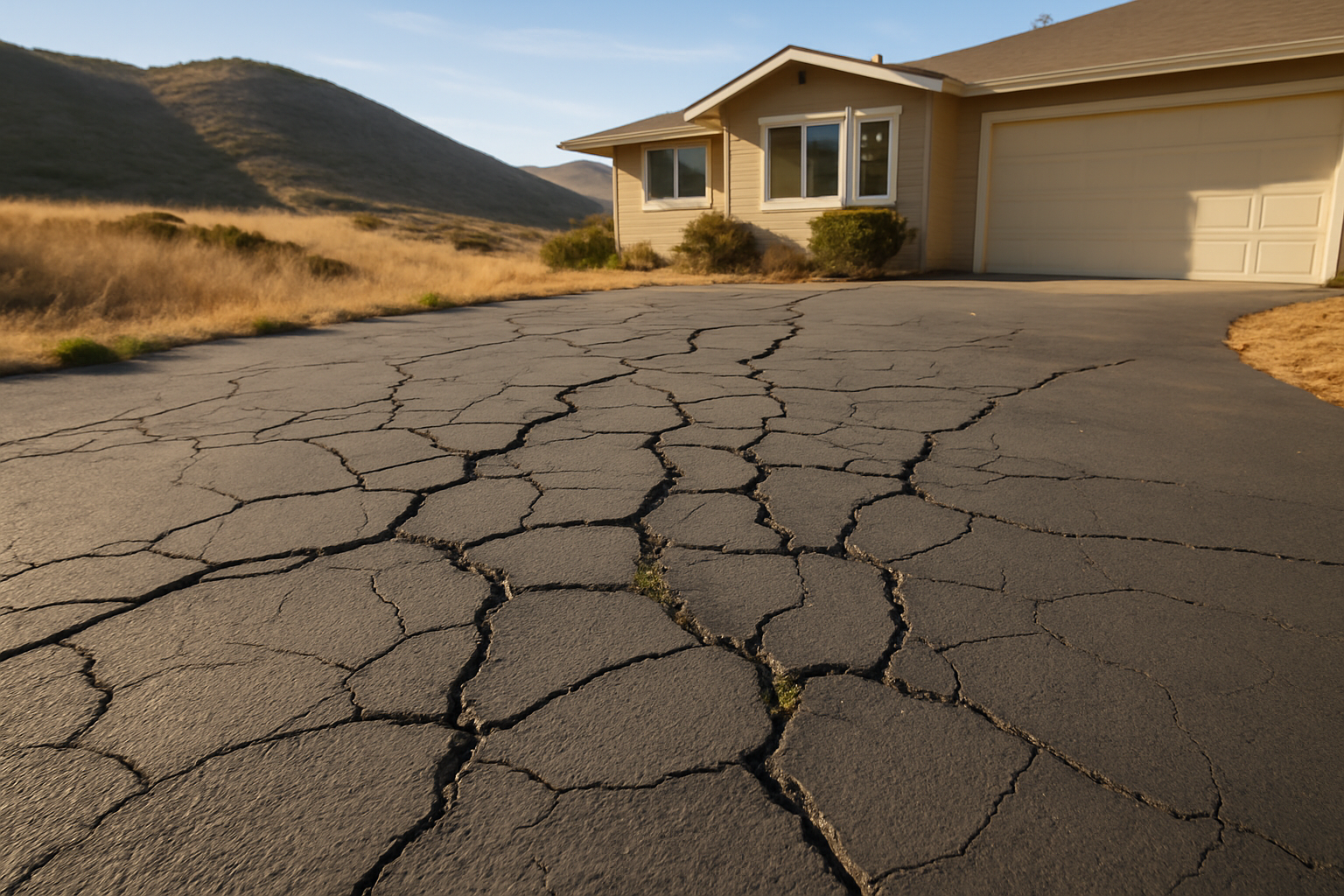
How Monterey’s Drainage Patterns Speed Up Driveway Damage
Water is the single biggest enemy of any paved surface. And Monterey County gets its water in a way that’s particularly hard on driveways — in heavy, concentrated bursts after dry stretches.
The November 2024 atmospheric river events hit parts of Monterey County with several inches of rain over just a few days. Soil that had been dry and compact for months suddenly had to absorb far more water than it was ready for. Driveways that had looked fine all summer started showing new cracks and edge failures within weeks of that storm cycle.
When water pools around or beneath a driveway — rather than draining away from it — it softens the base. A softened base can’t support vehicle weight the same way. Every car that rolls across a wet, soft base is pressing down on material that isn’t fully supporting the pavement above it. That’s called subgrade failure, and it’s responsible for a significant share of premature driveway cracks throughout the county.
Driveways near the Salinas River corridor and low-lying areas of the Pajaro Valley are especially vulnerable. Properties in those areas often deal with high water tables or standing water after heavy rain, and the ground never fully dries before the next storm cycle hits.
Fixing drainage before resurfacing isn’t optional — it’s the only way a new surface lasts. If water is already pooling in the same spots on or near your driveway, that tells you exactly where the next round of cracks will start.
Signs that drainage is contributing to your driveway damage:
– Cracks that appear along the edges before the center
– Soft or spongy spots when you walk the driveway after rain
– Standing water that takes more than 24 hours to drain near the driveway
– Erosion or soil washout at the base of the driveway apron
– Cracking that follows the path of a nearby underground pipe or low point in the yard
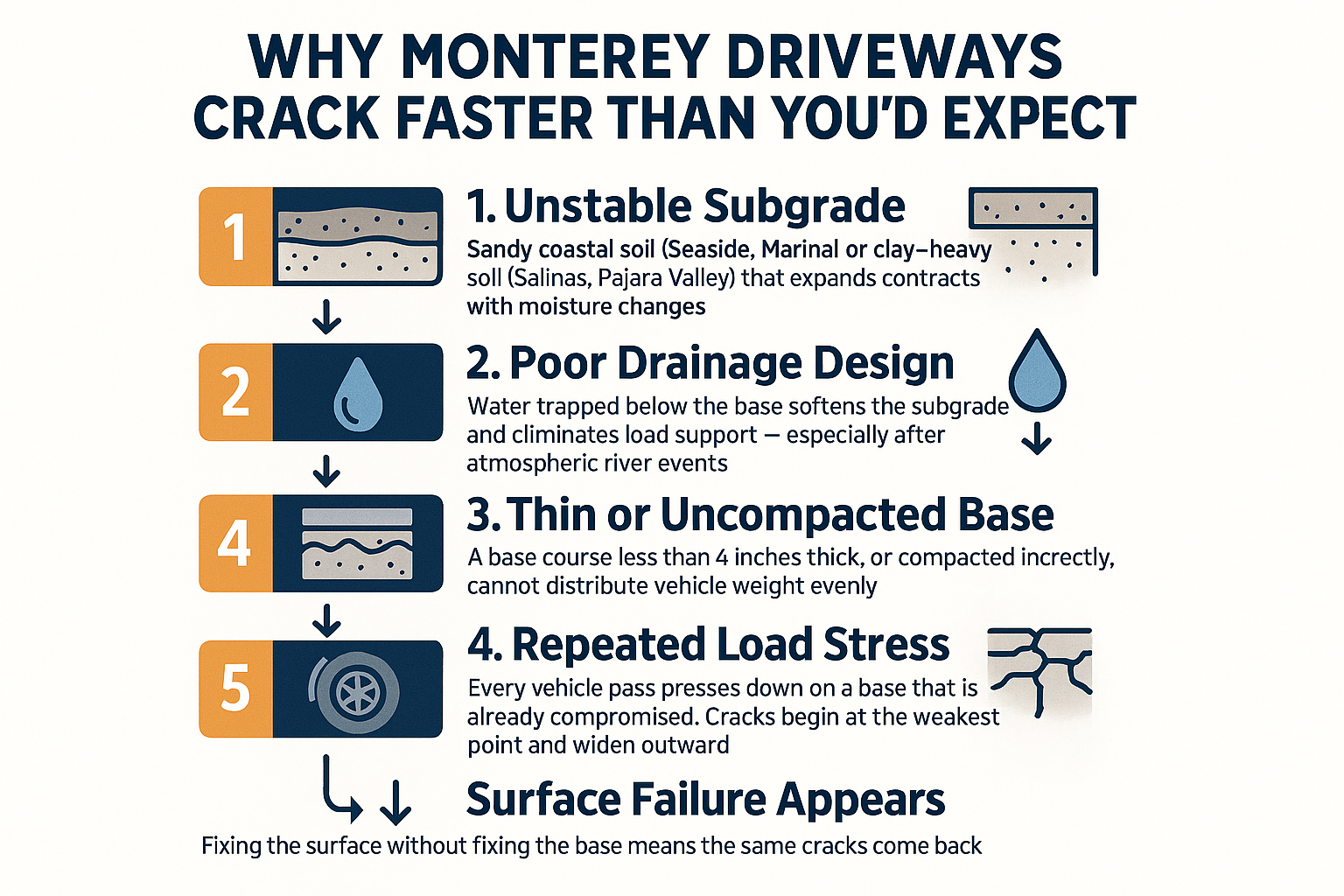
What Actually Causes a Monterey Driveway to Crack
This breakdown shows the most common failure points, starting underground and working up to the surface.
Monterey County Soil Types and Driveway Risk by Area
Different parts of Monterey County present different challenges. Here’s a quick reference for how local soil conditions affect driveway performance.
| Location | Dominant Soil Type | Primary Driveway Risk |
|---|---|---|
| Marina / Seaside | Loose sandy fill, some dune soil | Base settlement, edge erosion, poor load distribution |
| Salinas / Pajaro Valley | Heavy clay, high swell potential | Seasonal heaving, cracking from expansion/contraction cycles |
| Carmel Valley / Hillsides | Rocky, mixed clay-loam on slopes | Surface runoff channeling, erosion at driveway edges |
| Monterey / Pacific Grove | Coastal loam with moderate drainage | Salt air surface degradation, cracking accelerated by moisture |
| King City / South County | Alluvial silty clay | Subsidence risk, poor base stability in wet seasons |
Why a New Driveway Still Cracks If the Base Work Wasn’t Done Right
This is the part that frustrates most property owners the most. They paid for a new driveway. It looked perfect. And then within two or three years, the cracks came back in nearly the same places.
In most of those cases, the paving contractor skipped or rushed the site preparation phase. They came in, removed the old surface, put down a thin layer of base aggregate, and paved over it. That approach can look fine for a season. But Monterey’s rain and soil conditions stress-test a driveway in ways that shortcuts don’t survive.
Proper driveway base prep for Monterey County conditions should include:
– Removing the old surface and excavating down to stable native soil — often 12 to 18 inches depending on soil type
– Grading the subgrade to direct water away from the driveway, not under it
– Importing and compacting a Class 2 aggregate base in lifts, not all at once
– Verifying compaction with a plate compactor or roller before any paving begins
– Installing edge drains or French drains where the soil type or grade requires it
That’s a meaningful amount of work before anyone lays a single inch of asphalt. But it’s the work that determines whether the driveway lasts 5 years or 20.
If you’re wondering what actually separates a driveway that holds up from one that doesn’t, the base preparation process is the clearest dividing line. The surface material matters — but it’s secondary to what’s underneath it.
For hillside or sloped driveways in areas like Carmel Valley or the hills above Monterey, there’s an additional concern: erosion. A driveway built on a slope without proper drainage channels or erosion control measures on the surrounding soil will undermine itself from the edges inward. That’s worth understanding before any site work begins — erosion on an untreated slope can do serious damage in even a single rainy season.
Sealing Helps — But Only If the Foundation Is Sound
Sealcoating is the most common maintenance step property owners take to extend driveway life, and it does work — within limits.
A good seal keeps water from penetrating the asphalt surface and slows the oxidation that makes pavement brittle over time. For a Monterey driveway in reasonable shape, sealing every 2 to 3 years is a reasonable maintenance schedule. But sealing over a driveway that already has structural cracks is roughly equivalent to painting over a wall that has water damage. It covers the problem without addressing it.
If the cracks in your driveway are wider than a quarter-inch, run through the full thickness of the pavement, or are showing vertical displacement — meaning one side is higher than the other — sealing won’t fix them. That’s a base or subgrade problem, and it calls for excavation, not a coating.
For a detailed look at how often you should be sealing your driveway based on condition and climate, that’s worth reading before you decide whether a seal or a full repave is the right call for your property.
Frequently Asked Questions About Monterey Driveway Cracking
My driveway was repaved two years ago and it’s already cracking. What went wrong?
Almost certainly a base preparation issue. If the contractor didn’t excavate deep enough, compact the base material properly, or address drainage before paving, the subgrade was already set up to fail. Monterey’s soil conditions — especially in clay-heavy areas like Salinas or the Pajaro Valley — are unforgiving of shortcuts in that phase of the work. A new surface on a bad base won’t outlast the original problem.
Does the type of soil on my property actually change what needs to happen before paving?
Yes, significantly. Sandy coastal soils in Marina and Seaside require deep compaction and sometimes a thicker base layer because they don’t naturally lock together under load. Clay soils in Salinas and south county require careful attention to drainage and grading because they swell when wet and crack when dry. The prep work should be specific to what’s under your driveway — not a one-size approach.
Can I just fill the cracks and seal the surface, or do I need to start over?
It depends on the type and severity of the cracking. Hairline surface cracks with no vertical displacement can often be treated with crack fill and seal. But if cracks are wide, jagged, or show heaving — where one side of the crack is higher than the other — that’s a structural problem. Filling and sealing buys a season at best before the same movement creates new cracks.
How deep does the base need to be for a driveway in Monterey County?
For most residential driveways with standard passenger vehicle traffic, a 6-inch compacted aggregate base over stable native soil is the typical starting point. Driveways that see trucks, RVs, or heavy vehicles regularly may need 8 to 10 inches of base material. Sloped or hillside driveways often need additional drainage infrastructure on top of the base depth. The soil type under your specific property is what ultimately determines the right spec.
Is it worth fixing the drainage before I repave, or can I do that later?
Do the drainage work first — always. If water is getting under your driveway base, a new surface will fail on the same timeline as the old one. Fixing drainage after paving usually means cutting into the new surface to install drains, which costs more and disrupts the work you just paid for. Getting the site grading and drainage right before the first inch of base goes down is the only sequence that makes long-term sense.
Ready to Find Out What’s Really Going On Under Your Driveway?
If your Monterey County driveway keeps cracking — whether you’re in Salinas, Marina, Carmel Valley, or anywhere in between — the answer almost never starts at the surface. DW Excavation works throughout Monterey County assessing site conditions, drainage, and base preparation needs before any paving decision gets made. Call 707-601-9091 or reach out through the contact page at dw-excavation.com to talk through what you’re seeing and what it might actually mean.