
Direct Answer: Most foundations fail because of what happens before the concrete is poured — poor soil prep, inadequate drainage, and excavation that wasn’t done to spec. The ground, not the slab, is usually the problem.
Nobody wants to talk about what went wrong underground. By the time a foundation starts cracking, heaving, or settling unevenly, the framing is up and the blame-shifting has already started. But in most cases, the failure was set in motion weeks earlier — before a single yard of concrete was placed.
In Monterey County, this problem runs deeper than most places. The region’s soil conditions are some of the most variable in California — expansive clay in the inland valleys, unstable sandy fill near the coast, and pockets of decomposed granite that drain too fast in one spot and hold water in another. A foundation design that works fine in Fresno can fail here inside of two rainy seasons.
This article breaks down the two things that actually cause most early foundation failures: what happens at the bottom of the excavation, and what happens to water after the foundation is in the ground. If you’re planning a build in Monterey, Salinas, Seaside, or anywhere in the Pajaro Valley, these are the details worth understanding before dirt starts moving.
What Goes Wrong at the Bottom of the Hole
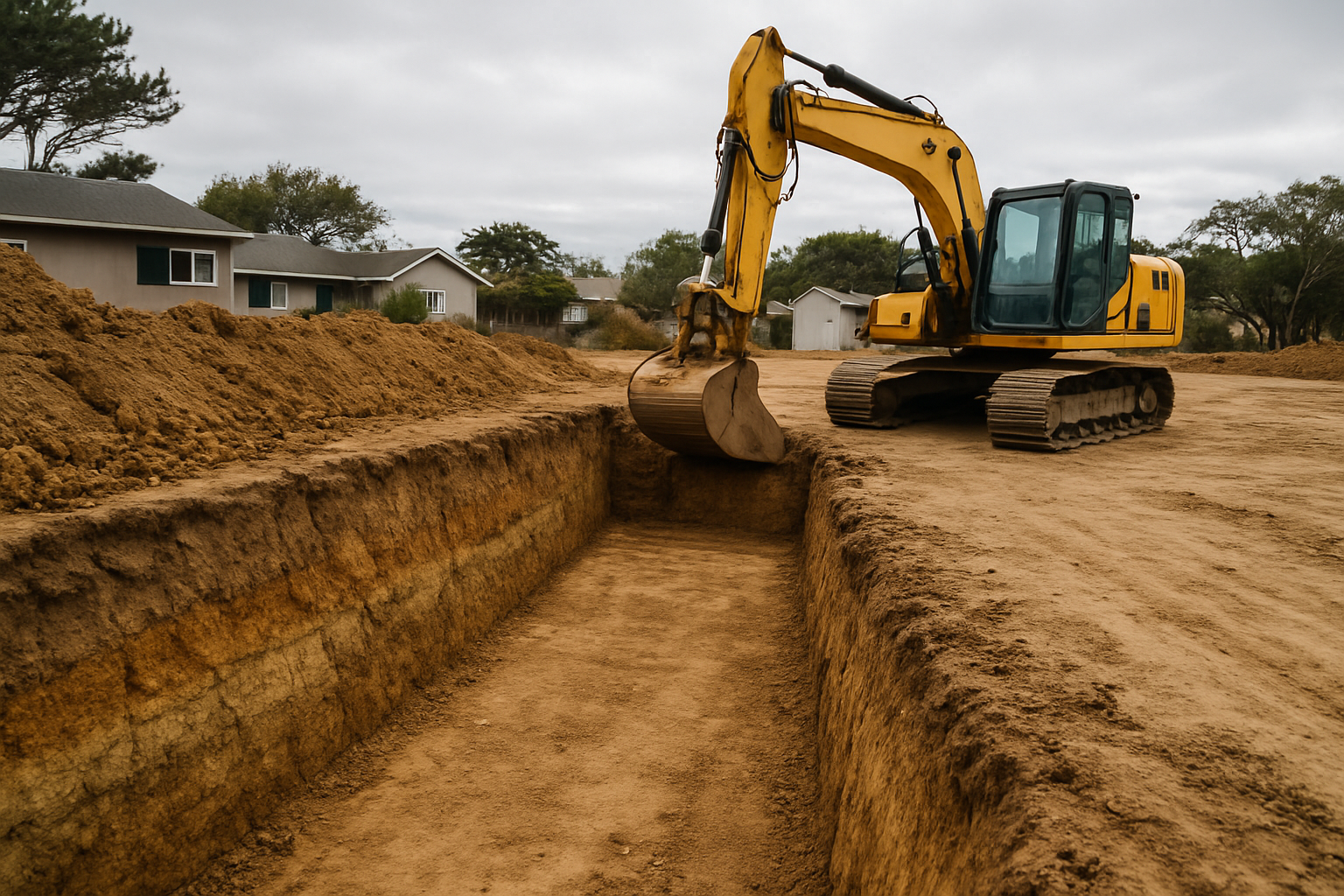
The excavation trench is where most foundation problems start. Not at the surface — at the very bottom of the dig, where the footing will eventually sit.
When soil at the bottom of a trench isn’t compacted correctly, or when the wrong material is left in place, the foundation has no stable base. Concrete is strong in compression, but it can’t fix a soft or uneven subgrade beneath it. Once the structure above starts applying load, the movement begins.
In Monterey County, a few conditions show up again and again on job sites:
- Expansive clay — especially in the Salinas Valley and inland Monterey areas. Clay swells when it absorbs water and shrinks when it dries out. A foundation sitting on untreated clay will move with every wet and dry cycle.
- Fill material with no compaction records — older properties, especially in unincorporated areas, sometimes sit on fill that was placed decades ago with no documentation. You don’t know how it was compacted or what’s in it.
- Disturbed soil that wasn’t re-compacted — trenching for utilities, old septic systems, or prior excavation work can leave pockets of loose material that won’t show up until the load hits them.
- Moisture in the trench at pour time — Monterey’s coastal fog and winter rains mean standing water in a trench is common. Pouring concrete into a wet, unprotected excavation changes the water-cement ratio and weakens the finished product.
A licensed excavation contractor should be verifying subgrade conditions before any concrete goes in — not assuming the soil report from three months ago still reflects what’s at the bottom of the hole today. As explained in our deeper look at why Monterey soil makes foundation work harder, these aren’t edge cases. They’re standard conditions on most residential sites in this county.
The Drainage Problem Nobody Budgets For
Here’s where builders and homeowners get caught off guard: even a well-dug, properly compacted foundation trench can fail if water isn’t managed once the structure goes in.
Foundations don’t fail from a single flood. They fail from repeated, low-level water intrusion — the kind that happens every time it rains and nobody notices because it’s slow. Water finds the path of least resistance. And after excavation, backfill, and construction traffic, the path of least resistance often runs directly toward the foundation.
In November 2024, back-to-back atmospheric river events dropped over 12 inches of rain on parts of Monterey County in a short window. Sites that had no drainage plan in place — no swales, no French drains, no positive slope away from the structure — took on water in exactly the places that do the most long-term damage.
The specific failures we see tied to poor drainage around foundations:
- Hydrostatic pressure building up against foundation walls when soil becomes saturated, eventually causing lateral cracking or wall movement
- Subgrade softening under footings when water migrates down through backfill material that wasn’t properly specified
- Soil erosion behind retaining walls that were installed without adequate drainage outlets, redirecting water pressure toward the structure
- Foundation heave on clay-heavy sites where persistent moisture causes the soil to swell upward against the slab
The fix for all of these happens before the foundation goes in, not after. That means grading the site to drain away from the structure, specifying the right backfill material, installing perimeter drainage where conditions call for it, and making sure every drainage decision ties back to how water naturally moves across that specific piece of ground. If you’ve ever wondered why water pools in the same spot every time it rains, the answer is almost always in the grading — and it rarely gets better on its own.
Sonoma County’s grading permit threshold is cuts or fills over 50 cubic yards. Monterey County’s is 100 cubic yards. Either way, drainage planning should be part of the permit package, not an afterthought bolted on after the building department asks questions.
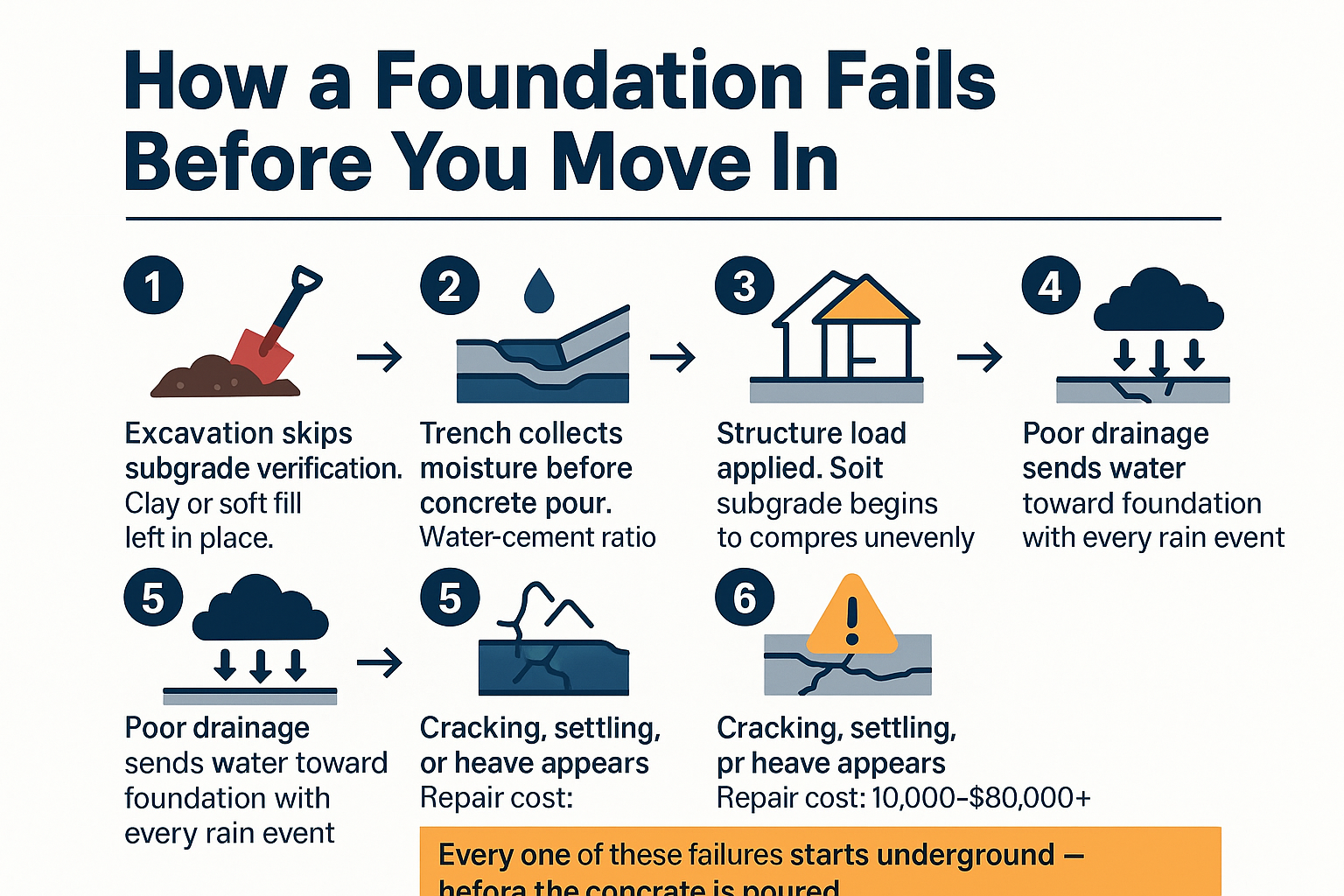
How a Foundation Fails: The Underground Timeline
This shows the sequence of events that leads from a skipped step in excavation to a visible foundation failure months or years later.
Common Foundation Failure Causes vs. What Should Have Happened
These are the conditions we encounter most often on Monterey County job sites where early foundation problems appear. Each one has a clear point of prevention that happens during excavation and site prep — not after.
| Failure Condition | What Went Wrong | When It Should Have Been Caught |
|---|---|---|
| Uneven settling | Soft or variable subgrade left in place at trench bottom | During excavation, before concrete pour |
| Slab heave | Expansive clay not removed or stabilized below footing depth | Soil assessment before excavation begins |
| Lateral wall cracking | Hydrostatic pressure from saturated backfill | Drainage design before backfill placement |
| Corner cracking at grade | No positive slope away from structure; water pools at foundation | Finish grading after backfill, before framing |
| Footing movement on fill | Old or undocumented fill with no compaction data | Geotechnical review before site work begins |
| Moisture intrusion under slab | Wrong backfill material; no vapor barrier or drainage layer | Material specification before trench backfill |
Why Grading Sign-Off Matters More Than Most Builders Acknowledge
There’s a step in the construction process that often gets treated as a formality: the grading inspection. In Monterey County, any grading project that moves 100 cubic yards or more requires a permit and inspection through the county. On smaller sites, the threshold is lower depending on slope, proximity to waterways, and whether the project is in a designated flood zone.
But the inspection isn’t just a box to check. A grading inspection verifies that the site is draining correctly, that fills are compacted to spec, and that the conditions the foundation will sit on actually match what the engineer of record designed for. Skipping it — or rushing it — is how projects end up with a signed permit and a failed foundation.
We’ve seen this pattern on sites in the Pajaro Valley, where the 2023 flooding exposed how many properties had drainage and grading that looked acceptable on paper but failed the moment they faced real storm volume. How grading was done is one of the most important questions a property owner can ask — and one of the hardest to answer after the fact.
The practical checklist for getting this right:
- Confirm subgrade bearing capacity before concrete is scheduled
- Use compaction-tested fill material — not whatever’s on site
- Establish positive drainage slope (minimum 2% grade) away from all foundation edges
- Install perimeter drainage where soil conditions or site topography require it
- Get the grading inspection signed off before backfill covers critical areas
- Document everything — photos, compaction test results, inspection reports
That last point matters more than most people realize. If a problem shows up two years from now and you need to make a warranty or insurance claim, having documentation of what was done — and when — is the difference between a covered claim and an out-of-pocket repair.
Frequently Asked Questions About Foundation Failures and Site Prep
Can a foundation be fixed after it’s already failed, or does it have to be redone from scratch?
It depends on how far the failure has progressed and what caused it. Minor settling in one corner can sometimes be addressed with underpinning or soil stabilization without touching the rest of the slab. But if the subgrade beneath the footing has been compromised over a large area, or if water intrusion has been ongoing for more than one or two seasons, a full repair often costs more than doing it right the first time would have. Repair costs for residential foundations in California typically run $10,000 to $80,000 or more depending on access, scope, and soil conditions.
How do I know if the soil on my Monterey County property is a problem before excavation starts?
A geotechnical report — also called a soils report — will answer this. For most permitted construction in Monterey County, a soils report is required before a building permit is issued. It will identify whether you’re dealing with expansive soils, fill material, high water tables, or other conditions that affect how the foundation needs to be designed and how the excavation needs to be handled. If you’re buying land to build on, getting a soils report before you close escrow is worth every dollar.
Does drainage around the foundation really matter if the house is in a dry climate area like Salinas?
Yes. Salinas sits in a valley that can go months without measurable rain and then receive several inches in a short window during storm events. Soil that has dried and cracked will absorb the first heavy rain rapidly, and that water travels fast. Clay soils in particular shift dramatically between dry and wet cycles. Drainage design needs to account for those extremes, not just average conditions.
Who is responsible for subgrade prep — the excavation contractor or the concrete contractor?
This is one of the most common gaps in residential construction. In practice, the excavation contractor is responsible for getting the trench to the correct depth, verifying the subgrade, and meeting compaction specs. The concrete contractor typically assumes the trench is ready when they arrive. If there’s no clear scope of work defining who owns subgrade verification, it often falls through the cracks. Get this in writing before work starts.
What is the grading permit threshold in Monterey County?
Monterey County requires a grading permit for any project moving 100 cubic yards or more. Projects near waterways, on slopes greater than 15%, or within designated flood or erosion hazard zones may have lower thresholds or additional requirements. Sonoma County’s threshold is lower — 50 cubic yards — so if you’re working in both markets, the rules aren’t the same.
Can poor site drainage cause foundation problems even years after construction is finished?
Absolutely. This is actually the most common scenario. The foundation looks fine at inspection and passes every check, then two or three wet seasons later, differential settling or cracking starts showing up. Water has been moving toward the foundation the entire time — slowly softening the subgrade or building lateral pressure against the walls. By the time it’s visible, the process has been going on for a while. Early signs include doors that stick, windows that won’t close cleanly, and hairline cracks at corners.
Planning a Build in Monterey County? Start Underground.
If you’re preparing for a new build, an ADU, or any project that involves foundation excavation in Monterey County, DW Excavation works with homeowners, builders, and developers throughout the region — from Salinas and Seaside to Marina and the Pajaro Valley. We hold CA General Engineering Contractor License #1060838 and have been doing this work since 2013. Call us at 707-601-9091 or reach out through the contact page at dw-excavation.com to talk through your site conditions before work begins.