
Direct Answer: If you’re seeing slow drains, sewage odors, or wet patches in your yard that won’t dry up, your sewer line may be failing and likely needs a professional inspection.
Most homeowners in Monterey County don’t think about their sewer line until something goes very wrong. A slow drain here, a strange smell outside there — easy to ignore until the yard turns into a swamp or sewage backs up into the house.
The problem is that sewer lines fail quietly. By the time the signs are obvious, the damage is usually significant. And in a county where older clay and cast iron pipe is still common in neighborhoods from Salinas to Seaside, that failure can happen faster than most people expect.
This guide walks you through the real warning signs, what causes sewer lines to fail in this region, and what you can realistically expect from a replacement project. No guesswork — just straight answers.
The Most Common Warning Signs a Sewer Line Is Failing
Some of these signs show up one at a time. Others hit all at once. Either way, they’re your property telling you something underground is wrong.
Slow drains throughout the house are one of the earliest signals. If it’s just one drain, the clog is probably local. But when multiple drains in different rooms are sluggish at the same time, the problem is almost certainly in the main line.
Sewage odors — either inside the house or outside near the yard — are a serious red flag. A properly functioning sewer line is sealed. If you’re smelling it, something is broken or open somewhere it shouldn’t be.
Other signs to watch for:
- Gurgling sounds coming from toilets or drains after water runs elsewhere
- Soggy or sunken patches in the yard, especially in a line running toward the street
- Unusually green or fast-growing grass over where the sewer line runs (sewage is fertilizing your lawn)
- Sewage backing up into toilets, tubs, or floor drains
- Foundation cracks or settling caused by saturated soil under or near the house
If you’re seeing two or more of these together, don’t wait. Get a camera inspection scheduled before the situation gets worse.
Why Sewer Lines Fail Faster in Monterey County
The soil and terrain here play a big role in how quickly pipes break down. Monterey County has a mix of sandy coastal soils near Marina and Seaside, heavier clay-like soils inland toward Salinas, and shifting hillside ground throughout the county.
Clay and silty soils expand when wet and contract when dry. That constant movement puts stress on buried pipe joints over time — especially on older clay or cast iron lines that were installed decades ago. We’ve written about this in more detail in our guide on what soil conditions make foundation work harder in Monterey County — many of those same forces are at work on your sewer line.
Tree root intrusion is another major cause. Roots naturally seek out moisture, and even a hairline crack in an old pipe creates enough of a signal to draw them in. Once roots get inside, they grow fast and can collapse a section of pipe within a few seasons.
The 2023 Pajaro flooding also accelerated pipe failures across the region. Saturated ground shifts, and pipes that were already aging got pushed past their limits. We’re still seeing the downstream effects of that event on properties throughout the county.
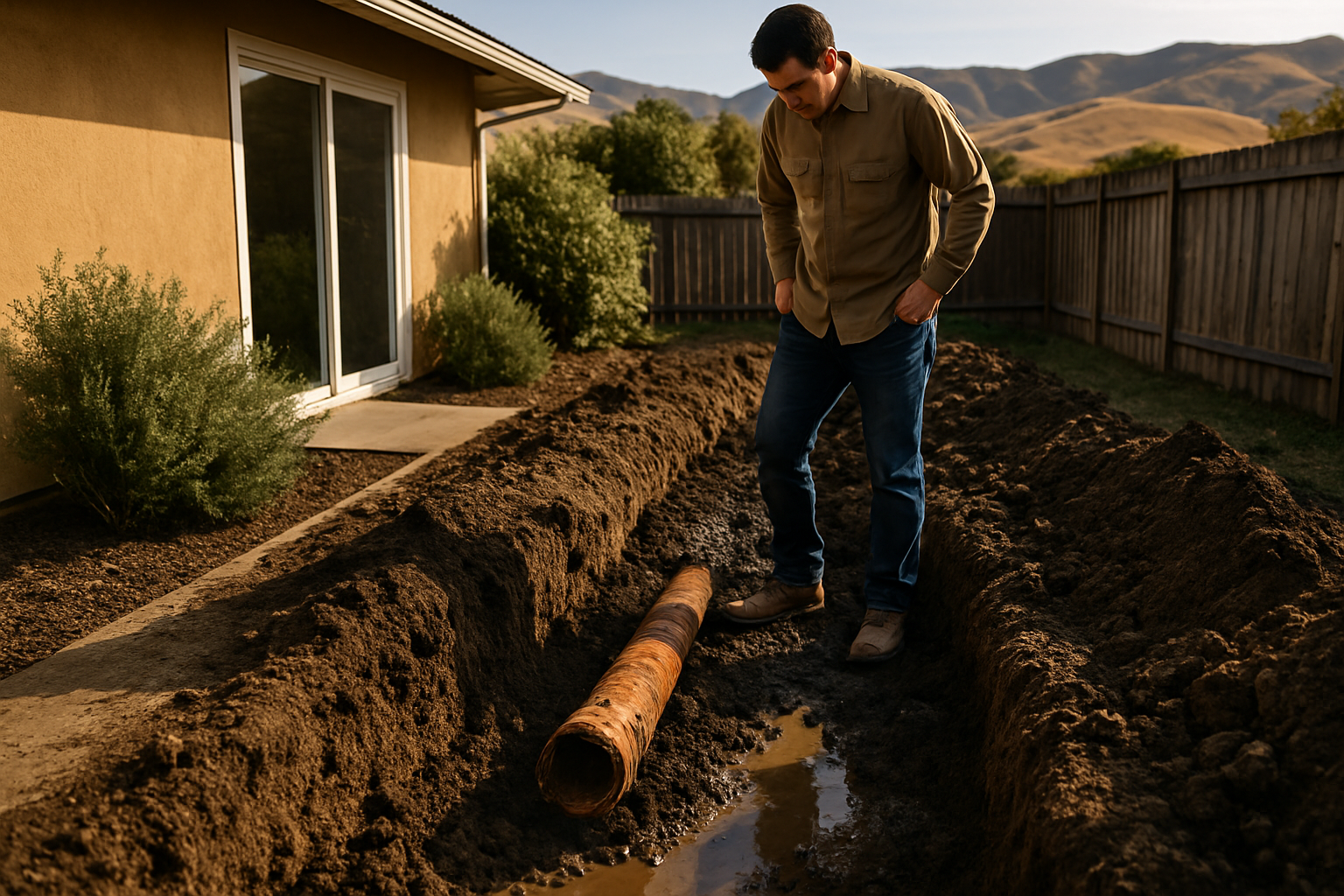
How Old Is Your Pipe — and What Is It Made Of?
Pipe material and age are two of the biggest factors in whether you’re looking at a repair or a full replacement.
Clay pipe was standard through the mid-1900s. It’s brittle, prone to cracking at joints, and highly vulnerable to root intrusion. Many homes in older Salinas neighborhoods and unincorporated Monterey County still have clay lines in the ground.
Cast iron pipe holds up better than clay but still corrodes from the inside out over time. After 50 to 70 years, interior scale buildup and rust reduce flow significantly.
ABS and PVC plastic pipe became the standard from the 1970s forward. These materials are far more durable and root-resistant, and they don’t corrode. If your home was built after 1980 and hasn’t had major tree issues, your line may still have decades of life left.
Here’s a quick breakdown by material:
- Clay pipe: Lifespan of 50–60 years; high risk of cracking and root intrusion
- Cast iron: Lifespan of 75–100 years; fails from internal corrosion and joint separation
- Orangeburg pipe (rare, pre-1970s): Lifespan of 50 years maximum; made of compressed tar paper — extremely fragile
- PVC / ABS: Lifespan of 100+ years with proper installation; most common material used today
If you don’t know what’s in the ground, a camera inspection will tell you quickly. That’s always the right starting point before any repair decision.
Sewer Pipe Material Comparison at a Glance
This table gives you a quick reference for the most common pipe types found in Monterey County properties and what to expect from each.
| Pipe Material | Typical Lifespan | Common Failure Mode |
|---|---|---|
| Clay | 50–60 years | Cracking, root intrusion at joints |
| Cast Iron | 75–100 years | Internal corrosion, joint separation |
| Orangeburg | Up to 50 years | Structural collapse, severe deformation |
| ABS / PVC | 100+ years | Rare; usually damage from improper install or shifting soil |
Camera Inspections: What to Expect Before Any Work Begins
A sewer camera inspection is the only way to know for certain what’s happening inside your pipe. A flexible camera is fed into a cleanout access point, and the contractor can see exactly what the line looks like from the inside — cracks, root intrusion, pipe belly, or full collapse.
This inspection should happen before anyone recommends a full replacement. Some problems — like a localized root blockage — can be addressed with a targeted repair. Replacing an entire line when only a 10-foot section is damaged is an unnecessary expense.
A good contractor will also note the slope of the pipe. Sewer lines rely entirely on gravity to move waste. A pipe that has settled and lost its slope — called a belly — holds water and solids in the low spot and causes chronic backups even when the pipe itself isn’t cracked.
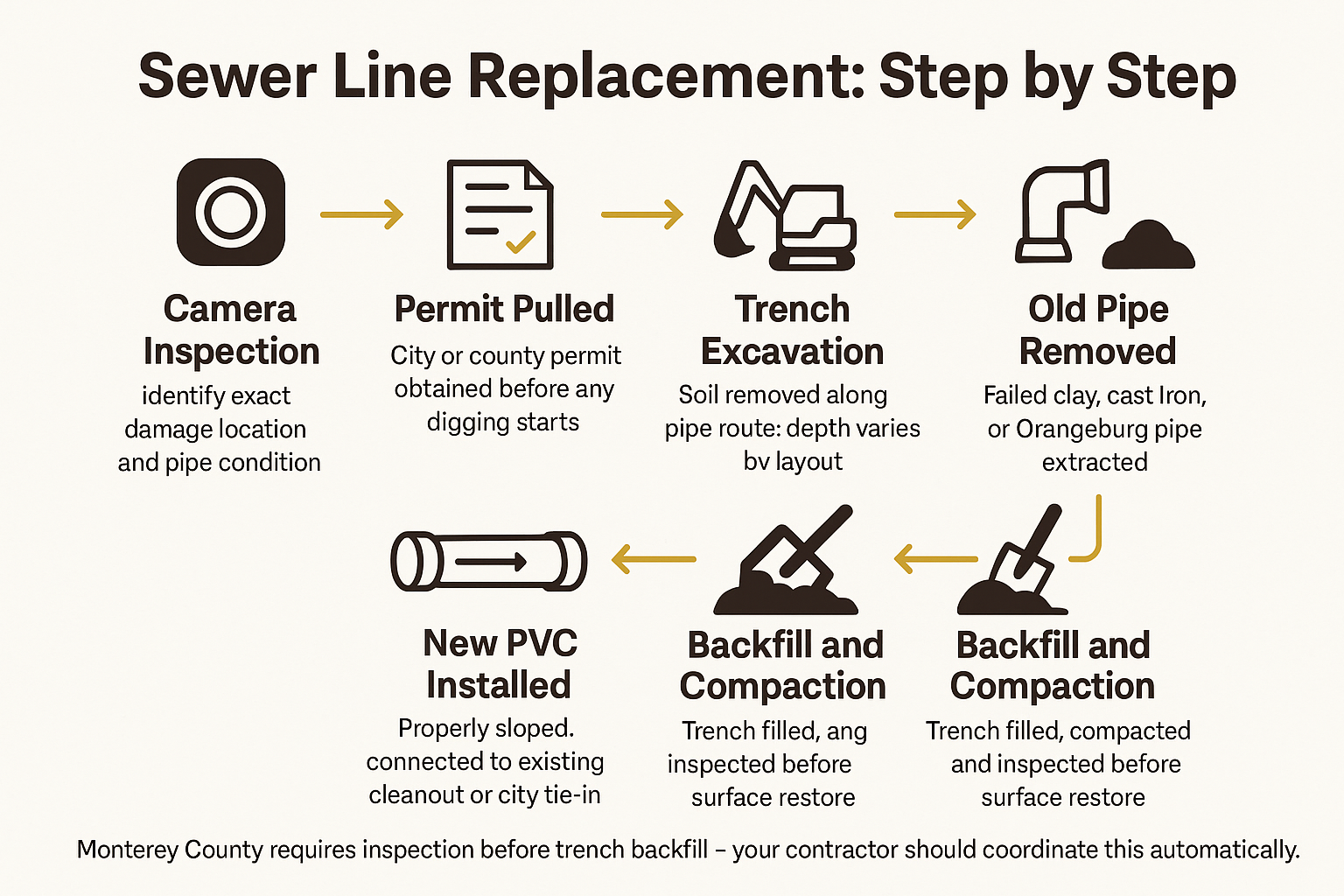
In Monterey County, permit requirements for sewer work vary by city and jurisdiction. Work in Salinas or Monterey city limits typically requires a permit from the Public Works department, and inspections are required before the trench is backfilled. Your contractor should know this process and handle it correctly.
What Happens During a Sewer Line Replacement
Here’s a step-by-step look at the sewer line replacement process from first inspection to final backfill.
When Repair Is Enough — and When It’s Not
Not every failing sewer line needs to be completely replaced. The answer depends on what the camera shows and how much of the line is compromised.
Spot repairs make sense when:
- Only one section of pipe is cracked or offset
- The rest of the line is in solid condition
- Root intrusion is isolated and hasn’t caused structural damage
Full replacement is typically the right call when:
- The line is clay or Orangeburg and over 50 years old
- Multiple sections show damage or root intrusion throughout
- The pipe has significant belly or has lost its slope
- You’ve had repeated backups or cleanouts over the past few years
- The pipe has collapsed or is fully blocked
There’s also a middle option: trenchless pipe lining. In some situations, a resin liner can be inserted and cured inside the existing pipe, effectively creating a new pipe within the old one. This avoids full excavation but requires the existing pipe to still have structural integrity.
We cover the full installation process in more detail in our sewer pipe installation guide for California homeowners. It’s worth reading before you make any decisions on repair vs. replace.
What the Excavation Process Actually Looks Like
If a full replacement is needed, here’s what the work typically involves on a Monterey County property.
First, the old pipe has to come out. That means opening a trench from the house connection point out to the city sewer main or septic tie-in — usually somewhere between 30 and 100 linear feet, depending on the property layout and lot size.
Depth varies. Most residential sewer lines run 3 to 6 feet deep, but hillside properties in areas like Carmel Valley can push that deeper depending on terrain and frost requirements. Soil type matters too — sandy coastal soils near Seaside excavate quickly, while heavier soils inland take more time and care to keep the trench walls stable.
Once the old pipe is out and the new PVC is set at the correct slope, the trench gets backfilled in lifts and compacted properly. Poor compaction here causes yard settlement and pavement failure down the line — we see that mistake often on properties where someone cut corners.
If the sewer line runs under a driveway or concrete, that section will need to be cut, removed, and restored after the pipe work is done. Budget for that separately.
For context, santa rosa sewer pipe installation projects we’ve completed in Northern California have shown us how similar this process plays out across regions — the terrain, soil behavior, and permit coordination challenges are comparable whether you’re in Windsor or Salinas.
How Drainage Problems and Sewer Problems Can Overlap
One thing homeowners don’t always realize: surface drainage issues and underground sewer problems can look nearly identical from above. Both can create soggy yard patches, foul smells, and standing water.
If you’ve noticed water pooling in the same area after every rain, there’s a chance you’re dealing with a drainage problem rather than — or in addition to — a sewer issue. That’s a separate fix, but it matters to diagnose correctly before digging. Our guide on why water pools in the same spot every time it rains covers the surface drainage side of this well.
Sometimes both problems exist on the same property. A failed sewer line that’s been leaking for months can saturate the subsoil and make surface drainage failures worse. Getting both diagnosed at the same time saves you from opening the ground twice.
If your property is dealing with both, a contractor who handles stormwater system work along with underground utility excavation can address everything in a single mobilization — which is almost always cheaper than two separate projects.
Frequently Asked Questions About Sewer Line Replacement
How much does it cost to replace a sewer line in Monterey County?
Costs vary depending on pipe length, depth, soil conditions, and whether pavement needs to be cut and restored. Most residential replacements in Monterey County fall somewhere between $8,000 and $25,000 for a full main line. Get an inspection done first — that number can change significantly based on what’s actually in the ground.
Do I need a permit to replace a sewer line in Monterey County?
Yes. Sewer line work in Monterey County — whether in Salinas, Seaside, Marina, or unincorporated areas — requires a permit from the local Public Works or building department. An inspection is also required before the trench is backfilled. A licensed contractor should handle the permit process as part of the project.
Can I keep living in my house while the sewer line is being replaced?
In most cases, yes — but you won’t be able to use toilets, sinks, or showers while the line is disconnected. That window is usually one to two days for a standard replacement. Your contractor should tell you exactly when water use needs to stop and when it’s safe to resume.
Is trenchless pipe lining a good option instead of full excavation?
It can be, but only when the existing pipe still has structural integrity. Trenchless lining doesn’t work on collapsed or severely offset pipe. A camera inspection will tell you whether the pipe walls are solid enough to support a liner. If they’re not, traditional excavation is the only option.
How long does a new PVC sewer line last?
A properly installed PVC line should last 100 years or more under normal conditions. The bigger risk factors are soil movement from earthquakes or flooding, and improper slope at the time of installation. Done right, a new sewer line is a problem you won’t hand to the next generation.
Ready to Find Out What’s Actually Going On Underground?
If you’re seeing any of the warning signs covered here — slow drains, yard wet spots, sewage odors, or chronic backups — the right move is a camera inspection before anything else. Our team serves homeowners and property owners throughout Monterey County, from Salinas and Seaside to Marina and the Pajaro Valley, and we know how soil conditions and local permit requirements affect every step of this kind of work. Call DW Excavation at 707-601-9091 or visit dw-excavation.com to tell us what you’re seeing — we’ll help you figure out exactly what you’re dealing with.