
Direct Answer: Legalizing unpermitted grading starts with an after-the-fact permit application. You document existing conditions with an as-graded plan, add a soils report if the work sits on a slope, and correct anything that fails review.
You bought a house with a nice flat backyard on a sloped lot. Years later, a city or county inspector knocks and tells you the grading and the retaining walls holding it up were never permitted. Now you are being asked for engineering reports, and you have no idea where to start.
I hear a version of this every few months. One homeowner put it about as plainly as anyone could: they felt backed into a corner and did not know what to do. The work had been done by a previous contractor nearly a decade earlier, and the city only just noticed.
The good news is that this is a process, not a punishment. Below I will walk through what an after-the-fact permit actually requires, why the soils engineer request is not red tape, and how the scope of the original work decides how heavy the lift gets.
How unpermitted grading gets flagged in the first place
Most of these cases do not start with an inspector driving around looking for problems. They start with something else.
Common triggers I see:
- A neighbor complaint after runoff shows up somewhere it did not used to
- A permit application for something unrelated, like an ADU or a deck, that puts a plan checker on your parcel
- A property sale where the appraiser or buyer’s inspector notices grading that does not match county records
- Aerial imagery review, which counties now use more often than people realize
Sonoma County requires a grading permit for cuts or fills over 50 cubic yards. Monterey County’s threshold sits at 100 cubic yards. To picture 50 cubic yards, think about five full dump truck loads of soil. Raising a section of backyard by two feet across a 40 by 40 area blows past that easily.
Once a jurisdiction has flagged the work in writing, ignoring it is not an option. Unresolved notices tend to resurface at the worst possible moment, usually escrow. And in my experience, the file only gets more complicated the longer it sits.
What an after-the-fact grading permit actually requires
An after-the-fact permit asks you to document what is already there as carefully as if you were proposing it fresh. That surprises people. The dirt is already moved, so why does the county need a plan?
Because nobody at the counter knows what is under that fill. The paperwork is how they find out.
A typical submittal package includes:
- An as-graded plan showing existing contours, cut and fill areas, and estimated volumes
- A soils report from a licensed geotechnical engineer when the work sits on a slope or crosses volume thresholds
- A drainage report showing how the existing grading moves water on and off your parcel
- Details for any retaining walls, including height, footing, and drainage behind the wall
- Photos and, when available, any records of the original work
Sonoma County publishes a grading permit questionnaire through Permit Sonoma, and their grading and stormwater section handles both new applications and after-the-fact ones. Filling that questionnaire out honestly is a decent first move before you spend money on engineering.
If a civil site plan is required before a grading permit in your situation, that gets drawn by a civil engineer working from field survey data. Somebody has to shoot the actual elevations. That part is not optional.
How Scope Changes the Documentation You Need
Not every unpermitted grading case carries the same weight. Here is roughly how the scope of the original work drives what a jurisdiction will ask for.
| Situation | Typical Professionals Involved | What Review Usually Focuses On |
|---|---|---|
| Flat backyard fill that simply exceeded the cubic yard threshold | Licensed contractor, sometimes a civil engineer | Volume calculations, drainage impact on neighbors |
| Fill placed on a slope with retaining walls | Geotechnical (soils) engineer, civil engineer, contractor | Compaction of existing fill, wall stability, subsurface drainage |
| Grading near a creek, drainage swale, or riparian corridor | Geotechnical, civil, and often environmental review | Sediment discharge, setbacks, agency permits |
| Grading that altered how stormwater leaves the parcel | Civil engineer plus separate drainage permit | Runoff volume, discharge point, downstream effects |
Why the soils engineer requirement protects you, not just the county
When a homeowner first hears they need a soils engineer, it usually lands as one more expense on a problem they did not create. I understand that reaction. But this is the step I would not skip even if the county did not ask.
Fill that was never inspected during placement is an unknown. It might have been placed in proper lifts and compacted correctly. Or it might be loose material dumped over a slope and shaped to look right.
In Sonoma County’s clay soils, the difference does not show up for years. Clay swells when it soaks and shrinks when it dries. Uncompacted fill on a clay slope can sit there looking fine through five dry winters and then move during one wet one.
We watched that play out when over 12 inches of rain fell on Santa Rosa in three days in November 2024. Slopes that had held for a decade did not hold that week.
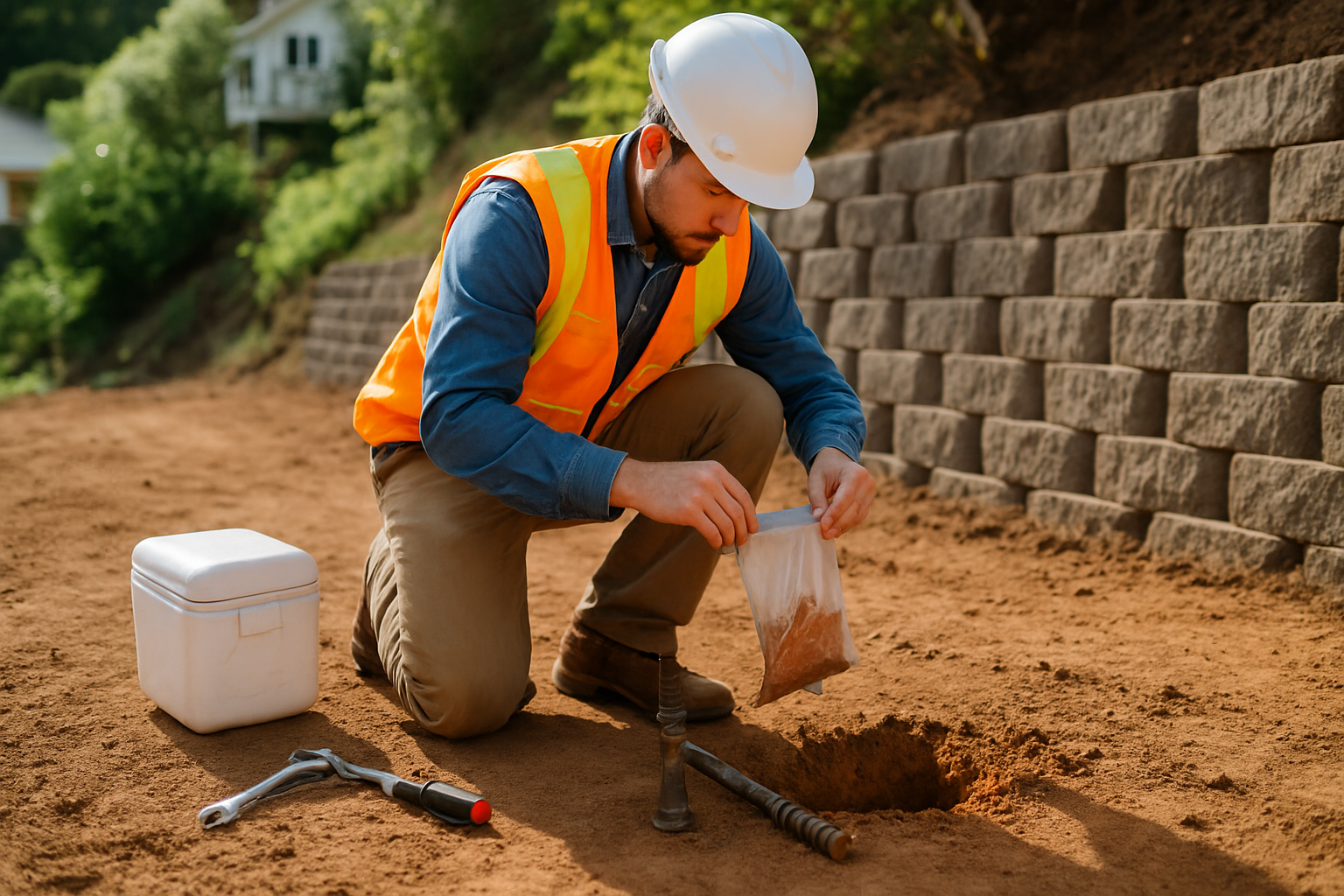
A geotechnical investigation involves test borings or test pits into the existing fill. The engineer checks:
- Whether the fill was compacted to an acceptable density
- Whether water is draining through or collecting behind the wall
- Whether the underlying native soil was prepared before fill was placed
- What remediation, if any, is required as part of legalization
That report either clears the work or tells you exactly what to fix. Both outcomes are better than guessing about the ground your kids play on.
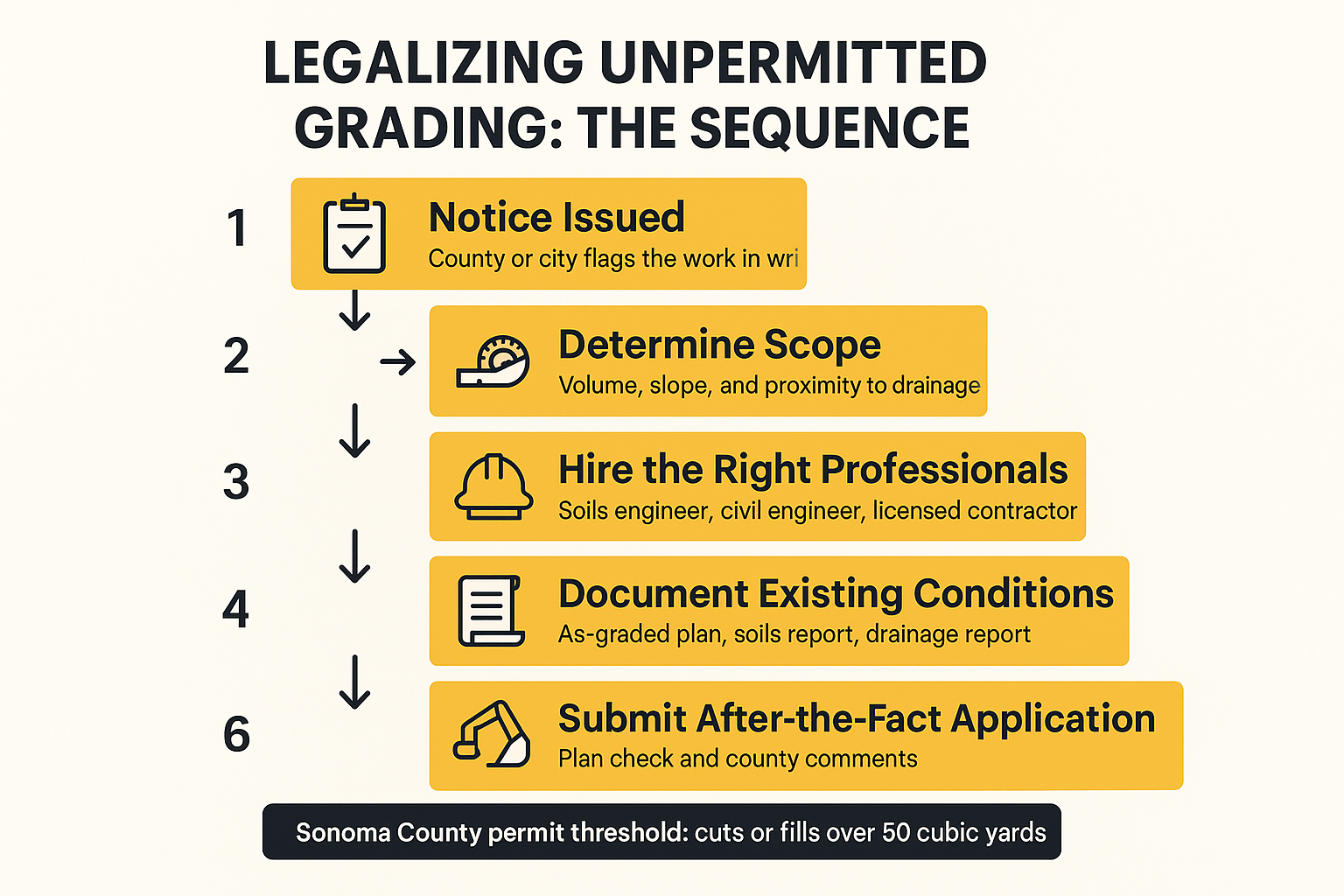
The Legalization Sequence, Step by Step
Here is the order most of these cases follow, from the first notice to a closed permit.
The drainage permit that trips people up
This is the detail I see homeowners miss most often when they try to handle legalization on their own.
In Sonoma County, drainage permits are separate from grading permits. Under county code section 11.04.010, drainage improvements or site clearing that changes drainage patterns needs its own approval.
So you can do everything right on the grading side and still be short a permit. If your terracing redirected water toward a neighbor’s fence line, that is a drainage issue in the county’s eyes, not just an earthwork issue.
Retaining walls follow the same logic. Legalizing the fill does not automatically legalize the structure holding it. That is usually a parallel track, and the unpermitted retaining wall legalization process has its own engineering requirements.
Monterey County works differently in the details but follows the same logic. Coastal slopes above Seaside and Marina, plus the low ground around the Pajaro Valley that flooded in 2023, mean local reviewers look hard at where water goes after it leaves your dirt.
Costs vary a lot depending on scope, and I would not trust anyone who quotes an engineering package sight unseen. What I can say is that legalizing correctly the first time almost always costs less than doing it twice after a plan check rejection.
Frequently Asked Questions About Legalizing Unpermitted Grading
Am I responsible if a previous owner did the grading?
Yes. Permit obligations run with the property, not the person who moved the dirt. That feels unfair, and I have had that conversation more than once, but the current owner is who the county works with.
Can the county make me tear it all out?
Full removal is the rare outcome, not the default. Most cases resolve through documentation plus targeted corrective work, like adding subsurface drainage or rebuilding a wall footing. Removal usually only comes up when the fill is genuinely unstable or sits somewhere it legally cannot be.
How long does the whole legalization process take?
Plan on several months, not weeks. Field survey and geotechnical work take a few weeks. Plan preparation adds more. County plan check often runs a round or two of comments, and each round takes time. Corrective work happens after approval, and if you hit the rainy season, grading work may need to wait for dry conditions.
Do I need a soils report if my grading was on flat ground?
Often no. Flat backyard fill that only exceeded the volume threshold is usually a simpler path, focused on volume calculations and drainage impact. The soils report requirement tends to appear when there is slope, significant fill depth, or a structure sitting on the fill.
What if I am not sure whether the work needed a permit at all?
Start with the county’s grading permit questionnaire before hiring anyone. Some backyard work genuinely falls under the threshold. Getting that answer early saves you from paying for engineering you did not need.
Working through a grading notice on your property?
If you have received a notice about unpermitted grading in Sonoma County or Monterey County, the first useful step is understanding what scope you are actually dealing with before anyone starts writing reports. Our team works on these files regularly and can walk a property with you to sort out what the county will likely require. You can reach DW Excavation at 707-601-9091 or through the contact page at dw-excavation.com.