
Direct Answer: The asphalt is rarely the problem. Driveways fail early because the subgrade under them was graded wrong, under-built on base rock, or never properly compacted, and because water had nowhere to go.
I have walked two driveways in the same week that were paved with the same mix, by the same crew, in the same year. One was still tight and quiet at fifteen years. The other had alligator cracking, a sunken low spot near the garage, and edges crumbling like a cookie at three years.
The asphalt was not the difference. What was underneath it was. That is the part nobody photographs, nobody brags about, and nobody sees again once the surface goes down.
In Monterey County I see this constantly, from sandy lots in Marina and Seaside to heavy adobe clay out toward Salinas and the steep approaches above Carmel Valley Road. This article covers the three things that actually decide how long a driveway lasts: subgrade and base, drainage, and who owns the handoff between grading and paving.
Two Driveways, Same Asphalt, One Fails in Three Years: What Actually Differs
Asphalt is a flexible pavement. It does not span gaps and it does not carry load by itself. It moves with whatever it is sitting on.
So when a driveway fails early, I am not looking at the black stuff first. I am looking down.
Here is what separated the two driveways I mentioned:
- The fifteen-year driveway had base rock at a depth matched to the soil and the vehicles using it, not a token spread of gravel.
- Its surface shed water in a clear direction. Nothing ponded, even after a wet March.
- The subgrade was compacted in lifts and checked, not driven over a couple times with a loaded truck and called good.
- The three-year driveway was paved over soft, wet clay in a hurry, on a slope that dumped runoff right across it.
That last point matters more here than most people expect. Central Coast soils swing hard between bone dry and saturated, and clay expands when it takes on water. Pave over clay that has not been dried back and compacted, and the pavement becomes a lid over a sponge.
A good crew can lay a beautiful surface on a bad base. It will still look great the day the check clears. The bill comes due the second or third winter.
The Three Things That Decide Subgrade Quality
Almost every early driveway failure I have dug into traces back to one of three items. Sometimes all three.
1. Grading so water sheds instead of ponds. A driveway needs a deliberate cross slope, usually a modest fall to one side or a crown down the middle, plus a plan for where that water lands. Grading by eye on a flat Salinas Valley lot is how you end up with a birdbath at the garage apron. We grade to plan, not by feel, because a quarter inch per foot is not something you can judge with a boot.
2. Base rock depth and gradation. Depth depends on the soil below and the load above. Gradation matters just as much. Well-graded crushed rock with a mix of sizes locks together and spreads load. Rounded river gravel or single-size rock rolls and shifts under the same weight.
- A car-only driveway on stable sandy soil needs less base than a rural drive that sees a delivery truck, a water truck, and a fire apparatus turnaround.
- On clay, part of the base depth is doing drainage work, not just structural work.
- Wrong rock type is a quiet failure. It compacts to a number and still moves later.
3. Compaction that is verified, not assumed. This is the big one. Soil and base get placed in lifts and compacted, and the result should be measured rather than eyeballed.
What inadequate compaction looks like a few winters later is specific and recognizable. The surface starts telegraphing every soft spot below it. You get a shallow dip where a utility trench crossed, a sag at the edge where fill was pushed out and never re-compacted, and then cracking that spreads into that scaly alligator pattern because the pavement is flexing over a void it was never meant to bridge.
Once a driveway is telegraphing, sealcoat does nothing for it. Sealcoat protects a sound surface from oxidation and water intrusion. It is not structure. If you want the honest version of when sealing helps, our guide on how often you should seal your driveway walks through it.
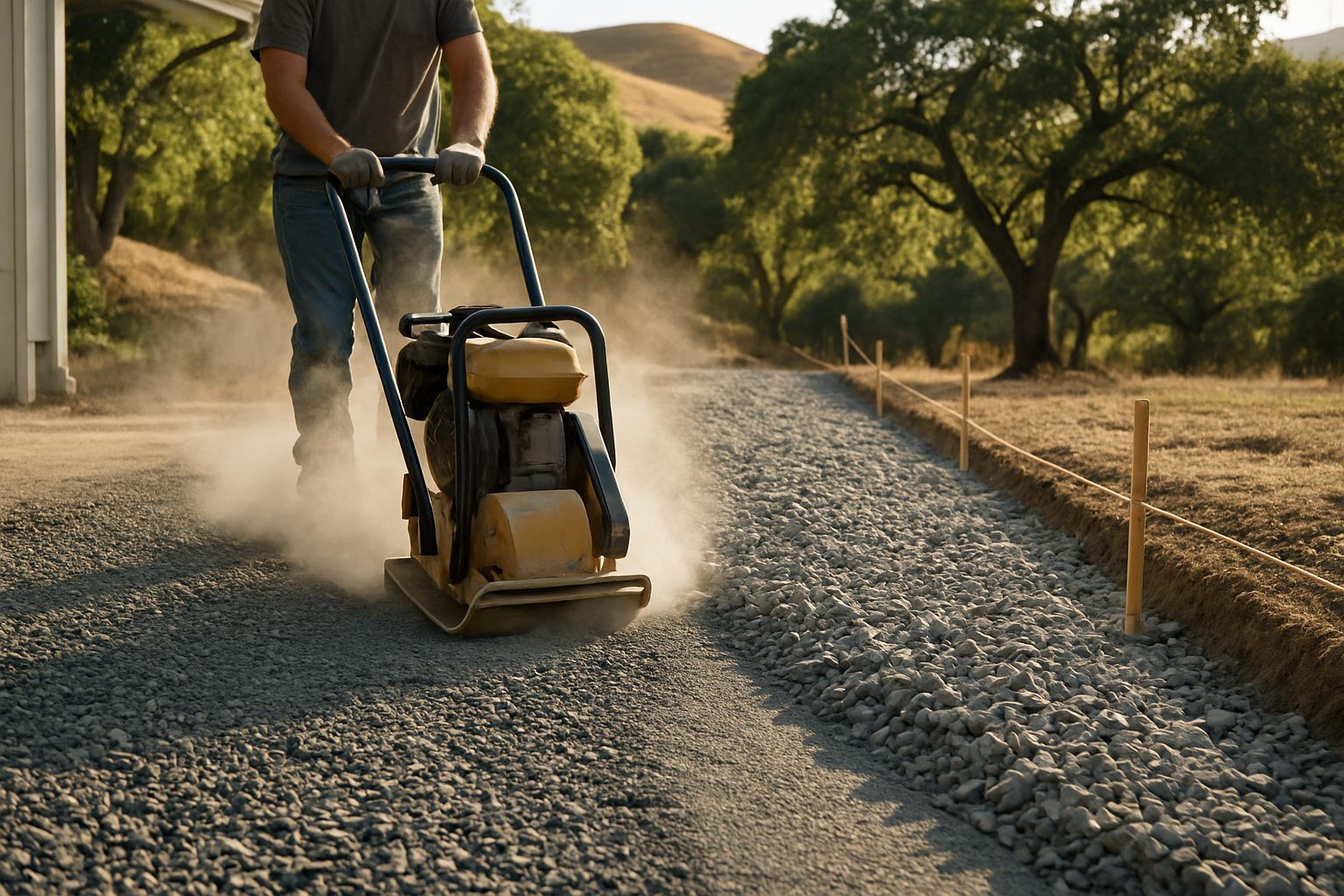
Pavement Fails at Its Edges and Low Points, So Drainage Is Not a Side Topic
I have never seen a driveway start failing in the middle of a well-drained section. It starts where water collects and where the pavement has no support beside it.
That means where the water goes matters as much as what the surface is made of.
Monterey County makes this obvious. Coastal runoff comes off slopes fast, the Pajaro Valley learned in 2023 what happens when water has nowhere to go, and flat farmland lots near Salinas hold water on the surface for days because there is no fall to work with. Up north in Sonoma County, the November 2024 atmospheric river dropped over twelve inches on Santa Rosa in three days, and every driveway with a bad edge showed it by spring.
The pieces I look at on a driveway job:
- Edge drains and a defined shoulder. Unsupported asphalt edges break off. Water sitting against an edge undermines the base beneath it.
- Culverts under driveway crossings. A driveway that crosses a natural drainage path needs a properly sized and bedded pipe, set at the right invert so it flows. An undersized culvert becomes a dam.
- Where the discharge goes. Moving water off a driveway is only half the job. It has to reach a real outlet without dumping on a neighbor or into a creek channel carrying sediment.
One request comes in over and over: there is an open ditch along the front of a property, it is ugly and hard to mow, and the owner wants it filled and piped so the driveway approach widens out. That work is very doable. It is also the easiest way to create a brand new low spot if the pipe grade, size, and inlet protection are not right.
Fill a ditch without maintaining flow and you have not removed water from the property. You have hidden it. Then it comes up through the driveway base. If you already have a spot that puddles every single storm, why water pools in the same spot every time it rains explains what is usually going on underneath.
What the Symptom Usually Tells You About the Base
When a homeowner sends me photos, the crack pattern narrows down the cause before I even walk the site. Here is how I read it.
| What you see | Most likely cause below | Will a surface fix hold? |
|---|---|---|
| Interconnected alligator cracking in patches | Base or subgrade failure, usually compaction or saturation | No. The section needs to be removed and rebuilt |
| Sunken dip along a straight line | Utility trench backfill that was not compacted in lifts | No. Dig, re-compact, then patch |
| Crumbling, breaking outer edge | No shoulder support or water running along the edge | Sometimes, if edge support and drainage are added |
| Standing water in the same spot every storm | Grading problem, not a pavement problem | No. Re-grade or add drainage first |
| Fine surface cracks spread evenly, no movement | Age and sun oxidation on a sound base | Yes. This is what sealcoat is actually for |
| Cracking right where the driveway meets a ditch or culvert | Undersized or poorly bedded pipe undermining the base | No. Correct the culvert first |
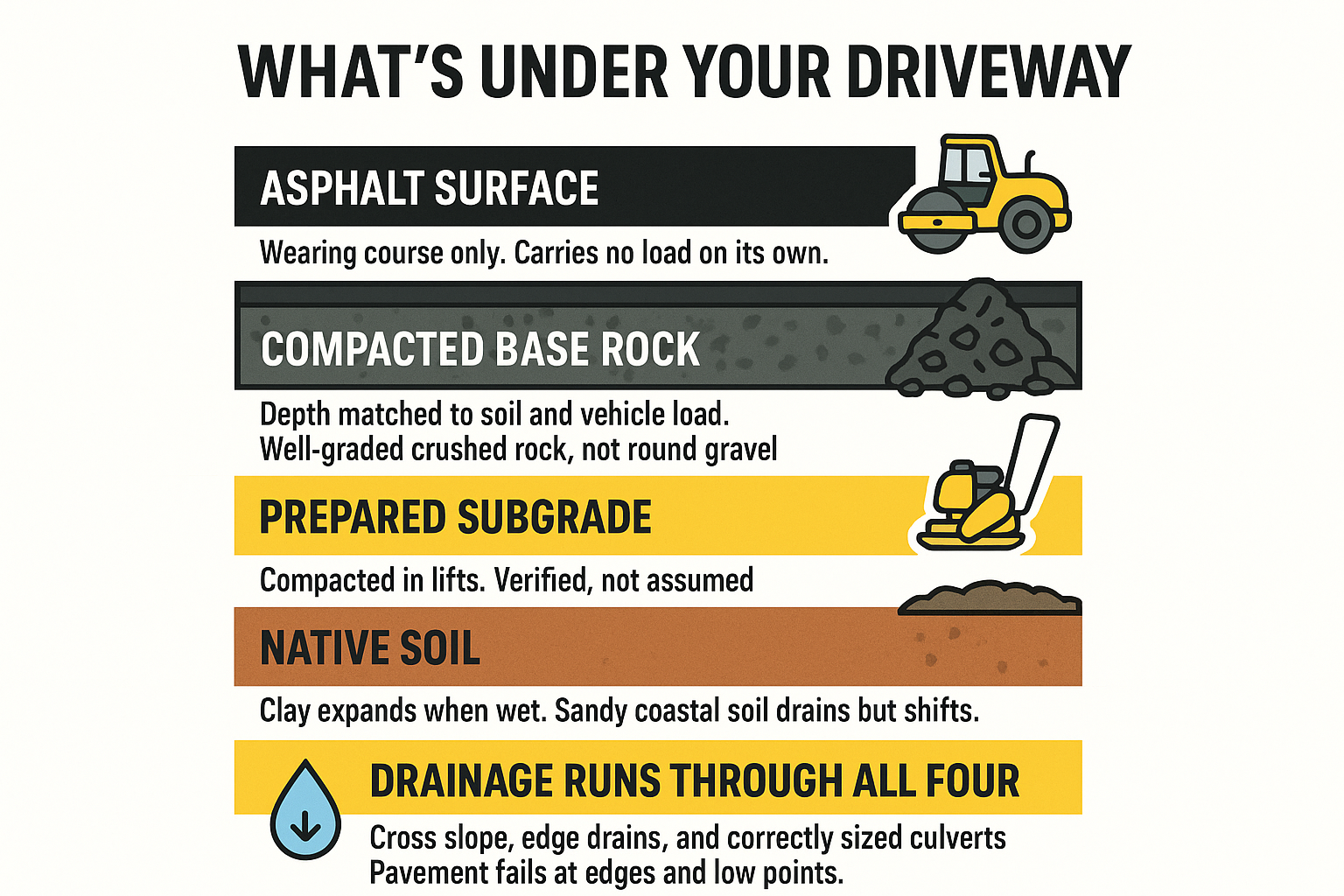
The Layers That Decide a Driveway’s Lifespan
This breaks down what sits under a driveway and what each layer is responsible for. Get any one of them wrong and the surface pays for it.
The Sequencing Trap: When Nobody Owns the Handoff
Here is the pattern I get called into most often, and it has nothing to do with skill. It is about who is accountable.
The grading gets bid by one outfit. Base rock comes from whoever had material available. Paving is a third company. Each one does their piece and leaves.
Then the driveway cracks in year three, and the homeowner is standing in the middle of a disagreement about whether the base was wrong or the paving was. The grader says the pad was to grade when they left. The paving crew says they paved what they were given. Both may be telling the truth.
What I have watched go wrong at those handoffs:
- Base gets placed after a rain, over subgrade that was never dried back.
- Nobody re-checks grade between crews, so a low spot survives into the finished surface.
- The rock delivered is whatever was in the yard that week, not what the soil report or the load actually called for.
- Drainage was somebody else’s line item, so it never happened at all.
What changes with one crew accountable from subgrade through finish surface is simple. There is no gap to argue about. The person who compacted the base is the same person who has to live with the surface that goes over it.
On our jobs we do the grading, the compaction, and the drainage work ourselves before anything gets paved, and we supply our own aggregate and base material. That means the base spec gets matched to what the site actually needs, not to whatever a separate supplier happened to have on the yard. More on that logic in what separates a driveway that lasts from one that doesn’t.
One more sequencing note that catches people. On a long driveway or a hillside approach, moving dirt adds up fast. Monterey County generally requires a grading permit for cuts or fills over 100 cubic yards, and Sonoma County’s threshold is lower at 50 cubic yards. Confirm your parcel’s requirements with the county before dirt moves, because a stop-work order mid-project is far more expensive than the permit.
Permeable Paving Is a Real Option, Not Just a Trend
Permeable paving has been gaining ground here as drought years and runoff rules put pressure on both ends of the water problem. Instead of shedding stormwater to a discharge point, a permeable driveway lets it pass through the surface into an open-graded rock reservoir below.
When it makes sense on the Central Coast:
- A flat lot where there is genuinely no good place to send surface runoff.
- A property where the county wants stormwater managed on site.
- An owner who wants the driveway doing double duty as infiltration.
It is not a shortcut, though. Permeable systems live or die on the reservoir depth, the aggregate gradation, and honest infiltration in the native soil below. On heavy clay the water has to go somewhere, so the design gets more involved. The EPA has a plain overview of how permeable pavement systems work if you want the mechanics.
There is also a money angle worth knowing. In Sonoma County, the Resource Conservation District has run a rainwater harvesting rebate program offering roughly $0.50 per gallon of storage capacity, up to about $5,000 for qualifying projects, which can pair with permeable and infiltration work. Program funding and rules change, so verify current terms directly with the district before you count on it. Monterey County property owners should check with their own county and water agency, since incentives here are structured differently.
As for cost, I am not going to hand you a number in an article. Driveway pricing swings on length, access for equipment, how much material has to be imported or hauled off, soil condition, and whether drainage work is part of the scope. Costs vary a lot, and the honest range is wide enough that only a site visit narrows it. If you want general market context to start from, our driveway repaving cost guide lays out the factors, and we will give you an exact figure for your property.
One thing I will say plainly. When a bid comes in noticeably low, the savings almost always came out of base depth, compaction time, or drainage. Those are the three things you cannot see and the three things that decide whether you are repaving in year three or year fifteen. And if you are on the Peninsula wondering why local driveways seem to go early, why Monterey driveways crack faster than you’d expect gets into the coastal specifics.
Frequently Asked Questions About Driveway Subgrade and Base Prep
How thick should the base rock under my driveway be?
It depends on your soil and what drives on it, which is why I will not give a single number. A car-only driveway on firm, well-draining coastal soil needs less than a rural drive on adobe clay that sees loaded trucks. The two variables that set it are bearing capacity of the native soil and the heaviest vehicle you expect, including the occasional water or fire truck.
Can you just pave over my cracked driveway instead of tearing it out?
Sometimes. An overlay works when the existing pavement is stable and the cracking is surface-level oxidation. It does not work over alligator cracking or sunken areas, because the base under those sections has already failed and the new asphalt will crack in the same places within a couple of winters. I would rather remove and rebuild the failed sections than sell you a surface that reflects the same problem back.
My contractor said the base was compacted. How do I know it actually was?
Ask how it was verified and what the target was. Compaction is placed in lifts and measured, and on larger jobs it gets tested. “We ran a truck over it” is not verification. If the answer is vague, that is your answer.
Do I need a permit just to redo my driveway in Monterey County?
Resurfacing in the same footprint usually does not trigger a grading permit. Once you are cutting, filling, or changing drainage, it can. Monterey County’s grading permit threshold is generally 100 cubic yards of cut or fill, and encroachment permits come into play where a driveway meets a public road. Requirements vary by jurisdiction inside the county, so confirm with the county before work starts.
Can the open ditch in front of my property be filled in and piped?
Often yes, and it is a request we get regularly. The pipe has to be sized for the flow it carries, bedded and compacted properly, and set at a grade that keeps water moving to a legitimate outlet. Done wrong, you trade a ditch for a soft spot under your new driveway, plus a headache with the road agency.
What time of year is best for driveway base and paving work on the Central Coast?
Late spring through early fall, generally. Subgrade needs to be dry enough to compact properly, and asphalt needs warm, dry conditions to lay and cure well. Once the rains settle in, I would rather do drainage and erosion work and hold the paving until the ground cooperates.
Ready to Find Out What’s Under Your Driveway?
If you have a driveway that is cracking early, a low spot that fills every storm, or a ditch out front you want filled and piped correctly, we are happy to walk the site with you and explain what we see. We handle the grading, compaction, and drainage ourselves across Monterey County and up through Sonoma County, so the base spec matches the site rather than the material yard. Reach our team at 707-601-9091 or through the contact page at dw-excavation.com when you want a straight assessment and a free estimate.