
Direct Answer: Most Sonoma County yards flood because heavy clay soil drains slowly. Rain has nowhere to go, so it pools in low spots and runs toward the foundation instead of soaking in.
You watch the rain come down, and within an hour the same corner of your yard turns into a pond. Two days later, it is still there. And every winter it gets a little worse.
I hear this call constantly from Santa Rosa, Windsor, Healdsburg, Petaluma, and Rohnert Park homeowners, and I hear a version of it from Monterey County, CA property owners too. The words change a little, but the problem is almost always the same: water has nowhere to go.
Below I want to walk through what is actually happening under your lawn, what the November 2024 storms taught us about which yards fail, and the warning signs I look for on a property before the ground saturates.
Clay Soil Is the Root Cause of Most Sonoma County Yard Flooding
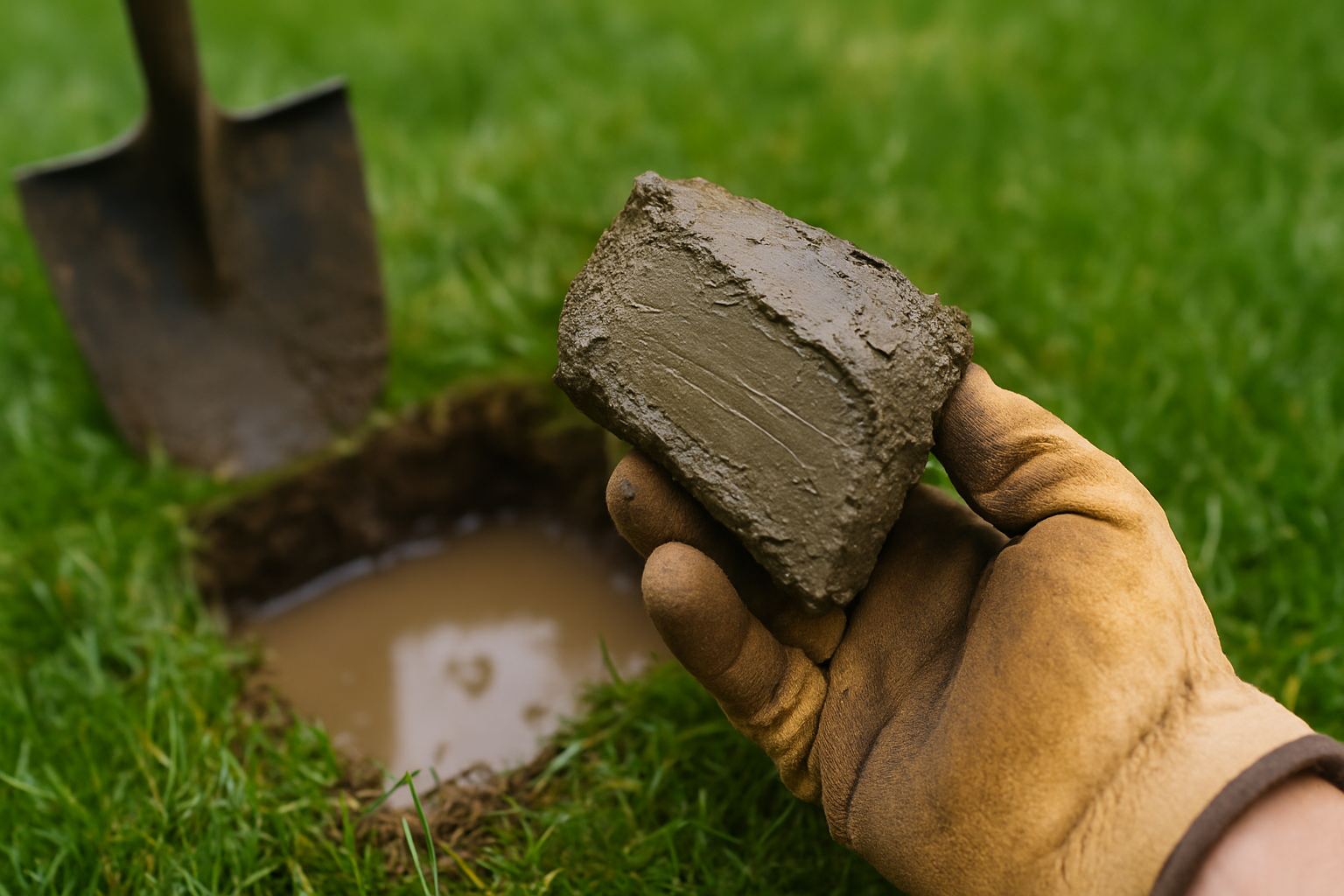
Sonoma County sits on heavy clay. Clay particles are tiny and pack tight, so water moves through them very slowly compared to sand or loam.
Sandy soil can take in inches of rain per hour. Dense clay may only accept a fraction of an inch per hour once it is wet. That gap is the whole story.
So when a real storm hits, the top few inches of your yard saturate fast and everything after that becomes surface runoff. It does not soak in. It travels.
Where it travels depends on three things:
- Grade, meaning the slope of the ground and whether it moves water away from the house or toward it
- Low spots that were never shaped or filled, which act like bowls
- Discharge points, meaning where the water is actually supposed to end up
Most flooded yards I see are missing that third one entirely. There is no outlet. Water collects and just sits until it evaporates or slowly seeps.
You can look up your parcel’s soil type through the USDA’s Web Soil Survey, which maps soil texture and drainage class down to the property level. If yours comes back as a clay or clay loam with slow permeability, that pond in your yard is not bad luck. It is soil behavior.
What the November 2024 Atmospheric River Exposed
In November 2024, an atmospheric river dropped over 12 inches of rain on Santa Rosa in three days. That storm did not create new drainage problems. It revealed the ones that were already there.
After it passed, the calls came in with the same short list of damage:
- Yards holding standing water for days, not hours
- Gravel driveways rutted and washed toward the road
- Slopes that lost soil in sheets, leaving bare cuts behind
- Water backing up against foundations and crawl space vents
The properties that came through it fine were not lucky. They had a graded path for water and a place to put it.
I think about that storm as a stress test. A normal Sonoma winter rain will not tell you much, because clay can absorb the first inch or so. A three-day soaking event tells you exactly where your property fails.
The same lesson played out on the coast. Monterey County, CA properties deal with fast hillside runoff and flood-prone lowlands, and the 2023 Pajaro flooding showed how quickly a system with no capacity left gets overwhelmed. Different soil, same principle.
The Warning Signs I Look For Before the Rain Starts
When I walk a flooding property, I am reading the ground for evidence. Most of these signs are visible in dry weather if you know what you are looking at.
Drainage red flags:
- Standing water that lingers more than 24 hours after rain stops
- Downspouts dumping right at the base of the foundation instead of piping away
- Low spots that have never been graded, often left over from original construction
- Mud lines or silt fans on hardscape showing where water ran last winter
- Moss, algae, or dead grass patches in the same footprint every year
Slope and erosion red flags:
- Cracks in the soil surface running roughly parallel to the slope face
- Trees or fence posts leaning downhill
- Water pooling at the base of a hillside where it should be moving past
- Exposed roots or a small soil ledge where turf has pulled away
That last group matters more than the first. Water in a flat yard is a nuisance. Soil moving on a slope is a structural issue, and it does not reverse itself.
If the water always shows up in the same footprint, that is grade telling you something. I wrote more about that pattern in why water pools in the same spot every time it rains.
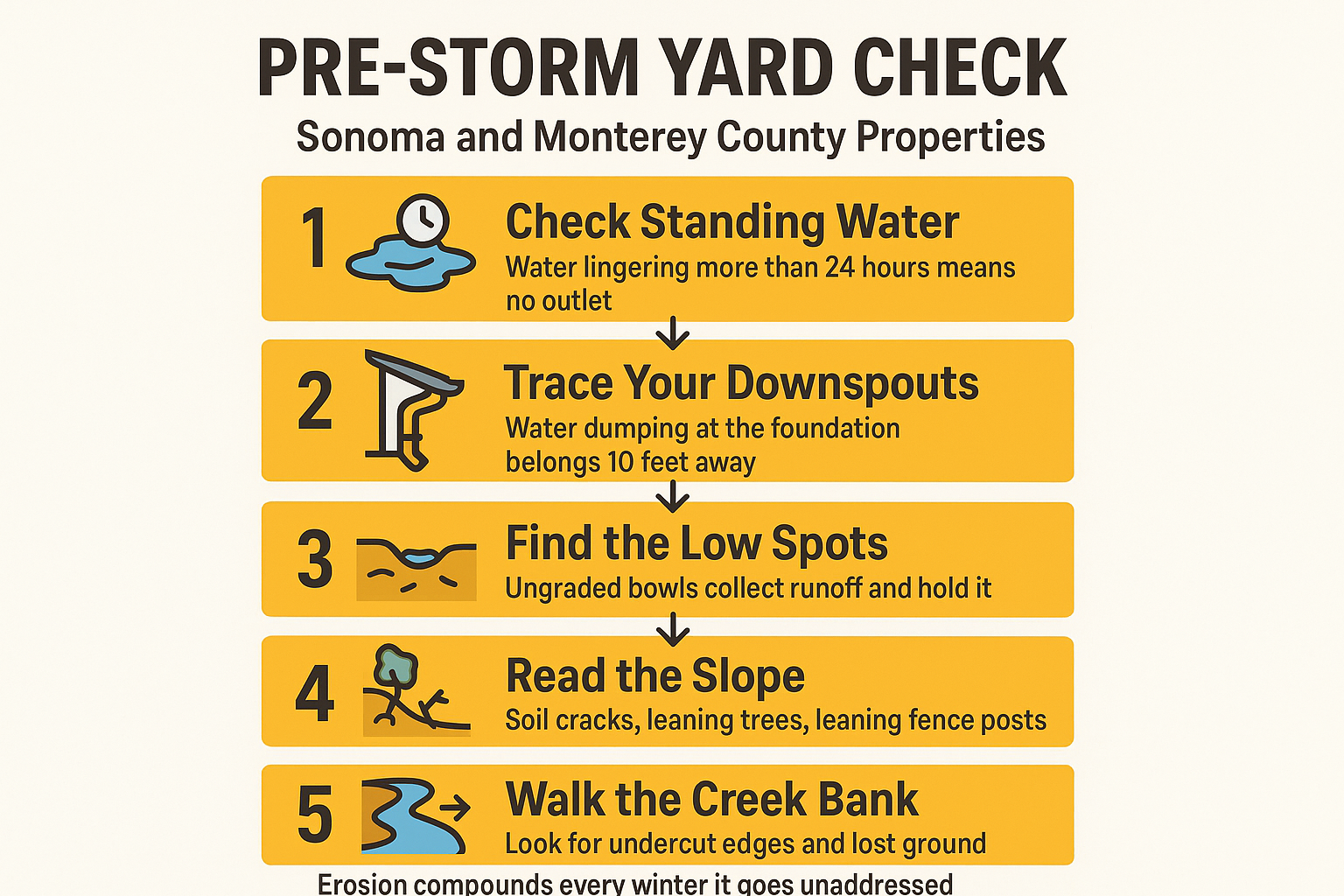
Your Pre-Storm Yard Check
Here is the walk-around I recommend doing before the first real storm of the season, while the ground is still dry enough to read.
What Each Warning Sign Usually Means
This is roughly how I triage a property on a first walk. Every site is different, so treat it as a starting point rather than a diagnosis.
| What You See | What It Usually Points To | How Soon It Matters |
|---|---|---|
| Standing water lasting 1-3 days | Slow clay infiltration with no discharge point | Before the next wet season |
| Downspout draining at the foundation | Roof water loading the soil against your footing | Right away, often a same day fix |
| Same low spot floods every year | Original grade was never corrected | Before the next wet season |
| Cracks in soil on a slope | Soil beginning to move downhill | Urgent, before saturation |
| Creek bank pulling back each winter | Active erosion removing usable land | Urgent, gets more expensive yearly |
| Driveway rutting and washing out | Runoff crossing the surface with no cross drainage | Before the next wet season |
Creekside and Hillside Properties Lose Ground Every Winter
Some of the hardest conversations I have are with homeowners backing onto a creek. One Sonoma County homeowner described losing many cubic yards of usable land over the years, watching the back of the property wash downstream a little more each heavy rain, and worrying the house itself could eventually be at risk. The city and the county had both declined to help.
That is more common than people expect. Once water is moving on private property, the fix usually falls to the property owner.
What I want people to understand is that erosion compounds. A cut bank that loses a foot this winter presents more exposed face to the current next winter, so it loses more. The curve steepens.
That is why the cheapest version of the fix is almost always the earliest one. Reshaping a bank, adding armoring, and redirecting the flow that is causing the scour is real work, but it is far less involved than rebuilding after a slope has failed under a structure.
Hillside properties follow the same math. Water pooling at the base of a slope, cracks along the face, and leaning trees are all early notice. Waiting until the ground is fully saturated turns a shaping and drainage project into a repair project.
Work close to a creek or waterway also carries its own review layer. Depending on the scope, that can mean coordination with the California Department of Fish and Wildlife or the Army Corps of Engineers on top of county approvals.
What a Real Fix Involves, and What Drives the Cost
There is no single product that fixes a flooding yard. The work is a combination, and the combination depends on your site.
Typical pieces of a drainage correction:
- Regrading the surface so water moves toward a discharge point instead of a bowl
- Subsurface drains to collect water that clay will not absorb
- Catch basins and culverts placed where water actually collects, not where it looks tidy
- Downspout extensions carrying roof water well away from the foundation
- Erosion control on any exposed slope before the rain returns
Costs swing widely, and I will not pretend otherwise. A downspout rerouting and a small regrade sits at one end. A creek bank stabilization or a hillside drainage system sits far at the other.
What generally moves the number: how much dirt has to move, whether machines can reach the work area, how far spoil has to be hauled, whether a permit and engineering are required, and how saturated the ground already is. An exact figure requires someone standing on the site.
One piece worth planning around: Sonoma County requires a grading permit for cuts or fills over 50 cubic yards, while Monterey County’s threshold is 100 cubic yards. Rules and review paths do change, so it is worth confirming current requirements with your county before scoping work. If your project is near that line, read up on how Sonoma County grading permits work now and on storm and flood preparedness for Sonoma County properties.
Frequently Asked Questions About Yard Flooding in Sonoma County
How long should water sit in my yard after a storm before I worry?
As a rule of thumb, more than 24 hours of standing water after the rain stops means the site has no working outlet. A few hours of puddling during a heavy storm is normal, even in clay.
Can I fix this myself with a French drain from the hardware store?
Sometimes, if the problem is small and you have somewhere downhill to send the water. The reason DIY drains fail in clay is that people install the pipe but never solve the discharge. A drain that collects water and dead ends just moves the pond underground.
Is the best time to fix drainage before the rain or during the wet season?
Before. Dry ground compacts properly, machines can work without tearing up the site, and you are not racing a storm. Summer and early fall are the practical window in Sonoma and Monterey counties.
Does yard flooding mean my foundation is already damaged?
Not necessarily, but repeated soil saturation against a footing is one of the ways problems start, especially in expanding clay. If you are seeing water at the foundation regularly, it is worth understanding what makes foundation work in Sonoma County different.
My property was recently added to a FEMA flood map. Does that change anything?
It can change insurance, permitting, and what a county will approve on your site. It does not change the physical drainage on your parcel, but it does raise the stakes on getting that drainage right.
Thinking Through a Drainage Problem on Your Property?
If you have been watching the same corner of your yard flood every winter, the dry months are when a site walk is actually useful. DW Excavation is a licensed California general engineering contractor based in Windsor, CA LIC #1060838, owner operated since 2013, with over a decade in Sonoma County clay soils and coastal ground across Monterey County, CA. When you call 707-601-9091 or reach out through dw-excavation.com, you are talking to the team that will be on the site, not a dispatcher, and we are glad to talk through what you are seeing.