
Direct Answer: Foundation excavation in Sonoma County is complicated by expansive clay soils, steep terrain, and shallow water tables, factors that affect depth, cost, and permit requirements before a single concrete truck shows up.
Most homeowners planning a new build in Sonoma County think the hard part is finding a foundation contractor. What they don’t realize is that before any concrete gets poured, someone has to dig a hole, and that hole is where most projects hit their first real complication.
I’ve worked foundation excavation across Windsor, Healdsburg, and the hillside parcels east of Petaluma. The terrain here is genuinely different from a flat suburban lot in Sacramento or San Jose. The soil moves. The slopes are real. And the groundwater shows up when you least expect it.
This article covers the three things that consistently make foundation excavation in Sonoma County harder than people expect, and why understanding them before you pull a permit matters more than most first-time builders realize.
The Soil Is the First Problem, and It’s Already on Your Lot
The clay-heavy soils that run through Windsor, Healdsburg, and the foothills above Santa Rosa are not just dense. They’re expansive, meaning they absorb water and swell, then dry out and shrink. That cycle happens every season, and the movement is significant enough to crack foundations that weren’t designed to account for it.
What that means for an excavation job is that the bottom of the trench often can’t just be dug and left. In many cases, we have to over-excavate, go deeper than the foundation plan calls for, and then bring in engineered fill, compact it in lifts, and get a soils engineer to sign off before any concrete goes down. That’s not extra work someone added to the project. It’s what the soil requires.
Before we ever start a dig on a parcel with known clay content, I want to see a soils report if one is available. The Sonoma County Grading, Drainage and Erosion Control Ordinance outlines when a soils report becomes a permit requirement, but even when it isn’t required by code, skipping it on a clay-heavy lot is a gamble that costs more to fix later than it would have to address upfront.
For first-time builders, this is often the first time they hear the phrase soil bearing capacity. It’s exactly what it sounds like: how much load the soil can carry before it moves. And in parts of Sonoma County, that number is low enough to change how deep your foundation has to go.
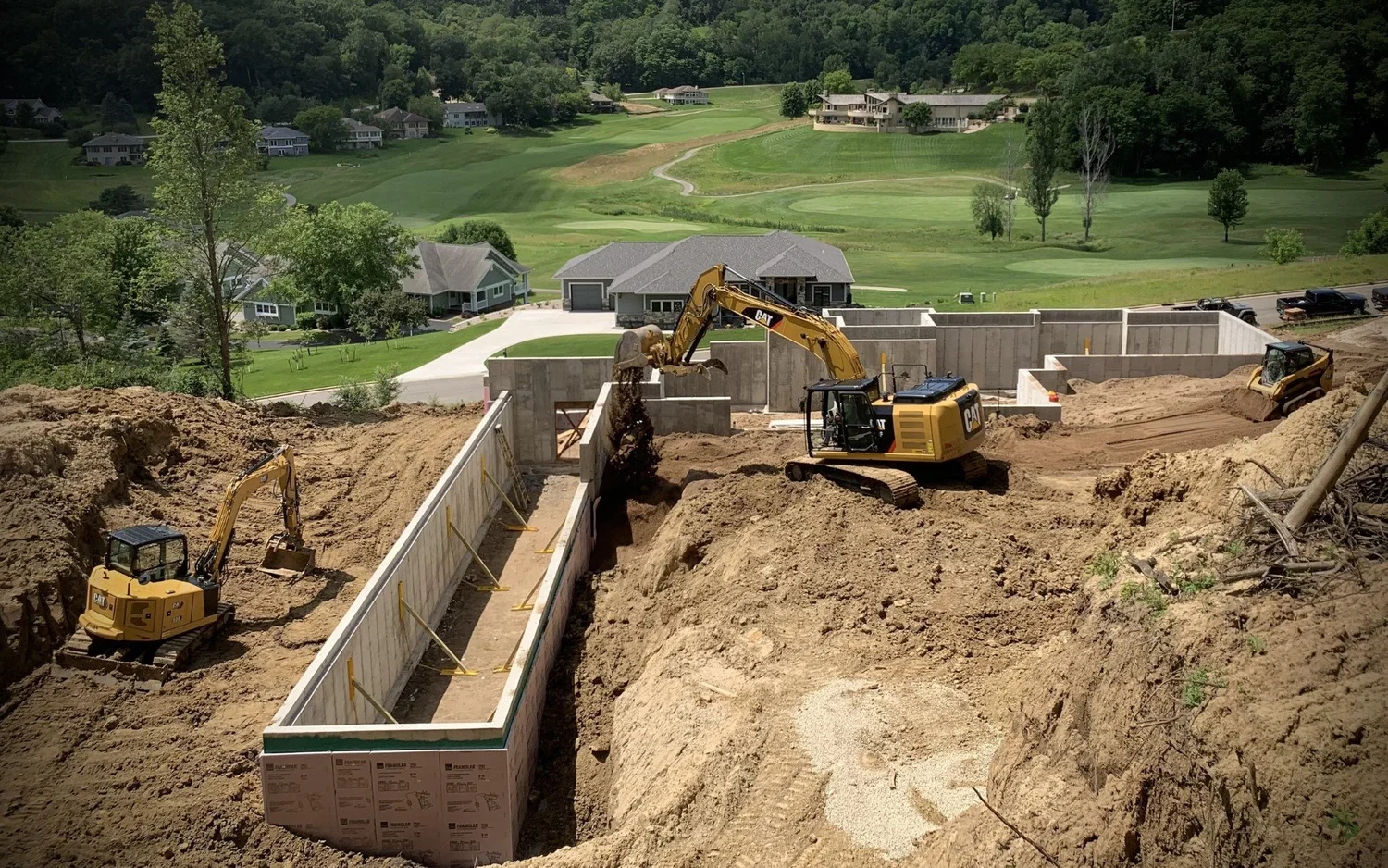
Slope Changes the Entire Scope of the Job
A level lot in a flat subdivision is a straightforward dig. A hillside parcel in the Mayacamas foothills, or an unincorporated lot east of Petaluma with a meaningful grade, is a different job entirely.
On a sloped site, the uphill cut is often the deepest part of the excavation. We’re cutting into the hillside on one end while the downhill side may need fill to level the pad. That combination, cut on one side, fill on the other, is where Sonoma County’s grading permit thresholds come into play.
Sonoma County requires a grading permit for any cut or fill that exceeds 50 cubic yards, or for any cut or fill deeper than 3 feet. On a sloped foundation dig, those numbers get reached faster than most homeowners expect. And if the parcel is in a geologic hazard zone, a mapped landslide area, or near a ridgeline, the job may qualify as Engineered Grading, which requires a licensed civil engineer to prepare the grading plan and a soils report before work begins.
Starting work without that permit in hand is a code violation. Stop-work orders in Sonoma County can set a project back by weeks, and the fines compound. If you’re planning a build on any parcel with slope, I’d strongly encourage running the permit process in parallel with your foundation contractor selection, not after. We cover more on this in our breakdown of residential excavation limits in Sonoma County.
The permit question is also directly connected to who scopes the work. If you want to understand how excavation contractors and foundation contractors divide responsibility on a typical new build, this article on who actually digs your foundation clears up the confusion we hear about on nearly every first-build project.
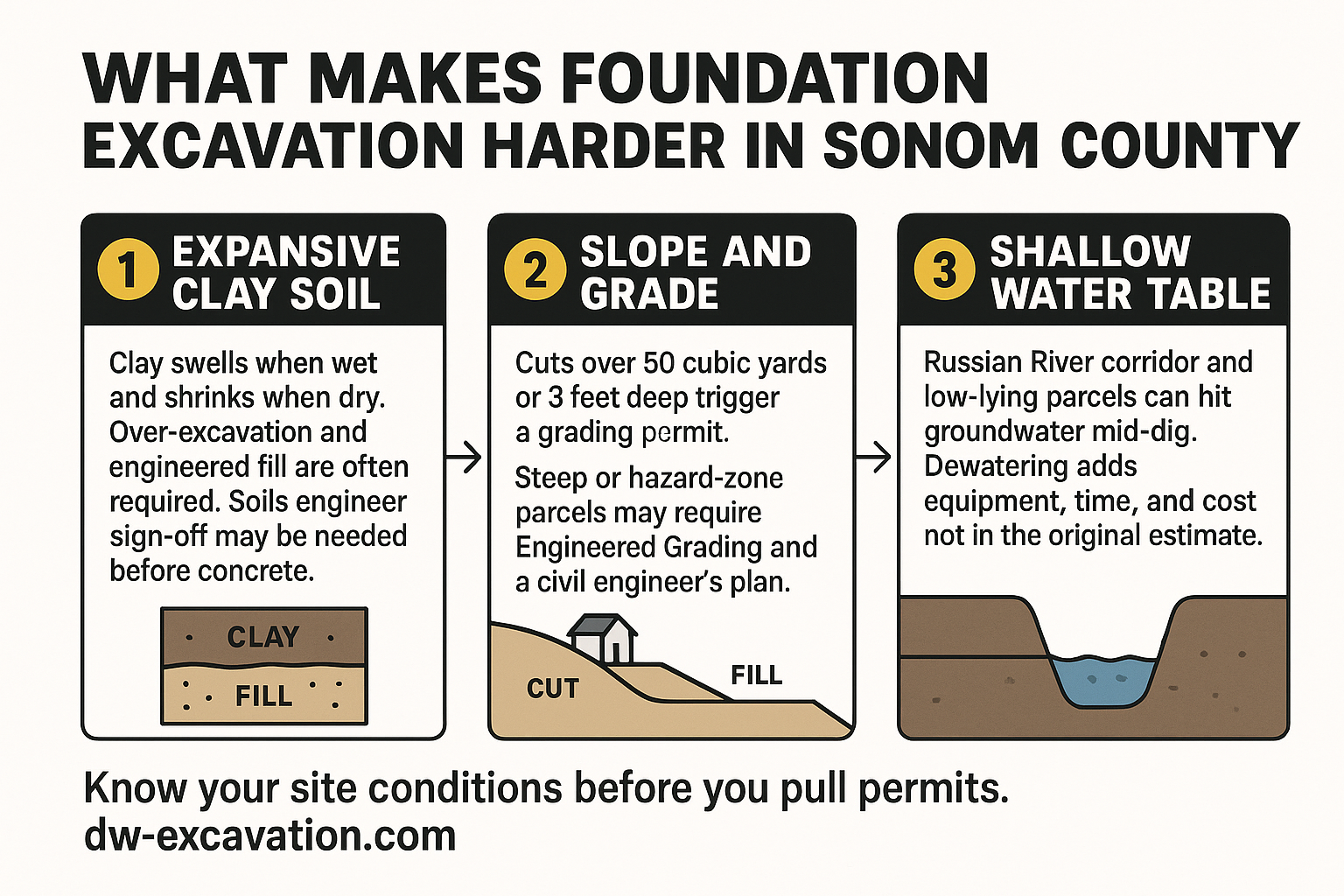
Three Factors That Complicate Foundation Excavation in Sonoma County
This infographic breaks down the three site conditions that most commonly add time, cost, or permit complexity to a Sonoma County foundation dig.
Water Shows Up When You’re Already Three Feet Down
The third complication doesn’t announce itself ahead of time. Parts of Sonoma County, especially parcels near the Russian River corridor and flood-prone lowlands in the unincorporated areas, have a water table that sits much closer to the surface than the soil profile suggests.
We’ve opened foundation trenches on sites where there was no visible indication of drainage issues at grade, only to hit groundwater at four to five feet down. When that happens, the job changes. You’re no longer just digging, you’re dewatering, which means bringing in pumps, managing discharge, and potentially waiting for conditions to stabilize before the trench bottom is stable enough to work from.
None of that was in the original estimate. And a contractor who hasn’t worked Sonoma County’s specific terrain before may not flag this risk during the scoping conversation. That’s one of the things we try to address before we ever show up on a site, reading the FEMA flood data, checking parcel drainage records, and understanding which parts of the property sit low. If you’re building near a creek or in a known flood-risk area, the article we wrote on FEMA’s flood map remapping of Santa Rosa properties is worth reading before you finalize your site plan.
Good drainage planning at the foundation stage also prevents longer-term problems. A foundation dig that hits water and handles it correctly, with proper drainage routing and subgrade preparation, sets up the structure to stay dry for decades. One that doesn’t address it creates ongoing settlement and water intrusion issues that are expensive to fix after the fact, as we discuss in what actually happens underground before a foundation gets poured.
Sonoma County Foundation Excavation: What Each Site Condition Triggers
This table gives a quick reference for how common Sonoma County site conditions affect what the excavation job actually requires.
| Site Condition | What It Affects | Likely Requirement |
|---|---|---|
| Expansive clay soil | Trench depth, bearing capacity, subgrade stability | Over-excavation, engineered fill, soils engineer sign-off |
| Slope with cut or fill over 50 CY or 3 ft deep | Permit threshold, earthwork scope | Sonoma County grading permit required |
| Engineered Grading zone (steep, hazard area) | Plan preparation, agency review | Licensed civil engineer grading plan + soils report |
| Shallow water table (Russian River area, lowlands) | Trench stability, timeline, equipment needs | Dewatering equipment, potential schedule delay |
| Geologic hazard zone or landslide-mapped parcel | Overall site safety, permit type | Additional review, possibly geotech study |
Who Actually Does the Dig, and Why That Question Matters Before You Hire Anyone
One thing that comes up regularly with homeowners planning their first new build: confusion about who is responsible for the excavation itself. Several people have contacted us after their general contractor told them the foundation contractor handles the dig, only to find out the foundation contractor expected a prepped, cleared, excavated hole to already be waiting.
On most residential new-construction projects in Sonoma County, the excavation contractor and the foundation contractor are separate trades. Our job is to get the hole to the correct depth, slope, and bearing conditions. The foundation contractor works from there.
This matters because the excavation contractor is the one who has to read the soil, manage the slope, handle any dewatering, and make sure the trench bottom is solid enough to build from. If that work is scoped incorrectly, or if nobody owns it clearly, the foundation contractor shows up to a site that isn’t ready, and the project stalls.
For a deeper look at how these trades divide responsibility and what questions to ask before you sign anything, the breakdown in Foundation Contractor or General Contractor: Who Digs Your Foundation? is the most direct answer we’ve put together on this.
Frequently Asked Questions About Foundation Excavation in Sonoma County
Do I need a grading permit for a foundation excavation in Sonoma County?
Often yes. Sonoma County requires a grading permit if the cut or fill exceeds 50 cubic yards or goes deeper than 3 feet. On most foundation digs, especially on sloped lots or parcels with significant clay content, you’ll hit one or both of those thresholds. The permit has to be in hand before work begins, not pulled after the fact.
What is Engineered Grading and when does it apply?
Engineered Grading is a classification Sonoma County uses for grading work on steep slopes, geologic hazard zones, or high-volume earthwork projects. When a foundation dig falls into this category, a licensed civil engineer has to prepare the grading plans, and a soils report is typically required. It adds time to the pre-construction phase, so plan for it if your parcel has any significant slope or is in a known hazard area.
What happens if groundwater is hit during excavation?
The job shifts to dewatering, pumping water out of the trench to stabilize the bottom before foundation work can proceed. This adds equipment and labor that typically weren’t in the original estimate. It’s not a contractor error; it’s a site condition. But a contractor with local experience should flag the risk before the dig starts on parcels near the Russian River or known flood-prone lowlands.
How does clay soil affect how deep my foundation excavation has to go?
Clay soils expand and contract seasonally, which can undermine a foundation that wasn’t designed to account for it. On clay-heavy parcels, the trench bottom often needs to be over-excavated, filled with engineered material, and compacted in controlled lifts. A soils engineer typically reviews the subgrade conditions before any concrete is poured. The depth you see on the architectural plan may not be the final depth once soil conditions are evaluated in the field.
Can a foundation contractor also do the excavation?
Some can, but on most residential new builds in Sonoma County, excavation and foundation work are handled by separate licensed contractors. The excavation contractor prepares the site, correct depth, slope, and bearing conditions. The foundation contractor works from that prepared hole. Assuming one covers the other’s scope is one of the most common planning mistakes we see on first builds.
Planning a Foundation Dig in Sonoma County?
If you’re getting ready to pull permits or hire a foundation contractor in Sonoma County, we’re glad to talk through your site conditions before anything is committed to paper. Our team at DW Excavation has been working these soils since 2013, we know what the clay does, where the water shows up, and which parcels are likely to cross into Engineered Grading territory. Call us at 707-601-9091 or reach out through the contact page at dw-excavation.com to start the conversation.