
Direct Answer: Yes, residential excavation in Sonoma County has several hard limits — permit thresholds at 50 cubic yards, required utility notifications, property line setbacks, and fire hazard zone restrictions that most homeowners don’t know about until they’re already in trouble.
I get some version of this question pretty regularly: “Are there any limitations to residential excavation?” The short answer is yes — quite a few, actually. And the ones that bite homeowners hardest aren’t the obvious ones.
Most people assume that if the work is on their own property, they can dig where they want. In Sonoma County, that’s not how it works. Between permit thresholds, setback rules, utility notification requirements, and fire zone restrictions, there’s a lot that can bring a project to a stop — or create liability down the road — if you don’t know what you’re walking into.
I want to walk through the limits that come up most often in real projects here in Sonoma County. Not every possible regulation — just the ones that actually matter when a homeowner is standing in their backyard trying to figure out why their retaining wall project just got complicated.
The 50 Cubic Yard Rule That Most Homeowners Miss
This one is the most consequential limit I run into on residential jobs, and almost nobody knows the exact number before we talk.
In Sonoma County, any excavation, cut, or fill that moves more than 50 cubic yards of material requires a grading permit from Permit Sonoma before work begins. Fifty cubic yards sounds like a lot. It isn’t. Picture a cube of soil roughly 15 feet wide, 15 feet long, and 15 feet deep — that’s the threshold. A foundation excavation, a retaining wall on a sloped lot, or a drainage correction on a hillside property can hit that number faster than most people expect.
I had a homeowner contact us about a retaining wall replacement on a slope in Forestville. They thought it was a straightforward swap. When we walked the site, it was clear the excavation alone — pulling out the old wall, re-cutting the slope, and placing proper fill — was going to move well over 50 cubic yards. Without a permit in place, that project couldn’t legally proceed.
Working past that threshold without the required permit exposes the property owner to:
- Stop-work orders that halt the entire project mid-excavation
- Fines from Permit Sonoma for unpermitted grading
- Re-permitting costs after the fact, which are often more expensive than permitting upfront
- Potential complications when selling the property, since unpermitted grading shows up in disclosure requirements
If you want to understand what a civil site plan looks like before a grading permit gets pulled, Do You Need a Civil Site Plan Before You Can Pull a Grading Permit? walks through the process in detail.

Utility Notifications and Property Line Rules Aren’t Optional
Beyond the grading permit threshold, there’s a second category of limits that catches homeowners off guard — and these apply even on small excavation jobs that fall well under 50 cubic yards.
California law requires a USA (Underground Service Alert) dig notification at least two business days before any ground-breaking work begins. This isn’t a courtesy call. It’s a legal requirement. Before we put a blade in the ground on any job, that notification has to be submitted. Utility lines — gas, water, sewer, electrical — run at depths that aren’t always obvious, and the consequences of hitting one are serious.
One form submission we received recently described exactly the kind of situation this prevents: a homeowner in Santa Rosa was converting their garage into an ADU and needed to connect the new unit to the existing sewer line. They assumed that was purely the plumber’s job. What they didn’t realize was that the sewer lateral ran under the driveway and an existing concrete pad — and before any plumbing work could happen, an excavation contractor needed to open that ground first. That excavation has its own permit and inspection requirements, separate from the plumbing work.
The lateral support rule is another limit that matters near property lines. If excavation undercuts the soil that supports a neighboring property, the property owner doing the digging can face civil liability — even if the actual work stayed within their own lot lines. This comes up most often on sloped lots in areas like Healdsburg and the unincorporated hills west of Windsor, where adjacent properties are close and the grade changes quickly.
If you’re working on a slope and planning any kind of wall work, Retaining Walls Built on Slopes: What the Excavation Has to Get Right First explains why the excavation sequencing matters before the wall even goes up.
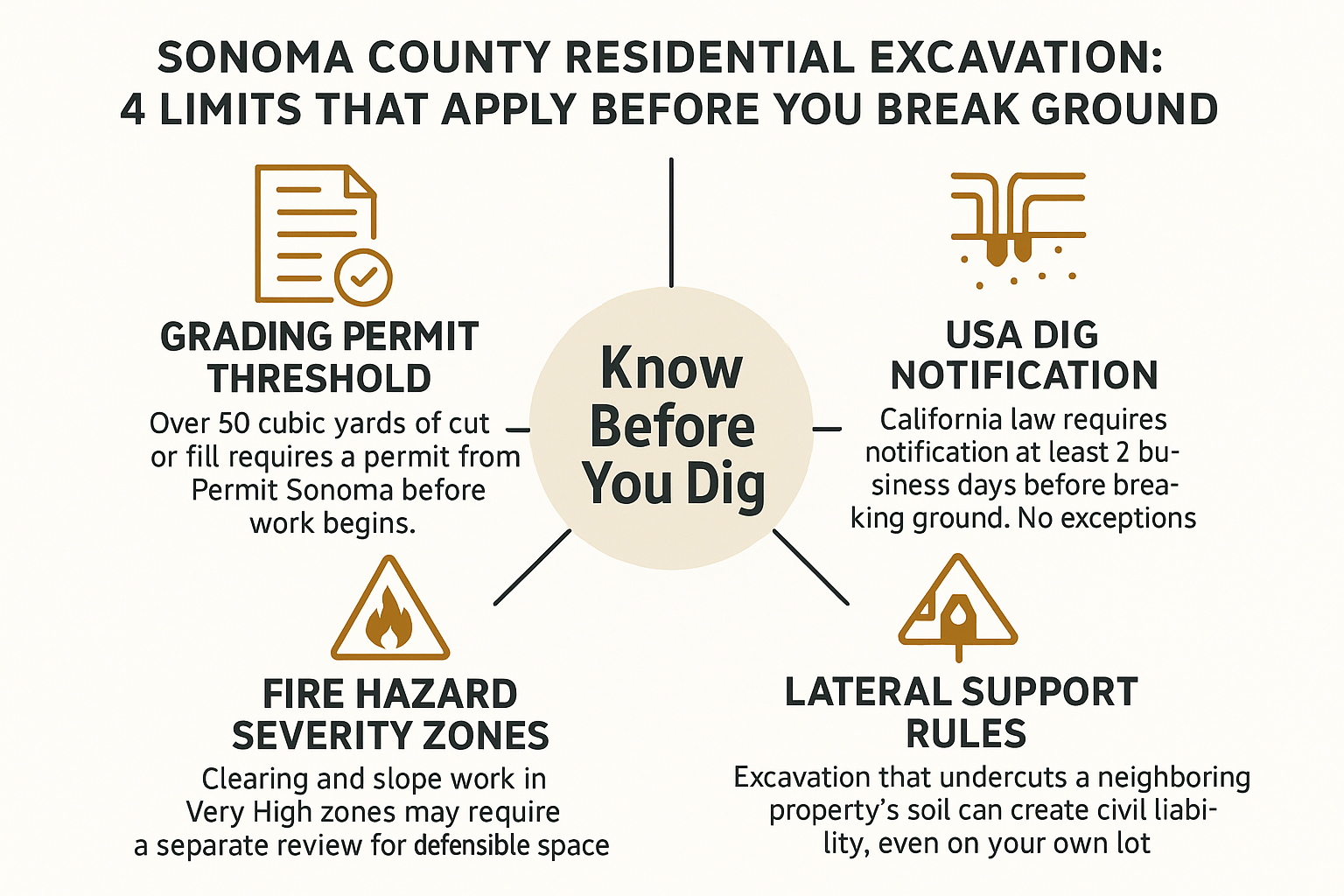
Sonoma County Residential Excavation: Key Limits at a Glance
This quick reference covers the four most common limitations that affect residential excavation projects in Sonoma County before a shovel hits the ground.
Fire Hazard Severity Zones Add a Layer Most Homeowners Don’t See Coming
This is probably the least-known limitation, and it applies to a significant portion of the unincorporated residential land in Sonoma County.
Large parts of the rural areas around Windsor, Healdsburg, and the western hills are designated Very High Fire Hazard Severity Zones by Cal Fire. In those areas, site disturbance work — including large-scale land clearing and slope excavation — can intersect with defensible space requirements in ways that aren’t immediately obvious.
Specifically, clearing or grading work that removes vegetation or reshapes slope drainage patterns may require a review to confirm it won’t:
- Eliminate existing firebreak areas that are part of the property’s defensible space plan
- Alter water flow patterns in ways that increase fire-related erosion risk after a burn
- Create new bare soil areas that become a problem in subsequent wet seasons
After the fires that have burned through Sonoma County since 2017, county agencies have gotten more attentive to this overlap. It’s not a barrier to doing the work — it’s a step that needs to happen before the work starts.
If you’re working on a hillside or slope property and wondering what long-term erosion risk looks like if that work isn’t planned correctly, What Happens to a Hillside If Erosion Goes Unfixed for One Winter? is worth reading before you finalize any scope.
Residential Excavation Limits: Sonoma County vs. Monterey County
The two counties we work in most often have different thresholds. Here’s how the key limits compare — and what that means for your project.
| Limit Type | Sonoma County | Monterey County |
|---|---|---|
| Grading permit threshold | 50 cubic yards of cut or fill | 100 cubic yards of cut or fill |
| USA dig notification | Required 2 business days before ground-breaking — state law applies in both counties | Required 2 business days before ground-breaking — state law applies in both counties |
| Fire Hazard Severity Zone review | Applies to large portions of unincorporated areas (Windsor, Healdsburg, western hills) | Applies in select hillside and coastal canyon zones — confirm with Monterey County Planning |
| Lateral support / setback liability | Civil liability applies if neighboring property is undercut | Civil liability applies if neighboring property is undercut |
| ADU sewer lateral excavation permits | Separate excavation permit and inspection required before plumbing connection | Separate excavation permit and inspection required before plumbing connection |
The ADU Sewer Connection Problem Nobody Mentions Until It’s Too Late
ADU projects are one of the most common jobs we see right now across Sonoma County, and there’s one specific excavation limitation that keeps catching homeowners by surprise.
Connecting a new accessory dwelling unit to an existing sewer line isn’t just a plumbing question. If that sewer lateral runs under a driveway, a concrete pad, a landscaped area, or any paved surface, an excavation contractor needs to be in the sequence before the plumber can do anything. That excavation has its own permit requirements and its own inspection, separate from the plumbing permit.
We’ve had multiple homeowners reach out after discovering this mid-project. In one case, a homeowner in Santa Rosa was converting a garage into an ADU and needed to locate the existing sewer line before any trench work could begin. They hadn’t budgeted for the excavation phase at all — it wasn’t on their contractor’s timeline, and it nearly stalled the whole project.
The practical takeaway: if you’re planning an ADU, ask your contractor to map the sewer lateral route before pulling any other permits. Knowing where the line runs and what’s in the way determines whether the excavation is a half-day job or a week-long sequence involving concrete removal, permit coordination, and inspection scheduling.
For properties dealing with creek-side erosion on top of a development project — which comes up more often than you’d think along Mark West Creek and the Laguna de Santa Rosa drainage — When a Creek Eats Your Property: What Erosion Control on a Riparian Lot Actually Takes covers what that process actually involves.
What Happens When Someone Gets Caught Working Without a Permit
I want to be direct about this because I’ve seen what it costs people.
One of the most telling form submissions we’ve received came from a homeowner who’d had retaining walls installed and grading done about nine years earlier — without permits. The work looked fine, held up fine, and nobody said anything for nearly a decade. Then the city noticed. Now they’re facing a requirement to retroactively legalize the grading and the walls, which means a soils engineer assessment because the work is on a slope, and a formal grading permit process that should have happened at the start.
Retroactive permitting is almost always more expensive than doing it right the first time. You’re paying for documentation of work that’s already done, engineering assessments to prove the existing conditions are sound, and in some cases, remediation if the work doesn’t meet current code.
California’s Uniform Building Code grading provisions set the foundation for what counties like Sonoma and Monterey have adopted into local grading ordinances. The county versions are more specific — Sonoma’s 50-cubic-yard threshold is stricter than many people realize — but the underlying requirements for permits, inspections, and soil management come from that statewide framework.
Understanding how to tell if your property was graded right before problems surface is something every homeowner on a sloped lot should read.
Frequently Asked Questions About Residential Excavation Limits in Sonoma County
Do I need a grading permit for a small backyard project in Sonoma County?
It depends on volume, not the size of the project on paper. Any excavation, cut, or fill that moves more than 50 cubic yards of soil requires a grading permit from Permit Sonoma. A 15×15-foot area dug about 15 feet deep hits that number. Retaining walls, drainage corrections, and foundation work on sloped lots can exceed 50 cubic yards faster than most people expect.
What is the USA dig notification and do I actually have to do it?
Yes. Underground Service Alert (USA/811) notification is a legal requirement in California, not an optional step. You — or your contractor — must submit a dig notification at least two business days before any ground is broken. This triggers utility companies to mark the locations of underground gas, water, sewer, and electrical lines. Skipping it creates serious safety risk and legal exposure.
Can my excavation project affect my neighbor’s property even if I stay on my own lot?
It can. Excavation that removes lateral soil support from an adjacent property can create civil liability regardless of where your property line sits. This is most common on sloped lots where the neighboring grade is higher than yours. It’s one reason why excavation near property lines needs to be planned carefully, not just marked on a survey.
My ADU project is mostly a plumbing job. Does an excavation contractor really need to be involved?
If the sewer lateral runs under a driveway, concrete pad, or other paved or landscaped surface — yes. The excavation needed to access that lateral has its own permit and inspection requirements, separate from the plumbing permit. We’ve seen ADU timelines get thrown off significantly when homeowners find this out mid-project. Knowing where the sewer line runs before you pull permits is the right place to start.
Does living in a fire hazard zone add permit requirements for grading work?
It can. In Sonoma County’s Very High Fire Hazard Severity Zones — which cover large portions of unincorporated land around Windsor, Healdsburg, and the western hills — clearing and slope work may need a review to confirm it doesn’t affect defensible space requirements or alter drainage in ways that increase post-fire erosion risk. It’s not a prohibition on the work, but it’s an extra step that needs to happen before ground is broken.
What’s the grading permit threshold in Monterey County compared to Sonoma?
Monterey County’s threshold is 100 cubic yards — double Sonoma’s 50-cubic-yard limit. That said, the same underlying rules about utility notifications, lateral support, and setbacks apply in both counties. And 100 cubic yards still goes faster than most property owners picture on a real residential job.
Have Questions About Your Specific Project?
If you’re planning a residential excavation project in Sonoma County — whether it’s a foundation, a retaining wall, a drainage fix, or an ADU sewer connection — and you’re not sure which permits apply or what the sequencing looks like, DW Excavation can walk through it with you. We’ve been doing this work in Sonoma County and Monterey County since 2013, and we know the local terrain, the permit offices, and the soil conditions that make each project different. Call us at 707-601-9091 or reach out through the contact page at dw-excavation.com to request a free estimate.