
Direct Answer: A retaining wall on a slope fails or succeeds based on what happens before the wall goes in — specifically how the slope is cut back, how the footing is prepared, and whether drainage is installed behind the wall during excavation.
Most homeowners planning a retaining wall spend their time picking materials — block versus timber, poured concrete versus segmental. That’s understandable. The wall is what you see every day. But after years of doing retaining wall excavation on Sonoma County hillsides, I can tell you that the wall choice matters far less than what happens in the ground before the first course ever goes in.
We’ve fielded calls from homeowners in Forestville with deteriorating slope walls, property owners in Guerneville with county-approved plans ready to break ground, and a homeowner who discovered nine years after the fact that their unpermitted terracing needed to be retroactively legalized. Every one of those situations points to the same truth: the excavation phase is where retaining walls are won or lost.
This article focuses on the two things I see go wrong most often — slope cutting and drainage installation — and what has to happen at each step to give a wall any chance of lasting. If you’re planning a slope project in Santa Rosa, Windsor, or anywhere in Sonoma County, this is where I’d start.
Why the Excavation Cut Is More Complicated Than It Looks
When someone asks for a retaining wall on a slope, the instinct is to size the excavation to the wall’s face dimensions. That’s almost never right.
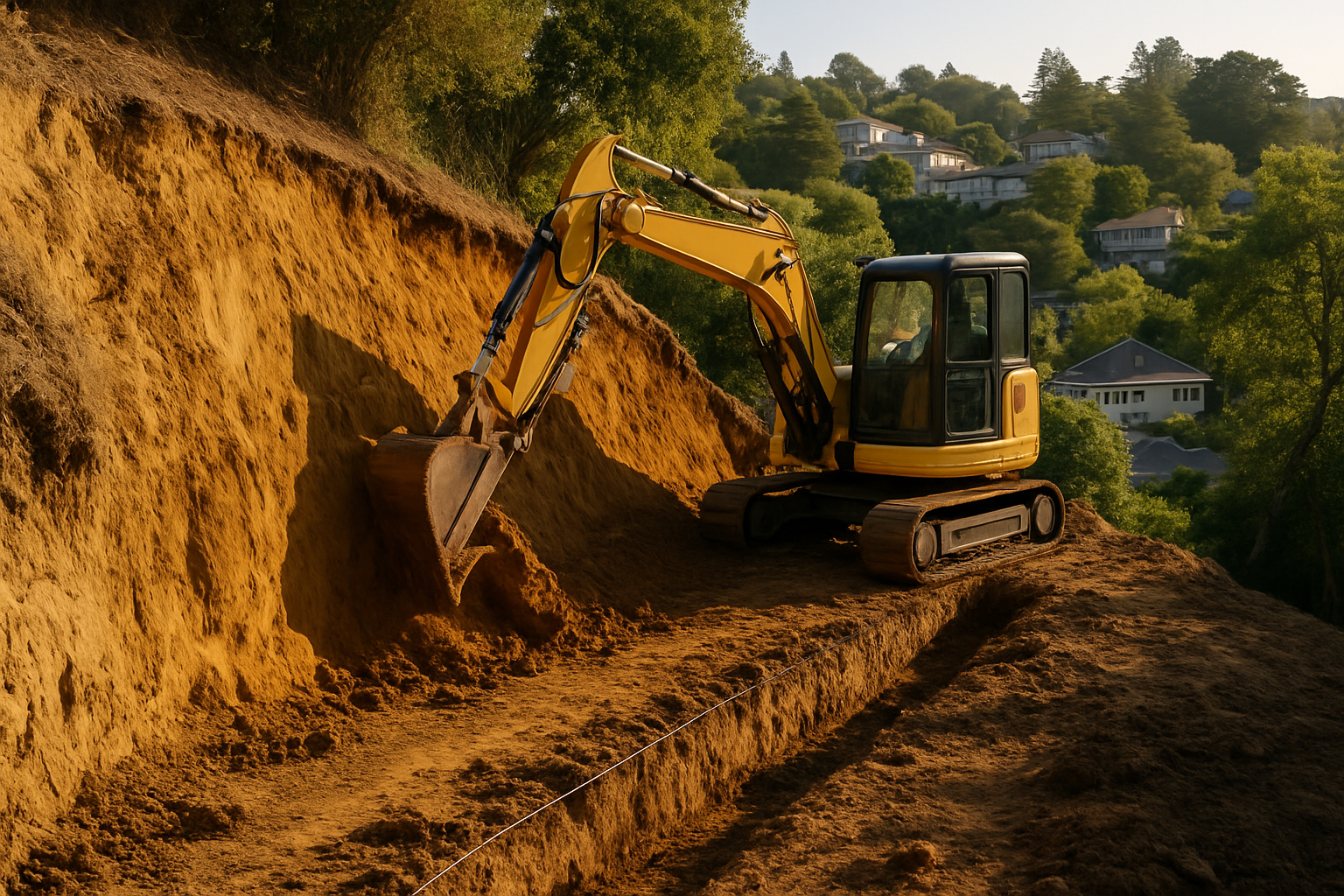
The wall needs a compacted footing pad below it, working room to backfill in lifts, and space to install drainage material behind the wall face. On a steep Sonoma County hillside — the kind you find in the hills above Healdsburg or along the ridge properties west of Santa Rosa — that working room can mean removing substantially more soil than the wall’s visible footprint suggests.
That extra material has to go somewhere. Hauling excavated soil off-site is one of the costs that surprises homeowners most when they compare early rough estimates to final proposals. A wall that looks like a straightforward job from the street can generate hundreds of cubic yards of spoils once the slope is properly cut back. That’s equipment time, trucking, and disposal — none of it optional.
The cut itself also has to be made at a stable angle. Clay-heavy soils — which dominate large portions of Sonoma County — don’t always hold a vertical face well, especially when they’re wet. Cutting the slope back to a safe working angle and removing any loose or unstable fill before work begins is part of what proper site grading looks like in practice, not just theory.
Hydrostatic Pressure: The Actual Reason Most Walls Fail
I want to spend real time on this because it’s the failure mode I see most often, and it’s almost entirely preventable.
When a retaining wall holds back a slope, it’s also holding back the water that moves through that soil every winter. In Sonoma County’s clay terrain, water doesn’t drain through the ground quickly — clay holds moisture, and when rain saturates the hillside behind a wall, that water builds up and starts pushing laterally against the wall face. That force is called hydrostatic pressure, and it’s what tips walls forward, cracks footings, and causes block walls to bow outward mid-panel.
The fix isn’t a stronger wall. The fix is a drainage system installed during excavation, before the wall goes in. A properly installed drainage system behind a retaining wall includes:
- Crushed drain rock (typically ¾” clean gravel) packed directly behind the wall face
- A perforated pipe running horizontally at the base of the wall to collect and redirect water
- Weep outlets or daylight drains that give water a place to exit rather than accumulate
Skipping or underfunding that drainage system is the single most common cause of retaining wall failure I’ve seen within the first five years. The November 2024 atmospheric river that dropped over 12 inches of rain on Santa Rosa in three days didn’t fail retaining walls randomly — it failed the ones where water had nowhere to go.
For a broader look at what that kind of saturation does to unprotected slopes, what happens to a hillside when erosion goes unfixed is worth reading before a major storm season.
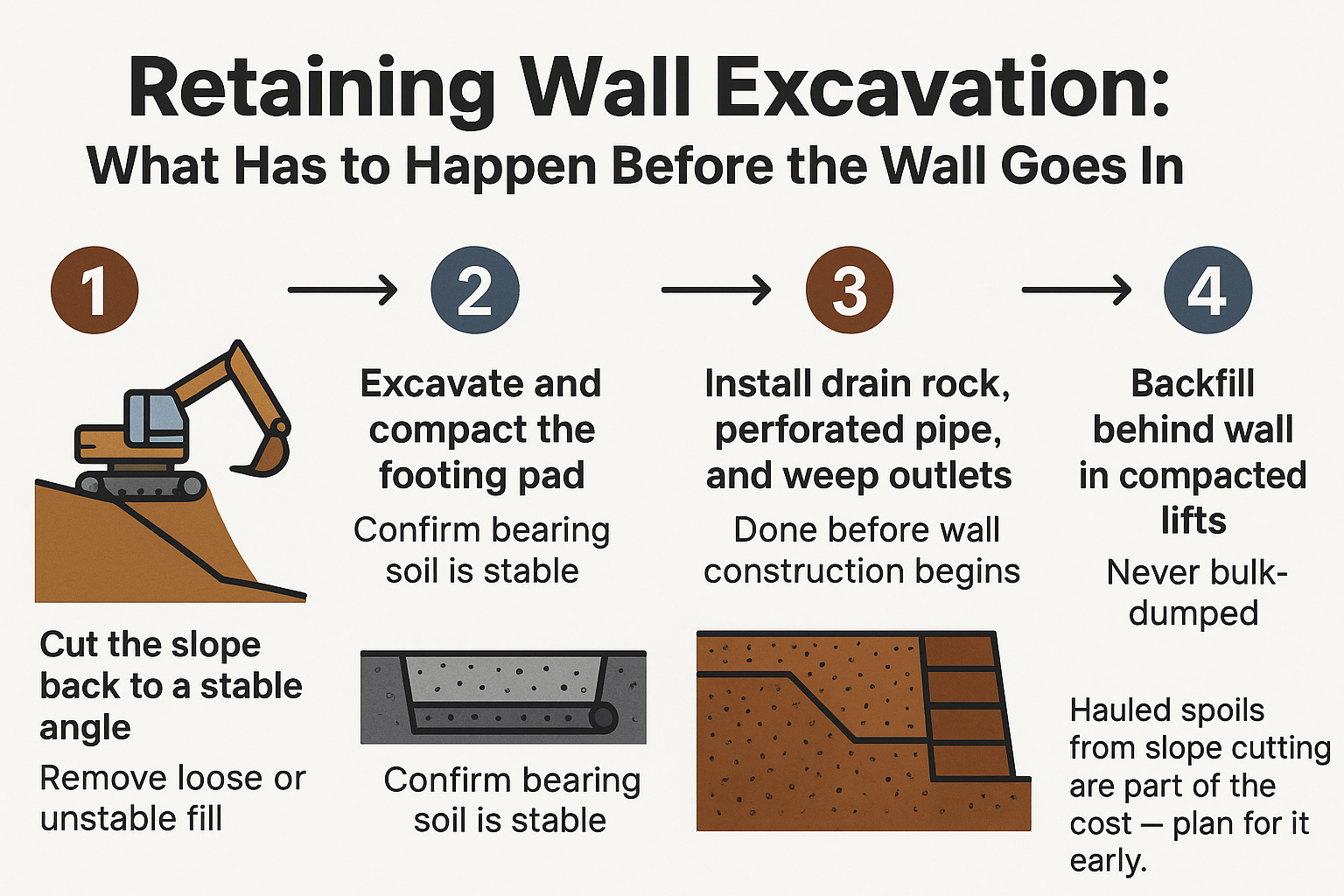
The Four Phases of Retaining Wall Excavation
Here’s how the excavation sequence breaks down from initial slope cut to backfill — the steps that happen before the wall ever goes up.
Permits, Soils Engineers, and the Cost of Skipping Them
In Sonoma County, any retaining wall that holds back more than four feet of unbalanced fill typically requires a building permit and a licensed engineer’s design. The soils report that comes out of that process directly influences how deep the footing needs to go and what drainage specification is required. These aren’t bureaucratic obstacles — they’re the mechanism by which the drainage and footing requirements get documented and enforced.
I’m sharing this because of a situation we encountered firsthand. A homeowner reached out after their city flagged unpermitted terracing and retaining walls that had been installed nine years earlier without a permit. No structural failures, no obvious problems — but the moment a neighbor or inspector notices, the clock starts. They were required to retroactively legalize the grading, which meant working backward through the permit process with a soils engineer to document what was actually built underground. That process is far more expensive and time-consuming than pulling the permit correctly the first time.
Sonoma County requires grading permits for cuts or fills exceeding 50 cubic yards. Monterey County’s threshold is 100 cubic yards. Either way, a steep slope with a wall replacement is likely to hit those thresholds quickly once you account for footing excavation and spoils removal. Understanding whether you need a civil site plan before pulling a grading permit can save weeks of delay at the permit counter.
The International Building Code guidelines for retaining walls give a useful framework for when engineered design is required — though local county amendments always take precedence, so confirm specifics with your local building department.
What Drives Retaining Wall Excavation Cost in Sonoma County
These are the factors that move the number most on retaining wall excavation projects in our area. No single factor tells the whole story — it’s usually a combination of several.
| Cost Factor | Why It Matters | What to Ask Your Contractor |
|---|---|---|
| Slope steepness and access | Steeper cuts require more soil removal and may limit equipment options | How will you access the slope, and does that affect pricing? |
| Spoils volume and haul distance | Extra soil from the overcut has to be trucked off-site | How many yards of spoils do you estimate, and where does it go? |
| Drainage system specification | Drain rock volume and pipe length vary by wall height and soil type | Is drainage behind the wall included in this bid? |
| Footing depth required | Clay soils or poor bearing conditions push footings deeper | Does the soil condition here affect how deep the footing needs to go? |
| Permit and engineering requirements | Walls over 4 feet of unbalanced fill typically require a soils report | Will this wall require an engineer’s stamp, and is permit assistance part of your scope? |
What ‘Ready for the Wall’ Actually Looks Like
By the time the excavation phase is complete and the wall contractor can start laying block or forming concrete, a few specific conditions need to be true.
The slope behind the future wall face should be cut back to a stable angle with no loose material that could shift under load. The footing trench should be excavated to the depth the soils engineer or permit drawings specify — in clay-heavy Sonoma County soils, that’s often deeper than it looks necessary from the surface. And the drainage system — crushed rock, pipe, and outlets — should already be in place, not added as an afterthought.
The footing pad itself should be compacted, not just rough-cut and left. A wall sitting on uncompacted subgrade is going to settle unevenly, and even small settlement differences across a long wall face show up quickly as cracking or bowing.
Backfill behind the wall after it’s built also needs to be placed in compacted lifts, not bulk-dumped. Bulk backfill compresses unevenly over the first few wet seasons, and that movement transfers directly into lateral pressure on the wall. This is one of those steps that costs almost nothing extra to do correctly and costs a significant amount to fix after the fact.
For projects that also involve foundation work further up the slope, what actually happens underground before a foundation gets poured covers how the subgrade preparation for walls and foundations often overlaps on complex slope projects.
Frequently Asked Questions About Retaining Wall Excavation
Does a retaining wall always need a permit in Sonoma County?
Not always, but the threshold comes up faster than most homeowners expect. In Sonoma County, walls retaining more than four feet of unbalanced fill generally require a building permit and an engineer’s design. On top of that, if the overall grading involved exceeds 50 cubic yards of cut or fill, a separate grading permit is typically required. If you’re replacing an old wall on a slope, between the footing excavation and spoils removal, you’re likely to hit both thresholds.
What happens if retaining walls were put in without a permit years ago?
The city or county can require retroactive legalization at any time — sometimes triggered by a building permit application for other work, a property sale inspection, or a neighbor complaint. The process involves working backward with a soils engineer to document what was actually built. It’s slower and more expensive than permitting correctly the first time. We’ve seen this situation come up with homeowners who had no idea the original work was unpermitted.
Why do some retaining wall bids come in much lower than others?
Usually because the low bid doesn’t include the full scope of excavation work. Drainage behind the wall, spoils hauling, and footing compaction are the three items most commonly left out of early estimates. When you’re comparing bids, ask each contractor specifically whether drainage installation and spoils removal are included in the number. A wall bid that skips drainage installation is a wall that’s going to have problems.
How much extra soil does retaining wall excavation actually generate?
More than most people expect. Beyond the footing trench itself, cutting the slope back to a safe working angle and creating room to install drainage and compact the backfill can generate significantly more spoils than the wall’s face dimensions suggest. On a steep Sonoma County hillside, it’s not unusual for the hauled material to represent a meaningful portion of the overall project cost. Get a cubic yard estimate from your contractor before you finalize a budget.
Can I pour a concrete footing on a slope without a soils report?
It depends on the wall height and local permit requirements. For walls under the permit threshold in your jurisdiction, a soils report may not be formally required. But in clay-heavy terrain — which covers much of Sonoma County — the footing depth and drainage specification that come out of a soils report are genuinely useful, not just a regulatory formality. A wall footing that doesn’t account for local soil bearing capacity is a gamble.
Planning a Retaining Wall on a Slope in Sonoma or Monterey County?
If you’re working through a slope project — whether it’s a wall replacement in Forestville, a new build site in Carmel, or a property you need to bring into permit compliance — our team at DW Excavation is available to walk through the excavation and site prep side of the work with you. Call us at 707-601-9091 or visit dw-excavation.com to start with a free estimate.