
Direct Answer: Soft ground patches, unusually green grass strips, slow drains throughout the house, and unexplained water bills are the clearest signs a buried pipe is failing before it collapses completely.
Most underground pipe failures don’t happen without warning. They give you signals for months — sometimes years — before the ground opens up or sewage backs into the house. The problem is most homeowners don’t know what they’re looking at.
In Monterey County, the soil conditions make this especially tricky. Coastal clay near Salinas and Marina holds water tightly, and sandy lowland soils near the Pajaro Valley shift with every wet season. Both conditions accelerate pipe stress in ways that properties in drier inland areas don’t experience at the same rate.
This article covers the three warning signs that matter most — the ones that consistently show up before a buried pipe turns into a full excavation emergency. If you recognize any of them on your property, the time to act is before the rainy season, not during it.
What the Ground Is Trying to Tell You
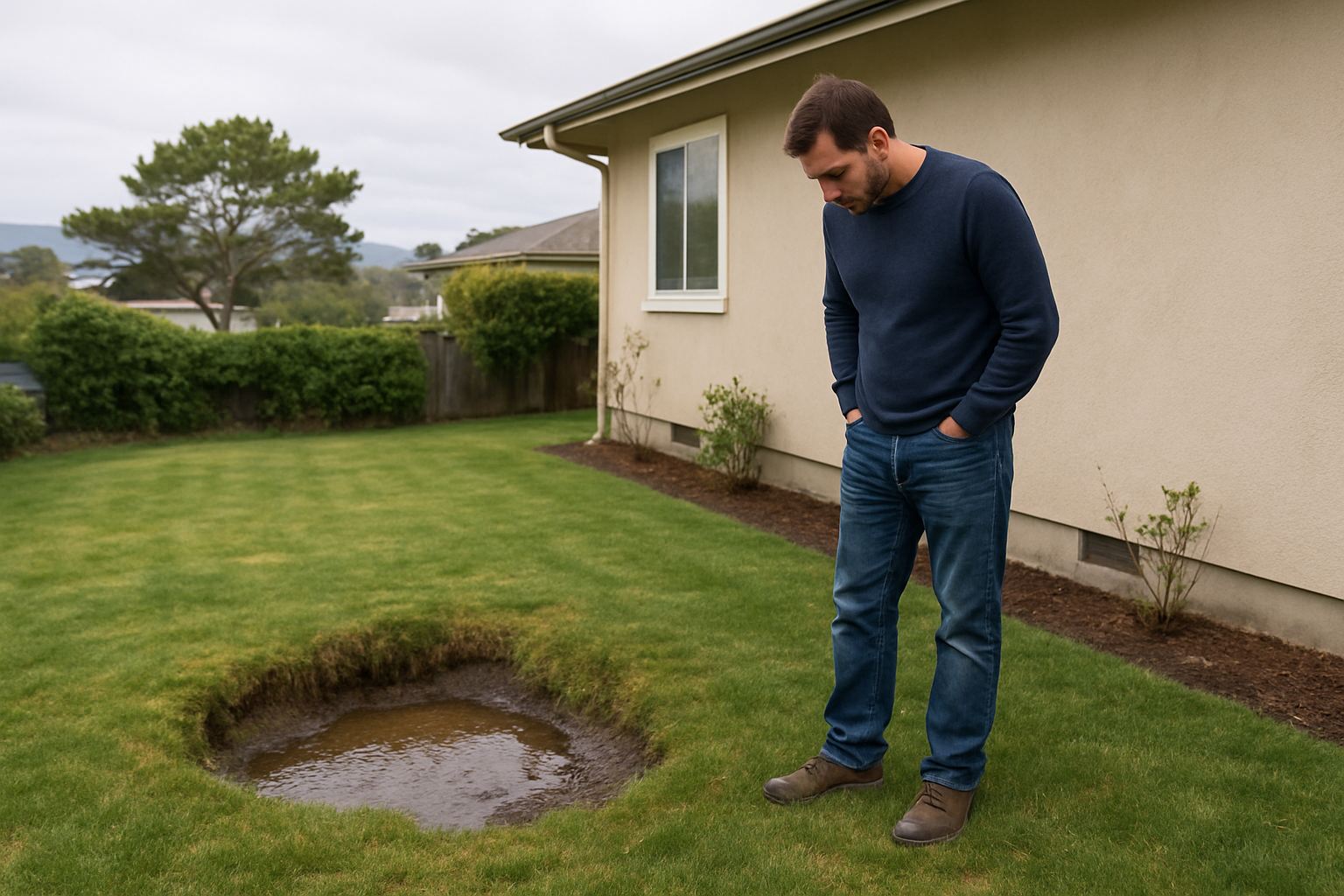
The most reliable early signal of a failing pipe isn’t inside your house — it’s outside, in the yard.
When a buried sewer, water, or drain line starts to crack, it leaks into the surrounding soil. Over time, that moisture creates patterns on the surface that are easy to miss if you’re not looking for them.
Watch for these specific signs in your yard:
- A strip of unusually green or fast-growing grass running in a straight line across the yard — this almost always follows a buried pipe
- A sunken or soft patch of ground that wasn’t there before, especially near the foundation or property edge
- Pooling water in a fixed spot after rain that dries out everywhere else first — if you’ve noticed why water pools in the same spot every time it rains, a leaking pipe underneath may be the cause
- Odor near the soil surface, particularly near a sewer cleanout or low spot in the yard
- Cracks in hardscape — driveways, patios, or walkways that started cracking along a line rather than randomly
That last one gets ignored constantly. A driveway cracking in a straight line over a water or sewer trench is often the earliest visible sign of pipe movement below. By the time the crack is wide enough to notice, the pipe has usually been shifting for a while.
In coastal areas like Seaside or Marina, sandy soils can void out around a leaking pipe quickly. The surface looks fine right up until it doesn’t — which is why waiting for obvious collapse is the wrong strategy here.
The Indoor Warning Signs That Get Blamed on the Wrong Thing
Homeowners often blame slow drains on old fixtures, tree roots, or just aging pipes inside the walls. And sometimes that’s right. But when the problem is happening simultaneously in multiple fixtures, the failure point is almost always in the main line — underground.
Here’s the distinction worth knowing:
- One slow drain = likely a localized clog in that fixture’s branch line
- Two or more slow drains at the same time = the main sewer or drain line is restricting flow
- Gurgling sounds from a toilet after running the washing machine = the main line is backed up enough to push air backward
- Water backing up into the tub when you flush = a blockage or collapse downstream, below grade
These symptoms show up together when the underground pipe is partially collapsed, heavily root-infiltrated, or broken at a joint. In older parts of Salinas and Monterey — where homes built in the 1950s and 60s still have clay tile or Orangeburg pipe in the ground — joint separation and root infiltration are extremely common once those pipes hit 50 or 60 years of service.
Orangeburg pipe, in particular, was widely installed during and after World War II as a cheap alternative to cast iron. It was made from compressed tar paper and wood pulp. It was never meant to last 80 years, and it didn’t. If your property dates to that era and you’ve never had the main line inspected, there’s a real chance you’re running on original pipe. A camera inspection will tell you exactly what’s there.
If you’re already researching what comes next after a confirmed failure, this guide to sewer line installation in California breaks down what the replacement process actually involves.
Early vs. Late-Stage Pipe Failure: Know Where You Are
This breakdown shows how pipe failure typically progresses — from the first subtle signs to full emergency. Knowing which stage you’re in changes what your options are.
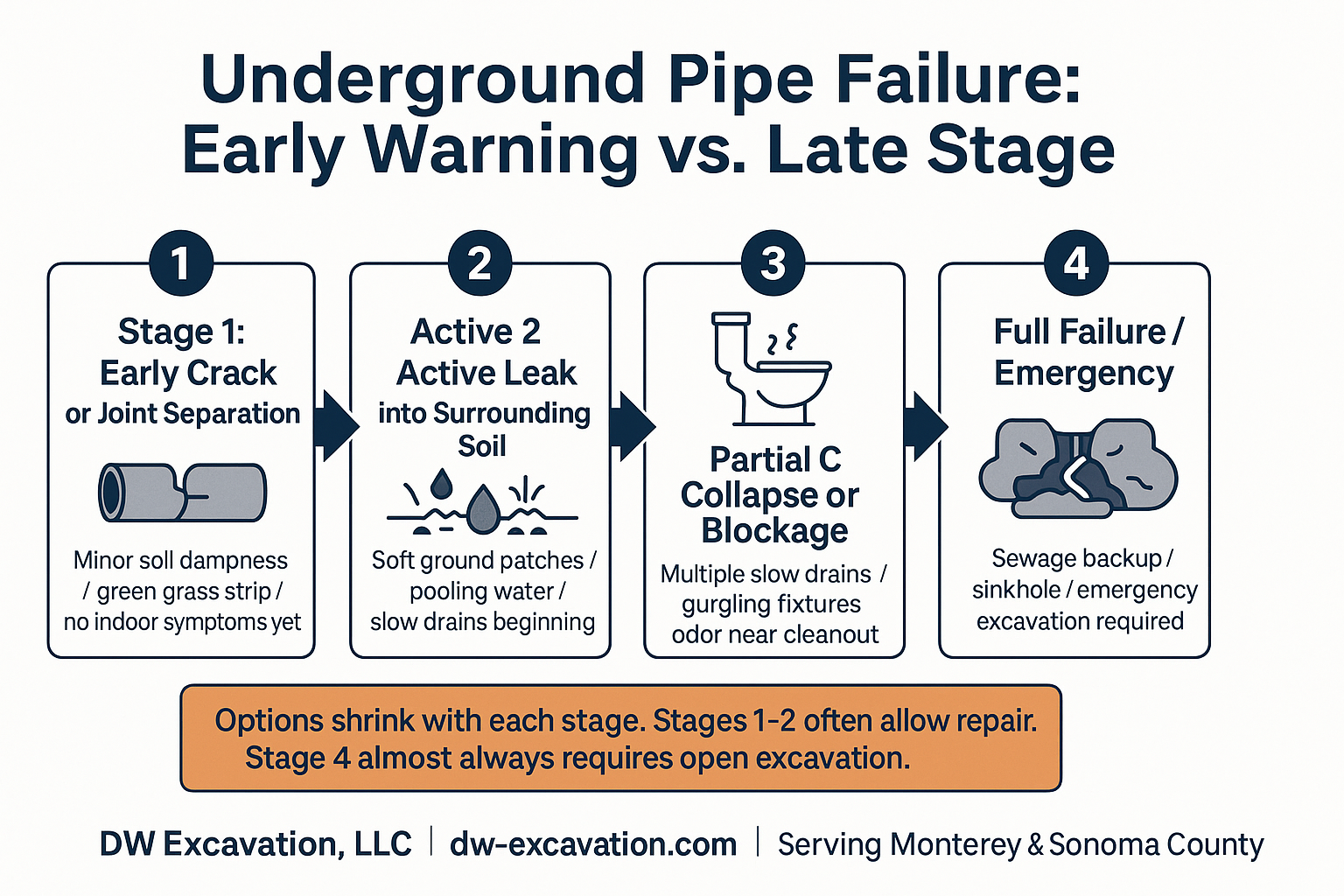
Pipe Warning Signs by Stage: What You’re Seeing and What It Means
These patterns show up consistently in the field. Match what you’re seeing on your property to understand how far along the problem likely is.
| What You’re Observing | Likely Stage | Urgency Level |
|---|---|---|
| Green grass strip in yard, no indoor symptoms | Stage 1 — Early crack or joint separation | Low — schedule inspection within 30–60 days |
| Soft or sunken ground patch near sewer line | Stage 2 — Active soil saturation from leak | Moderate — inspect before next rain season |
| Single slow drain inside the house | Stage 1–2 — Possible branch or main restriction | Low — camera inspection recommended |
| Two or more slow drains simultaneously | Stage 2–3 — Main line restricting or partially blocked | High — don’t wait on this one |
| Gurgling toilet or drain after other fixture runs | Stage 3 — Significant main line blockage or collapse | High — inspection within days, not weeks |
| Sewage odor at cleanout or yard surface | Stage 3–4 — Active leak or backpressure | Very High — call immediately |
| Sewage backup into tub or floor drain | Stage 4 — Emergency | Emergency — stop using water, call now |
Why Monterey County’s Soil Conditions Change the Timeline
A pipe leaking in Fresno clay behaves differently than one leaking in the sandy loam near the Salinas Valley floor or the coastal bluff soils above Pacific Grove. Soil type determines how fast a small leak becomes a big problem.
In sandy or loose soils — common in Marina, Seaside, and the lower Pajaro Valley — water from a leaking pipe disperses quickly. The pipe may be dumping significant volume before you see any surface sign. The ground can void out beneath a driveway or foundation slab without warning, which is how you get sudden sinkholes rather than gradual soft spots.
In heavier clay soils — more common in Salinas inland areas and Monterey hillsides — water stays near the break and saturates slowly. You’ll usually get more surface signals earlier, but the sustained moisture can soften soil bearing capacity around foundations over time. That connection between buried pipe leaks and foundation stress is something a lot of homeowners don’t make until it’s expensive.
The other factor specific to Monterey County is the winter rain intensity. After the 2023 Pajaro River flooding and the series of atmospheric rivers that rolled through the Central Coast in early 2023, a lot of older infrastructure got stressed in ways that won’t show up as obvious failures immediately. Pipes that were already cracked took on groundwater pressure they weren’t designed to handle. That additional hydrostatic pressure accelerates joint separation — particularly in clay tile systems.
If your property flooded or sat in standing water during any of those events, a pipe inspection isn’t a bad idea even if you haven’t seen symptoms yet. The stormwater and drainage problems that flood events create underground don’t always announce themselves right away.
What Your Options Look Like Based on How Far Along the Problem Is
This is where timing matters more than most homeowners realize.
In Stages 1 and 2 — before a significant collapse — trenchless repair methods are often on the table. Pipe lining and pipe bursting can address cracked or infiltrated pipe without tearing up a yard, driveway, or landscaping. If you want to understand that process and whether it applies to your situation, this breakdown of fixing a broken pipe without digging up the yard is worth reading before you call anyone.
By Stage 3 or 4, open excavation is usually unavoidable. The pipe has either partially collapsed, shifted significantly at the joints, or the surrounding soil has compromised enough that lining won’t hold. At that point the question isn’t whether to dig — it’s how much needs to come out.
In Monterey County, excavation work on sewer and water laterals often requires a permit depending on depth and proximity to the street right-of-way. Monterey County’s grading permit threshold is 100 cubic yards, but utility work has its own requirements that vary by jurisdiction — the city of Salinas, for example, has different encroachment permit rules than unincorporated county land. Getting that sorted before work starts is part of doing the job correctly.
If you’re also wondering how a sewer line inspection connects to what your property might need, that article walks through the diagnostic side in more detail.
Frequently Asked Questions About Underground Pipe Failure
How do I know if it’s my sewer line or my water line that’s leaking?
A leaking water line usually causes a noticeable spike in your water bill — sometimes $50 to $200 higher than normal in a single month — even if water use hasn’t changed. A failing sewer line typically shows up as slow drains, odors, or gurgling rather than a bill spike, since sewage doesn’t run through a metered supply. A camera inspection confirms which line is the problem and exactly where.
My yard has always had a wet spot in that corner. How do I know it’s not just normal drainage?
Natural low spots collect surface water during rain and dry out within a few days after the rain stops. If the wet spot stays damp for a week or more after dry weather returns, or if it smells like sewage at all, that’s not normal drainage — that’s a subsurface leak. The location relative to your sewer cleanout or water meter shutoff is also a good clue.
Can tree roots really destroy a buried pipe?
Yes, and faster than most people expect. Clay tile pipe — common in older Monterey and Salinas homes — has open joints every few feet where sections fit together. Roots find those joints and grow inside toward the moisture. Over time they fill the pipe completely. Even PVC can be infiltrated if a joint was glued poorly or shifted under soil movement. A camera inspection shows exactly what’s inside.
Is a camera inspection expensive?
Most plumbing or excavation companies in Monterey County charge $150 to $400 for a basic sewer camera inspection of the main lateral. That cost is minor compared to what an undetected collapse costs to repair. Some companies apply the inspection cost toward the repair if you hire them for the work.
Do I need a permit to replace a sewer lateral in Monterey County?
Usually yes, at least partially. Work in the public right-of-way — meaning between your property line and the street connection — typically requires an encroachment permit from the city or county. The rules vary depending on whether you’re in the City of Salinas, City of Monterey, or unincorporated county land. A contractor who pulls permits regularly will know what’s required for your specific address before any work starts.
Seeing Any of These Signs on Your Monterey County Property?
If something on your property matches what’s described here — a soft yard patch, slow drains in multiple fixtures, an odor near the cleanout — DW Excavation works throughout Monterey County and can help you figure out what’s actually happening before the situation forces your hand. Call 707-601-9091 or reach out through the contact page at dw-excavation.com to talk through what you’re seeing and get a free estimate on next steps.