
Direct Answer: Dredging scope comes down to basin size and depth, sediment type, water table, equipment access, and where the material goes. All of that gets assessed before a machine ever touches the bed.
Almost nobody calls about a pond cleanout twice in their lifetime. So when a property owner asks what dredging a basin should cost or how long it takes, they usually have no reference point at all, and the answers they find online are written for industrial lagoons in other states.
I got a call this past summer from a homeowner in Glen Ellen with a man-made lake of about 0.85 acres. Years of sludge and washed-in debris had built up on the clay bottom, and the plan was to let it evaporate through the dry season and then clean the bed. The real question was simple: what does a realistic scope look like?
This is how I answer that. Not with a number, but with the five things that actually set the scope on a pond or lake dredging job in Sonoma and Monterey counties, and why we settle all of them before a machine leaves the yard.
What Actually Sets the Scope on a Pond or Lake Dredging Job
Every dredge project starts with knowing what is in the basin and what is under it. Two ponds the same size can be completely different jobs.
Here is what I walk and measure first:
- Basin size and depth. Surface acreage tells me almost nothing on its own. A shallow 1-acre stock pond may hold less sediment than a deep half-acre lake.
- Sediment composition. Soft organic silt, dense clay fines, and woody debris all behave differently once the water is gone.
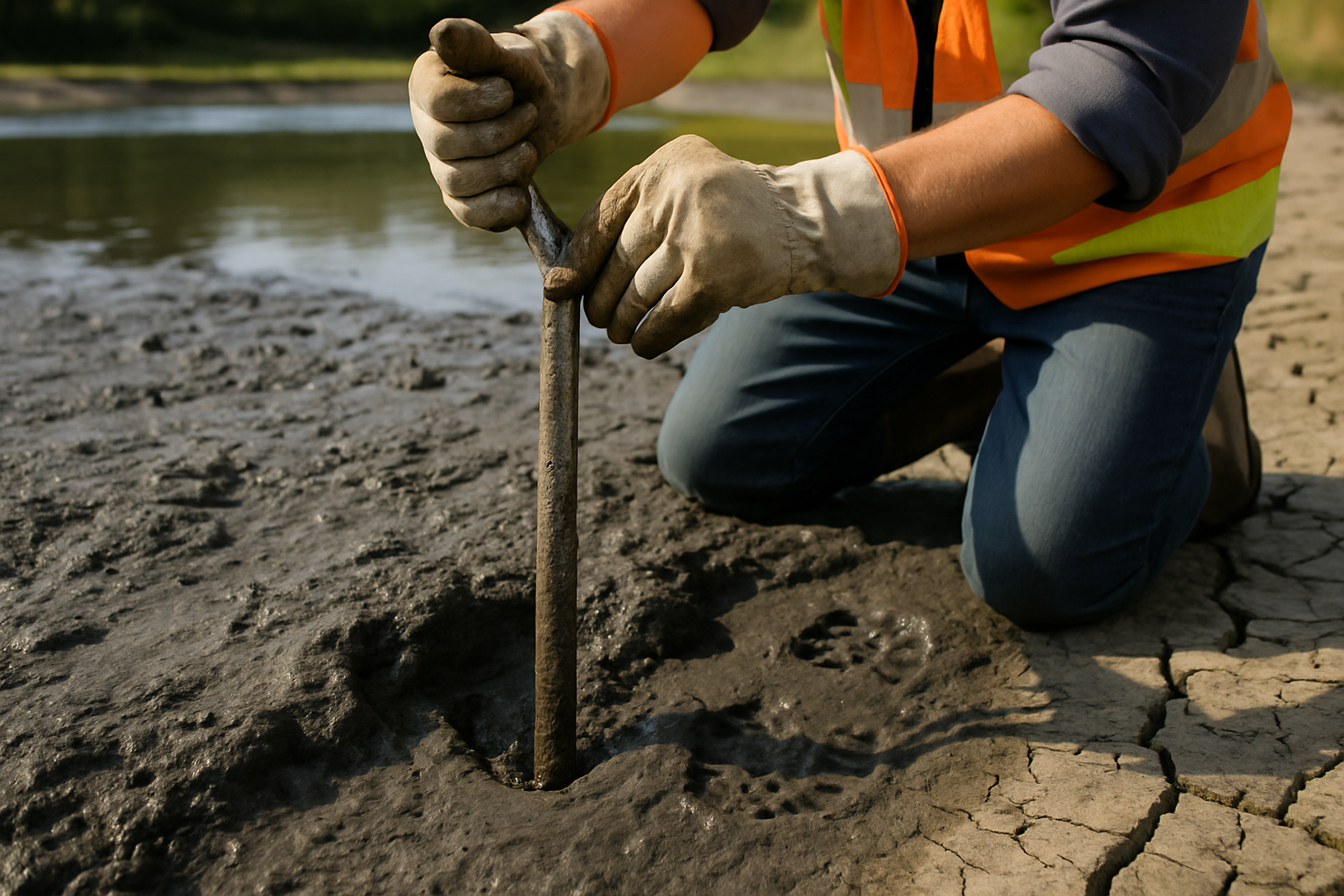
- Depth of accumulation. I probe in a grid pattern to find how many feet of muck sit on top of the original bottom. That number drives volume, and volume drives everything else.
- Water table. In low-lying ground near creeks, groundwater seeps back in as fast as you dig. On a clay-bottom hillside lake, it usually does not.
- Inlet and outlet structures. A dam, spillway, standpipe, or culvert has to be managed during the cleanout, and sometimes repaired while the basin is empty.
A natural clay-bottom lake in Sonoma’s wine country behaves nothing like a lined agricultural pond in the Salinas Valley. The clay basin usually firms up in the dry season and can support tracked equipment. A lined pond means we cannot dig aggressively at the bottom without risking the liner, so the approach changes completely.
Access Is the Variable Most People Underestimate
This is where dredging jobs go sideways. A silted lakebed can look walkable and still swallow a machine the second you add fifteen tons of weight to it.
Soft sediment has high moisture content and almost no bearing strength. The crust on top is often just a few inches of dried skin over saturated muck. I have seen contractors trust that crust and spend two days pulling equipment out.
So before anything rolls in, I look at:
- The route to the basin. Gate widths, culvert crossings, tree canopy, driveway grade, and whether a lowboy trailer can actually turn around.
- Bank slope and staging room. Dredge material has to sit somewhere while it drains. If there is no flat ground near the bank, the job gets more expensive fast.
- Bed firmness at multiple points. Not one spot. The deepest area is almost always the softest.
- Whether staged dewatering is needed. Sometimes we drop the level, wait, let the bed firm, then go again.
On softer beds we use tracked equipment with low ground pressure, or we reach from the bank with a long arm and never put a machine on the bottom at all. On a firm clay bed that has baked through a Sonoma summer, we can often work directly on the floor. Picking wrong is not a small mistake, it is days of lost time and damage to the basin you were hired to fix.
How Sediment Type Changes the Equipment Plan
Here is a rough guide to how different material behaves once a basin is drained, and what that means for how we approach the work.
| Sediment type | How it behaves once drained | Typical equipment approach |
|---|---|---|
| Soft organic silt and muck | Holds water for weeks, stays soupy under a thin dry crust | Reach from the bank, or stage dewatering and wait for the bed to firm |
| Dense clay fines | Firms up well through a dry summer, cracks on the surface | Tracked equipment can often work on the bed directly |
| Sand and gravel wash-in | Drains fast, carries weight sooner than clay | Standard excavation and load-out, faster cycle times |
| Woody debris, tules, cattails | Tangles buckets, adds bulk without adding weight | Clearing pass first, then dredge the sediment underneath |
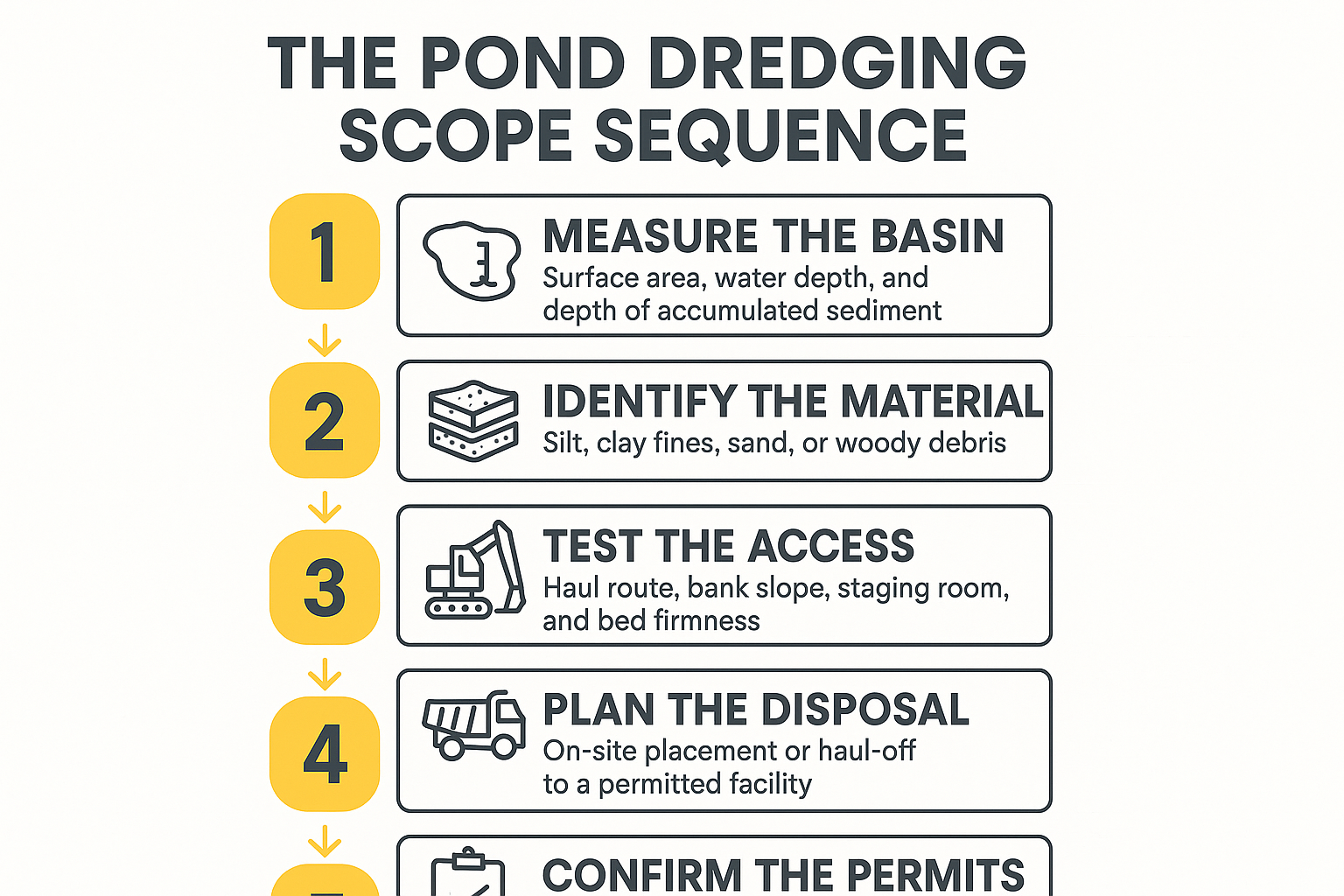
The Scoping Sequence We Follow
This is the order the questions get answered before any equipment is scheduled.
Where All That Material Goes
Disposal is the part almost nobody thinks about until the sludge is already piled on the bank. And by then, the options have narrowed.
Pond and lake sediment is usually a mix of organic material, clay fines, and whatever has washed off the surrounding property over the decades. On rural Sonoma County parcels where vineyards, pasture, and homes sit close together, that history matters. Material from a basin downhill of old ag ground is not automatically clean fill.
The realistic options look like this:
- On-site placement. If the material tests out fine and there is room, we can spread and grade it on the property. This is usually the cheapest path, but it needs space and it needs the grading done to plan rather than by feel.
- Drying and reuse. Wet sediment can be windrowed and left to dry down before it is moved or reused. That adds calendar time but cuts hauling weight.
- Haul-off to a permitted facility. Sometimes the only answer. Cost here is driven by tonnage, moisture content, round-trip distance, and the facility’s acceptance rules.
- Testing first. If there is any reason to suspect contaminants, sampling comes before the plan, not after.
I never quote a dredge job without a disposal plan attached, because hauling and disposal can end up being a large share of total cost. Every wet ton you truck off the property is money. Reducing moisture before it moves is often the single biggest lever an owner has.
The Permit Rural Landowners Do Not See Coming
Here is the one that surprises people. Their pond feels private and self-contained, so they assume no agency cares what happens in it.
In California, work in or near a river, stream, or lake can require notification to the California Department of Fish and Wildlife under a Lake and Streambed Alteration Agreement. It applies when work will change the bed, bank, or channel of a waterway, or affect riparian habitat. You can read the state’s own explanation of when notification is required on the CDFW Lake and Streambed Alteration Program page.
When does it usually come up? When the pond is fed by or discharges to a creek, when there is riparian vegetation along the bank, or when the dam or outlet structure sits in a drainage. A fully isolated stock pond with no connection to a stream channel often falls outside it.
County grading rules stack on top of that. Sonoma County generally triggers a grading permit for cuts or fills over 50 cubic yards, and Monterey County’s threshold is 100 cubic yards. Dredge volumes clear those numbers quickly, and how the county has been handling grading permits recently affects the review path.
Permit coordination is not fast. Agency review takes weeks, sometimes longer during busy season. That is why we sort this out in spring for a late-summer dredge, not in August.
What Actually Drives Cost and Timeline
I will not put a number on a basin I have not walked, and I would be careful with anyone who does. Costs vary widely across Sonoma and Monterey counties depending on the specifics.
These are the factors that move the price more than anything else:
- Cubic yards of sediment, not surface acreage
- Moisture content of the material at the time of removal
- Haul distance to the disposal or placement site
- Access difficulty, including whether staged dewatering is needed
- Permit path, and whether agency review is involved
- Structure repairs to dams, spillways, or outlets while the basin is empty
Timing matters just as much. The dry-season window in this part of California is real but not unlimited. Once the first serious storms arrive, a partially dredged basin becomes an erosion problem, which is why the same pre-winter site work deadlines apply here as anywhere else on the property.
Frequently Asked Questions About Pond and Lake Dredging
Do I have to drain the pond before it can be dredged?
Not always, but on most small residential and ranch basins in Sonoma County it is the simpler path. Letting a basin evaporate through summer lets the bed firm up and cuts the moisture weight you have to haul. Ponds that cannot be drained get worked differently, usually reaching from the bank.
How long does a pond cleanout take?
For a basin under an acre with reasonable access, the digging itself is often the shortest part. Drying time and hauling usually control the schedule, and permit review can add weeks before anyone starts. I have seen half-acre ponds run a week and I have seen them run a month, entirely because of access and disposal.
Can I spread the dredge material somewhere else on my own property?
Often yes, if you have the room and the material is clean. It has to be placed and graded so it does not send runoff toward structures or a neighbor’s parcel, and the volume may still trip a county grading permit.
Will dredging damage my pond’s ability to hold water?
It can if it is done carelessly. On a natural clay-bottom basin, the clay seal is what holds the water, so digging past it can create a leak that was not there before. That is why we probe to find the original bottom before removing anything.
Is late summer really the only window for this work?
It is the best window in this region. Dry-season conditions give you a firm bed, low water, and time to finish before the rains. Starting a dredge in November is asking for a mess.
Thinking About a Pond or Lake Cleanout This Season?
If you have a basin in Sonoma County or Monterey County, CA that has been filling in for years, the scoping conversation is worth having well before the dry window closes. Our team walks the site, probes the sediment, and lays out the access and disposal picture so you know what you are looking at. You can reach us at 707-601-9091 or through the contact page at dw-excavation.com when you are ready to talk it through.