
Direct Answer: A sewer lateral needs a narrow band of fall, commonly around a quarter inch per foot. Too flat and solids settle. Too steep and liquid outruns solids, leaving buildup behind.
Most people assume a sewer line fails because it was too flat. Water pools, solids settle, and years later the line backs up into a shower pan. That happens, and I have dug up plenty of them.
But a lateral can fail just as easily because it has too much fall. When a pipe drops too fast, the liquid runs ahead and leaves the solids sitting on the pipe wall. You get a dry deposit that builds week after week until the line chokes itself.
That narrow window between too flat and too steep is a survey question, not something you eyeball with a shovel in your hand. In Monterey County, where you might be working a pancake-flat lot near Salinas one week and a Carmel hillside the next, that few inches of difference is what separates a line that runs for thirty years from one that gets dug up in five.
The Narrow Band of Fall a Sewer Lateral Has to Hit
The California Plumbing Code sets minimum slopes for drainage piping, and your local building department enforces them. For a typical 4 inch residential sewer lateral, the common design target is about a quarter inch of fall per foot, which works out to roughly a 2 percent grade.
That sounds simple until you run the numbers on a real lot. A 100 foot run from the house to the street needs about 25 inches of total drop, and every one of those inches has to exist between the depth of your house connection and the depth of the sewer main.
Here is where both ends of the problem show up:
- Too flat. Flow slows, solids drop out, and the pipe slowly narrows from the bottom up. Roots find the joints because there is standing water feeding them.
- Too steep. Liquid separates from solids and races ahead. Waste dries onto the pipe wall and builds into a hard blockage.
- Inconsistent. A line that dips and rises across the run acts like a series of small traps, even if the average grade looks fine on paper.
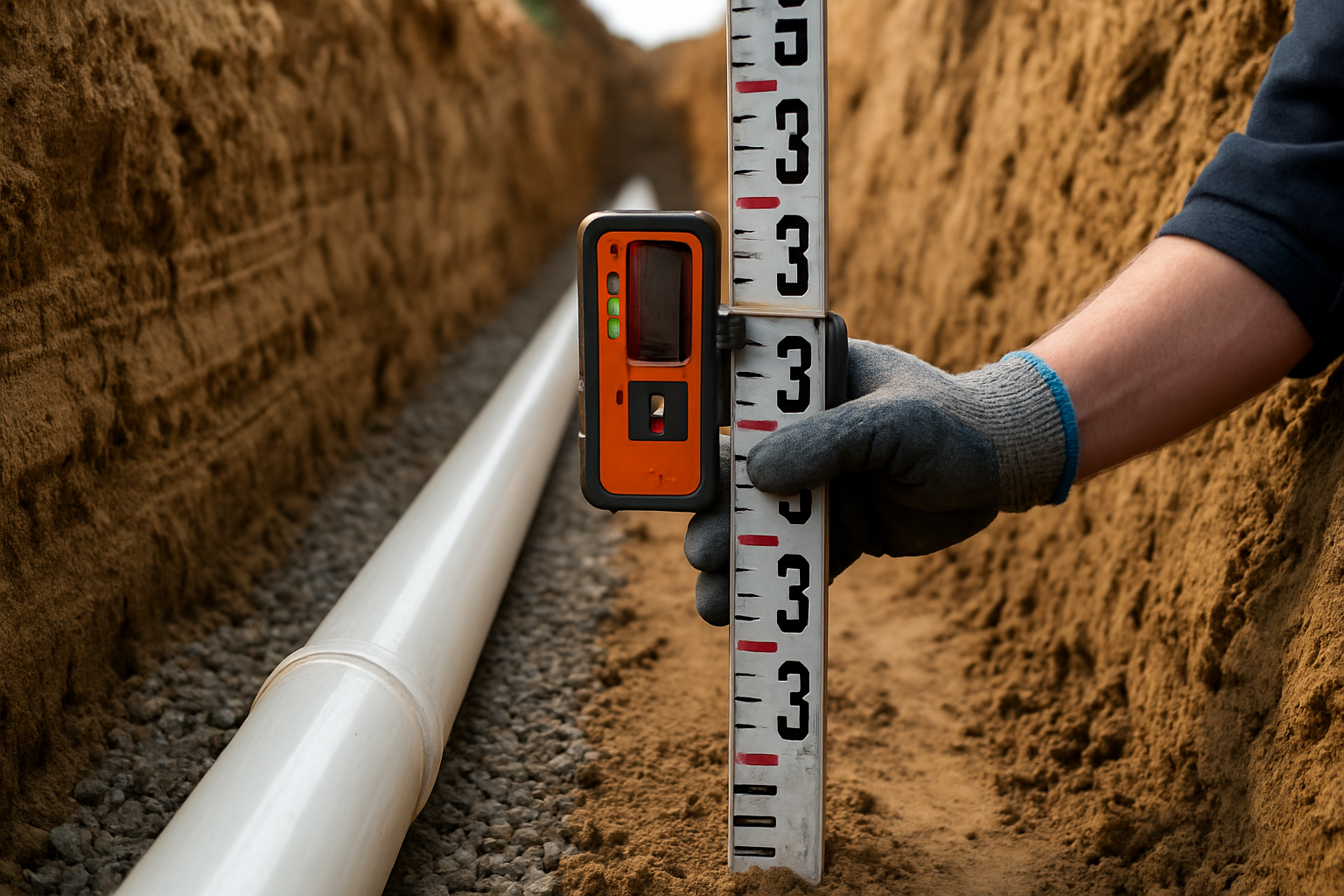
On flat ground down in the Salinas Valley, the fight is finding enough fall at all. On the slopes above Monterey and Pacific Grove, the fight is controlling fall so the line does not drop faster than the waste can travel. Both get solved with a laser and a grade rod before anyone lays pipe.
Slope Targets and What Goes Wrong at Each End
This is a general reference, not a substitute for the plan and the local code your inspector is holding. Pipe size, run length, and the depth of the main all move these numbers.
| Situation | Typical design target | What goes wrong if it is off |
|---|---|---|
| 4 inch residential lateral | About 1/4 inch of fall per foot (roughly 2 percent) | Below this, solids settle and the line narrows over years |
| Long run on a flat lot (100+ feet) | Same fall held consistently the whole way | 100 feet needs roughly 25 inches of drop, which the connection depth has to allow for |
| Hillside or steep coastal lot | Controlled fall, often with a drop structure at the transition | Liquid outruns the solids and leaves dried waste on the pipe wall |
| 6 inch and larger lines | Code may allow less fall than a 4 inch line | Still has to be surveyed to grade, not set by feel in the trench |
| Main sits higher than the house outlet | Gravity flow is not possible | A grinder pump or ejector system is needed, which changes the whole design |
The Last Two Hours of an Open Trench Decide the Next Thirty Years
Underground utilities installed correctly should perform for thirty years or more. When I get called to a line that failed early, the cause almost always traces back to what happened right before that trench got closed.
Three things get buried and none of them are cheap to fix later:
- Bedding material. The pipe needs to sit on clean sand or fine gravel, not on rocks or lumpy native soil. A single rock under a pipe becomes a point load, and point loads crack PVC.
- Haunching and side support. Material has to be worked in under the pipe haunches so the pipe is supported around its lower third, not just resting on a strip down the middle.
- Backfill and compaction. Material goes back in lifts and gets compacted as it goes. Dumping the spoil pile back in and driving over it once is how you get a driveway that sinks three years later.
Soil type changes the plan. Around Marina and Seaside you are often in sandy material that drains well but does not hold a trench wall, so shoring and careful compaction matter more than people expect. Push inland toward the Pajaro Valley and you hit heavier, wetter ground where the wrong backfill turns into a settlement problem the first winter.
And settlement is not just a cosmetic issue. When backfill drops, the pipe bedded in it can drop with it, and that quarter inch per foot you surveyed so carefully turns into a belly holding water.
Finding the Line You Cannot See Yet
Before any excavation, marking through Underground Service Alert is required. In our part of the state that is USA North 811, and the call has to go in before a bucket touches dirt.
What gets missed is what those marks actually mean. They show the approximate location of known utilities, usually within a tolerance zone, and they only cover lines the utility owners have on record.
Private lines on your own property are a different story. Older homes routinely have:
- Sewer laterals rerouted decades ago with no record of where they went
- Abandoned clay or cast iron sections still in the ground
- Irrigation and electrical runs added by a previous owner
- Old septic components nobody documented before hooking up to the street
This comes up constantly with garage conversions. A homeowner called us because they were turning a garage into an ADU and needed the existing house sewer found before anyone could design where the new connection would tie in. That is the right order of operations. You cannot set an invert elevation for a new line until you know the depth and location of the line it is joining.
If you are working through that yourself, our breakdown on connecting an ADU to your existing sewer line walks through what the trenching side of that job looks like.
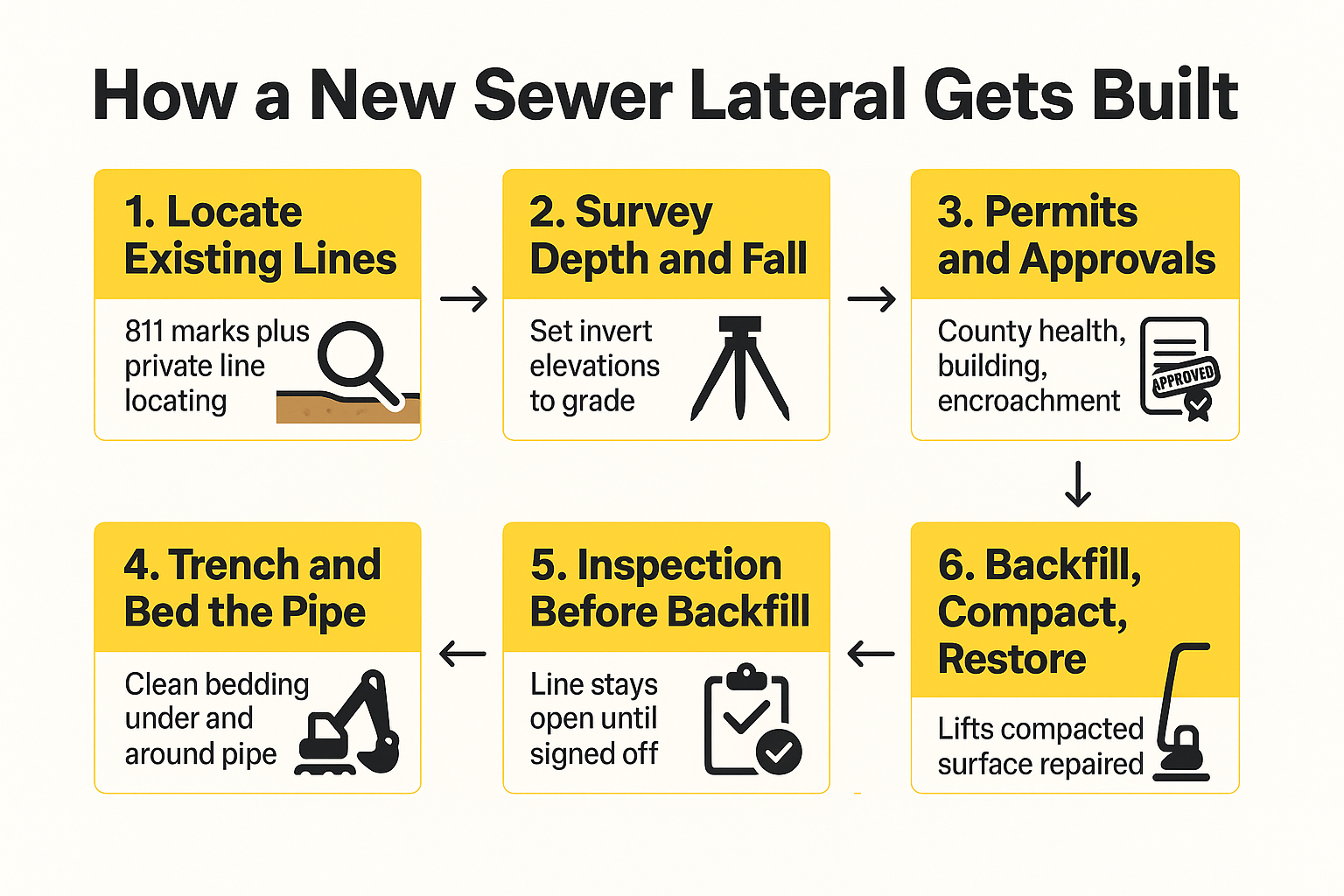
How a Sewer Lateral Job Actually Sequences
Homeowners usually picture one day of digging. The dig is often the shortest part of the process.
Septic to Sewer Conversions and the Permit Nobody Mentions
Converting off septic drives a lot of the below grade work we do. The homeowner sees it as one job. It is really two.
Job one is the new connection to the street sewer. If the house outlet sits below the main, gravity is off the table and you are looking at a grinder pump system, which means a pump basin, a power feed, and a pressurized line to the street instead of a simple sloped lateral. One property owner reached out describing exactly that setup: disconnect the septic, drop in a grinder pump, trench to the street.
Job two is the old septic tank, and this is the piece that surprises people. Decommissioning a septic tank usually requires its own permit and its own inspection through the county environmental health department. The tank generally has to be pumped, the bottom broken, and the void filled and compacted, with an inspector present.
I have seen the reverse order more than once. A homeowner gets the sewer connection signed off, has the tank crushed and filled, and only afterward learns the demolition needed its own inspection. Now they are chasing photos, receipts, and a written account of the work to satisfy the county after the fact.
The fix is simple and it is free: pull the tank abandonment permit before anything gets filled. Our full walkthrough on switching from septic to sewer covers the excavation sequence in more detail.
The Street Connection Is Where Projects Move or Sit
Everything on private property is under your control. The moment the trench crosses the property line, you are in someone else’s jurisdiction, and this is the stage most homeowners have not planned for.
Depending on the street, the tie-in can involve:
- An encroachment permit from the city or county public works department, and from Caltrans if the frontage is a state route
- A traffic control plan, which for a busier street can mean flaggers, cones, and approved hours of work
- Utility separation requirements, since the sewer has to keep specified clearance from water lines, gas, and dry utilities
- Inspection scheduling, with the trench required to stay open until the inspector signs off
- Pavement restoration, which some jurisdictions require to a wider trench patch than you cut
Each of those has a lead time. An encroachment permit is not a same-week item in most Monterey County jurisdictions, and inspection windows depend on the department’s calendar, not yours.
The practical takeaway is to start permitting before you start scheduling equipment. And be aware that if the job also involves moving meaningful dirt volume, Monterey County generally triggers a grading permit at 100 cubic yards of cut or fill, compared to a 50 cubic yard threshold up in Sonoma County. Two different counties, two different numbers, and the one you assume is usually the wrong one.
What Actually Drives the Cost of a New Lateral
I will not quote a number here, because the honest answer is that two houses on the same block can differ by a wide margin. What I can do is tell you what moves the price.
- Length of the run. More feet means more trench, more pipe, more backfill and more restoration.
- Depth. Deeper trenches may require shoring, wider excavation, and more spoil to handle.
- Surface you are cutting through. Turf is cheap to restore. Concrete driveways, pavers, and mature landscaping are not.
- Gravity versus pumped. A grinder pump system adds equipment, electrical work, and long-term maintenance the homeowner now owns.
- Access. A tight side yard on a Pacific Grove lot may mean smaller equipment and more hand work than an open Salinas parcel.
- Permits and traffic control. Encroachment work in a busy street costs more than a quiet residential cul-de-sac.
When someone asks for a ballpark over the phone, what I want to know first is the distance to the main, the depth of the main, and what is sitting on top of the path. Without those three, any number is a guess.
If you are still deciding whether replacement is even warranted, it is worth reading how to tell if your property needs a new sewer line before you spend money on design.
The Range of Work That Happens Below Grade
Sewer laterals are one piece of a larger category. The same trench discipline, the same locate process, and the same compaction standards apply across everything we put underground.
On a given month that includes:
- Sewer laterals and street connections
- Water line installation and repair
- Septic tank and leach field excavation
- Electrical and gas line trenching, including runs out to detached structures
- Telecommunications conduit
- Joint utility trenches on approved commercial sites
The coordination piece matters as much as the digging. County environmental health for septic work, 811 locates, and utility company scheduling are handled as part of the job at DW Excavation, not handed back to the property owner with a phone list.
If your project involves power out to a detached structure or a spa pad, our piece on trenching for electrical lines on a residential property covers the depth and separation rules that apply there.
Frequently Asked Questions About Sewer Line Slope and Installation
Can a sewer line really have too much slope?
Yes. When a pipe drops too fast, the liquid runs ahead of the solids and leaves them on the pipe wall, where they dry and build up. The fix on steep lots is usually a controlled fall with a drop structure at the transition rather than one continuous steep run.
How do you check slope during installation?
With a rotating laser and a grade rod, checking invert elevations as the pipe goes in. Grade is set to the plan, not by feel. Anyone setting a lateral by looking down the trench is guessing at inches that matter.
What if 811 marks are wrong or a line is not marked at all?
It happens, especially on older properties. The 811 marks show approximate locations of known utilities that the owners have on record, and private lines added by previous owners are frequently not in any record. That is why locating the existing line is its own step before design, not something to discover mid-dig.
Do I need a permit just to abandon my old septic tank?
In most cases yes, and it is separate from the sewer connection permit. The county environmental health department typically wants the tank pumped, the bottom opened, and the void filled and compacted with an inspection. Pull that permit before anyone touches the tank, because documenting it after the fact is a much harder conversation.
How long does a sewer lateral replacement take start to finish?
The excavation itself is often a matter of days. The full timeline depends on permitting, especially if an encroachment permit and traffic control plan are involved for the street connection. Plan the permit window first and schedule equipment around it.
Why does my driveway sink years after a trench was dug under it?
Almost always backfill that was not compacted in lifts. Loose material settles under load, the surface drops, and in bad cases the pipe bedded in that material settles too, creating a low spot in a line that was originally at the right grade.
Planning a Sewer Line Project in Monterey County?
If you are looking at a lateral replacement, an ADU connection, or a septic to sewer conversion anywhere from Salinas to Carmel, it helps to get the slope and permit questions answered before equipment gets scheduled. Our team at DW Excavation handles the locating, grading, and county coordination as part of the work. You can reach us at 707-601-9091 or through the contact page at dw-excavation.com when you are ready to talk through your site.