
Direct Answer: The Pajaro flood showed that low-lying Monterey County land fills faster than it drains. Storm readiness here means checking runoff paths, slopes, and access roads before the rain, not after.
In March 2023, the levee along the Pajaro River gave way and the town of Pajaro went under. People were evacuated in the middle of the night, and homes and farmland sat in standing water for days after the rain stopped.
I have walked plenty of properties in the Pajaro Valley and along the coast since then. The thing that sticks with me is how little warning most owners had, and how many of the problems were visible months earlier if anyone had known what to look for.
This article covers three things: why storm damage in Monterey County, CA behaves differently than inland flooding, what to walk your property looking for before the next storm, and why washed-out driveways and access roads keep repeating every winter.
The Pajaro Breach Showed How Fast Low Ground Fills
The lesson from Pajaro was not really about one levee. It was about timing.
When a river or creek in this county rises, the surrounding low ground can fill in a matter of hours. Draining it back out takes days, because the water has nowhere lower to go and the soil is already saturated.
That gap between how fast water arrives and how slowly it leaves is where the damage happens:
- Foundations sit in standing water long enough to soften bearing soil under footings
- Septic systems surcharge when leach fields are submerged
- Access roads soften and rut under any vehicle traffic during or right after the event
- Fields and yards hold silt that has to be scraped and hauled once things dry out
I have had calls from owners who assumed the water would recede overnight. It did not. And by the time it did, they were dealing with site recovery, not cleanup.
If your parcel sits near a creek, a slough, or the flat farmland edge anywhere from Pajaro down through the Salinas Valley, treat elevation as your first fact. Everything about drainage planning starts with knowing where water goes when your ground is already full.
Why Monterey County Storm Damage Looks Different
Storm damage here does not look like inland flooding, and that trips people up.
On the coastal side, we have short, steep runs from hillside to flat. Rain lands on a slope near Carmel or Seaside and moves fast, picking up soil and gravel on the way down. The water is not slowly ponding; it is cutting.
On the valley side, it is the opposite problem. The ground is flat, the water table comes up, and the runoff from the hills arrives all at once with nowhere to spread.
A few things make it worse:
- Older drainage infrastructure. A lot of culverts and roadside ditches out here were sized for a different rainfall pattern and a lot less pavement upstream.
- Atmospheric river storms. These drop rain in concentrated bursts rather than steady soaking. The National Weather Service’s flood safety guidance is a good reminder of how quickly a few inches of moving water changes what your property can handle.
- Saturated clay and compacted farm ground. Once the top layer is full, almost everything after that becomes surface runoff.
So a property can have a real drainage problem and never show it during a normal wet winter. The failure only appears when three or four inches land in a day.
The Walkthrough I’d Do Before the Next Storm
You do not need equipment or a survey to do this. You need an hour, boots, and a willingness to look at the ugly corners of your property.
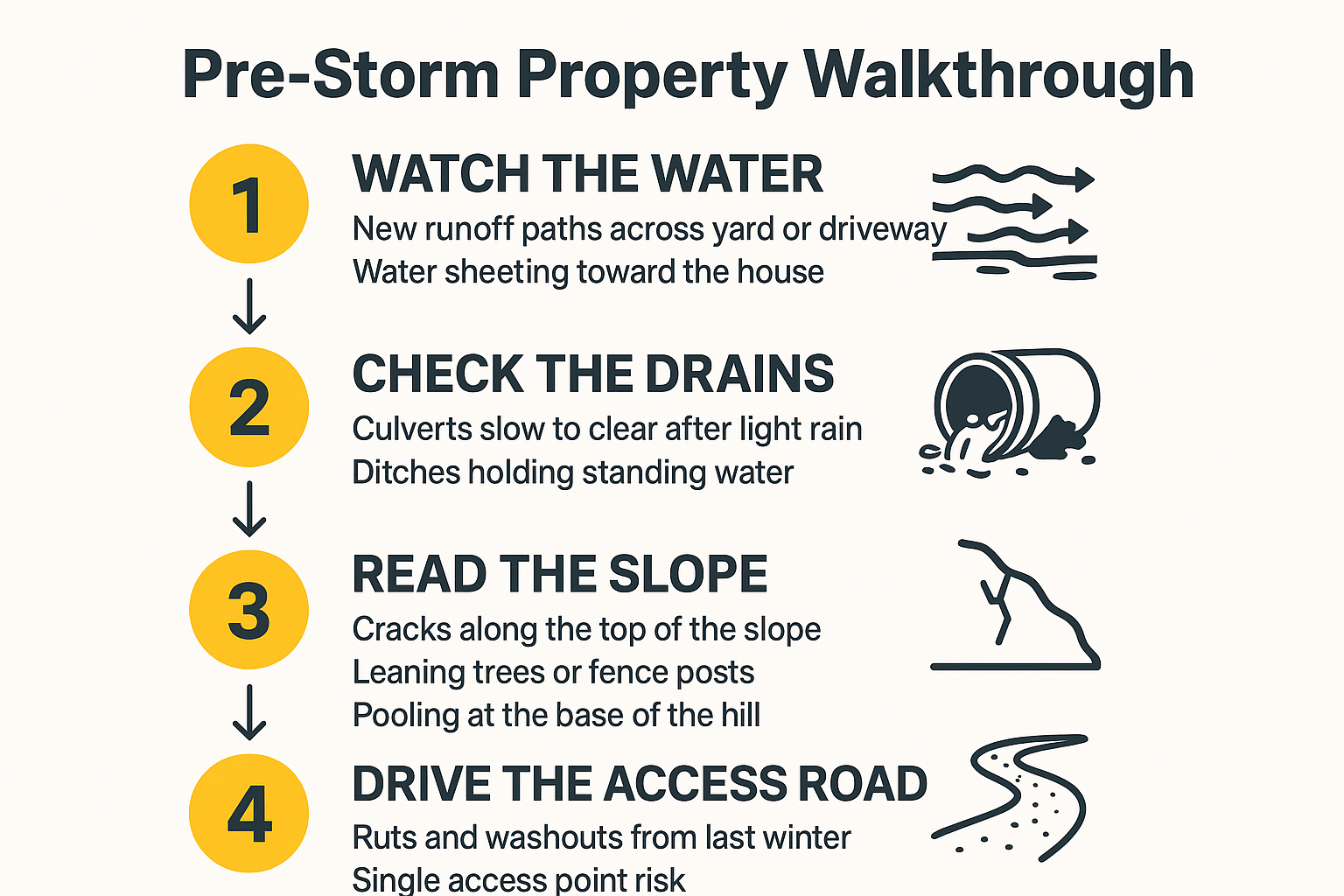
Start with where water already goes. Walk the parcel after any normal rain and look for these:
- Runoff carving new paths across a yard, pasture, or driveway that were not there last year
- Storm drains, culverts, or roadside ditches that are still slow to clear hours after light rain
- Low spots near a creek, slough, or drainage channel that have flooded before, even briefly
- Water sheeting toward the house instead of away from it
Then look at your slopes. These are the warning signs I take seriously when I am walking a hillside property:
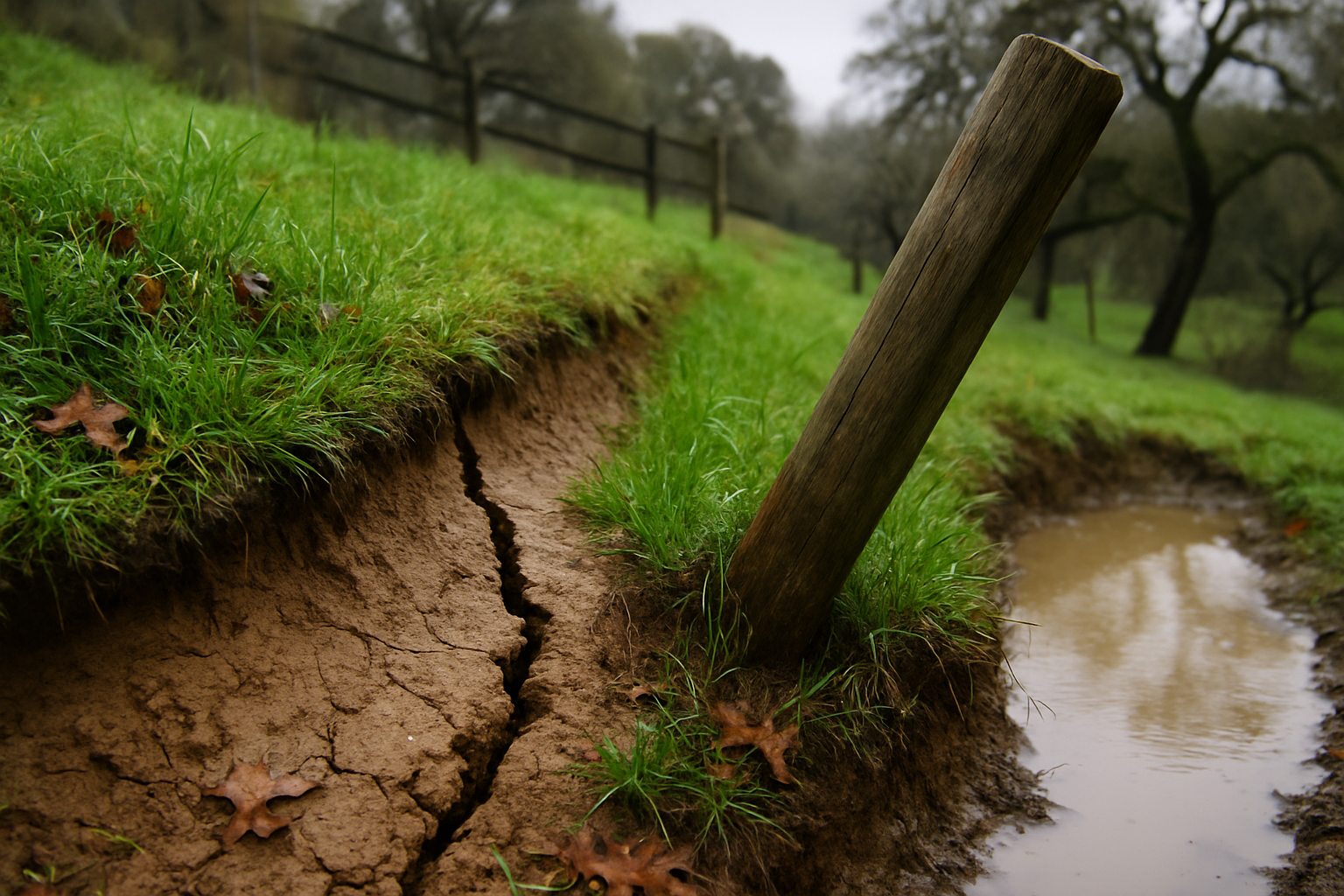
- Cracks in the soil running parallel to the top of a slope
- Trees or fence posts leaning downhill when the ones nearby stand straight
- Water pooling at the base of a hillside that used to drain
- Small soil slumps, bulges, or fresh bare patches on the face of the slope
Any one of those on its own may be nothing. Two or three together on the same slope means the ground is already moving, and a heavy storm is what finishes the job. That is the point to get eyes on it rather than wait and see.
Your Pre-Storm Property Walkthrough
Here is the same walkthrough laid out as a simple checklist you can take outside with you.
Washed-Out Driveways Are the Call We Get Most
After every serious storm, the phone lights up with the same problem: the driveway or ranch road is gone.
On rural and coastal properties, a washout is more than an inconvenience. If you have a single access point, a washed-out road means no vehicles in or out, and that includes emergency vehicles, propane delivery, and anyone coming to fix anything else.
What usually causes it is simple. The road has no crown, so water runs down the wheel tracks instead of off the side. There is no ditch or the ditch is full. The culvert is undersized or plugged with last year’s debris.
One Healdsburg-area property owner described the routine well: every year they regrade the main roads and add gravel where winter storms dug it out, then treat the surface. That annual cycle is normal for rural land, but the size of the repair depends entirely on whether the drainage was fixed the first time.
Cost varies more than people expect. A short regrade with some base rock is a different project than rebuilding a quarter mile of hillside road with new culverts and ditching, and the number moves with access, haul distance, and how much rock the road needs. The honest answer is that it takes a site visit to price, but the pattern I see is that owners who add drainage during the repair stop paying for the same repair every winter.
Warning Signs and What They Usually Mean
These are the signs I see most often on Monterey County properties and what they typically point to.
| What you see | What it usually means | Best time to address it |
|---|---|---|
| New channels cut across the yard or drive | Surface runoff has changed course and is picking up speed | Dry season, before the next wet winter |
| Culvert or ditch still full hours after light rain | Undersized or blocked drainage that will fail under a big storm | Late summer or early fall |
| Cracks along the top of a slope | Soil is starting to move; saturation may accelerate it | As soon as it is noticed |
| Fence posts or trees leaning downhill | Active slope creep, not just settling | As soon as it is noticed |
| Water pooling at the base of a hill | Water has no outlet and is loading the toe of the slope | Before the first heavy rain |
| Ruts and washouts on the access road | No crown, no ditch, or a plugged culvert upslope | Summer, when the ground is firm enough to compact |
Permits, Timing, and Why Summer Is the Real Storm Season
Here is the part that surprises homeowners: the best time to fix a winter problem is July.
Earthwork needs dry, workable soil to compact properly. Trying to build a road base or cut a drainage swale in saturated clay gives you a repair that fails the first time it gets tested.
Permits matter too. In Monterey County, grading permits are generally triggered at 100 cubic yards of cut or fill, and in Sonoma County the threshold drops to 50 cubic yards. Thresholds, review timelines, and drainage plan requirements differ by jurisdiction, and work near a creek or waterway brings state and federal agencies into the conversation.
That review time is real. Waiting until November to start a project that needs a grading permit and a drainage plan usually means the work happens after the storm, not before it. Our storm and flood preparedness in Monterey County page goes deeper on how we sequence that kind of work.
It also helps to know what the maps say about your parcel. Flood zone designations change, and a remap can affect insurance and what a county wants to see on your plans, which we covered in our piece on FEMA flood map changes and property drainage.
Frequently Asked Questions About Monterey County Storm Readiness
My property flooded once. Does that mean it will flood again?
Not automatically, but it is the strongest signal you have. Water follows terrain, and unless the grading, drainage, or upstream conditions changed, the same path is still there. A property that has flooded before deserves a real look at where the water enters and where it is supposed to leave.
When should I start storm work if I want it done before winter?
Summer. Between June and September the ground is dry enough to grade and compact correctly, and there is room in the schedule for county permit review if the project needs one. Calling in October usually means you are choosing between a rushed fix and waiting a year.
Do I need a permit to fix drainage on my own land?
It depends on how much dirt moves and where it moves. Monterey County generally requires a grading permit at 100 cubic yards of cut or fill, and work near a creek, wetland, or drainage channel can bring additional agency review regardless of volume. Small swale cleanup and roadside ditch maintenance often fall below that line, but it is worth confirming before you start.
Is a washed-out driveway something I can patch with gravel myself?
You can, and plenty of people do. But if you are hauling gravel into the same rut every February, the problem is drainage, not surface material. Adding a proper crown, a functioning ditch, and a culvert that actually passes water is what stops the cycle.
How do I know if a slope is actually moving or just settling?
Look for a pattern rather than one clue. Soil cracks along the top of the slope, several posts or trees leaning the same direction, and fresh bare patches on the slope face together suggest active movement. On a steep slope with a structure below it, that is worth an in-person evaluation rather than another winter of watching.
Thinking Through Storm Work on Your Monterey County Property?
We have been a licensed California general engineering contractor since 2013 (CA LIC #1060838), and the team you talk to on the phone is the team that shows up on site. If you want a set of experienced eyes on a slope, a drainage problem, or an access road that keeps washing out in Monterey County, CA, we are available for site visits and free estimates at 707-601-9091 or through the contact page at dw-excavation.com. Summer is when this work goes best, so it is a reasonable time to start the conversation.