
Direct Answer: A septic-to-sewer conversion involves three separate excavation scopes: trenching to the street main, decommissioning the old tank, and sometimes installing a grinder pump when gravity flow won’t work.
Most homeowners going through a septic-to-sewer conversion spend a lot of mental energy on the permits. And there is real paperwork involved, county environmental health, encroachment permits, grading permits in some cases. But the permits are just the paperwork. The physical work on your property is where the actual project scope and cost lives.
I’ve talked with enough property owners across Sonoma County and Monterey County to know that most people have no idea what the excavation side of this project actually covers until the equipment shows up. One recent form submission described it clearly: disconnecting a septic tank, installing a grinder pump system, and trenching to the street. That’s three separate excavation tasks, and each one has its own depth requirements, equipment needs, and backfill specs.
This article breaks down those three scopes in plain terms, what they physically involve, what drives the cost, and where the surprises tend to come from. If you’re planning this conversion anywhere in Monterey County or up through Sonoma County, here’s what your property is actually going to go through.
The Trench Run: Distance Is the Biggest Variable
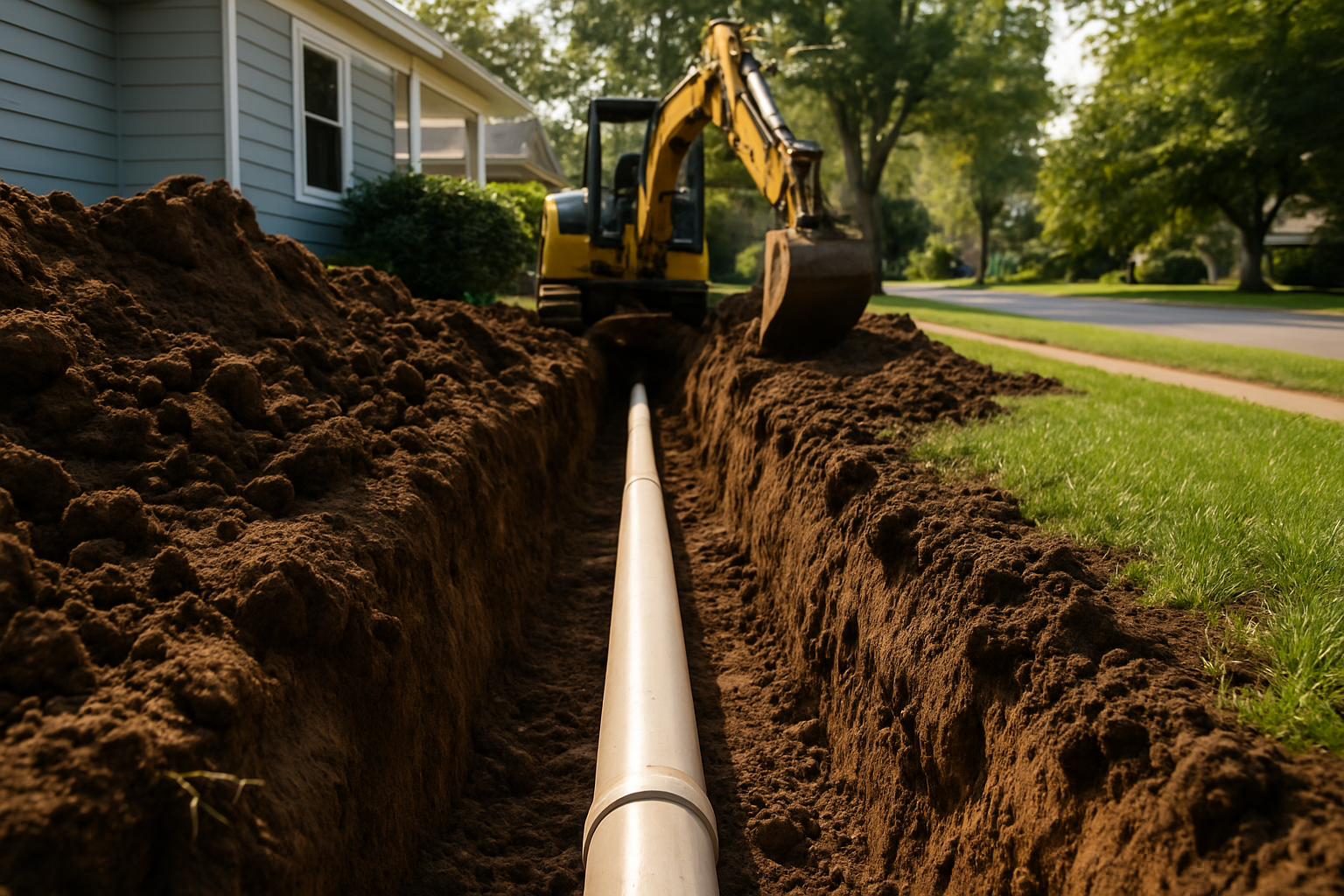
The trench from your house to the sewer main in the street is usually the most variable part of the job. Distance matters more than almost any other single factor.
A home 50 feet from the main is a fundamentally different project than one 200 feet away. That gap grows even wider when the trench has to cross a driveway, a concrete patio, or mature landscaping. Each of those obstacles adds time, specialized cutting or saw work, and restoration costs afterward.
There’s also the issue of fall. A gravity sewer line has to maintain a consistent downward slope to keep waste moving, typically around 1/4 inch of drop per foot of run, though your local inspector will confirm the exact requirement. That means the trench at the street end can be significantly deeper than at the house, depending on how your lot sits. In older neighborhoods in Santa Rosa and on some Healdsburg streets where the sewer main runs deep, it’s not unusual for the connection point to be 6 to 8 feet down. That kind of depth changes the excavation entirely, shoring requirements, soil management, and compaction work all go up from there.
Key factors that affect trench scope:
- Distance from the house to the street main
- Existing improvements in the trench path (driveways, patios, landscaping)
- Depth of the sewer main at the connection point
- Soil conditions along the run, clay soils in Sonoma County hold walls differently than sandy coastal soils near Monterey
- Whether the trench crosses public right-of-way, which triggers encroachment permit requirements
For context on how trench work fits into a broader underground utility project, our underground utility services page covers what proper depth, bedding material, and compaction standards actually look like in the field.
When Gravity Doesn’t Work: Grinder Pump Excavation
A grinder pump system comes into play when gravity flow to the sewer main isn’t viable. This happens more often than people expect, on properties with low-lying structures, flat lots, or situations where the ground actually slopes away from the main rather than toward it.
A grinder pump does what the name says: it grinds solid waste and pumps it uphill through a pressurized line to the main. Installing one means three things from an excavation standpoint:
- Excavating a pit for the pump chamber itself, sized to manufacturer specs and positioned for access
- Running a pressurized line rather than a standard gravity pipe, the trench specs are different because you’re not sloping for flow
- Coordinating the electrical connection to power the pump, which is part of the project scope and sometimes surprises homeowners who didn’t realize it was involved
I’ve had people ask whether they can just pick a different connection point to avoid a grinder pump. The honest answer is no, the location and elevation of the sewer main are fixed by the public utility. Your site conditions determine whether gravity works. If the math doesn’t work out, a pump is the path forward, not a workaround.
The cost difference between a gravity connection and a grinder pump installation is real. Pump hardware alone can run several thousand dollars before excavation, electrical, and inspection fees are factored in. General market context suggests grinder pump systems on residential conversions in California commonly add $8,000 to $15,000 or more to overall project cost depending on depth, run length, and site conditions, but your actual number depends on specifics we can only assess on-site.
The Three Excavation Scopes in a Septic-to-Sewer Conversion
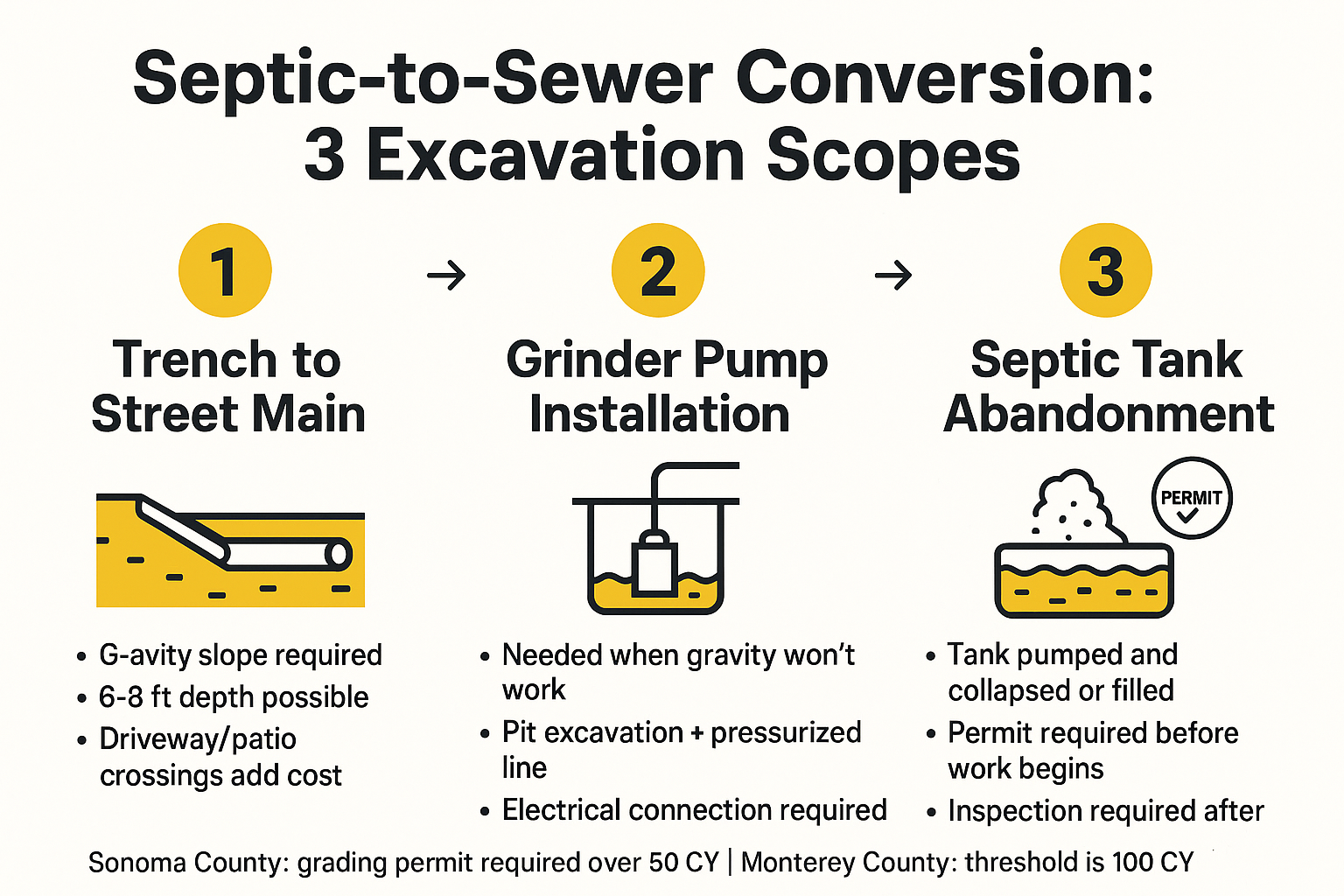
Every septic-to-sewer conversion involves at least two of these scopes, and often all three. Here’s how they stack up side by side.
Septic Tank Abandonment: The Step That Gets Treated as an Afterthought
This is the part I want to spend some time on, because I’ve seen it go sideways more than once.
In California, you cannot simply leave an old septic tank in the ground after connecting to city sewer. The tank has to be pumped out, and then either structurally collapsed or filled with an approved inert material, typically sand or concrete. Most counties require a separate abandonment permit, and an inspection has to happen before the work is covered back up.
One homeowner who reached out to us had already had their tank punctured and filled by a tractor, without pulling a permit first. They were trying to figure out how to document the work after the fact because the county inspection had already been scheduled. That situation is completely avoidable, but only if the decommissioning permit is pulled before any equipment touches the tank.
According to Permit Sonoma’s grading and stormwater requirements, starting excavation work before a required permit is issued is a code violation subject to penalties and fines. That applies to septic abandonment as much as it does to a cut-and-fill grading project.
The abandonment process involves:
- Hiring a licensed pumper to empty the tank before any demolition begins
- Physically collapsing the tank walls or filling the void with approved material
- Calling for a county inspection before the excavation is backfilled
- Keeping documentation, photos, pump receipts, and inspection sign-off, for your permit file
If your property in Sonoma County moves more than 50 cubic yards of soil during the overall conversion project, a grading permit from Permit Sonoma is required separately from the abandonment permit. Monterey County’s threshold is 100 cubic yards. A long trench on a larger lot can hit those numbers faster than most people expect.
Septic-to-Sewer Excavation: Key Scope Comparison
These three scopes are often treated as one job, but each has distinct requirements. Here’s a quick side-by-side.
| Scope | What the Excavation Involves | Common Complications |
|---|---|---|
| Trench to Street Main | Open-cut trench, graded to slope, bedded pipe, backfill and compaction | Depth at connection point, crossing driveways or patios, encroachment permit for public ROW |
| Grinder Pump Installation | Pump chamber pit, pressurized discharge line trench, electrical conduit coordination | Site elevation vs. main elevation, electrical scope, manufacturer-specified pit dimensions |
| Septic Tank Abandonment | Tank pumped, collapsed or filled with sand/concrete, inspection before backfill | Permit must be pulled before work begins; unpermitted work can trigger fines and documentation problems |
Permit Triggers and Property Setbacks You Need to Know About
Beyond the abandonment permit and the encroachment permit for the street connection, there are two more permit triggers that catch property owners off guard.
First, grading permits. In Sonoma County, any cut or fill exceeding 50 cubic yards, or any cut greater than 3 feet in depth, requires a grading permit from Permit Sonoma before work starts. In Monterey County, the threshold is 100 cubic yards. A septic-to-sewer conversion on a larger lot can easily move that much soil between the trench run, the pump pit, and the tank abandonment work combined.
Second, waterway setbacks. Properties near a creek, drainage channel, or wetland in Sonoma County are subject to setback rules that were updated in February 2026, the governing principle now is that when multiple setbacks apply, the most protective one controls. If your property backs up to a drainage channel like many homes near Mark West Creek in Santa Rosa, that rule affects where excavation equipment can work and what erosion controls have to be in place before a shovel goes in the ground. We covered the creek-side erosion angle in more depth in our article on what erosion control on a riparian lot actually takes.
For anyone planning a new build that includes a sewer connection from scratch, the site planning and grading work involved overlaps with what we cover in what a site plan actually controls, and why getting one wrong delays everything. Getting the drainage and utility plan right before excavation starts saves a lot of mid-project corrections.
Frequently Asked Questions About Septic to Sewer Conversion Excavation
How long does the excavation part of a septic-to-sewer conversion typically take?
It depends on the three scopes involved. A straightforward trench run with no major obstacles can often be completed in one to two days of field work. Add a grinder pump installation and the tank abandonment, and you’re typically looking at three to five days on-site, not counting inspection holds. Inspection scheduling, especially for the tank abandonment, can add days to the overall timeline depending on the county’s workload.
Can I just abandon the septic tank myself to save money?
Not legally, no. In California, septic tank abandonment requires a permit and a county inspection before the tank is covered back up. The work itself typically has to be performed by or at least coordinated with a licensed contractor. Doing it without a permit first can result in fines and documentation problems that are harder to resolve after the fact than the permit would have been to pull in the first place.
How do I know if I need a grinder pump?
The short answer is that your excavation contractor and the connecting utility or county agency will tell you during the planning phase. But the underlying issue is elevation: if your house sits lower than the sewer main, or if the slope of your property runs the wrong direction, gravity alone can’t move waste to the main. A site assessment looking at your property elevation relative to the main’s invert elevation is the only reliable way to know.
Will the excavation tear up my driveway or landscaping?
Possibly, yes. If the trench path runs across a driveway or patio, that surface has to be cut and later patched or restored. A good excavation contractor will walk the trench route with you before starting so there are no surprises about what gets disturbed. Restoration, saw-cutting concrete, repaving asphalt, re-grading disturbed soil, is part of the overall project scope and should be included in your estimate.
Does this project require a grading permit in Sonoma or Monterey County?
It depends on how much soil moves across all three scopes combined. In Sonoma County, a grading permit is required for cuts or fills over 50 cubic yards or any cut deeper than 3 feet. In Monterey County, the threshold is 100 cubic yards. On a larger lot with a long trench run, a grinder pump pit, and a full tank abandonment, it’s worth calculating that volume before assuming you’re under the threshold.
Planning a Septic-to-Sewer Conversion in Sonoma or Monterey County?
If you’re trying to understand what your property is actually going to go through before committing to this project, a site visit is the most useful first step. We work on septic-to-sewer conversions across Sonoma County and Monterey County and can walk you through the trench route, assess whether a grinder pump is in play, and flag any permit triggers before work begins. Reach out to our team at (707) 601-9091 or send us the details through the contact form at dw-excavation.com.