
Direct Answer: Permit Sonoma launched a Grading Self-Certification Program in April 2026, allowing approved licensed professionals to certify qualifying grading work themselves — potentially cutting review time significantly. Not every project qualifies.
If you’re planning any grading work in Sonoma County — whether it’s a new build, a retaining wall, a driveway approach, or drainage correction — there’s a meaningful change to the permit process that most homeowners and builders haven’t heard about yet. Permit Sonoma launched a Grading Self-Certification Program in April 2026, and it has the potential to move qualifying projects significantly faster through review.
But here’s where I want to be straight with you: the phrase qualifying projects is doing a lot of work in that sentence. Sonoma County’s terrain — the clay hills around Windsor, the seasonal drainages cutting through Healdsburg neighborhoods, the slope-heavy parcels in the unincorporated hills above Santa Rosa — pushes a lot of residential jobs out of the simple category before a shovel ever hits the ground.
This article breaks down what actually changed, what hasn’t, and what you need to know before you submit anything to Permit Sonoma. I’ve been pulling grading permits in this county for over a decade, and the questions I hear most often are the ones this program directly affects.
What the Grading Permit Threshold Still Requires
The standard grading permit threshold in Sonoma County has not changed. You need a permit any time your project involves:
- A cut or fill exceeding 50 cubic yards
- A cut or fill greater than 3 feet in depth
- Fill placed on terrain steeper than 15 percent slope
These numbers apply regardless of the new self-certification program. What changed is one of the pathways to getting that permit approved — not the trigger for needing one in the first place.
I mention this because one of the most common calls we get goes something like: ‘I just need to grade a small area — do I really need a permit?’ Sometimes the answer is no. But more often than people expect, the scope crosses one of those thresholds, especially on properties with any meaningful slope. If you’re not sure where your project lands, that’s exactly the kind of question worth asking before plans are drawn.
For context on what a complete permit submission looks like, see our breakdown of what a civil site plan requires before you can pull a grading permit.
Regular Grading vs. Engineered Grading — and Why It Matters for Self-Certification
The self-certification pathway applies to Regular Grading designations — the more straightforward end of the permit spectrum. Think: a relatively flat or gently sloped site, no geologic hazard flags, no waterway proximity issues, and a scope that doesn’t require a licensed civil engineer to design the grading plans.
Engineered Grading is a different designation entirely. It applies when:
- The project is located in or near a Geologic Hazard Area Combining District
- A licensed civil engineer’s stamp is required on the grading plans
- A soils report is referenced in the plans or required by the county
- The site’s complexity — slope instability, expansive clay, proximity to a creek or wetland — demands engineered oversight
For Engineered Grading projects, the full review process still applies. A licensed civil engineer must prepare the plans, and Permit Sonoma reviews them directly. The self-certification route is not available for these jobs, period.
Why does this distinction matter so much right now? Because a lot of Sonoma County residential properties — particularly in the unincorporated hills, along the Laguna de Santa Rosa corridor, and on any lot with seasonal drainage features — are going to land in the Engineered Grading category even if the homeowner assumes otherwise. Clay soils common throughout Windsor and Santa Rosa retain water differently than sandy or loamy profiles, which affects how drainage reports need to be structured and whether compaction standards can be met without engineered oversight. I’ve seen more than a few projects start down the self-certification path and get redirected mid-application when the county identifies a geologic hazard overlay on the parcel.
The Permit Sonoma Grading Program guidelines detail the specific criteria for both designations — worth reading before you assume which category your project falls into.

What a Complete Grading Permit Application Actually Requires
The application process trips people up before they even get to the self-certification question. A complete submission to Permit Sonoma requires:
- Grading plans submitted as a single PDF — not multiple files, not separate sheets
- A drainage report that addresses how the site manages runoff before and after grading
- A letter of authorization signed by the property owner
- A soils report if the grading plans reference one or if the county requires it based on site conditions
Engineered grading plans can only be prepared by a licensed civil engineer. A property owner cannot self-prepare those, regardless of the new self-certification option. That’s a distinction worth understanding clearly before you invest in any planning work.
There’s also a step that catches people off guard even after the application is accepted: Sonoma County requires a pre-construction consultation with Permit Sonoma staff before any permitted grading work begins. This is not optional, and skipping it — or not knowing it exists — is one of the most common sources of project delays I see. It doesn’t have to be complicated, but it has to happen.
If you want a deeper look at what goes into getting this right from the ground up, our article on how to tell if your property was graded right before it costs you covers the downstream consequences of shortcuts in this process.
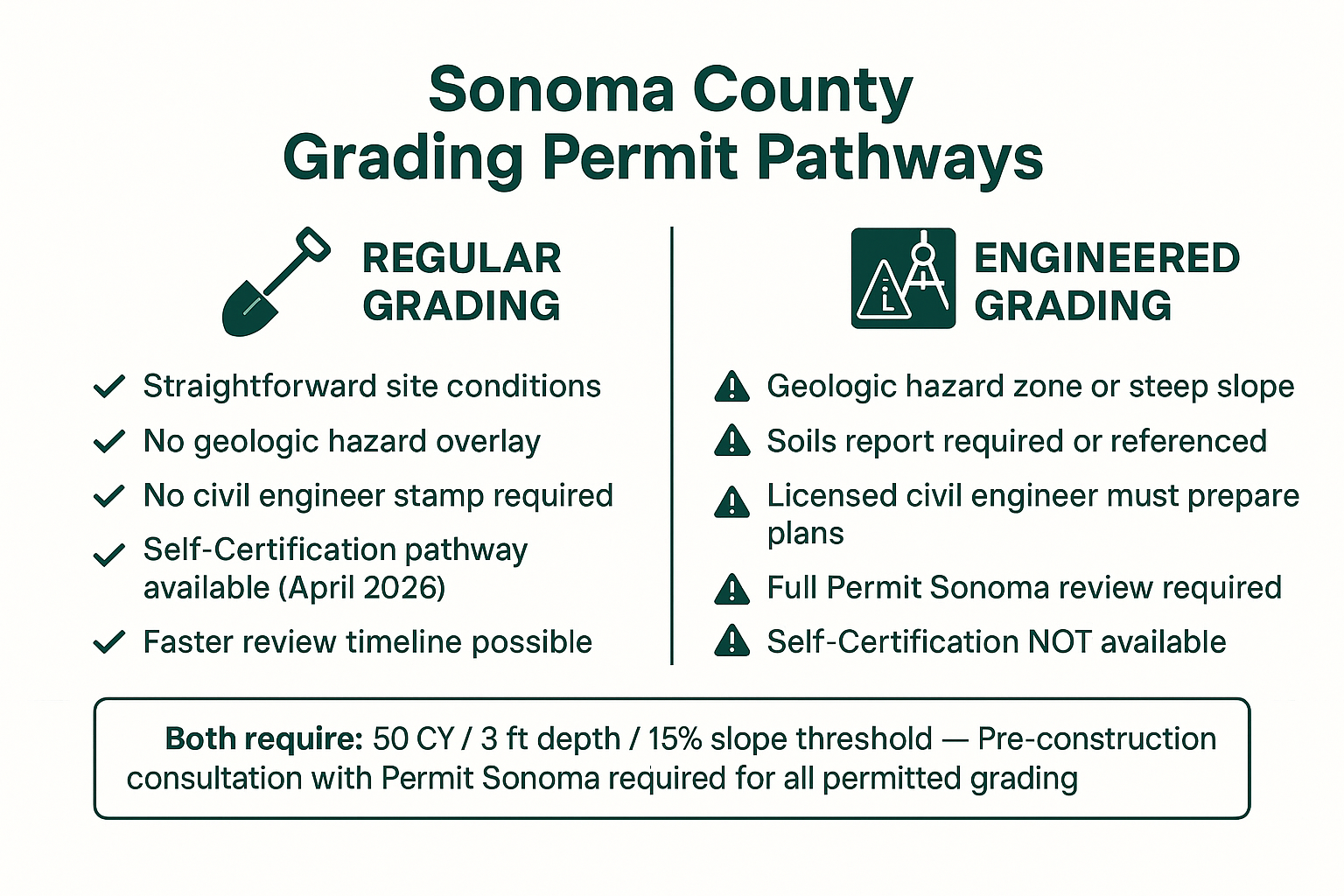
Regular Grading vs. Engineered Grading at a Glance
This comparison breaks down the key differences between the two grading designations in Sonoma County and which permit pathway each one follows.
Waterway Setbacks: The Layer Most People Miss
Sonoma County updated its waterway setback documentation as recently as February 2026, and it’s directly relevant to any grading project near a creek, drainage channel, or wetland.
The rule is simple but the implications aren’t: when multiple setbacks apply to a waterway, the most protective one governs. That means the setback isn’t always what the map shows at first glance — it may be larger depending on the specific waterway designation, the type of work planned, and the applicable combining district.
This matters practically for a lot of Sonoma County properties. Properties along Mark West Creek, along the Laguna de Santa Rosa, or near the smaller seasonal drainages that cut through residential lots in Healdsburg and Petaluma are common examples. We had a homeowner reach out after months of plan revisions — their grading scope near what they thought was a minor drainage feature triggered an additional review layer that neither they nor their designer had anticipated.
If your property has any creek, channel, pond, or seasonal drainage feature — even one that only runs in winter — get that proximity assessed early, before plans are drawn and fees are paid. It’s a much easier conversation before a grading plan exists than after.
For properties along Mark West Creek specifically, our article on creek bank erosion control on riparian lots gets into what site work in that zone actually requires.
Sonoma County Grading Permit Requirements at a Glance
Here’s a quick reference for the thresholds and documentation that apply to most residential and light commercial grading projects in Sonoma County.
| Factor | Threshold / Requirement | Notes |
|---|---|---|
| Cut or fill volume | Over 50 cubic yards | Permit required; Monterey County threshold is 100 CY |
| Cut or fill depth | Greater than 3 feet | Applies to either cut or fill individually |
| Slope for fill placement | Steeper than 15% grade | Fill on steeper slopes triggers permit requirement |
| Geologic hazard zone | Any parcel in or near a Hazard Combining District | Automatically triggers Engineered Grading designation |
| Waterway proximity | Any creek, channel, or wetland on or near the parcel | Most protective setback applies; updated Feb 2026 |
| Pre-construction consultation | Required before work begins | Not optional — skipping it causes delays |
| Self-certification eligibility | Regular Grading projects only | Approved licensed professionals only; launched April 2026 |
What Happens When Grading Was Done Without a Permit
This is the part of the conversation nobody wants to have, but I’ve seen it come up enough times that it’s worth saying plainly.
Starting grading work before a permit is issued is a violation of Sonoma County code. That applies to retaining walls, terracing, cuts, fills — all of it. And the county does find out. Sometimes it’s a neighbor complaint. Sometimes it’s an assessor’s visit. Sometimes it surfaces when you’re selling the property or pulling permits for something else entirely.
One homeowner who reached out recently described retaining walls and terraced areas that had been in place for nine years with no issues — until the county noticed and required permits retroactively, along with a possible soils engineer review because the work was on a slope. Nine years of no complaints didn’t protect them from the legalization process.
And here’s the part that matters most: the legalization process is typically more involved and more expensive than getting the permit right the first time. You’re often looking at a soils report, engineered plans for work that was done by hand or eye years ago, and potential penalties or fines on top of the permit fees. It’s a harder road, not an easier one.
If you’re in that situation right now — grading or walls that went in without permits and are now being flagged — the first step is understanding exactly what the county is requiring and what documentation is realistically achievable for the work as it exists. Our article on residential excavation limits in Sonoma County covers related permitting ground that’s useful context here.
Frequently Asked Questions About Sonoma County Grading Permits
Does the new self-certification program mean I can skip the grading permit entirely?
No. The permit requirement hasn’t changed at all. What changed is one of the approval pathways — for qualifying Regular Grading projects, an approved licensed professional can now certify the work rather than going through the standard back-and-forth plan check. The permit itself is still required.
How do I know if my project qualifies for the self-certification path?
The key factors are whether your project is classified as Regular Grading (not Engineered Grading), whether it’s located outside a Geologic Hazard Area Combining District, and whether it doesn’t require a soils report or civil engineer’s stamp. If any of those apply — and on sloped or clay-heavy Sonoma County parcels, they often do — you’re likely looking at the full review process.
What’s the penalty for grading without a permit in Sonoma County?
Sonoma County can issue stop-work orders, fines, and require full legalization of the unpermitted work — which typically means engineered plans drawn for work that already exists, a soils report, and all applicable permit fees. The cost and complexity of doing it after the fact almost always exceeds what the original permit would have cost.
My property backs up to a seasonal drainage channel. Does that affect my grading permit?
Yes, potentially significantly. Sonoma County updated its waterway setback documentation in February 2026, and when multiple setbacks apply, the most protective one governs. Grading near any creek, seasonal channel, or wetland can trigger an additional review layer. Get the site assessed for waterway proximity before plans are drawn — not after.
Can a property owner prepare their own grading plans?
For Regular Grading projects that don’t require an engineer’s stamp, yes — in some cases. But for Engineered Grading, the plans must be prepared by a licensed civil engineer. A property owner cannot self-prepare those, even under the new self-certification program.
Is the pre-construction consultation with Permit Sonoma really required, or is it just a recommendation?
It’s required. Sonoma County mandates a pre-construction consultation with Permit Sonoma staff before any permitted grading work begins. Skipping it — often because people don’t know it exists — is one of the most consistent sources of project delays. Build it into your timeline from the start.
Have Questions About Your Grading Project in Sonoma County?
We’ve been pulling grading permits in Sonoma County since 2013 — through plan check cycles, pre-construction consultations, soils report requirements, and now the rollout of the self-certification program. If you’re trying to figure out whether your project qualifies for the streamlined path, whether you’re in a geologic hazard zone, or how to handle grading that was done without a permit, we’re happy to talk it through. Reach out to DW Excavation at 707-601-9091 or through the contact page at dw-excavation.com — no pressure, just a straight conversation about what your site actually needs.