
Quick Answer
California handicap parking compliance means more than painting blue stalls. You need the right number of accessible spaces, correct car and van dimensions, properly marked access aisles, compliant signage, and precise grading so parking spaces and aisles stay within 1:48 slope limits and connect to an accessible route.
Planning a build, remodel, or parking lot upgrade in California gets complicated fast once accessibility enters the picture. If you're trying to understand handicap parking regulations california, the biggest mistakes usually happen before striping ever starts, during layout, grading, drainage planning, and curb work.
That matters on commercial sites, apartment properties, ADU projects, and mixed-use work across Santa Rosa, Sonoma County, Monterey County, and the California Central Coast. If the ground isn't set up correctly from the start, the paint and signs won't save the project.
The Foundation of Compliance How Many Accessible Spaces Are Required
A site can look workable on paper and still fail the accessible parking count once the stalls, aisles, curb returns, and accessible route are laid out. I see that problem early, during grading review, not at final striping.
California uses a parking-count table to determine how many accessible spaces a lot must provide. The 2023 California Building Code, Chapter 11B lays out the required counts by total parking spaces, and it also requires a share of those accessible spaces to be van accessible.
Why the count matters during site prep
The stall count sets the footprint you have to build. More accessible spaces mean more area that has to be held to tighter grade control, with enough width for access aisles and enough room to connect cleanly to the path of travel.
That affects excavation limits, curb placement, utility routing, and drainage layout.
On constrained sites, accessible parking usually belongs in the flattest part of the lot with the shortest practical route to the entrance. If the plan pushes those spaces into a corner near a swale, a steep cross-slope transition, or a patchwork of utility lids, the field crew ends up trying to force compliance into ground that was never prepared for it. That is how owners get hit with change orders after base rock, concrete, and asphalt are already in place.
Van-accessible spaces need to be planned, not squeezed in
Van spaces take more room and less forgiveness. California's code requires a minimum number of van-accessible stalls within the total accessible count, and that requirement changes the parking module early.
On the ground, that means reserving enough width, protecting the access aisle from drainage conflicts, and keeping poles, signs, wheel stops, and curb ramp flares out of the clearance area. If those decisions wait until the end, crews often have to shift islands, rebuild curb, or rework pavement grades to make one van stall function correctly.
Count first, grade second, stripe last
Property owners sometimes treat the accessible count as an administrative item. In the field, it is a layout and earthwork issue.
Get the count wrong, and the grading plan is wrong with it. Get the count right early, and the rest of the site has a better chance of fitting together without expensive rework.
Beyond the Blue Paint Dimensions Slopes and Surfaces
A compliant stall isn't defined by blue paint. It is built on dimensions, grade control, and surface condition. Earthwork and paving prep determine the job's success.
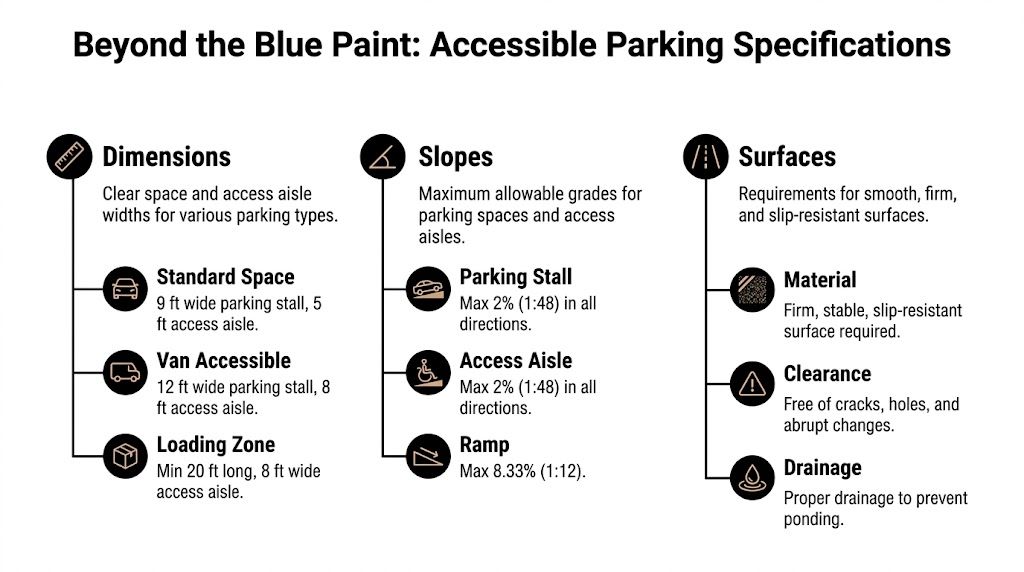
According to California handicapped parking compliance guidance, access aisles must be at least 60 inches wide for standard car spaces and 96 inches wide for van-accessible spaces, and surface slopes in both parking spaces and access aisles cannot exceed 1:48 in all directions.
The ground has to work before the striping crew arrives
Crews can stripe a clean-looking lot in a day. Fixing bad slope after that is a different story.
If the accessible stall drains like the rest of the lot, it may be too steep. If the access aisle is the low point, water can pond where someone needs wheelchair clearance. If a curb ramp edge or utility trench lands inside that aisle, the stall may look finished and still fail.
Dimensions affect the whole parking module
The accessible stall isn't a single rectangle. It's a stall plus the adjacent aisle plus the route leading away from it. Those pieces need to fit together without conflict.
A few field issues show up over and over:
- Tight curb placement: Curbs get poured before final field checks, then the aisle width no longer works.
- Drain in the wrong spot: An inlet ends up where tires, walkers, or wheelchair wheels need stable travel.
- Cross fall carried through: The lot's normal drainage slope continues through the accessible area and pushes it past the allowed limit.
A good overview of long-lasting pavement starts below the surface, not at the topcoat. This piece on what really makes pavement last lines up with what happens on accessible parking too. Subgrade prep, drainage control, and compaction all matter because compliant slopes don't stay compliant on a weak base.
If the subgrade moves, the finished surface moves with it. Accessibility problems often begin under the asphalt.
Surface quality matters as much as slope
The code numbers get most of the attention, but the feel of the surface matters in real use. Rough transitions, shallow settlement, edge cracking, and patched trenches can all create problems even when the striping is technically in the right place.
That's why accessible parking should be treated as a precision area. On many jobs, it's the part of the lot that needs the most careful grading passes, the most careful paving, and the least tolerance for last-minute field changes.
Navigating the Codes ADA Title 24 and Local Rules
California projects don't live under one rulebook. They sit at the intersection of the federal ADA, California Building Code requirements under Title 24, local plan review, and field inspection.
That overlap is where a lot of confusion starts. An owner hears "ADA compliant" from one person and assumes the parking layout is settled. Then city review, a CASp consultant, or final inspection raises issues because California may require more than the federal minimum.
Why Title 24 changes the conversation
According to California ADA parking requirements under Title 24, California's Title 24 Building Standards Code can mandate stricter handicap parking requirements than federal ADA standards, and some interpretations require two accessible spaces for every 25 total parking spaces in specific scenarios.
For site development, that means accessible parking can't be treated as a generic ADA box-check. The working assumption in California should be that the site team needs to verify the state standard first, then confirm what local reviewers expect on that property type and scope of work.
Where jobs go sideways
One common problem starts with a clean-looking concept plan. The architect shows standard parking counts, the engineer lays out grading around that count, and the accessible spaces get adjusted late. Once that happens, every revision gets harder.
Another issue shows up during resurfacing or renovation. The owner thinks the work is minor, but altered parking areas can trigger compliance obligations. By that point, the lot geometry, curb lines, and drainage pattern may already be locked in.
The expensive ADA fixes usually aren't complicated. They're late.
On permit-heavy projects, accessibility comments can also slow approval if the civil sheets, architectural sheets, and site details don't match. That's one reason early coordination matters. If you're dealing with review timing in Sonoma County, this guide on getting permits approved faster is worth reading because mismatched site information is one of the avoidable delays.
Local interpretation still matters
Two jurisdictions can look at the same parking field and focus on different details. One reviewer may flag route continuity. Another may focus on stall count, signage placement, or curb ramp conflict.
The practical answer is simple. Build the accessible parking layout with enough room, enough grade control, and enough coordination that it can survive plan review without field improvisation.
Connecting the Dots Signage and Accessible Routes
A blue stall isn't usable unless someone can get out of the vehicle, enter the aisle, and travel to the building without hitting a barrier. Parking compliance works as a chain. Break one link and the whole thing fails in practice.
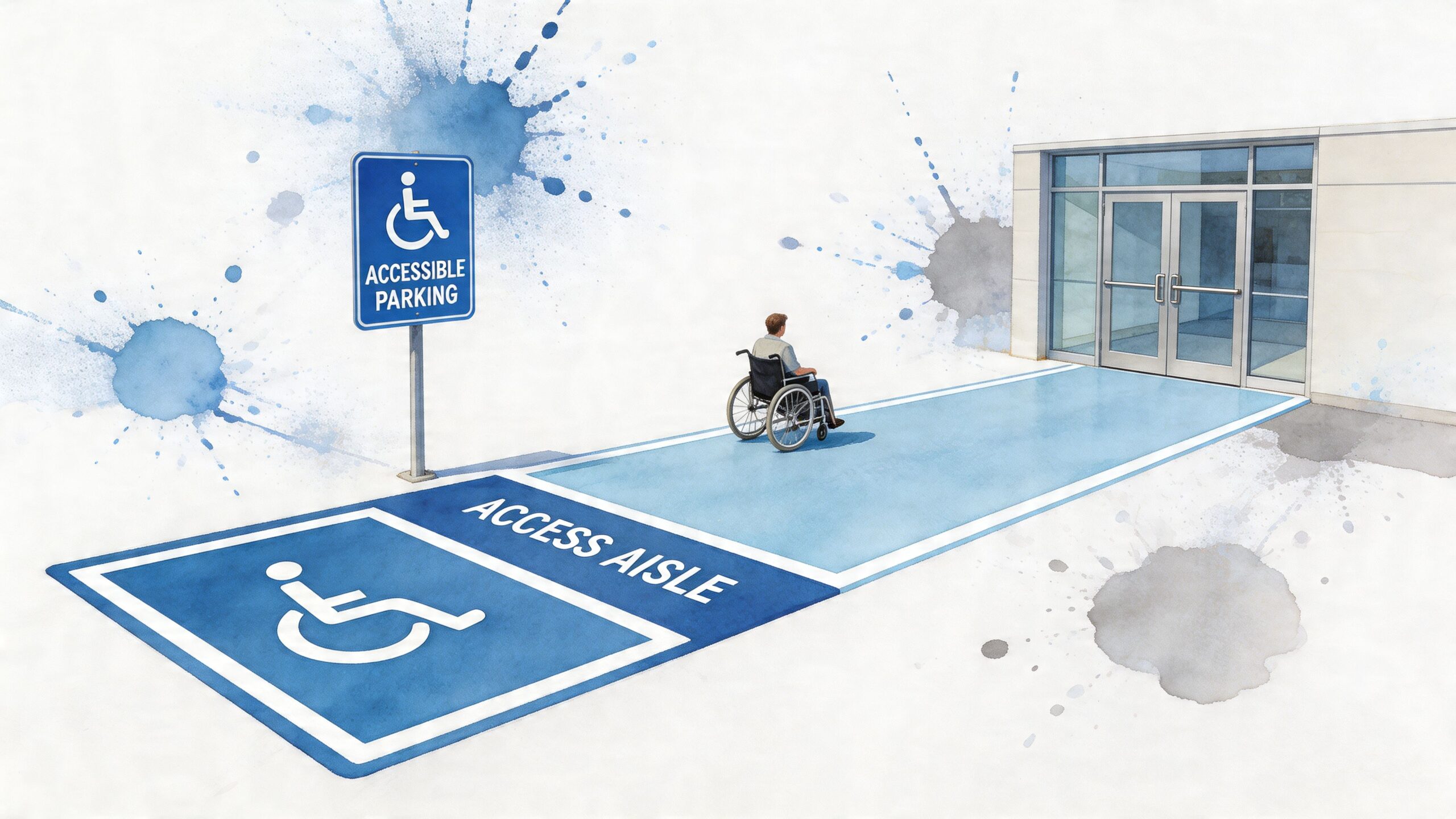
The site details matter here. The verified parking guidance states that spaces need proper signage visible from a seated position, adjacent access aisles, and routes linking those aisles to accessible pathways. It also notes that accessible routes must be at least 3 feet wide and the parking and route areas must stay within the required slope limits, as outlined in the earlier cited parking compliance sources.
What to check before concrete and asphalt go in
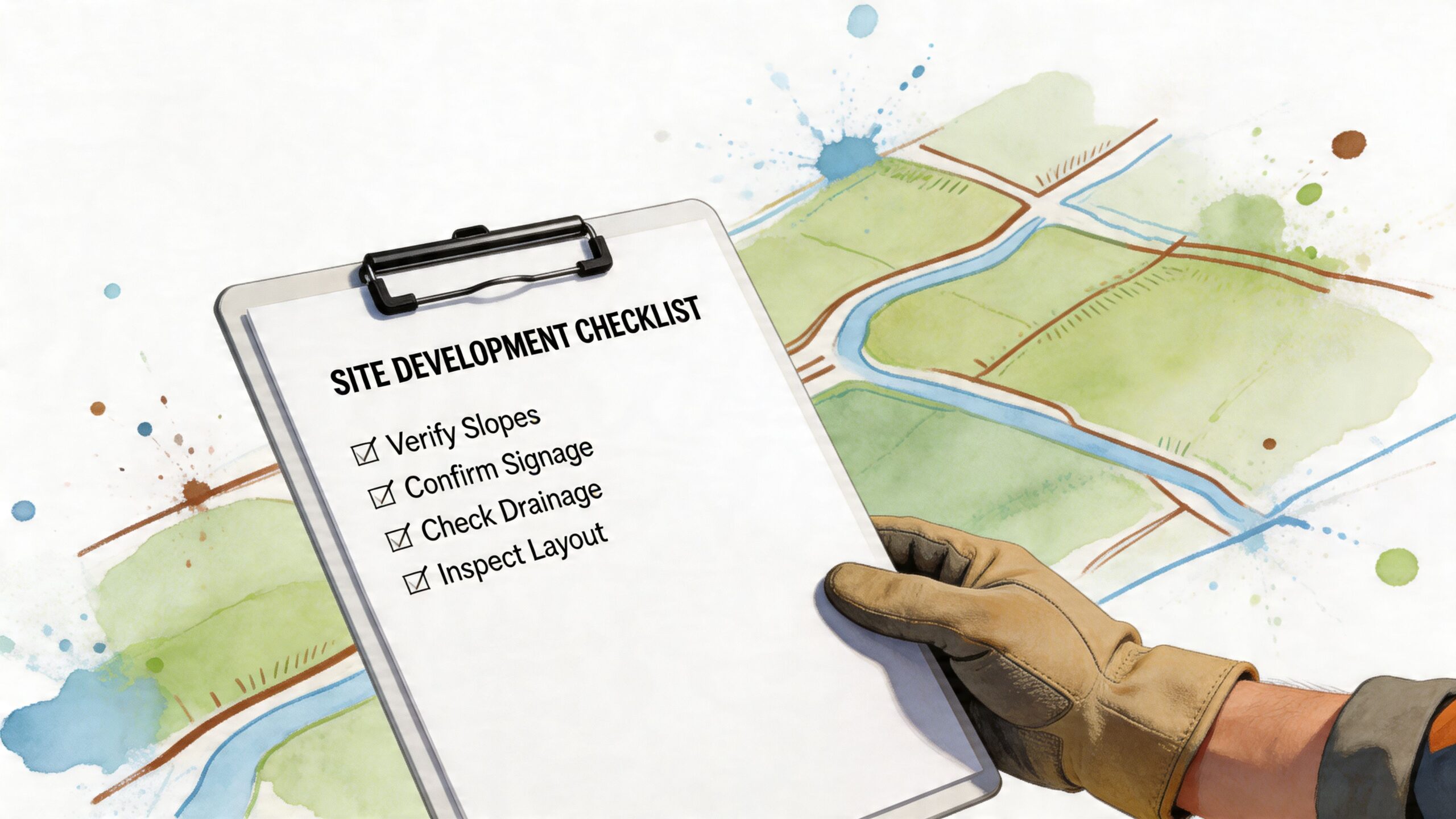
Use this as a field checklist during layout:
- Sign locations: Make sure signs will be visible to drivers and not blocked by landscaping, columns, or parked vehicles.
- Aisle continuity: The access aisle has to lead to a real path, not a dead end at a curb.
- Route width: Keep the accessible route clear and wide enough from the aisle to the entrance.
- Ramp placement: Curb ramps can't intrude into the stall or aisle area.
- Surface transitions: Watch every joint, lip, utility cut, and edge where the route changes material.
For teams reviewing sign packages and interior accessibility details, a supplier reference like ADA Signs with Braille can help clarify what compliant sign types look like. That's not a substitute for plan review, but it helps owners understand the signage side while the site crew handles grading and route construction.
Read the plans like the inspector will
Parking compliance problems often come from reading one sheet at a time. The striping plan may look right, but the grading plan, curb detail, and architectural route don't line up.
Anyone managing the build should know how to compare those sheets before work starts. This guide on how to read blueprints is useful because accessible parking errors usually show up where one drawing set stops and another begins.
A compliant parking space is part of a path, not an isolated feature.
Common Compliance Mistakes We See in the Field
The most expensive mistakes aren't usually dramatic. They're small layout or grading decisions that stack up until the accessible stalls no longer work.
One of the biggest is placing accessible parking in the same drainage pattern as the rest of the lot. Standard lot drainage often relies on steady fall across a wide area. Accessible stalls and aisles need tighter control. If the lot drains well overall but the accessible section exceeds the allowed slope or holds water, the project still has a problem.
Mistakes that start in rough grading
Rough grading sets the direction for everything that follows. If the pad is off, every trade after that is trying to recover lost tolerance.
Common examples include:
- Chasing the building elevation: The parking field gets forced to meet finished floor heights without preserving a compliant accessible route.
- Leaving utility conflicts for later: Trenches, pull boxes, and drains end up in or beside the aisle because no one reserved clear space early.
- Ignoring curb geometry: The curb return looks fine on paper but pinches the route or interferes with the aisle in the field.
Mistakes that show up after paving
Fresh asphalt can hide bad decisions for a while. Then final review brings them back.
Some of the usual late-stage problems are:
- Curb ramps pushed into access aisles
- Signs installed where drivers can't clearly see them
- Striping laid out to fit the lot instead of the approved dimensions
- Surface patches or settlement inside the route of travel
Training matters here, especially when multiple crews touch the same site. If a project team needs a broader view of how field staff and office staff stay aligned, this overview of regulatory compliance training is a useful general resource. It isn't parking-specific, but it does reinforce a point that applies on every job: compliance failures often come from coordination gaps, not from one big mistake.
A lot can pass through several hands and still fail for one overlooked inch, one misplaced ramp, or one bad drainage decision.
What works better
The jobs that go smoothly usually share the same habits. The team confirms stall count early, holds the accessible area in the best location, checks grades before base rock is locked in, and keeps accessible routes clear of utility improvisation.
That approach isn't flashy. It just prevents rework.
A Contractor's Checklist for Compliant Site Development
A good site plan handles accessible parking before the first machine starts cutting grade. The sequence matters because parking compliance touches earthwork, utilities, paving prep, concrete, striping, and final inspection.
Preconstruction checks
Start with the approved plan set and verify the accessible stall count against the lot count. Then confirm where the van space sits, where the route leaves the aisle, and whether that route crosses any curbs, drains, or utility work.
This is also the right time to make sure the civil, architectural, and striping sheets agree. If one sheet shows a route through an area another sheet fills with trenching or landscaping, fix it before layout.
A lot of owners don't realize how much of this falls under the contractor's practical coordination role. This article on what an excavation and engineering contractor actually does gives a clear picture of why grading, drainage, and compliance planning belong in the same conversation.
Field execution checks
Once work begins, verify the accessible area at each stage:
- During rough grade: Confirm the accessible zone still has enough flat workable area.
- Before base and paving: Check slope control where the stalls and aisles will land.
- Before curbs are poured: Measure actual clearances, not just plan dimensions.
- Before striping and signs: Walk the route from vehicle space to entrance and look for conflicts.
Final walk-through checks
The last review shouldn't be the first time anyone follows the accessible path end to end. Walk it at the pace of an actual user, not just as a superintendent checking boxes.
Look for ponding risk, abrupt surface changes, blocked signs, curb ramp intrusion, and route pinch points. If something feels tight, awkward, or forced, it usually is.
Frequently Asked Questions About Handicap Parking
If I resurface my lot, do I need to bring the accessible spaces up to current standards?
In many cases, yes. Resurfacing is often treated as an alteration, and that can trigger upgrades to the accessible parking area. In the field, such upgrades frequently catch owners off guard. They budget for grind and pave, then find out the stall, access aisle, cross-slope, or route to the building no longer passes.
From a site-work standpoint, resurfacing is the right time to correct grades, not just freshen the asphalt. If the accessible area has been holding water, drifting out of slope, or settling at the aisle edge, repainting over it does not solve the compliance problem.
Do apartment buildings and private residential properties have to follow these parking rules?
Yes. Apartment properties, mixed-use sites, workplaces, and other private developments can all have accessibility obligations.
I see a common mistake on residential projects. The owner assumes the rules only apply to retail or public buildings, so the accessible path and parking layout get treated as secondary items during grading. Then the project ends up with tight access aisles, poor drainage at the curb ramp, or a route that works on paper but not on the finished site.
Can a landlord reserve a blue accessible space for one specific tenant?
That can create legal and operational problems. California disabled parking rules generally allow use by any driver or passenger with a valid disabled placard or plate, not one named tenant. A practical overview of that issue appears in disabled parking requirements for California properties.
On multifamily sites, the better approach is to plan enough compliant parking in the right locations and make sure the route from those spaces is usable year-round.
What does a CASp inspector do for a parking lot project?
A CASp reviews the site for accessibility compliance and identifies trouble spots before they turn into failed inspections, complaints, or litigation.
For parking lots, that review often goes beyond striping counts. A good CASp will look at how the accessible stalls sit on the grade, whether drainage pushes water through the access aisle, whether the curb ramp lands cleanly, and whether the accessible route still works after real-world site adjustments. That matters because many compliance failures start below the paint line.
What are the risks if the lot isn't compliant?
The risk is cost, delay, and rework. A noncompliant lot can lead to complaints, legal exposure, failed inspections, and expensive corrective construction after the site is already paved and occupied.
The hardest fixes are usually the ones tied to grading. If the accessible space or access aisle is too steep, the solution may involve sawcutting, removing pavement, adjusting base, resetting curb work, and rebuilding the route connection. That is far more expensive than getting the elevations right during layout.
How often do parking violations get reported?
Often enough that owners should not treat accessible parking as a low-priority item. Parking areas are one of the first things users encounter, and they are easy to evaluate from the ground.
In practice, complaints usually come from visible field problems. Water ponding in the aisle. A route pinched by a curb return. A stall that meets width on the plan but loses usability because the finished surface is out of tolerance. Those are preventable mistakes if the grading, drainage, and layout are coordinated early.
Get Your Site Plan Right From the Start
If you're dealing with handicap parking regulations california, the safest approach is to solve the site work first. Get the count, layout, slope, drainage, route, and curb details right on paper, then build to that plan carefully. If you need help coordinating those pieces, this guide on getting a site plan approved faster is a practical place to start.
If you're planning a project in Sonoma County, Monterey County, or the California Central Coast, DW Excavation, LLC can help you think through grading, drainage, site prep, and parking layout before mistakes get built in. For a free estimate or site consultation, call (707) 601-9091, visit 470a Caletti Avenue, Windsor, CA 95492, or go to dw-excavation.com.