
Quick Answer
New driveways usually crack fast because the ground underneath wasn’t prepared correctly. The surface gets blamed, but the underlying problem is often weak subgrade, poor compaction, bad drainage, or missed control joints. If the foundation moves, the concrete or asphalt on top will crack no matter how new it is.
You paid for a new driveway, and now you're seeing cracks, low spots, or water sitting where it shouldn’t. That’s frustrating, and it usually means the problem started before the surface was ever poured or paved.
If you're asking why did my new driveway start cracking so fast?, the answer is usually below the surface. Poor grading, weak base prep, and rushed installation cause most early failures. A lot of that starts with the groundwork, not the finish. This is the same issue covered in how poor grading wrecks driveways before the asphalt even cracks.
The Real Culprit A Poorly Prepared Foundation
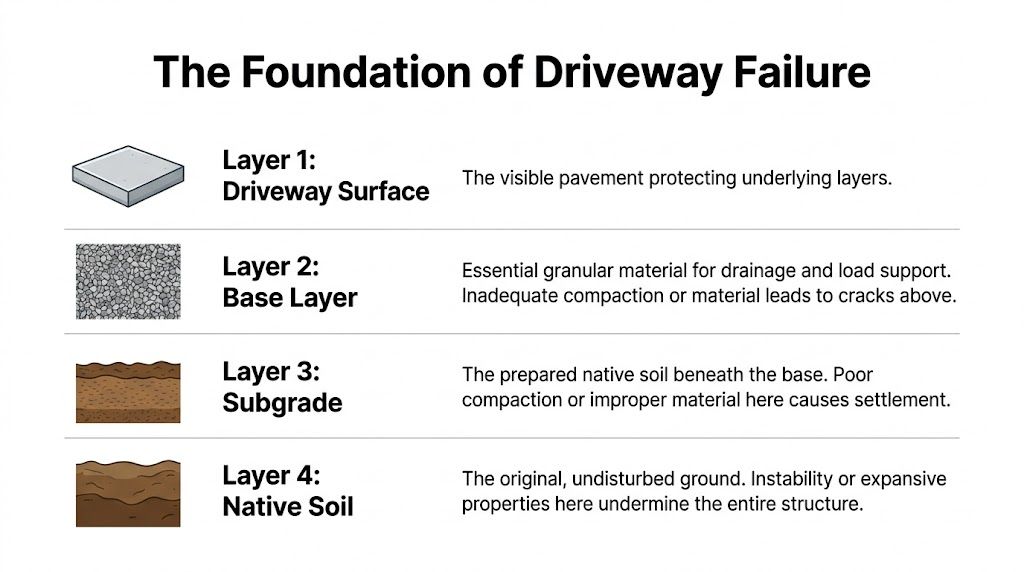
A driveway is only as stable as what sits under it. The visible concrete or asphalt is the top layer. Under that, you have the base, the subgrade, and the native soil. If those layers weren’t excavated, graded, and compacted properly, the surface is riding on something that can move.
That’s why a driveway can look clean on day one and start failing soon after. The finish may have been fine. The support underneath wasn’t.
What the base is supposed to do
The base spreads weight, helps drainage, and gives the surface a firm platform. If that layer is thin, soft, or uneven, vehicle loads start pushing it around. Then the slab or asphalt mat takes stress it wasn’t meant to carry.
Residential driveways require a compacted subbase of at least 4 to 6 inches of aggregate with 95 to 98 percent Proctor density, and uncompacted bases can show 3 to 5 times higher settlement rates according to GoThrasher’s driveway cracking explanation. That’s the kind of detail that separates a real site-prep job from a cosmetic paving job.
Practical rule: If a contractor talks mostly about the finish and barely mentions excavation, base thickness, or compaction, that’s a warning sign.
A lot of homeowners don’t realize that the driveway lifespan is often decided before the concrete truck shows up. The same principle applies to a house pad. If you want a plain-language look at that process, what is a building pad explains why support layers matter so much.
Where paving-only jobs go wrong
Some crews remove very little material, spread base fast, and move on. It saves time up front. It also leaves buried soft spots, loose fill, and inconsistent support.
Common failures usually trace back to a few problems:
- Loose subgrade: Native soil wasn’t compacted after excavation.
- Wrong base material: Soil or sand was left in place where crushed aggregate should have been used.
- Uneven lift thickness: The base was dumped and flattened instead of placed and compacted in controlled layers.
- No verification: Nobody checked whether the ground was dense enough to carry the load.
Why excavation expertise matters
Driveway performance starts with reading the site correctly. That means understanding the soil, cutting to the right depth, shaping the grade, and compacting each layer so water and weight are managed properly. In areas like Sonoma County and the California Central Coast, where soil conditions can change from one property to the next, that groundwork matters even more.
One option homeowners look for is an excavation contractor that handles grading, drainage, and driveway prep as one coordinated scope. DW Excavation, LLC does that kind of site work, which is often what’s missing when a new driveway fails early.
How Water and Weather Undermine Your Driveway
Water is one of the fastest ways to ruin a new driveway. It doesn’t need a dramatic storm to do damage. It just needs a path in and a place to sit.
When a driveway holds water, that moisture works on both the surface and the layers underneath. The damage can show up as cracking, heaving, soft edges, or sections that settle unevenly.
Pooling water is never harmless
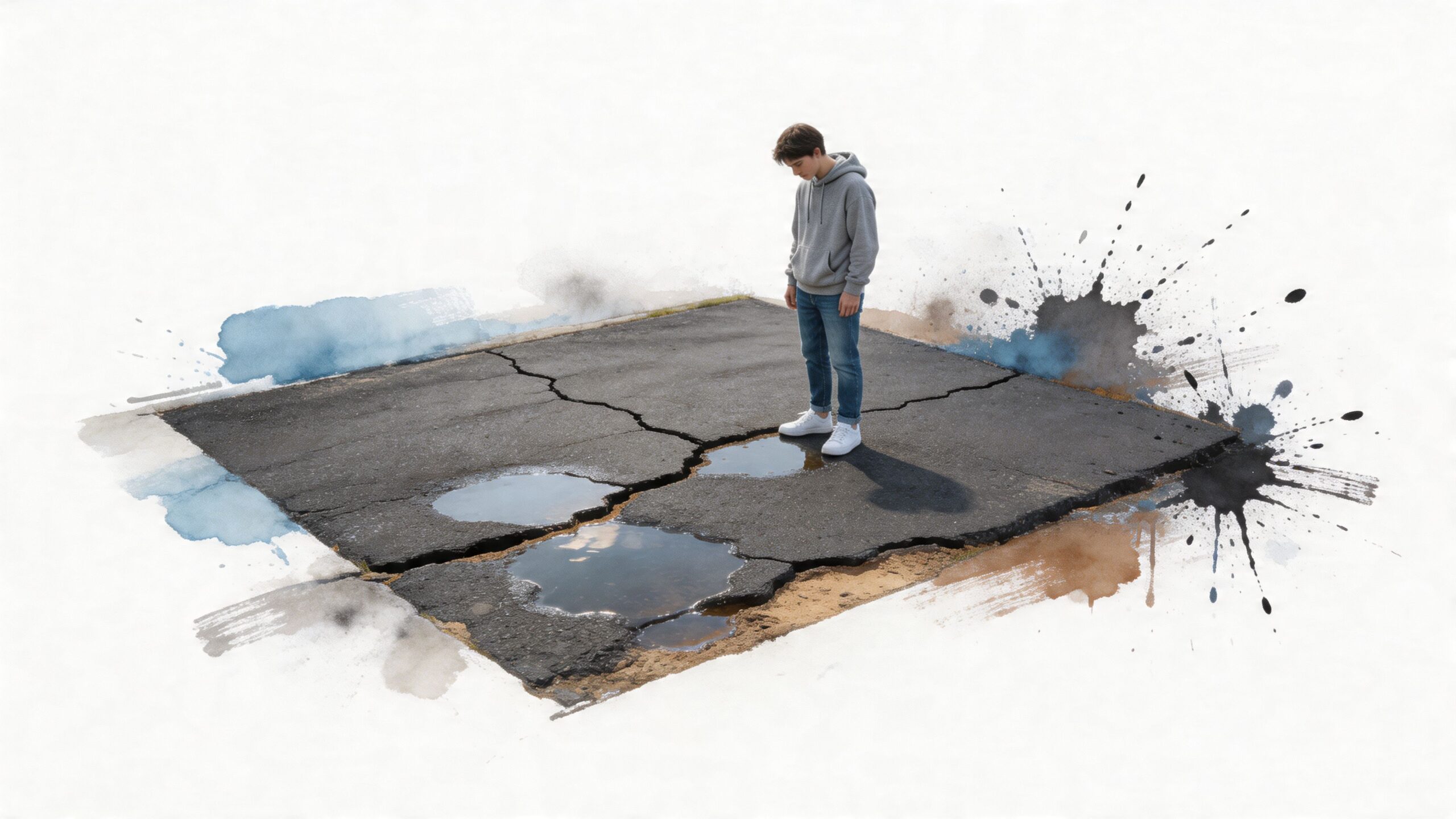
A driveway should shed water. If you see ponding after rain, the surface may be flat in the wrong places, or the grade may push runoff back toward the drive instead of away from it.
Poor drainage in the roadbed is a frequent cause of base failure. When water pools, it can seep into concrete pores and saturate the subgrade. In freeze-thaw conditions, that trapped water expands when frozen and widens cracks as described by Elite Concrete’s explanation of cracked and uneven driveways.
That freeze-thaw cycle isn’t just a cold-climate issue. Even where winters are milder, repeated wetting and drying puts stress on the base and on soils that expand when they hold water.
What happens below the surface
Once water gets through cracks, joints, or porous surface areas, it starts affecting the support layers. Saturated soil loses stability. Clay-heavy soil can swell. Water can also wash fine material out from under the driveway and leave voids behind.
Watch for these clues:
- Puddles that linger: The driveway probably isn’t draining correctly.
- Eroded edges or washed-out shoulders: Water is leaving the surface too aggressively and taking support with it.
- One slab corner sitting lower than the rest: The support underneath may be washing out or compressing unevenly.
- Cracks that get worse after wet weather: Moisture is likely involved.
Water problems rarely stay cosmetic. Once moisture starts affecting the base, surface repairs stop lasting.
If your driveway has been repaved or patched but still holds water, why repaving alone doesn’t stop water pooling gets into the grading side of that problem.
Local weather makes small mistakes bigger
Around Santa Rosa, Sonoma County, Monterey County, and the Central Coast, you often get a rough mix of winter rain, spring moisture, and long dry periods. That cycle exposes every shortcut under a driveway.
A surface may survive decent weather even with poor prep. Add standing water, shifting soil, and seasonal movement, and the weak spots show up fast.
Common Paving and Installation Mistakes
Some driveway cracks come from the pour or paving day itself. Even when the groundwork is decent, rushed installation can create weak points that show up early.
The problem is that these mistakes are easy to hide at first. A fresh driveway often looks good for a short time, even when the crew missed important steps.
Too much water in the mix
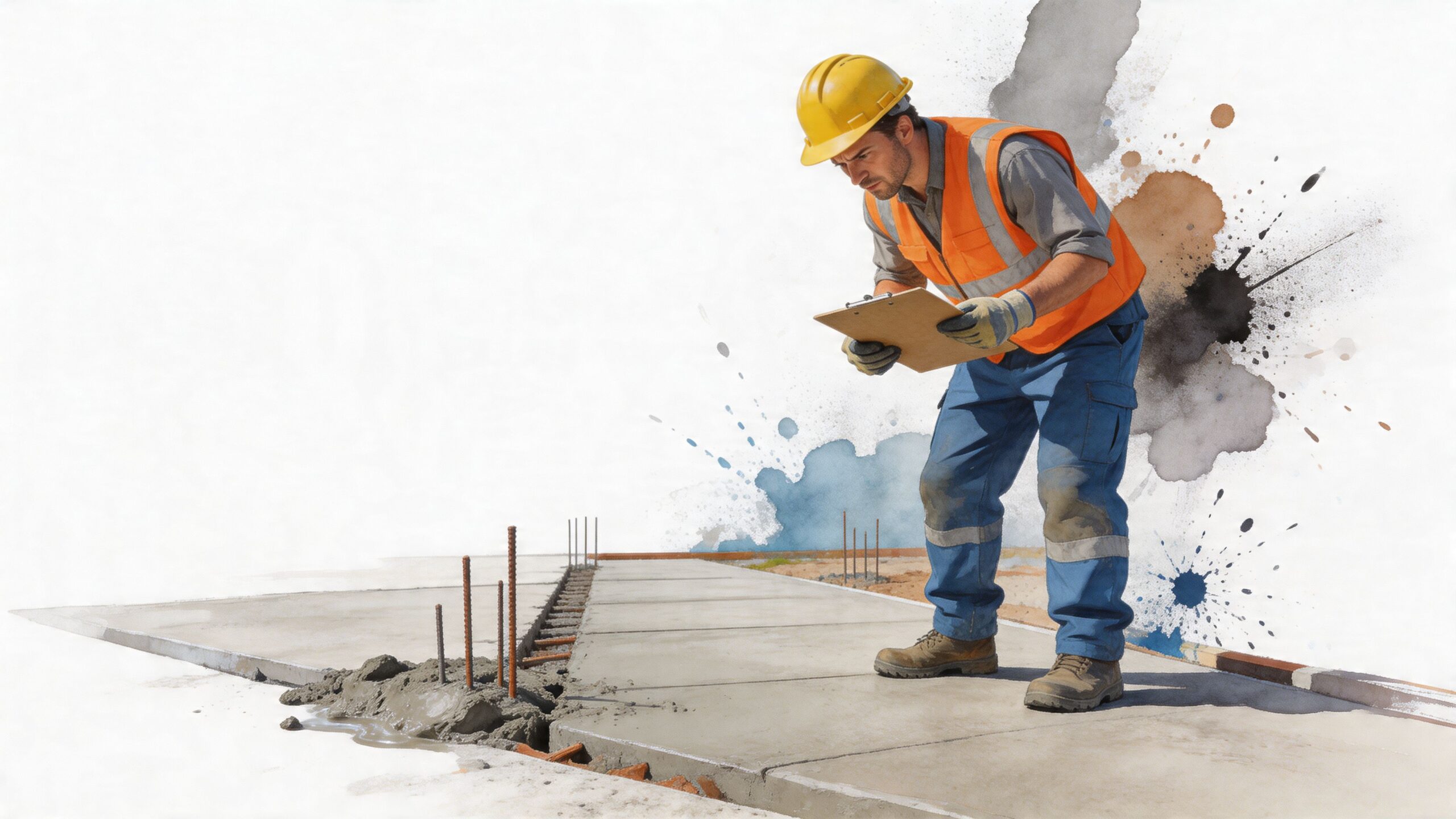
A driveway surface needs the right mix for the conditions and the use it will see. If a crew adds too much water to make placement easier, that can weaken the finished slab and increase shrinkage.
Homeowners usually don’t see this happen. They just see the result later. The surface may dust, crack, or look fine except for one random break that shouldn’t be there.
Poor curing and bad timing
Concrete needs controlled curing. If it dries too fast in heat, wind, or dry air, shrinkage stress builds quickly. Asphalt has its own timing issues. If the base is damp, unstable, or not ready, the surface gets laid over a problem instead of solving it.
This is one reason low-bid work fails so often. The crew is trying to finish fast, not control conditions.
Late control joints cause random cracks
Concrete is going to crack. The job is to tell it where. That’s what control joints are for.
A critical step is cutting those joints at the right time. They must be sawcut within 12 to 24 hours after pouring, because most concrete shrinkage happens in that window according to Fine Homebuilding’s discussion of new driveway cracking. If that step gets delayed, random cracks can form outside the planned joints.
If the crack runs where a control joint should have gone, the issue usually isn’t bad luck. It’s installation error.
What works and what doesn’t
Here’s the trade-off in plain terms:
| Approach | What happens |
|---|---|
| Fast placement with minimal planning | The driveway may look good at first, but shrinkage, settlement, and random cracking show up sooner |
| Careful prep, weather timing, and proper joint layout | The driveway has a far better chance of cracking in controlled locations instead of across the field |
| Waiting to see if cracks stabilize | That can waste time if the problem started with joint timing or hidden movement below |
| Diagnosing the crack pattern early | You can tell whether the problem is cosmetic, structural, or drainage-related before spending more money |
How to Diagnose the Cracks in Your Driveway
Not every crack means the same thing. The pattern usually tells you where to look first. If you can read the crack type, you can have a much better conversation with a contractor.
Spiderweb or alligator cracking
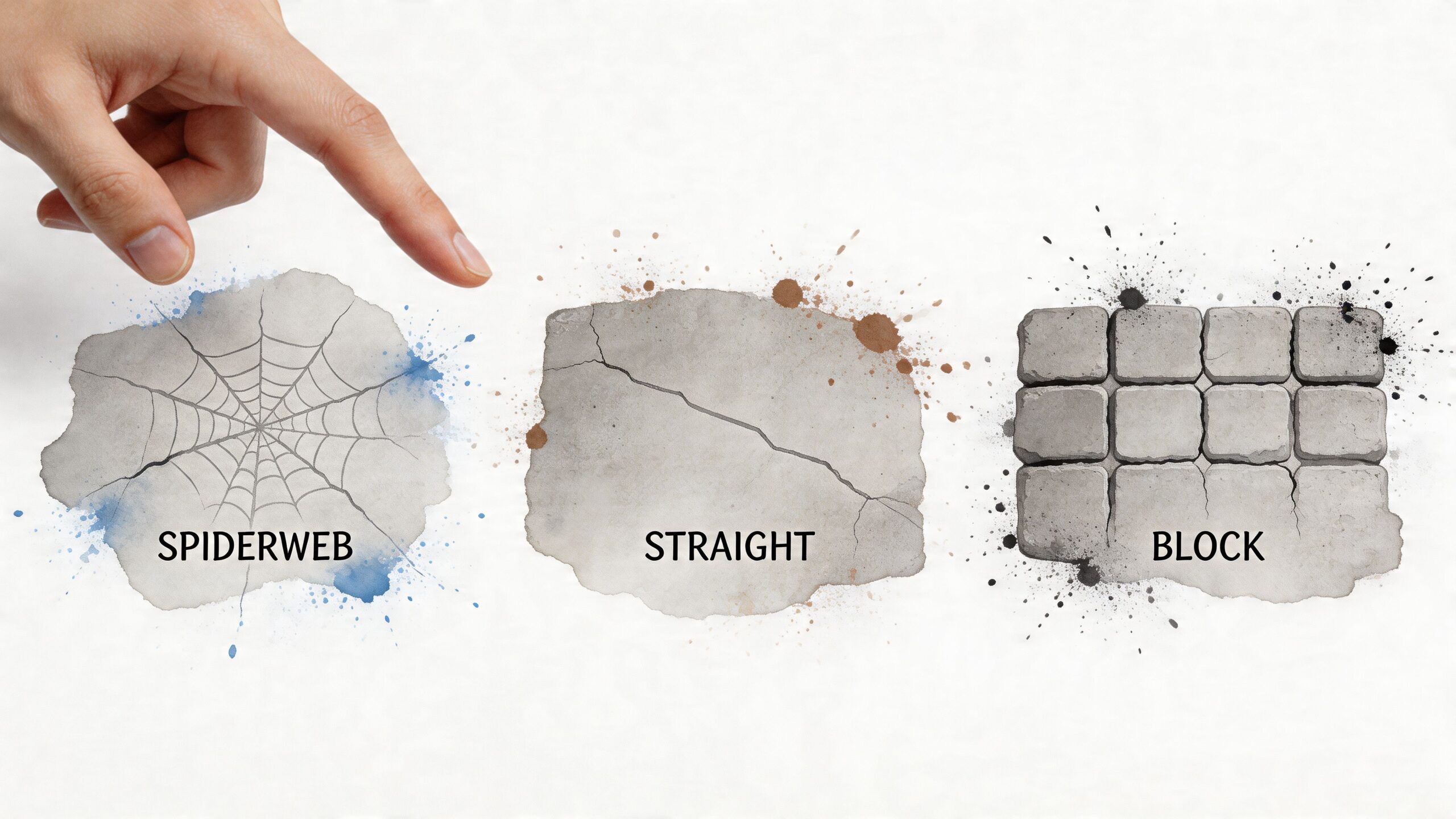
This pattern looks like connected small cracks forming broken-up sections. In asphalt, it usually points to failure underneath the surface, not just wear on top. The base or subgrade may be weak, wet, or settling.
If that’s what you’re seeing, alligator cracks in asphalt is worth reading before you approve any patch job.
One straight crack across the slab
A single linear crack can mean shrinkage stress, missing control joints, or movement concentrated in one area. If the crack lines up with a low spot, settlement may be involved. If it cuts across a panel that should have had a joint, installation timing is suspect.
Look at the slab edges too. Vertical difference from one side of the crack to the other usually points to movement below.
Block or pattern cracking
Block-style cracking can show up when the surface has aged poorly or when the pavement was built over a base that didn’t stay stable. On a new driveway, that’s a sign to check drainage, subgrade condition, and compaction history.
Quick field check before you call someone
Use a simple walk-around and note what you see:
- Check after rain: Where does water sit, and how long does it stay there?
- Look at the edges: Are shoulders washing out or breaking away?
- Watch transitions: Does the driveway dip near the garage, curb, or apron?
- Compare crack widths: Are they opening wider over time or staying the same?
- Test for movement: Do sections feel hollow, soft, or loose under load?
A crack pattern is a symptom. The real job is finding out whether the cause is shrinkage, drainage, or base failure.
Fixing the Problem Right The Difference Between a Patch and a Real Solution
A patch has its place. It can keep water out for a while, reduce trip hazards, or make a driveway usable again. But if the crack started because the ground is moving, a patch won’t stop that movement.
That’s the difference between a surface fix and a structural fix. One hides the symptom. The other addresses the cause.
When a patch makes sense
If the crack is minor, stable, and not tied to settlement or drainage failure, sealing or patching may buy you time. That can be reasonable if you’re managing appearance or trying to slow water intrusion while planning larger work.
It’s not a permanent answer when the base is failing.
When removal and rebuild are the honest answer
If the driveway is cracking early, settling unevenly, or holding water, the repair usually needs to go deeper. That means removing failed sections, correcting the grade, rebuilding the base, compacting properly, and then reinstalling the surface.
Homeowners don’t love hearing that. But it’s often cheaper than paying twice for repairs that don’t hold.
A simple patch can cost $20 to $40, while full replacement can reach $3,600, according to Angi’s breakdown of what causes driveway cracks. The lesson isn’t just about price. It’s that the wrong repair approach can turn a manageable issue into repeated spending.
What to ask before approving a repair
Before you agree to any fix, ask the contractor these questions:
- What caused the crack: Surface shrinkage, poor drainage, or base movement?
- Will you remove failed material: Or are you just filling visible openings?
- How will runoff be handled: If water started this, where will it go after the repair?
- What gets compacted: And how will you know it’s solid before repaving or pouring?
If you want a closer look at what temporary asphalt fixes can and can’t do, how to fix crack in driveway asphalt is a useful starting point.
How to Hire a Contractor Who Will Prevent Driveway Cracking
If you're trying to avoid asking why did my new driveway start cracking so fast a second time, hire for groundwork first and surface second. A smooth finish is easy to sell. Long-term support underneath takes more skill and more honesty.
The lowest bid often leaves out the parts you can’t see after the job is done. That’s usually excavation depth, base prep, compaction, slope control, and drainage planning.
Questions worth asking on every estimate
Ask the contractor to answer these plainly:
- How deep are you excavating before the driveway goes in
- What base material are you using for this site
- How are you compacting the subgrade and base
- How will water drain off the surface and away from the drive
- If this is concrete, when will control joints be cut
- What site conditions would make you change the plan
If a contractor gets vague on those answers, keep looking.
Why local site conditions matter
In Sonoma County, Monterey County, and across the California Central Coast, driveways deal with rain, dry spells, soil movement, and drainage patterns that vary from lot to lot. A contractor who understands excavation and grading is more likely to catch those problems before the surface goes down.
A paving job and a site-prep job are not the same thing. For a driveway that lasts, you want someone who treats the base, grade, and water flow as part of the same system.
Frequently Asked Questions About Driveway Cracks
Is it normal for a brand-new driveway to crack?
A small, controlled crack can happen in concrete, which is why joint layout matters. Random cracking, fast cracking, or cracking with settling is not something you should brush off as normal. Early failure usually points to preparation or installation problems.
Can bad grading really crack a driveway that fast?
Yes. If water drains toward the driveway, sits on it, or saturates the support underneath, the surface starts losing stable support. Grading errors often show up as ponding, erosion, and cracks that keep returning.
Should I seal the crack or replace the driveway?
That depends on the cause. A stable surface crack may be worth sealing for maintenance. If the driveway is moving, sinking, or cracking in patterns that suggest base failure, sealing is only a short-term step.
How do I know if the problem is under the driveway and not in the concrete or asphalt?
Look for settling, repeated ponding, edge erosion, soft spots, or groups of cracks instead of one isolated line. Those signs usually point below the surface. If you’re interviewing contractors, this checklist of 10 essential questions to ask a contractor is a practical way to sort out who actually understands site work.
Will a new layer over the old driveway solve the problem?
Not if the underlying base, slope, or drainage is still wrong. A new top layer can improve appearance for a while, but it won’t stop movement underneath. That’s why overlays often fail early on bad foundations.
What should a contractor inspect before recommending a fix?
They should look at drainage, grade, crack pattern, edge condition, and whether the surface has vertical movement or low spots. They should also explain whether the repair is cosmetic or structural. If they skip that inspection and jump straight to a price, be careful.
Get a Driveway Built to Last
A long-lasting driveway starts with excavation, grading, drainage, and compaction. The surface matters, but it can’t overcome bad groundwork. If your driveway is already cracking, the right next step is finding out whether the issue is cosmetic or structural before you spend more money on the wrong repair.
If you’re still comparing surface options, this ultimate guide to outdoor pavers can help you think through finish choices and layout considerations. But whatever material you choose, the support underneath still decides how well it holds up.
If you need a clear answer on why your driveway failed and what it will take to fix it properly, contact DW Excavation, LLC for a free estimate or site consultation. Call (707) 601-9091, visit 470a Caletti Avenue, Windsor, CA 95492, or learn more at dw-excavation.com. They serve homeowners and property owners across Sonoma County, Monterey County, and the California Central Coast.