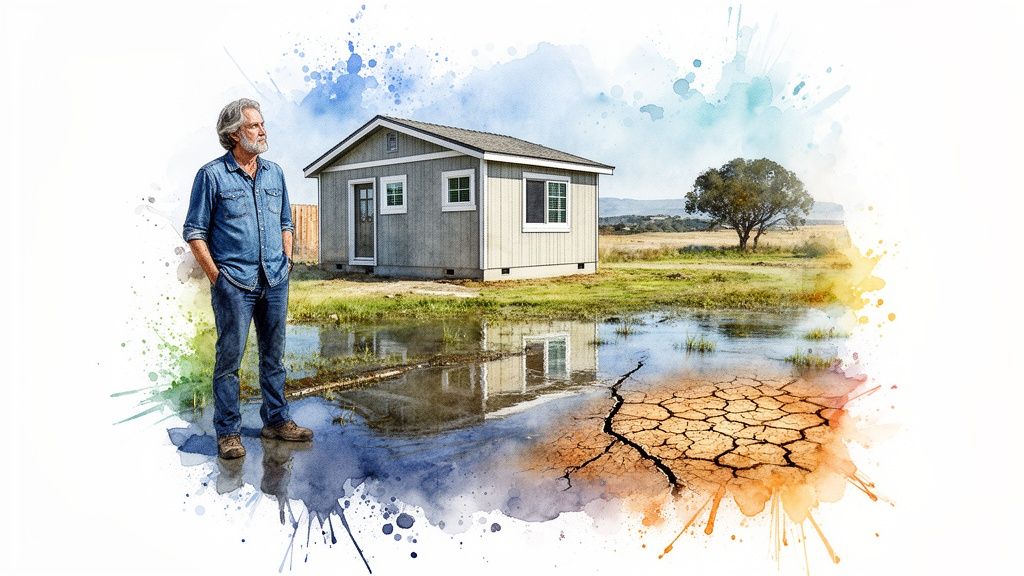
Here's what many Salinas homeowners miss about site planning and drainage: small oversights almost always lead to catastrophic costs down the road. Residents of Monterey, Salinas, and the Central Coast know that the weather can flip from weeks of drought to sudden downpours. This volatility exposes weak grading and poor site planning, leading to flooded basements, erosion, and permit issues.
That combination of volatile climate, heavy clay soils, and strict local water rules can turn a minor drainage issue into major property damage.
The Hidden Costs Of Overlooking Your Site Plan
For many homeowners here on the Central Coast, investing in a beautiful new landscape or a much-needed ADU feels like the final, exciting step. But that excitement can turn to pure frustration when the first big winter rain arrives, revealing a flooded yard, a cracked foundation, or a failed county inspection.
This scenario is far too common. It all comes down to a critical misunderstanding: proper site planning isn’t just an upfront expense; it's an essential investment to protect your property's value for years to come.
Our unique weather patterns, with long dry spells followed by sudden, intense storms, expose every single flaw in a property’s grading and drainage. When a contractor overlooks the specific slope, soil conditions, and rainfall data for your exact location in Monterey County, the results can be disastrous. Many also miss the benefits of modern, less invasive techniques, like using a hydro excavation vacuum for precision digging, which can dramatically reduce risks when preparing a site and installing drainage.
Why Local Expertise Is Non-Negotiable
A generic, one-size-fits-all site plan just won’t cut it in Monterey County. The consequences of getting it wrong are steep:
- Failed Inspections: Projects get shut down for months because of runoff violations or failing to meet local stormwater regulations.
- Property Damage: Water pooling against a foundation exerts immense hydrostatic pressure. Over time, that leads to cracks, leaks, and even serious structural instability.
- Costly Rework: Fixing a failed drainage system often means tearing up brand-new landscaping and starting over, costing thousands and undoing all that beautiful work.
We see these issues play out all the time. To give you a clearer picture, here’s a quick summary of the most common oversights and what they lead to.
Common Drainage Oversights And Their Consequences In Salinas
| Common Oversight | Short-Term Consequence | Long-Term Consequence |
|---|---|---|
| Ignoring Soil Type | Muddy, unusable yard after rain; drowned plants. | Soil compaction, poor landscape health, foundation pressure. |
| Improper Grading | Puddles forming against the house; minor basement leaks. | Saturated soil, severe foundation cracks, structural damage. |
| No Stormwater Plan | Gutter overflow, erosion on slopes, flooded walkways. | Fines from the county, overwhelmed city drains, sinkholes. |
| Forgetting Utilities | Annoying project delays; minor utility service interruptions. | Costly line repairs from accidental damage; safety hazards. |
Understanding these risks is the first step toward safeguarding your home. You can learn more about how a professional grading fix can mitigate flood risk in our detailed guide.
DW Excavation designs site plans specifically for Monterey County microclimates—factoring in coastal fog, clay-heavy soils, and new drainage regulations.
Why Salinas Soil And Slopes Demand A Custom Plan
Anyone who lives in the Salinas area knows our landscape is anything but one-size-fits-all. The land rolls from the flat valley floor to the steep hillsides of Carmel Valley, yet so many homeowners approach site planning like it's all the same. That's a huge mistake. A drainage plan designed for a flat lot will fail spectacularly on a slope, and the reverse is just as true.
The real troublemaker here is our region’s notorious clay-heavy soil. When it’s bone dry, it acts like a shield, forcing water to run right off the surface during a sudden downpour. But once it finally gets saturated, it swells up into a heavy, unstable mess that puts incredible pressure on everything around it.
This double-whammy creates a perfect storm for local properties. That initial runoff can carve away valuable topsoil and landscaping on sloped lots in minutes. On flatter ground, the poor absorption leads to massive puddles that drown plants and turn entire yards into muddy, unusable swamps.
The Problem With One-Size-Fits-All Drainage
When your site plan ignores the unique combination of your soil and your property’s slope, the results can be devastating. This is usually the moment people realize what Salinas homeowners miss about site planning and drainage—how our specific geology and weather patterns work together. Without a plan built for your lot, you’re leaving yourself exposed.
- On Slopes: Water picks up speed as it flows downhill, taking soil with it. This can easily undermine patios, retaining walls, and even threaten your home’s foundation.
- On Flat Land: If there's no grade to guide it, water just sits there. It pools right up against your foundation, slowly working its way into the concrete and creating the perfect breeding ground for mold and structural cracks.
This constant cycle of soil expanding and contracting is a leading cause of foundation heave and failure right here in Monterey County. A generic drainage system won't stop it. You need a solution that manages water before it ever gets a chance to saturate the ground around your home.
Why A Professional Soil Assessment Is Crucial
For any serious project, a professional soil assessment and a custom grading plan aren't just nice to have—they're non-negotiable. An expert can take a hard look at your property's specific soil makeup and slope to design a solution that works with the land, not against it.
Taking this step first is the key to building a solid base for any new construction. You can dig deeper into why proper ground preparation is so important in our guide on what a building pad is.
Here at DW Excavation, our engineering-integrated approach means we design and build drainage and grading systems specifically for Monterey County’s unique microclimates. We create solutions that stop erosion on the hillsides and get rid of pooling water in the valleys, making sure your property stays safe and dry, no matter what the weather throws at it.
Navigating Monterey County Water And Stormwater Rules
For many homeowners around here, the biggest project surprise isn’t the cost of a new ADU or a fancy landscape overhaul—it’s the maze of local water and stormwater rules you suddenly have to follow. These aren't just bureaucratic hoops to jump through; they’re in place to protect our local environment, from the Salinas River all the way down to our fragile groundwater aquifers.
The moment you plan a significant change to your property, you trigger these regulations. All of a sudden, you're on the hook for managing every drop of rain that falls on your lot. This is where you might hear terms like runoff violations or NPDES (National Pollutant Discharge Elimination System) regulations for the first time, catching you completely off guard.
Understanding Your Stormwater Responsibilities
In simple terms, the county needs to make sure your project won't send a flood of polluted runoff—carrying stuff like oil from the driveway or loose sediment—into the public storm drain system. Poor drainage planning has been directly linked to serious environmental headaches in our community.
For example, when stormwater isn't managed properly, it contributes to seawater intrusion, which has been a threat to our local water supply for a long time. Research shows that pressure is dropping in the 400-foot aquifer, one of our key sources of fresh water [USGS, 2022]. This problem gets even worse when rainwater rushes off properties instead of being allowed to soak back into the ground. If you're curious, you can explore how the USGS tracks these changes and learn more about our local hydrology.
Think of a compliant site plan as more than just a piece of paper for a permit. It's your blueprint for protecting the long-term health of our community’s water. Getting it wrong can lead to some painful fines and frustrating stop-work orders.
How An Expert Simplifies The Process
Trying to figure all this out on your own can feel like a full-time job. A seasoned local contractor already knows the ins and outs of what different jurisdictions, from Salinas to Pacific Grove, are looking for before they’ll sign off on a project. They can design a system that doesn't just scrape by but actually exceeds the county codes.
This is where professional site planning really pays off. An expert team can:
- Design Compliant Systems: They know how to create effective solutions like bioswales or retention ponds that manage all the runoff right there on-site.
- Handle the Paperwork: They’ll prepare and submit all the necessary documents to the right agencies, which makes the approval process a whole lot smoother.
- Prevent Future Headaches: By building proper drainage solutions into your project from day one, you dodge the risk of failed inspections and having to redo expensive work later.
At DW Excavation, we build site plans that are compliant from the ground up. We handle the complexities of Monterey County's stormwater rules so you can stay focused on the exciting parts of your project, knowing your property is protected and doing its part for the environment.
Effective Drainage Solutions For Your Salinas Property
Knowing the why behind drainage problems is one thing, but figuring out the how to fix them is where the real work begins. The good news is there are several proven drainage solutions that can safeguard your home from water damage.
The key is to pick the right tool for the job. A system that works perfectly for a flat, expansive lot in the valley might be completely wrong for a sloped property near Carmel. Let’s move from theory to practical, real-world fixes that we use for homes across the Salinas area.
Matching The Solution To Your Property
Not all drainage systems are created equal, and choosing the right one is critical. To protect your home, you need to implement the right fix for your specific problem. You can find plenty of expert solutions for fixing yard drainage, but these four are the most effective options for our local conditions.
-
Proper Grading: This is the absolute foundation of good drainage. Grading is all about carefully shaping your land to create a subtle slope that guides water away from your home’s foundation. It’s the single most important step in any site plan.
-
French Drains: Imagine an underground channel designed to intercept water. It’s a trench filled with gravel and a perforated pipe that collects both surface and groundwater, then carries it safely away from sensitive spots like your foundation or that perpetually soggy corner of your yard.
-
Bioswales: Think of these as hardworking landscape features. Bioswales are basically shallow, vegetated channels designed to slow down, filter, and absorb stormwater runoff. They are a fantastic, eco-friendly way to manage water while adding a beautiful, natural element to your yard.
-
Permeable Pavers: Traditional concrete and asphalt create impenetrable surfaces, forcing all rainwater to run off somewhere else. Permeable pavers are different—they're designed to let rainwater seep right through the surface and into the ground below. This dramatically cuts down on runoff.
This decision tree helps illustrate how Monterey County’s water rules often come into play.
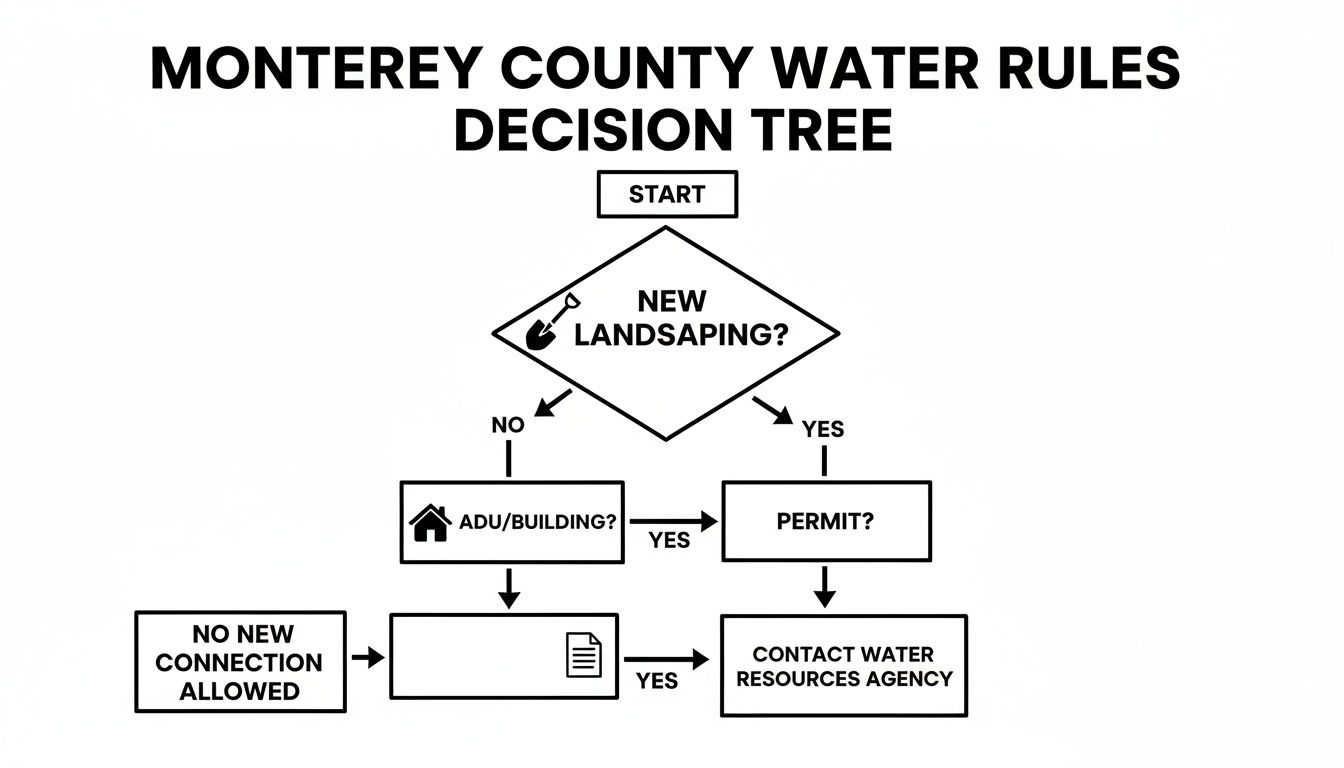
As you can see, almost any major change to your property—from a new landscape design to an ADU—is likely to trigger a permit requirement related to water management.
Comparing Drainage Solutions For Central Coast Homes
To help you visualize the best fit for your property, this table breaks down the most common and effective drainage options, outlining what they do, where they work best, and what it takes to keep them running smoothly.
| Drainage Solution | Primary Function | Best For… | Typical Maintenance |
|---|---|---|---|
| Proper Grading | Directs surface water away from the foundation using slope. | Every property. It's the essential first step. | Minimal; periodic checks for erosion or settling. |
| French Drain | Collects and channels groundwater and surface water away. | Properties on hillsides or with soggy yards/wet basements. | Occasional inspection of the outlet to ensure it's clear of debris. |
| Bioswale | Slows, filters, and absorbs stormwater runoff naturally. | Larger properties or those needing to manage significant runoff. | Seasonal weeding and plant care, just like a garden bed. |
| Permeable Pavers | Reduces runoff by allowing water to soak into the ground. | Driveways, walkways, and patios on properties with a lot of hardscaping. | Annual sweeping to keep joints clear of fine sediment. |
Each of these solutions tackles water in a different way, and sometimes a combination is the perfect recipe for a dry, stable property.
For a deeper dive into common issues, our guide on troubleshooting yard drainage problems is a great resource. Picking the right solution is a critical decision, and at DW Excavation, we have the local expertise to design and install the system your property truly needs.
The Link Between Site Prep, ADUs, and Foundation Health
Adding an Accessory Dwelling Unit (ADU) is one of the smartest ways to boost your property's value, but it brings a huge risk that many homeowners completely overlook: the impact on your existing home's foundation. Good site planning isn't just about the new build. It’s about making sure your new ADU doesn't become a drainage disaster for the main house. This is a critical detail in what Salinas homeowners miss about site planning and drainage.
When ADU site prep goes wrong, it can kick off a destructive domino effect. If the new lot isn't graded with absolute precision, it can accidentally carve out a new path for water, channeling it straight toward your main home’s foundation. This concentrated water flow soaks the soil, leading to foundation cracks, mold, and long-term instability that you never had to deal with before.
Why Utility Trenching and Drainage Must Go Hand-in-Hand
Beyond just grading, utility trenching is another area where you have to think ahead. When you dig to install water, sewer, and electrical lines for a new ADU, those trenches have to be part of the master drainage plan from day one. A poorly placed trench can act like a secret French drain, collecting runoff and dumping it right where you don't want it—next to your foundation.
This kind of proactive thinking saves you from major headaches down the road. By integrating the utility map with the drainage strategy, you avoid accidental line breaks and future leaks. You can dig deeper into why even small projects demand this level of planning in our guide on when a site plan is necessary.
Avoiding Common and Costly Hydrology Oversights
One of the biggest regrets we see from local homeowners is underestimating the complex hydrology of our area. Official reports for the Salinas River Valley point to the presence of clay-filled paleodrainage channels. These are ancient, buried waterways that can wreak havoc on new foundations if they aren't properly mapped during site planning. Missing this can lead to unexpected water flow and foundation settlement. You can learn more about our local water management challenges to see just how critical this is.
A new ADU should add value to your property, not threaten its core structure. The only way to guarantee this is by treating the entire property as one interconnected system, where every change is planned with water management in mind.
At DW Excavation, our engineering-integrated approach means we see the full picture. We manage the entire site development process, ensuring your new ADU not only stands on solid ground but also protects the long-term health of your entire property.
Choosing A Local Excavation Expert You Can Trust
Here on the Central Coast, trust isn't just a word—it’s built on a foundation of local knowledge and proven results. When homeowners in Salinas and Monterey need an excavation contractor, they don't just search online; they ask their neighbors. They know you need a team that truly understands our unique landscape.
When it comes to something as critical as site planning and drainage, getting it right the first time is everything.
So, how do you vet a potential contractor? Start by asking pointed questions about their experience with Monterey County's infamous clay soils and our specific, often tricky, permit processes. For instance, search behavior on the Central Coast reflects high local trust sensitivity. Homeowners tend to look for hyper-local terms like “grading near Pacific Grove” or “site plan for Seaside permit.”
In the Salinas Valley, a simple grading mistake can amplify groundwater issues, and those ancient paleodrainage channels hidden beneath our properties can lead to serious foundation cracks if ignored. You can discover more about our region's specific water challenges to see just how critical that local expertise really is.
A true professional won’t just give you a quote; they’ll offer a clear plan and transparent communication every step of the way. For a deeper dive on what to look for—and what to watch out for—check out our guide on the truth about excavation projects most contractors don't tell you.
Don't let another rainy season catch you unprepared. Talk to the team at DW Excavation. We design and execute site plans built for your terrain, your weather, and your county's rules.
Frequently Asked Questions About Site Planning and Drainage
How do I know if I have a drainage problem?
The most obvious sign is standing water that remains in your yard for more than 24 hours after rain. Other clues include water stains on your foundation, visible soil erosion, perpetually soggy patches of lawn, or a musty smell in your crawl space or basement.
Is a DIY French drain a good idea to save money?
While it's tempting, a French drain is a complex project. If installed incorrectly—without the right slope or materials for Monterey County's clay soil—it can fail or even direct water toward your foundation, causing more damage. Professional installation ensures a permanent, effective solution.
What should I expect professional site planning to cost in the Salinas area?
The cost varies based on lot size, slope, and project complexity. However, it's an investment, not an expense. Proper site planning can save you tens of thousands of dollars in future repairs by preventing foundation damage, failed inspections, and costly rework. The best approach is a custom quote from a local expert who understands your property's specific needs.
Will I need a permit for drainage work in Monterey County?
It depends on the scope. Minor landscaping usually doesn't require a permit. However, significant grading, excavation, or any project that alters how stormwater runs off your property—especially for a new ADU—almost always requires a permit to comply with local regulations.
Can poor grading really damage my home's foundation?
Absolutely. It's a leading cause of foundation failure in our region. When your yard slopes toward your house, water saturates the heavy clay soil. This creates immense hydrostatic pressure that pushes against the concrete, leading to cracks and serious structural instability over time.
Contractors and homeowners in Monterey and Salinas—don’t let another storm catch you off guard. Talk to us today about a plan that protects your investment.