Let's get straight to the point: trenchless pipe repair is an incredible technology, but it’s not a magic bullet. The "better" option comes down to your specific situation—the pipe's condition, the soil it's buried in, and just how bad the damage really is.
The truth is, a proper diagnosis is always better than picking a method based on assumptions.
What Is Trenchless Pipe Repair vs. Excavation?
Deciding on a pipe repair strategy can feel overwhelming, especially when you hear conflicting information. While trenchless technology offers a clean, less invasive solution, traditional open-trench digging is still the gold standard for certain complex problems.
Understanding the ideal scenarios for each is the first step toward making a smart, long-term investment in your property’s infrastructure. This guide gives you an honest, expert comparison to help you understand when to lean into trenchless methods and when good old-fashioned excavation is the safer, more reliable fix.
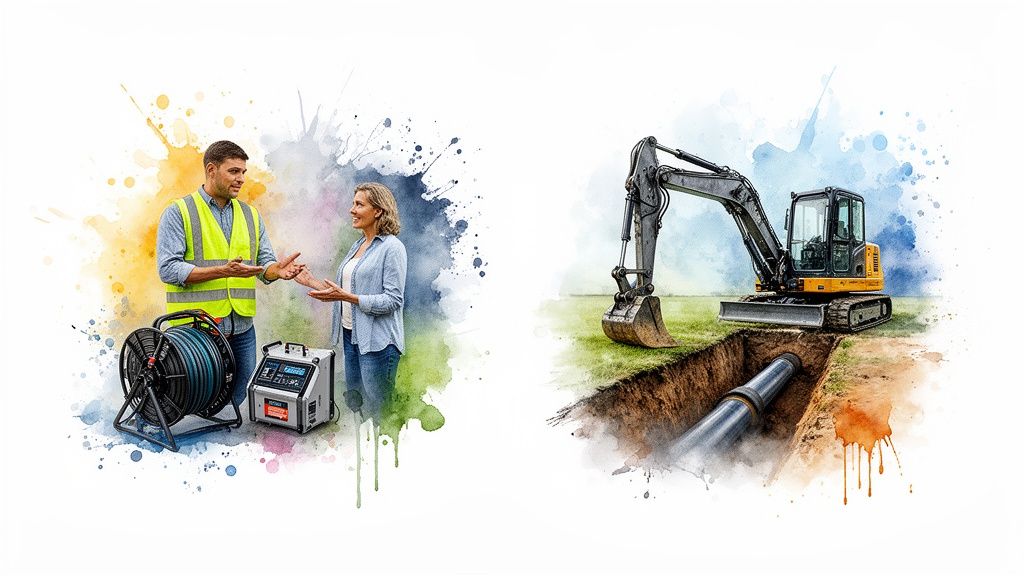
Quick Guide: When to Choose Trenchless vs Excavation
To make the decision a little easier, it helps to see how these two approaches stack up in common situations we see every day with property owners in Sonoma County and the California Central Coast. This high-level comparison highlights the best-use cases for each pipe repair method.
| Scenario | Trenchless Repair (Best For) | Traditional Excavation (Best For) |
|---|---|---|
| Pipe Condition | Pipes with cracks, leaks, or root intrusion but are still structurally intact. | Completely collapsed, severely bellied (sagging), or offset pipes. |
| Property Impact | Preserving established landscaping, driveways, patios, and mature trees. | Open lots or areas where surface disruption is less of a concern. |
| Project Urgency | Faster completion times, often finished in a single day with minimal disruption. | Complex jobs requiring slope correction or significant pipe upsizing. |
| Soil Conditions | Stable soil conditions without major obstructions like large boulders. | Rocky, dense, or unpredictable soil common in hillside properties. |
This table provides a great starting point, but the real story is always found underground. A professional assessment is the only way to be sure.
The trenchless rehabilitation market is booming—growing from $6.0 billion in 2023 to an estimated $8.4 billion by 2030 [Stratview Research, 2023]—but only when used on systems that qualify.
This means trenchless works well if the pipe is structurally sound, the slope is correct, and the surrounding soil supports it. But if the line is collapsed, misaligned, or too close to tree roots, excavation may be safer long-term.
How Trenchless Pipe Repair Actually Works
To figure out if trenchless repair is the right call for your property, you first need to get a handle on the tech itself. These aren't just simple patches; trenchless methods are sophisticated engineering solutions designed to fix pipes from the inside out.
They get the job done by using your existing, damaged pipe as a guide or host for the new one, which means no massive trench across your yard. In our work across Sonoma and Monterey County, we primarily use two methods: Cured-In-Place-Piping (CIPP) and Pipe Bursting.
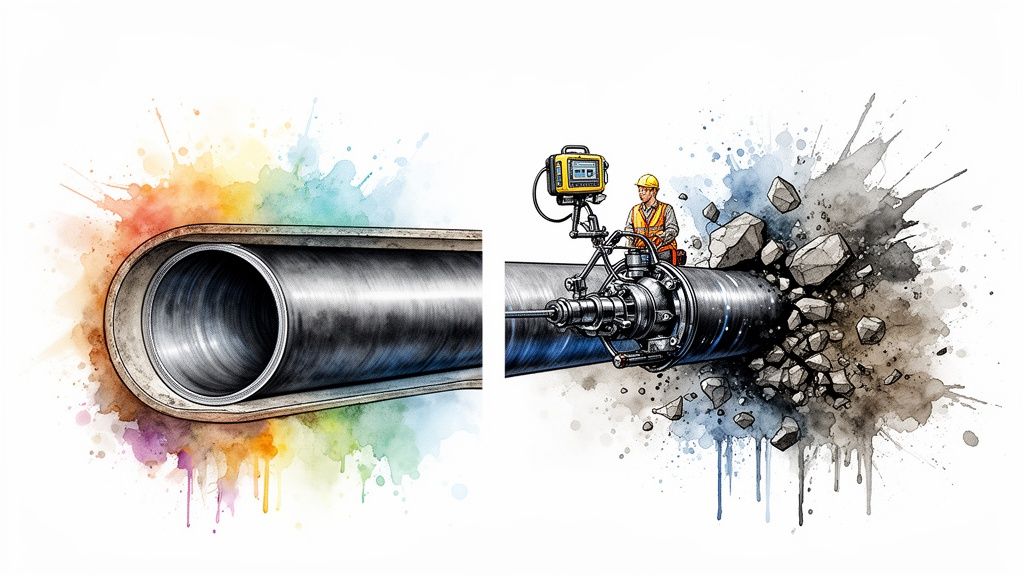
Cured-In-Place-Piping (CIPP)
Think of CIPP as building a brand-new, seamless pipe directly inside your old one. It’s an incredibly popular technique for repairing lines with cracks, persistent leaks, or minor root problems, as long as the original pipe is still mostly intact.
Here’s a quick rundown of the process:
- Cleaning and Inspection: First, we thoroughly clean the existing pipe to get rid of any debris, scale, or roots. Then, a camera inspection confirms the pipe is stable enough to act as a host for the new liner.
- Liner Insertion: We take a flexible, resin-saturated liner and insert it into the old pipe, usually through a small access point like a cleanout. No major digging required.
- Curing: The liner is then inflated with air or water, which presses it tightly against the inner walls of the old pipe. We use hot water, steam, or UV light to cure the liner, hardening the resin into a tough, rigid, and jointless new pipe.
The result is a perfectly smooth, durable pipe that restores full flow and seals off leaks for good—all without tearing up your property.
Pipe Bursting
Pipe bursting is the more aggressive of the two methods. We use it when the existing pipe is too far gone for a liner but still whole enough to serve as a guide. It's also the go-to method for upsizing a pipe—say, from a four-inch to a six-inch line—to handle more capacity.
Here’s how this technique works:
- Access Pits: We start by digging small entry and exit pits at either end of the pipe section we’re replacing.
- Cable Insertion: A heavy-duty steel cable is fed through the entire length of the old pipe, from the exit pit to the entry pit.
- Bursting and Replacement: A cone-shaped "bursting head" is attached to the new pipe (typically durable HDPE) and the cable. As we pull the cable through, the bursting head fractures the old pipe while simultaneously pulling the new pipe right into its place.
Both CIPP and pipe bursting are impressive, but their success depends entirely on the condition of the existing pipe. This is where the simple question of whether trenchless is always better starts to get a lot more complicated. You can dive deeper into this in our article on the latest trends in underground pipe repairs.
Understanding Traditional Open-Trench Excavation
While all the buzz seems to be around modern tech, it's a mistake to write off traditional open-trench excavation. This time-tested method is still the absolute best—and sometimes only—solution for complex pipe problems that trenchless technology just can't handle.
The process itself sounds simple, but it demands serious skill and meticulous planning. We methodically dig to expose the entire damaged pipe, remove it completely, and install a brand-new line with the correct grade.
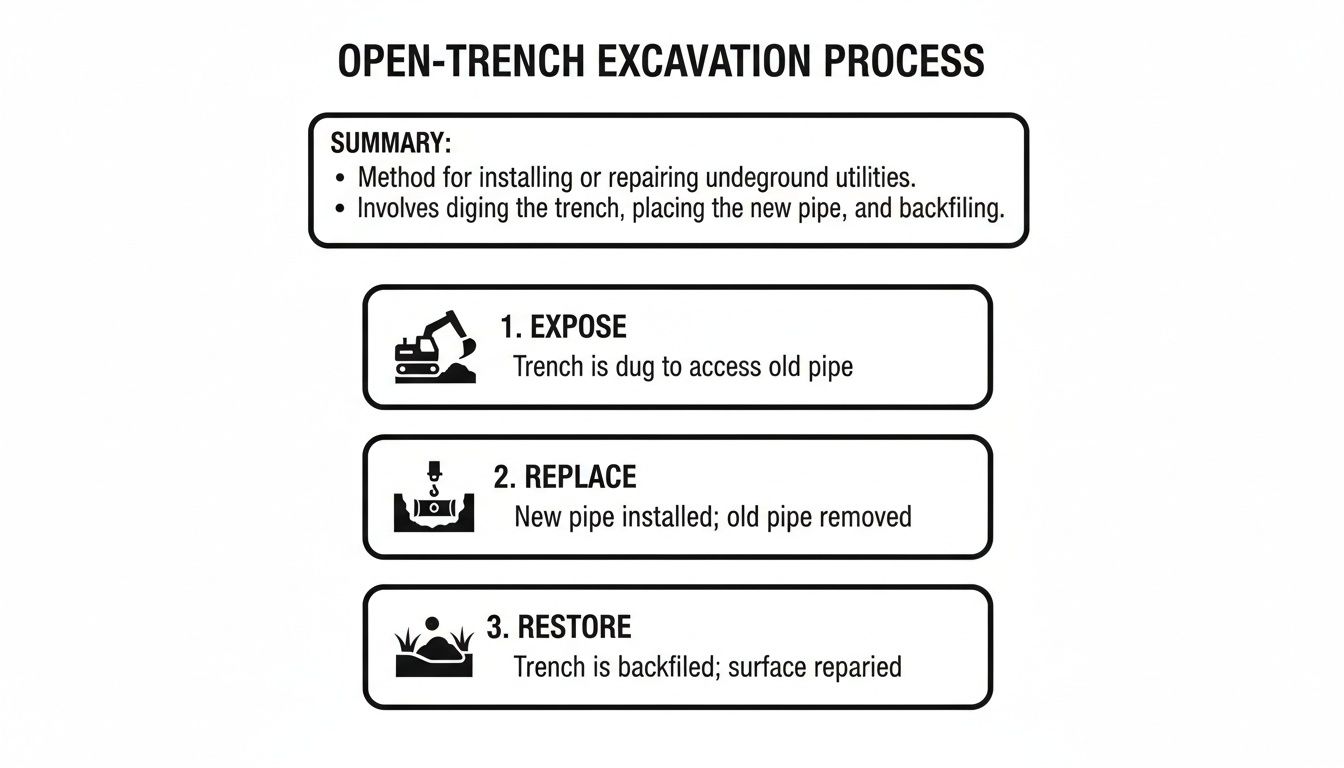
The Process Behind the Dig
Open-trench excavation isn't just about digging a hole; it's a strategic operation. Every move is calculated to ensure safety, compliance, and lasting performance, turning a major disruption into a permanent fix.
- Precise Exposure: We carefully dig along the pipe’s path, making sure the trench walls are stable and safe for our crew.
- Complete Removal: The old, damaged pipe—whether it’s collapsed, cracked, or bellied—is pulled out of the ground entirely.
- Proper Grading and Bedding: We lay a new, high-quality pipe on a carefully prepared bed of material, graded to ensure a perfect slope for flawless flow.
- Secure Backfilling: The trench is then filled in layers and compacted to prevent the ground from settling later, which could cause headaches with your landscaping or even your foundation.
This painstaking process is exactly why, for many tough jobs, digging isn't just an option—it's the only responsible one. You can get a better sense of what goes into a professional job by reading about the truths of excavation projects.
When Excavation Is the Smarter Investment
Trenchless methods are fantastic for rehabbing a pipe, but their success depends entirely on the condition of the pipe that’s already there. Excavation, on the other hand, starts with a clean slate.
It’s the guaranteed solution for situations where trenchless repairs would either fail or just be a temporary band-aid. For traditional open-trench excavation, especially in a region with specific requirements, a compliant SWMS template qld is crucial for detailing high-risk work procedures and controls.
Think of it like this: trenchless methods work within the limits of the existing problem, but excavation completely erases those limits.
Trenchless vs. Excavation: A Head-to-Head Comparison
To get to the heart of the question, "Is trenchless pipe repair always better?" we have to look past a simple pros and cons list. For homeowners and developers in Sonoma and Monterey County, this decision comes down to a few critical factors that go way beyond the initial quote.
Let’s break down how these two powerful methods really stack up when you look at the total cost, project timeline, impact on your property, and long-term durability.
Total Project Cost and Long-Term Value
At first glance, a quote for traditional excavation might look more appealing than a trenchless one. But that initial price tag almost never tells the whole story.
- Excavation Costs: The main expense here is the labor and heavy equipment. The real budget-busters are the "hidden" costs of restoring lawns, rebuilding fences, and repouring concrete driveways or patios.
- Trenchless Costs: While the specialized equipment for CIPP or pipe bursting can result in a higher upfront estimate, those costs are far more inclusive. By avoiding large-scale digging, you almost completely sidestep the painful expense of landscape and hardscape restoration.
While trenchless often cuts the total project cost, it's not a magic bullet. You can dig into the data in the full trenchless pipe rehabilitation market analysis.
Project Timelines From Start to Finish
Time is a huge factor in any construction project, impacting both your wallet and your sanity. This is where trenchless repairs have a clear and significant edge.
Most trenchless CIPP or pipe bursting jobs are wrapped up within 24 to 48 hours. A traditional excavation project, on the other hand, can easily stretch from three days to over a week, all depending on how deep and long the pipe is.
Impact on Your Property and Landscaping
The most obvious difference between the two methods is what they do to your property. For homeowners with beautiful, established landscaping, this is often the deciding factor.
Traditional excavation is, by its very nature, incredibly invasive. It means digging a long, wide trench that will tear up everything in its path.
Trenchless repair, in contrast, is surgical. It only needs one or two small access points, leaving your yard, driveway, and mature trees almost completely untouched.
Detailed Feature Showdown: Trenchless vs. Excavation
| Factor | Trenchless Repair (CIPP/Bursting) | Traditional Excavation |
|---|---|---|
| Total Cost | Higher initial quote, but lower overall cost due to minimal restoration needs. | Lower initial quote, but high potential for expensive landscape and hardscape repair costs. |
| Project Timeline | Extremely fast. Typically completed in 24-48 hours. | Slower. Can take 3 days to over a week, depending on depth and complexity. |
| Property Impact | Minimal. Preserves lawns, trees, driveways, and patios with only small access points. | Highly invasive. Requires a large trench, causing significant damage to landscaping and hardscapes. |
| Durability | 50+ year lifespan. Creates a seamless, root-resistant pipe. | 50-100 year lifespan. A brand new, perfectly graded pipe system. |
| Best For… | Repairing pipes under established landscaping, buildings, or hardscapes. Fixing leaks and cracks. | Severely collapsed or bellied pipes, situations requiring a change in pipe grade or size. |
| Limitations | Cannot fix major structural issues like bellies or improper slope. Requires an intact host pipe. | Massive surface disruption. Not feasible for pipes running under permanent structures. |
This table makes it clear: the "better" option is truly situational. It's a choice between preserving your property's surface and addressing deep-seated structural problems.
Long-Term Durability and Reliability
Both methods, when done right by a qualified professional, will give you a durable, long-lasting pipe. The key difference in their reliability is tied directly to the original problem you're trying to solve.
A brand-new pipe installed via excavation has an expected lifespan of 50 to 100 years. Because the old pipe is completely removed, any underlying problems like severe sags ("bellies") or poor grading are totally corrected.
Trenchless CIPP liners also have an impressive lifespan of 50+ years. The catch? The new liner simply follows the path of the old pipe. If that original pipe has a significant structural flaw, the liner will just conform to that flaw—it won't fix the root cause. If you want a crew you can trust, our guide on finding the best underground pipe repair contractor is a great place to start.
When Trenchless Repair Is The Wrong Choice
To really figure out if trenchless is always the best option, you have to be honest about where it falls short. Pushing a trenchless repair on a system that isn't a good candidate isn't just a bad idea—it’s a recipe for a recurring nightmare and wasted money.
The trenchless rehabilitation market works beautifully when the host pipe is mostly intact, the slope is correct, and the surrounding soil is stable. Trying to force it where it doesn't belong is just asking for failure.
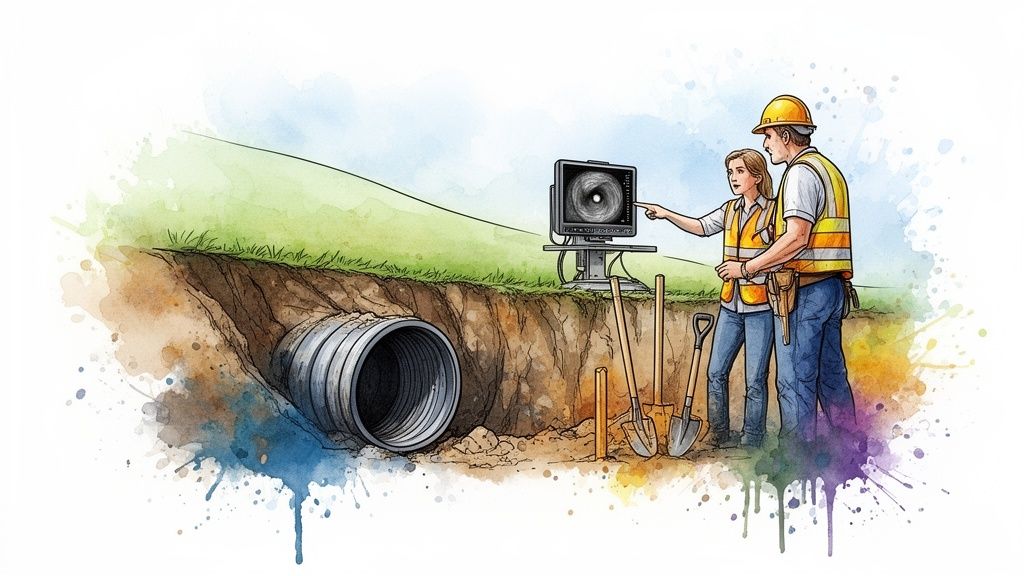
Completely Collapsed Pipes
This is the biggest and most obvious red flag. Trenchless methods like CIPP lining need an existing pipe to act as a mold for the new liner.
If the pipe is completely flattened or crushed, there's no path for the equipment or the new liner to get through. The only real solution is traditional excavation.
Severe Sags or "Bellies" in the Line
A "belly" is a low spot in a sewer line where water and waste pool instead of flowing downhill. It’s a grading problem, usually caused by a bad initial installation or shifting soil.
A CIPP liner will just follow the shape of the bellied pipe, creating a newly lined sag. You’ll keep getting chronic clogs because the slope is wrong. Excavation is the only way to truly fix this.
When a Major Pipe Upsize Is Needed
Pipe bursting can sometimes bump up a pipe’s diameter by one size, but it has its limits. This is especially true in the dense or rocky soils common around the California Central Coast.
If you need to significantly upsize a line—maybe to accommodate a new ADU—excavation is almost always the more reliable path.
Case Study: A Sonoma County Hillside Nightmare
Picture this: a homeowner on a sloped Sonoma County lot is dealing with slow drains. A contractor suggests a "quick and easy" CIPP liner without a full camera inspection. The problem doesn't go away.
A second opinion from an integrated excavation team uncovers the real issue: the original clay pipe had shifted due to soil movement, creating a severe off-set and a major belly. The liner had simply sealed a pipe that was already structurally failing. Dealing with the fallout of these failures often requires professional help, which we cover in our guide to sewage damage clean up.
The only permanent fix was excavation. A crew had to carefully dig, remove the failed section, and install a new, properly supported pipe. It was more disruptive, sure, but it was the right fix.
Making the Right Decision for Your Property
Choosing between trenchless technology and traditional excavation hinges on a careful diagnosis of your property’s unique conditions. A quick quote without a deep look underground is a major red flag.
A proper assessment involves understanding soil mechanics, site logistics, and how water moves across your property. This knowledge is what separates a temporary patch from a permanent, reliable solution.
Critical Questions to Ask Your Contractor
Before you sign any contract, arm yourself with these non-negotiable questions. The quality of the answers will tell you everything you need to know.
- What did the camera inspection reveal? Ask to see the footage. A professional should be able to show you the exact locations of cracks, root intrusion, or collapses.
- Can you confirm the existing pipe slope meets code? A simple liner won't fix a sagging pipe. You need confirmation that the grade is sufficient for proper drainage.
- What are the soil conditions on my property? In rocky or unstable soil, common on the Central Coast, excavation might be the only way to ensure the new pipe is properly supported.
- If you recommend trenchless, why is it the superior choice here? A trustworthy contractor will explain why your pipe is a good candidate and transparently discuss any potential risks.
These questions shift the focus from a quick sale to a long-term solution. Understanding the financial implications is paramount, and for professionals, using specialized tools like plumbing estimating software can provide accurate cost assessments.
Why a Comprehensive Diagnosis Is Non-Negotiable
Trenchless pipe repair offers remarkable longevity, but it's not a silver bullet. While CIPP linings can last at least 50 years, their effectiveness depends entirely on the host pipe's condition [NASSCO, 2022].
Ultimately, the goal is to make an informed decision that protects your property. A rushed choice can lead to repeated failures, escalating costs, and even compromise your home's foundation. Taking the time for a proper diagnosis is the smartest investment you can make.
Don't wait for a small problem to become a catastrophe. Find out why you should schedule pipe repair in Monterey before the next storm.
Your Top Questions About Pipe Repair Methods, Answered
When you’re staring down a broken pipe, you’re bound to have questions. Here are answers to the most common concerns we hear from property owners across Sonoma and Monterey County.
How much does trenchless pipe repair cost compared to digging in California?
Trenchless repair can have a higher upfront price tag, but it often ends up being cheaper overall. You avoid the massive collateral costs of restoring destroyed landscaping, repouring a driveway, or rebuilding a patio. However, for a short, easily accessible pipe section, excavation can sometimes be more cost-effective.
Can a trenchless repair fix a pipe clogged with tree roots?
It depends on the damage. If roots have cracked the pipe but the structure is intact, yes. We can clean the line and install a CIPP liner to seal it off. But if roots have crushed or severely shifted the pipe, excavation is the only way to remove the damaged section and clear the roots for good.
How do I know if my sewer line has a "belly" or slope problem?
A professional sewer camera inspection is the only way to know for sure. It provides a clear view of any sags where waste is pooling. A simple liner can't fix these critical slope issues; these situations almost always demand excavation to regrade the pipe correctly.
Is trenchless pipe repair a good option for older homes in Sonoma County?
Yes, it can be a fantastic solution for older homes with aging clay or cast iron pipes, as long as they haven't collapsed. Trenchless methods can upgrade old infrastructure without tearing up the mature landscaping and historic hardscaping that give a property its character.
What happens if a bad sewer line damages my foundation?
This is a serious concern, as prolonged leaks can saturate and destabilize the soil supporting your home, leading to cracks and settling. If a pipe failure is linked to foundation issues, the repair becomes more complex. It's critical to work with a team that understands both systems, like a skilled foundation contractor, to ensure a comprehensive and lasting solution.
Before recommending a solution, always start with a camera inspection and slope review. If in doubt, consult with a team that understands both trenchless methods and traditional excavation—so you’re choosing the best path, not just the most convenient.
Need help deciding between trenchless and open trench repair? DW Excavation offers honest assessments and will tell you when digging is actually the smarter investment. Call us at (707) 601-9091 to review your site conditions and avoid guesswork.