
If you're seeing cracks in your walls or floors, it's normal to feel unsure. Is it just cosmetic—or a sign of structural trouble? More importantly, how do you know if a contractor is giving you an honest assessment?
The truth is, understanding the difference between a real structural threat and a cosmetic issue is where you take back control. It all starts with a proper diagnosis, not a high-pressure sales pitch.
Is It a Failing Foundation or an Upselling Contractor?
When you spot a problem like a sticking door or a new crack, it’s natural to worry. But that moment of uncertainty is exactly what some contractors bank on, pushing homeowners toward expensive, one-size-fits-all solutions.
It’s a tough reality, but when you're facing a major home repair, some professionals may try to outwit you with low-ball offers or, worse, sell you on work that doesn’t even address the root cause.
Your first move should be to avoid panic. A common misstep is jumping straight into big repairs based on one contractor’s pitch, which is often just a sales appointment in disguise. Without a proper evaluation—including soil, grading, and drainage—you could be fixing the symptom, not the cause.
Differentiating Symptoms from Causes
Fixing a symptom without nailing down the cause is like putting a bandage on a broken arm. It might look better for a little while, but the underlying problem is still there.
A contractor might propose installing costly piers to lift a settled corner of your house. But if poor drainage is soaking the soil and causing the settlement in the first place, the problem will just reappear somewhere else.
What the Data Says About Foundation Repair
The foundation repair services market is a massive $3.2 billion industry, and with that much money on the line, homeowners are right to be cautious [PR Newswire, 2023]. Many forum users say they felt pressured into costly pier systems when a simpler drainage fix might have worked.
To give you a better idea of what to look for, here’s a quick guide to help you sort through the common signs you might be seeing.
Quick Guide to Symptoms and Potential Causes
This table can help you start differentiating between what might be a simple cosmetic issue and what could signal a deeper structural problem that needs an expert eye.
| Symptom You See | Potential Minor Cause (Less Urgent) | Potential Major Cause (Needs Expert Review) |
|---|---|---|
| Hairline cracks over doors/windows | Normal house settling or drywall shrinkage | Foundation settlement causing frame distortion |
| Sticking doors or windows | High humidity causing wood to swell | Significant foundation shift or upheaval |
| Cracks in exterior brick or stucco | Minor settling; thermal expansion/contraction | Bowing walls or severe foundation movement |
| Slightly sloping floors | Original construction quirks or minor joist settling | A sinking or heaving foundation slab |
| Water in basement after heavy rain | Clogged gutters or poor grading near the house | Hydrostatic pressure from a failing foundation |
Remember, this is just a starting point. A true professional diagnosis is always the next step for anything that falls into that "major cause" column.
An honest assessment always starts with "why." Is water pooling against your foundation? Are massive tree roots pushing things out of whack? You can learn more about what a comprehensive evaluation should look like by reading up on the truth about excavation projects most contractors don't tell you.
Your Homeowner Diagnostic Toolkit
Before you even pick up the phone to call a contractor, the smartest thing you can do is put on your investigator’s hat. Taking the time to do your own preliminary assessment shifts the power dynamic.
You go from feeling anxious and uncertain to being armed with actual data. This isn't about trying to diagnose the problem yourself—it’s about gathering the facts so you can have an informed conversation with any professional you bring in.
Documenting Cracks Like an Investigator
Cracks are what usually send homeowners into a panic, but not all cracks are created equal. The type, size, and direction tell a story about what’s happening beneath your home.
Let's break down what you might be seeing:
- Hairline Cracks: Often a sign of normal settling or concrete curing and usually aren't a big deal unless they start getting bigger.
- Vertical Cracks: A crack running straight up and down often points to foundation settlement. These are the ones you definitely want to measure and monitor.
- Stair-Step Cracks: These zigzag up brick or concrete block walls and are a classic sign that one part of the foundation is sinking faster than another.
- Horizontal Cracks: Pay close attention to these. A horizontal crack often suggests heavy pressure from the soil outside, which can lead to bowed walls.
Once you know the type, measure its width at the widest point and record it. Snap a few clear, well-lit photos—one up close and another from a distance to show its location on the wall.
This flowchart is a great way to visualize how to think about the cracks you're finding.
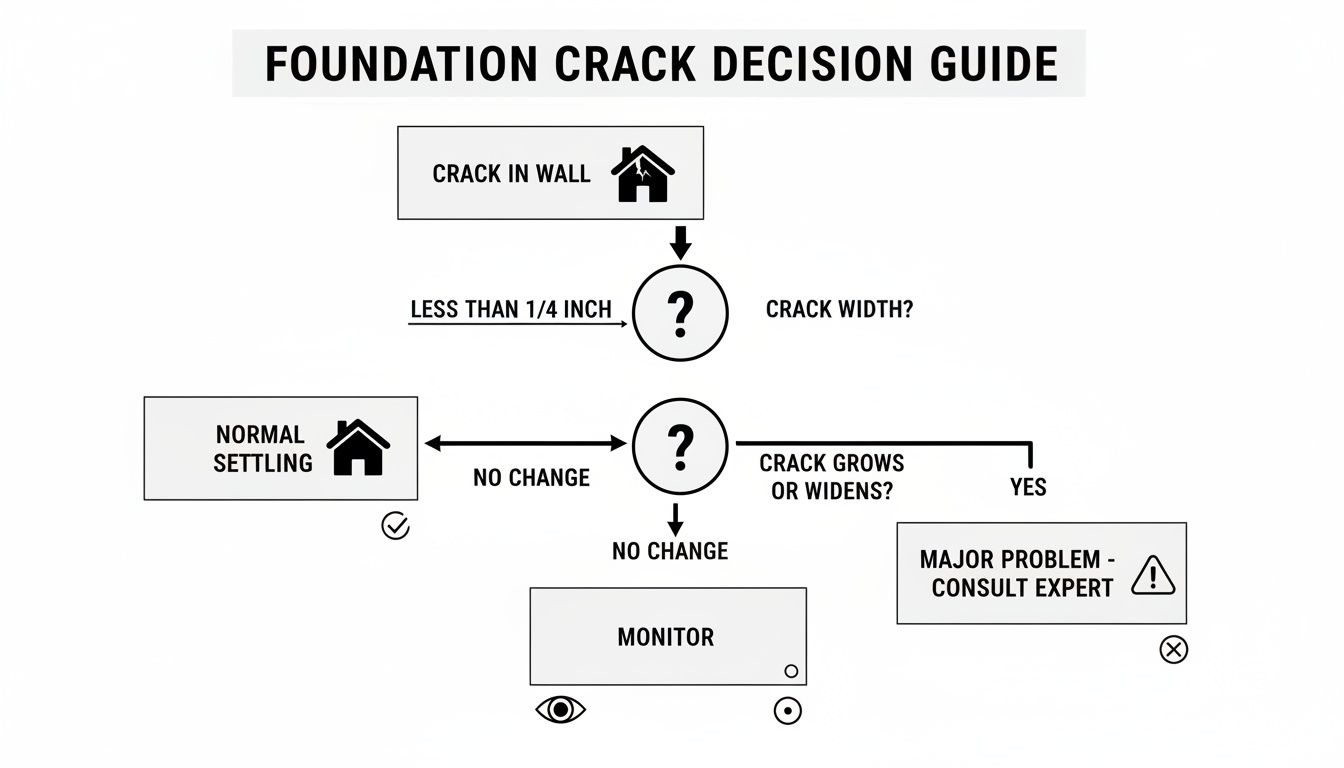
As you can see, the real goal is to figure out if you're dealing with a static, cosmetic issue or an active structural problem that needs a professional.
Looking Beyond the Cracks
Foundation problems rarely show up as just a single crack. Your diagnostic checklist should involve a full walk-around of your property, both inside and out.
Inside Your Home:
- Sticking Doors and Windows: Look for uneven gaps around the door and window frames.
- Sloping Floors: Place a marble on the floor in a few different rooms. If it consistently rolls in one direction, that can be a sign of a sinking or heaving slab.
- Gaps Around Trim: Check for separation where the walls meet the ceiling or where baseboards pull away from the floor.
Outside Your Home:
- Water Pooling: After it rains, see if water is collecting right up against your foundation. This is a massive red flag.
- Leaning Chimney: A chimney that’s tilting or has separated from the house is a dead giveaway for serious foundation settlement.
- Soil and Landscaping: Does your yard slope toward your foundation instead of away from it? Water is the enemy of a stable foundation.
Understanding how your property’s slope and drainage work together is critical. To dig deeper into this, check out our guide on whether poor grading could be damaging your foundation.
How to Vet a Contractor's Recommendation
A contractor just handed you a five-figure quote, and your stomach hits the floor. Is this recommendation based on solid structural analysis, or is it an aggressive upsell designed to cash in on your anxiety?
Knowing how to vet their proposal is your best defense against unnecessary and costly repairs. The most important thing to do is start with a contractor who works with engineers—not just sales reps.

Critical Questions to Ask Every Contractor
Before you even think about signing a contract, you need to flip the script and become the interviewer. An honest contractor will welcome these questions.
Here’s what you need to demand answers for:
- "Can you show me exactly what is causing this problem?" They should be talking about soil conditions, drainage patterns, and how hydrostatic pressure might be impacting your foundation.
- "Why is this specific solution the right one for my home?" Make them justify why a less invasive approach—like correcting the grading or installing a French drain—won't solve the root issue.
- "What are the alternatives, and what are their pros and cons?" A true professional will lay out multiple options and explain the reasoning behind their primary recommendation.
- "Can you provide a detailed, itemized quote?" Demand a breakdown of costs for labor, materials, permits, and any engineering reports. Vague proposals are a red flag.
- "What does your warranty actually cover?" Get the specifics. Does it only cover the exact spots they repaired, or the entire foundation?
Spotting Upselling Red Flags
Beyond the questions you ask, pay close attention to the contractor's behavior. High-pressure sales tactics are designed to make you feel like you have no choice but to sign on the spot.
Keep an eye out for these common warning signs:
- High-Pressure Tactics: Phrases like, "This offer expires today," or, "We have a crew available tomorrow, but you have to sign now," are designed to stop you from getting a second opinion.
- Vague Proposals: If the quote lacks specific details on methods and materials, it leaves the door open for surprise charges down the road.
- The "One-Size-Fits-All" Solution: Be skeptical of any company that immediately recommends the same expensive system for every home, regardless of the unique circumstances.
- No Mention of Engineering: A contractor who dismisses the need for a structural engineer's report on a major repair is a huge red flag.
DW Excavation partners with licensed structural engineers to ensure every foundation job is backed by real analysis. We explain when a minor issue needs simple grading or drainage correction—and when deeper support is truly required. For more tips on finding the right professional, check out our guide on selecting an excavating contractor.
Why a Second Opinion Is Non-Negotiable
You should never agree to a major structural repair based on a single diagnosis, especially when it comes from a company whose profits depend on selling you the most expensive fix.
Don’t be afraid to get a second opinion—especially if the quote seems high and vague. You wouldn't sign up for major surgery after consulting only one doctor, would you? The structural health of your home deserves the same level of care.
Finding a Truly Independent Expert
For a genuinely unbiased assessment, your best bet is always a licensed independent structural engineer. Unlike a contractor, an engineer's job is purely diagnostic. You're paying for their expert analysis and a detailed report, not for a particular repair system.
Here’s how to find a good one:
- Check State Licensing Boards: Before you hire anyone, verify that they hold a current, valid license with the state board for professional engineers.
- Ask for Referrals: Talk to architects, reputable general contractors, or even your local building department for recommendations.
- Confirm Their Independence: When you call, ask them point-blank if their company also performs the repair work. The expert you want is the one who only provides evaluations.
Once you have an engineer lined up, give them all the context you have. To truly get an unbiased assessment and avoid unnecessary costs, consider the value of seeking out independent building inspections.
What to Expect from an Engineer's Assessment
An engineer's visit is a world away from a sales call. They won't just glance at a few cracks; they'll analyze your entire home and the land it sits on.
Their process will likely involve a few key steps:
- A Detailed Visual Inspection: They’ll meticulously examine the interior and exterior of your home, noting every sign of stress and movement.
- Floor Level Survey: Using precise instruments, they will create a topographic map of your foundation to show exactly where and by how much it has settled.
- Analysis of Site Conditions: The engineer will evaluate your property's grading, drainage, and soil type. This is especially critical for homes in Sonoma and Monterey Counties, where expansive clay soils are common.
- A Written Report: This document should clearly state the root cause of the problem, the severity of the issue, and provide a recommended course of action based on sound engineering principles.
Understanding Real Foundation Solutions

Not every crack in your wall means you need a five-figure structural overhaul. Ask for a breakdown: is the issue structural, moisture-related, or cosmetic?
Foundation fixes really boil down to two types: those that manage the cause (which is almost always water) and those that just patch up the symptom (the movement itself). An honest pro will always start by looking at the cause.
Moisture-Related Fixes: Your First Line Of Defense
Water is the number one enemy of foundations. When soil gets soaked, it expands and shoves against your foundation; when it dries out, it shrinks, causing the ground to settle unevenly.
Many foundation problems can be dramatically improved—or solved completely—just by getting the water around your home under control.
Common moisture management solutions include:
- Improving Grading: Your yard needs to slope away from your foundation, ideally at a grade of at least 5% for the first ten feet.
- Installing French Drains: A French drain intercepts groundwater and pipes it away from your foundation, which is a fantastic solution for soggy soil.
- Gutter and Downspout Maintenance: Extending your downspouts so they discharge at least six to ten feet from the house is a simple change with a massive impact.
When Structural Repairs Are Genuinely Needed
Of course, sometimes moisture control isn't enough. If the settlement has already caused significant structural damage, or if the soil conditions are just plain terrible, you might need to go deeper.
These are the "major" repairs, and they should only be on the table after a very thorough analysis.
Structural solutions are designed to physically support and stabilize the foundation itself.
- Underpinning with Piers or Piles: This involves driving steel piers deep into the ground until they hit solid bedrock or stable soil, transferring the weight of your house onto these supports.
- Carbon Fiber Reinforcement: High-strength carbon fiber straps can be bonded to bowing basement walls to add incredible strength and stop movement.
- Wall Anchors: This method uses steel plates on the inside of a bowing foundation wall, connected by a rod to an anchor buried in stable soil in your yard.
Comparing Foundation Repair Options By Cost And Use
This table breaks down the most common repair methods, giving you a general idea of the costs, scope, and when they are legitimately needed.
| Repair Method | Typical Cost Range | Best For… | When It Might Be an Upsell |
|---|---|---|---|
| Grading & Downspouts | $500 – $4,000 | Minor settling, water pooling near the foundation, damp basements. | It's rarely an upsell—it's the fundamental first step. If a contractor skips this, ask why. |
| French Drains | $3,000 – $10,000+ | Persistent water issues, high water tables, homes on hillsides. | For a simple, isolated water problem that better grading or longer downspouts could easily fix. |
| Carbon Fiber Straps | $4,000 – $12,000+ | Bowing or buckling foundation walls with less than 2 inches of movement. | For hairline cracks that aren't getting wider or for walls that have minimal or no bowing. |
| Underpinning (Piers/Piles) | $10,000 – $30,000+ | Significant, ongoing foundation settlement (more than 1-2 inches), severe structural damage. | For minor settling in one corner that could be stabilized by correcting drainage issues first. |
Remember, these are just ballpark figures. The right solution always depends on a proper diagnosis. In Sonoma and Monterey County, we know the soils, slopes, and building conditions that cause foundation trouble. You can learn more about our commitment to proper diagnostics in our guide to foundation services on the California Central Coast.
Frequently Asked Questions About Foundation Repairs
1. How much does an independent foundation inspection cost in California?
A "free inspection" from a repair contractor is usually a sales call. For a truly independent opinion from a licensed structural engineer in California, expect to pay between $500 and $1,200. This investment can save you thousands by preventing unnecessary repairs.
2. Are hairline cracks in my garage floor a serious problem?
Usually, no. Thin, hairline cracks are often due to normal concrete shrinkage. You should only worry if the cracks are widening (more than 1/8 inch), if one side is higher than the other, or if you see other signs like sticking doors.
3. Will my homeowner's insurance cover foundation repairs?
Probably not. Standard policies typically exclude damage from gradual causes like soil settling. Coverage might apply if the damage was caused by a sudden, covered event, like a burst pipe washing out the soil, but you must read your specific policy.
4. What's the difference between underpinning with piers vs. piles?
Both transfer your home's weight to stable ground. Piers are typically concrete columns created on-site by drilling a hole and filling it with concrete and rebar. Piles are pre-made steel sections that are hydraulically pushed into the ground until they hit bedrock. An engineer can determine which is best for your soil. You can learn more about proper site prep in our guide on what a building pad is.
5. How can I tell if a contractor is reputable?
A reputable contractor encourages you to get a second opinion, provides a detailed itemized quote, and never uses high-pressure sales tactics. Always verify their license on the California Contractors State License Board (CSLB) website and ask for local references.
At DW Excavation, we’re upfront, not upsellers. If you're seeing signs of foundation trouble in Sonoma County, Monterey County, or anywhere on the Central Coast, let DW Excavation take a look—with no pressure, just clarity. Contact us today for an honest, engineering-backed assessment.