
Quick Answer
You know grading was done right when water moves away from the house, the soil stays firm, and the finished surface matches the plan instead of just looking smooth. A pretty surface can still fail if drainage and compaction were skipped. If you're repaving, this guide on grading before driveway work is worth reading first.
If you're standing in the yard after a project and wondering whether the contractor solved the problem, that's a fair question. Most grading problems don't show up as a bad-looking surface on day one. They show up later as water against the house, soft spots under pavement, erosion, or settlement.
When people ask me how do i know if grading was done right?, I tell them to stop looking only at the finish and start looking at where the water goes, how the soil was built, and whether the grade will still work after a hard rain.
The Foundation of Good Grading What to Look For First
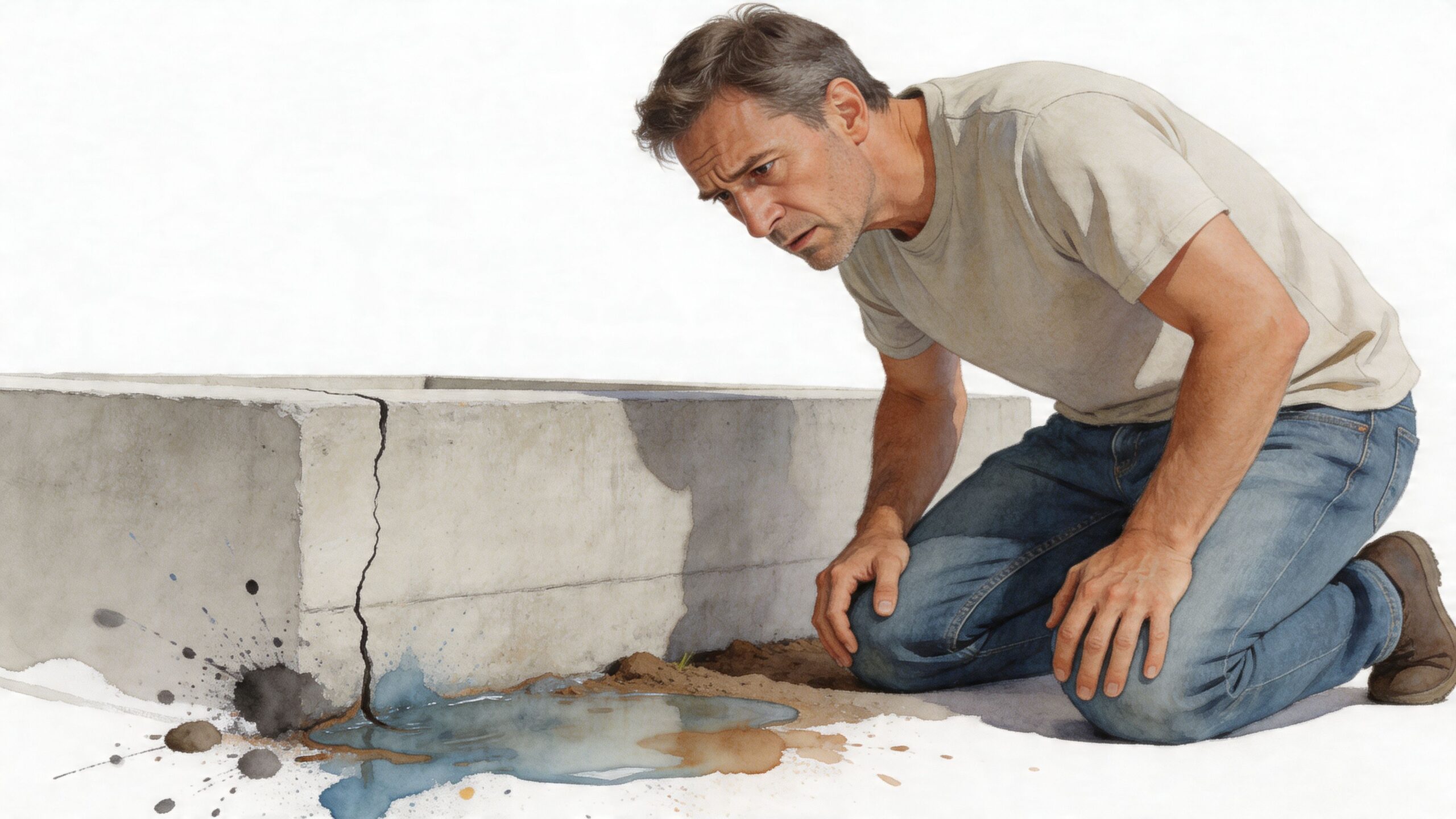
A lot of homeowners notice the symptom first. Maybe it's a driveway edge breaking down, a muddy strip along the foundation, or a puddle that sits where it shouldn't. The surface gets the blame, but the underlying issue is often underneath.
If you're asking how do i know if grading was done right?, start with one rule. Water should leave the structure and leave the usable parts of the site in a controlled way. If the grade holds water near the house, garage, ADU pad, or paving base, it wasn't done right.
A building pad is a good example. It isn't just a flat area for construction. It has to sit at the right elevation, tie into surrounding drainage, and stay stable over time. If you want a plain-language explanation, this page on what a building pad is gives helpful background.
Check the direction of flow first
Stand near the house and look outward. You want the surface to fall away from the structure, not flatten out immediately and not roll back toward it a few feet later.
You can check this with simple tools:
- Use two stakes and a string line: Set one near the house and one farther out. Pull the string tight.
- Put a small level on the string: This tells you whether the line is level.
- Measure from string to soil at both points: If the ground drops as you move away from the house, that's a good sign.
This doesn't replace survey equipment, but it tells you whether the grade is functioning or just dressed up.
Practical rule: Smooth isn't the goal. Dry and stable is the goal.
Look for drainage paths, not just slope
A yard can slope generally away from the house and still fail. Water needs somewhere to go after it leaves the structure. That might be a swale, a drain inlet, a gravel drainage feature, or a controlled flow path toward a lower collection point.
If you see low pockets, abrupt dips, or water trapped between planting beds and hardscape, the grade may be incomplete. That's especially common when someone focuses on appearance and ignores runoff during real weather.
Pay attention to firmness underfoot
Compaction matters because loose fill settles. When that happens, drainage changes, pavement cracks, and edges break away.
Walk the area after irrigation or rain, if possible. If the soil feels spongy, pumps under your feet, or leaves deep impressions in spots that should be firm, that's a warning sign. Good grading isn't just shaped well. It's built well.
A Practical Checklist for Inspecting Your Site Grade
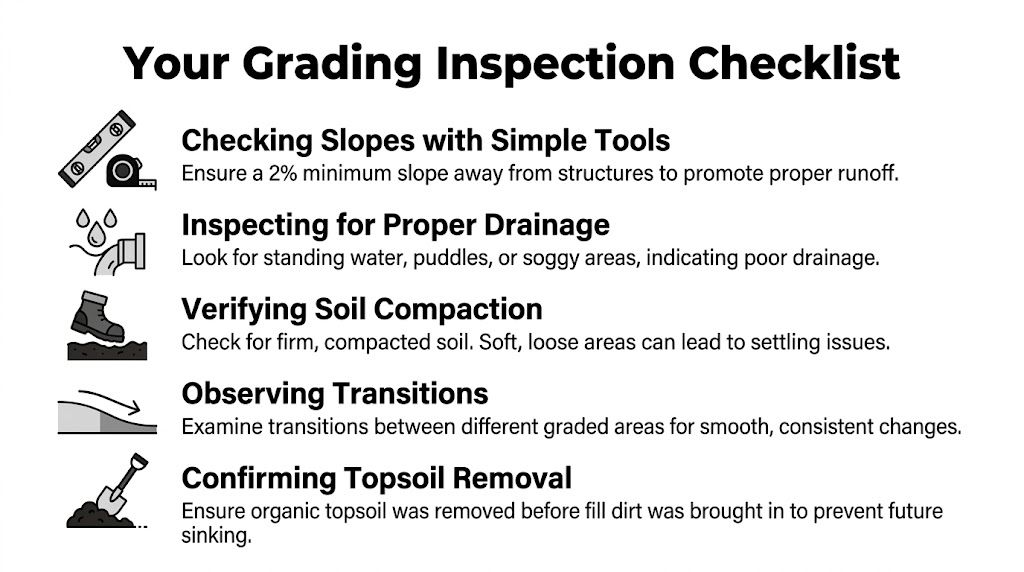
A lot of homeowners call me after the damage shows up. Water at the garage, cracks along the driveway edge, mulch washed into the walk, damp soil holding against the foundation. By that point, the grade has already told the truth.
You can catch a lot before it gets there. A careful walk, a level, and a hose will show whether the site was shaped to move water early and keep it moving, or whether it was only smoothed out to look finished. If your concern started with pavement damage, this article on why Monterey driveways fail after rain and how proper grading fixes it ties that surface failure back to the drainage below it.
Checking slopes with simple tools
Check more than one area. A house can look fine from the back patio and still trap water beside the driveway or at the side yard gate.
Use the stake-and-string method near the foundation, across walkways, beside paving edges, and anywhere new fill was placed. I also tell homeowners to step back and look for whether the grade has a clear direction. Good grading has intent. You can usually read where the water is supposed to go. Poor grading often flattens out at the wrong spot or rolls into a shallow dip where the machine work was never cleaned up.
Focus on these areas:
- Near structures: Soil should carry water away from the house and keep it from lingering near wall and footing areas.
- Along pavement edges: Driveways and walkways fail early where runoff sits at the edge and softens the base.
- At transitions: The change from yard to pad, pad to driveway, or slope to swale should be smooth and deliberate.
Inspecting for proper drainage
Water is still the most honest field test. Run a hose lightly over a small section and watch the path it takes. You are checking flow behavior, not trying to soak the whole yard.
A good surface sheds water and feeds it into a visible drainage path. A weak one stalls, spreads, or turns back into places that should stay dry. That is the before-and-after difference homeowners usually miss. Proper grading prevents the future problem. It does not just hide the current one.
Watch for these red flags:
- Standing water: Low spots hold water longer than they should.
- Water moving back toward the house: The slope, tie-in, or finish grade is wrong.
- Runoff cutting narrow channels: Flow is too concentrated and can start erosion.
For homes in Sonoma County and along the Central Coast, summer can hide grading problems. The site looks clean and usable, then the first winter runoff shows where water really wants to travel.
Signs of poor soil compaction
A surface can be shaped correctly and still fail underneath. I see that on newer driveways more often than homeowners expect. The grade looks finished, but the fill was placed too loose, too wet, too dry, or in lifts that were never compacted properly.
For areas that support paving or structural loads, compaction is commonly checked against a Proctor standard, with field density testing performed under ASTM methods such as ASTM D6938. If that part of the job was skipped, settlement can change drainage after the contractor is gone.
Watch for field signs that the base may be weak:
| What you see | What it often means |
|---|---|
| Tire ruts in new base | Fill may still be loose |
| Footprints sinking deeper in patches | Compaction is uneven |
| Cracks appearing soon after paving | Base movement below the surface |
| Depressions near utility trenches | Backfill settled after completion |
Ask direct questions if anything feels off. What material was used. How thick were the lifts. How was moisture handled. Was compaction tested. A contractor who did the work properly can usually answer that without dancing around it.
Looking for erosion control measures
Grade alone is not enough if runoff can tear it apart. On open slopes, cut banks, and fresh swales, the finish needs protection that matches the site conditions.
Look for:
- Stable swales: They should carry water without scouring.
- Protected slope faces: Especially on hillsides and fresh cuts.
- Finished discharge points: Water should empty into an area built to receive it.
If runoff leaves the property work exposed and starts cutting into bare soil, the grading was left unfinished in a practical sense.
Confirming topsoil removal and transition quality
Topsoil belongs in planting areas. Under fill, pavement, and structural sections, it can become a weak layer that holds moisture and settles over time. One shortcut I run into is grading directly over organic surface soil, then covering it with imported material. It can pass a visual check and still create long-term movement.
Look closely at transitions too. Low pockets, sudden humps, and awkward rollovers usually show up where two graded planes meet and nobody fine-tuned the tie-in. Those little mistakes are where water starts collecting, and once water starts collecting, paving life and foundation performance both start heading the wrong direction.
Field note: If one area stays wet longer than the rest, pay attention to it. That spot usually points to the grading issue before the bigger damage shows up.
How We Verify Grading Was Done Right with Precision Technology

A graded site can look clean and still be set up to hold water in the wrong places. I care less about whether it looks smooth from the patio and more about whether water now has a reliable path away from the house, future paving, and any structure on the lot. That is the fundamental before-and-after test.
Professional verification starts before the dirt is moved. We establish control points, record the existing elevations, and keep that baseline so the finished work can be checked against the plan instead of somebody's memory. After grading, we shoot the site again with survey equipment and compare the actual elevations to the design grades, especially around foundations, swales, driveways, and tie-ins at the property edges.
The equipment matters. The process matters more.
Machine control, RTK-GPS, laser levels, and total stations all help us work accurately, but none of them fix a bad setup or a lazy finish check. I've seen jobs with expensive grade technology still send runoff toward a garage because nobody verified the last few feet at the concrete edge. Those are the spots that decide whether the property stays dry or starts showing trouble after the first hard rain.
The tool matters, but the operator matters too
Good operators do not trust the screen alone. They confirm benchmarks, recheck calibration, and walk the drainage path with the plan in mind. On a residential job, that usually means checking where water leaves the pad, how the yard ties into neighboring grades, and whether paved areas will sit on a stable, uniform base instead of a patchwork of highs and lows.
I also want proof that the crew checked the work after rough grade and again at finish grade. Rough grade gets the shape right. Finish grade is where small errors become future puddles, soft edges, frost movement, and early pavement breakdown.
What professional verification should include
If you're hiring grading work tied to drainage, paving, a foundation, or an ADU pad, ask the contractor how they confirm the finished surface. A solid answer should include specific field checks, not general reassurance.
A careful grading contractor should be able to explain:
- Control points: Where elevation reference points were set before work began
- Pre-grade and post-grade checks: How the existing site and finished site were measured against plan
- Drainage verification: How runoff direction and outlet points were confirmed in the field
- Tie-in checks: How the new grade was blended into driveways, walks, curbs, and adjacent ground without creating traps for water
- Compaction records: How fill placement and density were checked where support matters
- As-built documentation: What measurements, notes, or survey records exist after completion
If long-term surface performance is part of your concern, this article on what really makes pavement last under real site conditions ties directly into grading quality. Water management below the surface usually decides how long that pavement stays intact.
Why this matters long after the machines leave
Precision protects the property in ways you may not see on day one. A verified grade helps keep water from soaking the base under a driveway, pushing against a foundation, or sitting near transitions where settlement starts. That is what gives you a dry site now and fewer repair bills later.
On hillside lots and drainage-sensitive properties, this matters even more. A small miss in elevation can change where thousands of gallons go over time. Getting the grade right on paper, then proving it in the field, is how you prevent the water problems that shorten the life of paving and put stress on the structure itself.
Common Grading Mistakes and How to Avoid Them
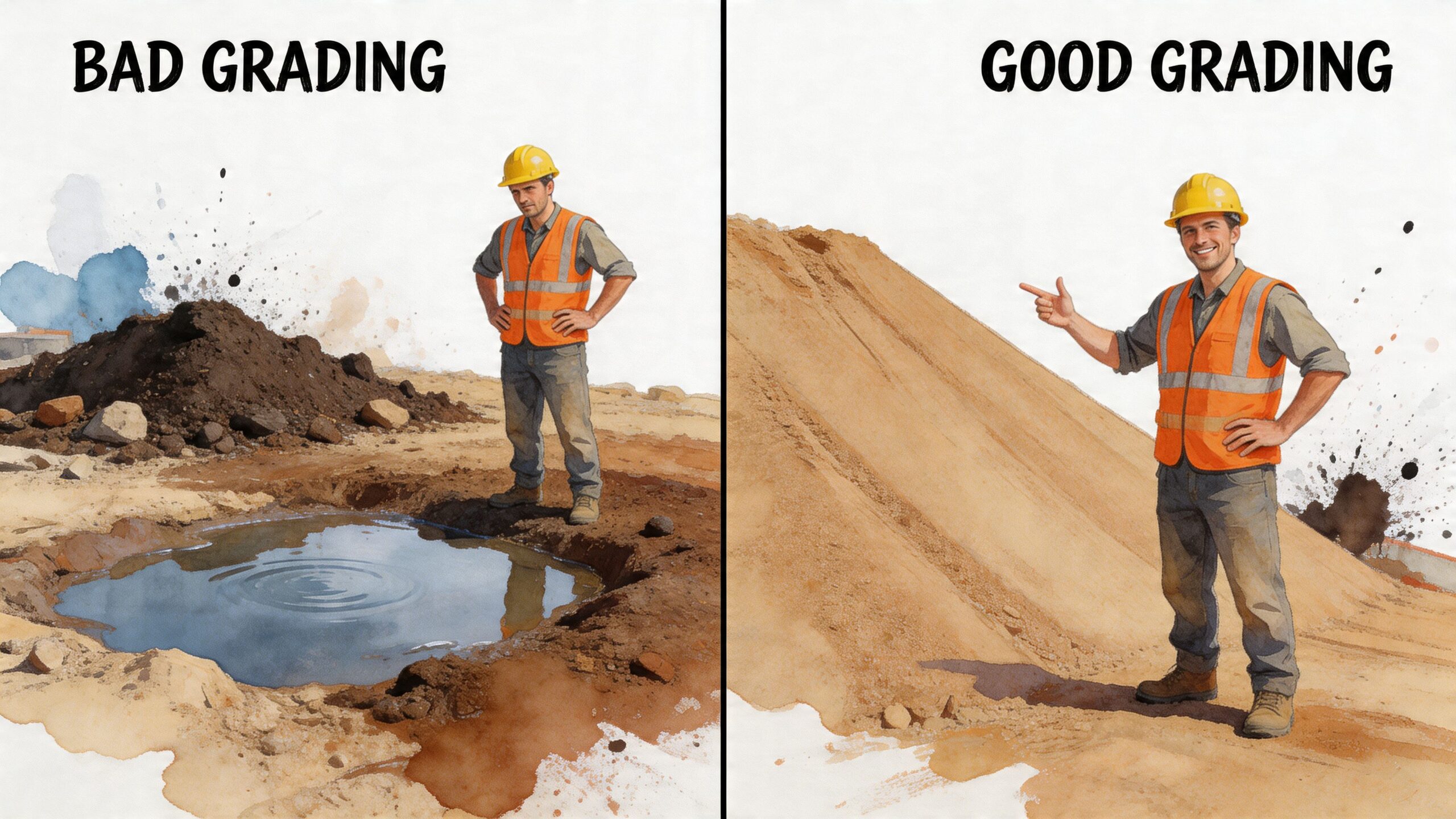
Most bad grading jobs don't fail because of one dramatic error. They fail because several small shortcuts stack up. A little trapped water here, a little loose fill there, no real outlet for runoff, and then the first wet season exposes all of it.
Grading for appearance instead of drainage
This is the most common issue I run into. The site looks neat, the soil is smooth, and the edges are dressed up. Then water shows up and heads straight for the structure or stalls in the middle of the yard.
A clean finish means nothing if runoff isn't controlled. New asphalt or concrete won't correct a drainage pattern that was wrong underneath.
Building over poor material
Another mistake is leaving soft or organic material in place under fill or paving areas. The problem doesn't always show immediately. It shows up as settlement, edge cracking, low spots, and movement around trenches or utility crossings.
One version of this problem is poor lift control. Failing to control lift thickness and exceeding 8 inches per layer can reduce soil density by up to 12%, which weakens the base for whatever sits on top of it. That finding comes from Caltrans data summarized in the earlier grading reference. The practical takeaway is simple. Fill has to be placed in manageable layers and compacted correctly, not dumped in thick and rushed over.
Bad grading often hides under good finish work. That's why the sequence matters as much as the final look.
Forgetting where the water goes next
Some jobs push water away from one problem area and create a new one somewhere else. I've seen water redirected across a driveway, into a side yard, toward a neighbor line, or against a fence where it had nowhere to discharge.
Good grading is a whole-site decision. If the contractor can't explain the water path from start to finish, the plan probably isn't complete.
Treating every lot like a flat lot
Hillsides, older properties, and tight residential sites need more thought. A slope that works on one parcel may be wrong on another. A simple regrade may help one yard, while another property needs drainage features, erosion control, or soil stabilization to keep the grade from failing later.
Red flags that usually need a closer look include:
- Persistent wet spots: They suggest the site still has trapped water.
- Soil movement on slopes: Even small slippage needs attention.
- Settling along foundations or paving edges: The base may be moving.
- Repeat repairs in the same location: The root cause likely wasn't fixed.
- Water crossing walking or driving surfaces: The site may be routing runoff poorly.
Choosing the lowest price without asking the right questions
Price matters. But grading is one of those trades where the cheap number can get expensive fast if prep was skipped.
Ask direct questions. Was topsoil stripped where needed? How was the fill placed? How was compaction handled? How was drainage confirmed before the job was finished? Those answers tell you more than a polished proposal ever will.
When to Call a Professional for a Grading Assessment
Some grading concerns are simple enough to spot on your own. Others need a trained eye, especially when water, structures, slopes, or future construction are involved.
If you're still asking how do i know if grading was done right? after doing the basic checks, that's usually the point where a professional assessment makes sense. The goal isn't just to confirm a defect. It's to identify whether the issue is surface-only, base-related, drainage-related, or tied to something deeper on the site.
Situations that deserve a closer look
Call for a grading assessment if you have any of these conditions:
- A hillside lot or retaining transition: Small grading mistakes can turn into erosion or movement.
- Water near foundations or under paving: That can affect both structural areas and finish surfaces.
- An ADU, garage, or new pad planned: The future load and drainage need to work together.
- Repeated puddling after prior fixes: The visible symptom may not be the source.
- Settlement around trenches, driveways, or walkways: That often points to base or backfill issues.
For homeowners comparing findings from different trades, it can also help to understand how broader home inspections approach drainage and property condition. A general inspection can identify symptoms. A grading contractor should be able to explain the site mechanics behind them.
What to ask before you hire someone to evaluate it
Don't settle for vague language. Ask what they will check on site.
A useful grading assessment should cover:
| What to ask | Why it matters |
|---|---|
| Will you check drainage flow, not just surface appearance? | Water movement is the core issue |
| Will you evaluate settlement and soft areas? | Surface defects often start below grade |
| Will you identify whether grading alone can fix it? | Some sites also need drainage work |
| Will you explain what is maintenance versus failure? | That helps avoid guesswork later |
If you want help deciding whether an earlier recommendation is solid, getting a second opinion before hiring a foundation contractor is often a smart move when grading and structural concerns overlap.
Frequently Asked Questions About Site Grading
Can grading look fine and still be wrong?
Yes. A site can look smooth and freshly finished and still have bad drainage, weak compaction, or poor tie-ins at the edges. Most grading failures show up when water moves through the site or when the base starts settling under use.
How soon do grading problems usually show up?
Some show up with the first decent rain. Others take longer and appear after irrigation cycles, seasonal moisture changes, or traffic over a driveway or pad. If a problem area keeps returning, the original grading likely didn't solve the cause.
Is standing water always a sign of bad grading?
Usually, but not always by itself. A brief film of water right after heavy runoff can be different from water that lingers, soaks in unevenly, or repeatedly collects in the same low spot. Persistent puddling is a strong reason to inspect the slope and drainage path more closely.
Should I worry if my new driveway is cracking at the edge?
Yes, especially if the cracks line up with soft shoulders, drainage crossing the pavement, or settlement beside the paved area. Edge failure often points to trouble in the grade or base, not just the surface material.
Can a grading problem be fixed without redoing the whole yard?
Sometimes. A targeted regrade, swale adjustment, drainage improvement, or localized base repair can solve the issue if the problem is limited. If the whole site was shaped poorly from the start, a broader correction may be the better long-term fix.
What should a contractor be able to explain clearly?
They should be able to explain where water starts, where it goes, how the soil was prepared, and how they know the finished grade matches the intended elevations. If the answers stay vague, that's a warning sign.
Do I need grading checked before repaving?
In many cases, yes. Repaving over a bad base or poor drainage pattern usually hides the problem for a short time instead of fixing it. If water is crossing the area or the edges are failing, inspect the grade first.
| Question | Answer |
|---|---|
| Can grading fail even if the yard looks smooth? | Yes. Surface appearance doesn't prove drainage or compaction was done right. |
| What's the first thing I should check? | Check whether water moves away from the structure and toward a clear drainage path. |
| Do soft spots matter if I don't see standing water? | Yes. Soft areas can mean loose fill or poor compaction that may settle later. |
| Is grading only important for big projects? | No. It affects small residential work too, especially near foundations, driveways, and ADUs. |
| When should I bring in a pro? | Bring one in when you have repeat water issues, settlement, slopes, or planned construction. |
If you want a straight answer on whether your grade is working, DW Excavation, LLC can take a look and talk through the site with you. For grading, drainage, site prep, and excavation work in Sonoma County, Monterey County, and the California Central Coast, call (707) 601-9091, visit 470a Caletti Avenue, Windsor, CA 95492, or reach out through dw-excavation.com.