Quick Answer
The installation of sewer pipe starts with planning, utility locates, and permits. Then the trench is dug to the right depth, the pipe is laid on stable bedding at the correct slope, joints are sealed, and the line is tested before careful backfill. Done right, it protects flow, safety, and long-term reliability.
If you're building a home, adding an ADU, or replacing an old line, the underground part of the job can feel like the least visible and most confusing part of the project. The installation of sewer pipe isn't complicated in theory, but small mistakes underground can turn into expensive problems later.
Modern sewer work also looks different than it did decades ago. Clay pipe has been used in U.S. sewer systems since 1815 and stayed in service for generations, but newer materials changed how residential sewer lines are installed and repaired (NCPI history of clay sewer pipe).
Planning Your Project and Securing Permits
A sewer line should never start with a machine in the yard. It starts with route planning, grade planning, and knowing exactly what the new line needs to connect to.
In Sonoma County, Monterey County, and across the California Central Coast, every site has its own limits. Lot slope, existing utilities, driveway crossings, trees, retaining walls, and the location of the public connection all affect the plan.
Start with the route, not the trench
The first question is simple. Where should the line run so it drains properly and stays serviceable later?
A good route avoids unnecessary bends, keeps enough cover over the pipe, and gives room to work safely. If the property has a hillside, an older home, or a tight ADU footprint, that route usually needs more thought than people expect.
If you need help understanding the layout side before digging, this guide on what is a site plan and who can help me make one is a useful place to start.
Utility locates come before excavation
Before any trenching, existing underground lines need to be located and marked. That includes water, gas, power, communications, and sometimes older private lines that don't show up clearly until the site is investigated.
Practical rule: If the route hasn't been verified on the ground, it isn't ready to dig.
Utility strikes don't just delay the job. They create safety risks, repair costs, and permit headaches. On older properties, you also have to assume prior work may not match old records.
Permits matter because inspections matter
Most sewer installations need permit approval and inspection before the trench is closed. The exact process depends on jurisdiction and whether you're connecting to a city sewer main, replacing a building sewer, or doing work tied to an ADU or major remodel.
Plans usually need to show the pipe route, depth, connection point, and how grade will be maintained. In some cases, the connection itself has to be coordinated with the local authority or utility district.
A contractor's early job is paperwork and field verification
On a proper sewer job, the contractor isn't just there to dig. The contractor should be checking grades, matching the line to the approved plan, and making sure the permit path and inspection schedule fit the build schedule.
That matters most when the sewer line is one piece of a larger site job. Foundation excavation, grading, drainage, and underground utility work all affect one another, so the sequence has to make sense.
Choosing the Right Pipe Materials and Tools
Pipe choice affects installation, repair options, and how the line performs over time. For most residential sewer work today, the common answer is PVC or ABS, but the existing pipe on your property may be something older.
Why old materials fail differently
Clay pipe has a long history and impressive staying power. Cast iron also served homes for many decades. But both materials have common failure patterns in residential work.
Clay is durable against corrosion, but it can crack when soil moves or roots press into joints. Cast iron is strong, but it can corrode and roughen internally over time, which is why older inspections often find rust-related problems.
The major shift came later. The move from cast iron to PVC in the late 1960s changed residential sewer work because PVC is about 1/6th the weight of cast iron and resists corrosion, which helped make it the standard material for new construction and many repairs (Skeen Plumbing on sewer pipe eras).
Material comparison at a glance
| Material | Pros | Cons | Typical Lifespan |
|---|---|---|---|
| Clay | Corrosion-resistant, long service history | Brittle, vulnerable to cracking and roots | Varies with installation and soil conditions |
| Cast iron | Strong, durable, handles load well | Can rust and corrode over time | Often discussed as long-lasting in older homes |
| PVC | Light, corrosion-resistant, easier to handle | Needs proper bedding and support | Depends on installation and site conditions |
| ABS | Light and common in some residential work | Material choice may depend on local code and use case | Depends on installation and site conditions |
For modern residential work, Schedule 40 PVC is a common choice where code and site conditions support it. The material is easier to stage, easier to cut, and easier to join than older pipe.
The tools are more specialized than most homeowners expect
Good sewer installation depends on measurement as much as digging. The crew may use laser levels, grade rods, compactors, trench shields, saws, pipe cutters, shovels for hand work around utilities, and inspection equipment to verify the finished line.
Small tool details matter too. If you're doing related work around forms, anchors, or accessory components, this guide on how to choose the right drill bit is helpful because matching the bit to the material prevents wasted time and damaged hardware.
A contractor such as DW Excavation, LLC may also bring GPS grading or trenchless equipment into the job if the site conditions call for it. That usually matters more on tight lots, hillside sites, and established properties where access is limited.
Safe Excavation and Trenching Practices
A sewer trench has to be accurate, but the first concern is safety. Soil can move fast, trench walls can fail, and a rushed excavation puts workers, the property, and nearby utilities at risk.
What a proper trench looks like
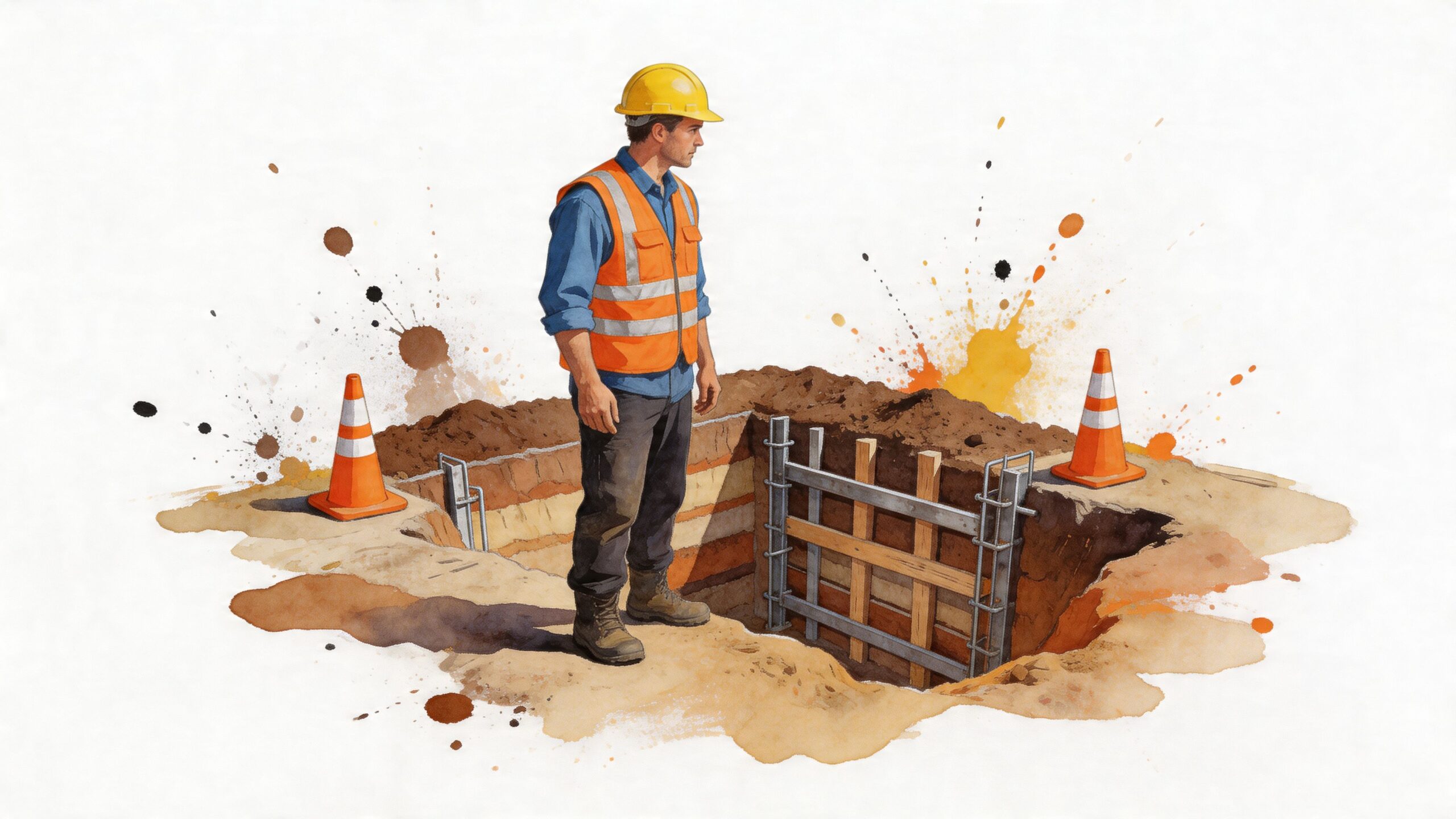
The trench needs enough width to place bedding, set the pipe correctly, and allow safe access for the crew. It also needs stable walls or protective systems when depth and soil conditions require them.
The point isn't to make the trench bigger than necessary. It's to give the pipe full support and give the crew a safe place to work without undermining nearby structures or disturbing more of the site than needed.
Depth changes the safety requirements
When trench depth increases, the risk goes up fast. For trenches deeper than 5 feet, shoring is part of safe practice because cave-ins are a real hazard in excavation work (Patriot Dirt on sewer installation mistakes and trench safety).
That rule matters on sewer work because grade often pushes the trench deeper as the line approaches the tie-in point. On a sloped lot, what starts as a shallow cut can turn into a serious excavation by the end of the run.
Good excavation protects more than the trench
Careful trenching also protects foundations, paving, landscaping, and existing underground services. Around older homes, the crew often has to slow down and hand-dig in critical areas because machine speed isn't worth the risk.
For homeowners who want a plain-language overview of the broader process, what is excavation in construction gives useful context.
A fast dig that damages a water line or undermines a footing isn't fast anymore.
Personal protective gear matters too. If you want a general overview of field basics, this complete guide to safety supplies covers the kind of equipment crews rely on before the machine ever starts.
Proper Pipe Laying and Bedding for Longevity
Once the trench is right, the sewer line still isn't ready for pipe. The bottom of the trench has to be prepared so the pipe sits evenly, holds grade, and stays supported after the trench is closed.
Slope is what makes the whole system work
Most residential sewer lines depend on gravity. That means the pipe has to fall enough to move waste, but not so much that liquids outrun solids.
For 3-inch to 6-inch pipes, the minimum slope is ⅛ inch per foot. Improper slope is a primary cause of sewer line failure and accounts for up to 40% of problems within the first five years of installation (Park Enterprise on sewer line setbacks and solutions).
That number lines up with what contractors see in the field. A line can look straight to the eye and still be wrong enough to cause trouble.
Bedding is not leftover dirt
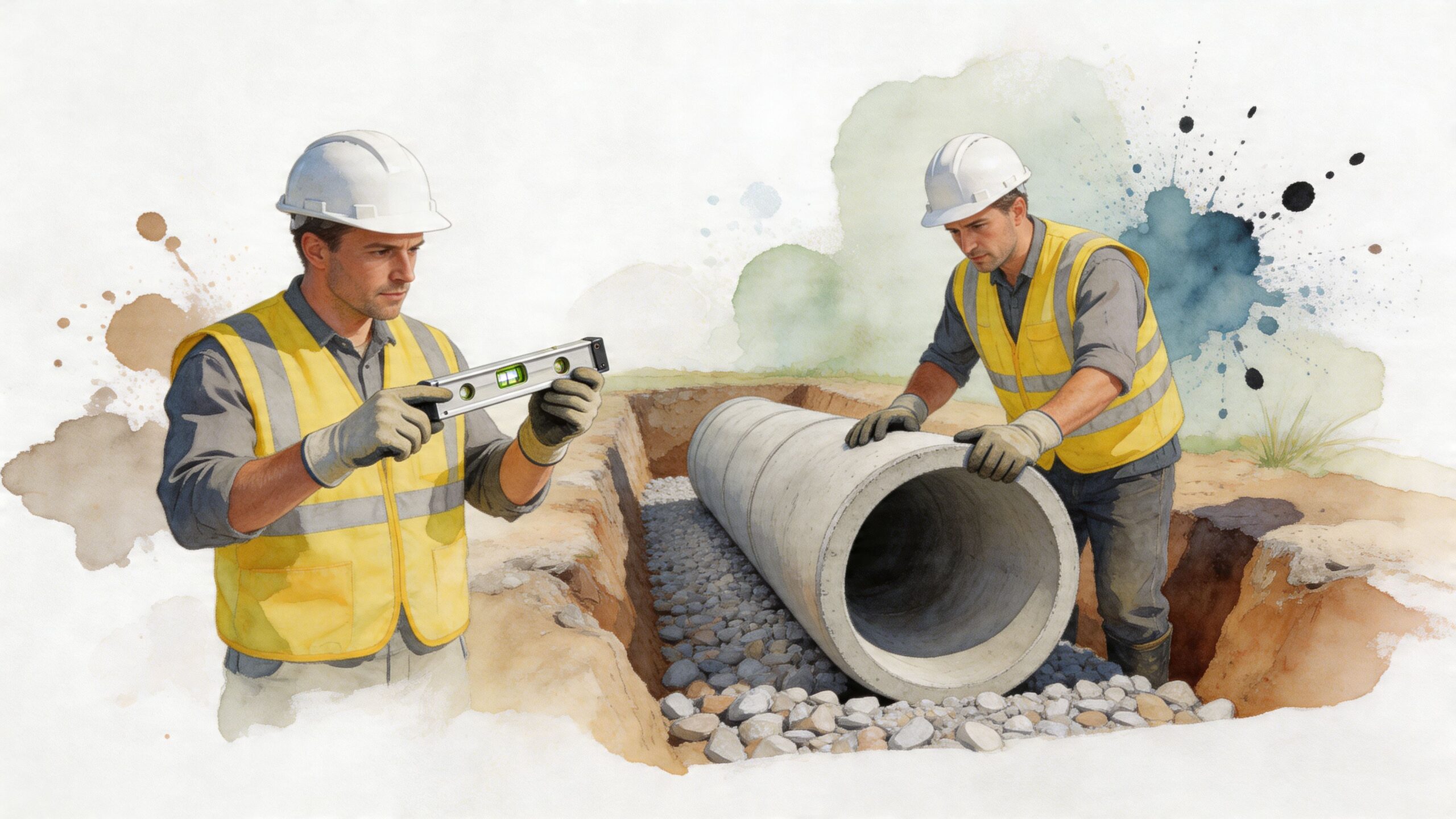
Pipe needs a stable bed. In practice, that usually means a prepared layer of suitable material that supports the barrel evenly instead of leaving hard spots and voids under the pipe.
If a pipe rests on random clods, rocks, or uneven trench bottom, the line can settle into low spots later. Those low spots collect waste and water, and that's when recurring clogs start showing up.
A well-bedded line does three things:
- Supports the full pipe length: The pipe shouldn't rock or bridge over gaps.
- Protects the joints: Uneven bearing puts stress at the connection points.
- Holds the grade you set: A line that settles after backfill loses the slope it had on install day.
Jointing has to be clean and deliberate
With PVC or ABS, the joints need to be cut square, cleaned, and assembled correctly. If the joint isn't fully seated or the alignment is off, the problem may not show up until after the trench is closed and the line is in service.
Crews typically start at the low end and work uphill so each section lines up with the planned grade. Bell orientation, clean cuts, and proper assembly all matter because one bad joint can become the service call later.
Field advice: Most sewer failures don't come from the pipe material alone. They come from poor support, poor grade, or poor assembly.
Obstacles change the work, not the standard
Tree roots, existing foundations, retaining walls, and tight ADU setbacks are where experience shows. You still have to maintain grade, maintain support, and avoid sharp layout mistakes even when the route gets awkward.
This is also where shortcuts usually show up. A crew that forces the route, skips bedding detail, or accepts a dip because "it's close enough" leaves the property owner with the consequence.
Backfilling, Connections, and Final Testing
A sewer line isn't finished when the last section of pipe goes in. A lot of good work gets ruined during backfill.
Backfill has to protect the line
The first material placed around the pipe should support it, not shift it. The pipe needs to stay on grade while the trench is closed, especially near joints and changes in direction.
Backfill is usually placed in lifts and compacted in stages so the trench doesn't settle later. If the trench is dumped full and compacted carelessly, the pipe can move, oval, or lose the slope that was carefully set.
The connection is usually the most sensitive point
Tying into the public sewer or an existing system needs to be precise and often inspected. That connection has to match elevation, flow direction, and approved materials.
On some projects, the connection work also has to be coordinated with the city, district, or another contractor. If the line is part of broader underground work, it's worth looking at the scope of underground utility services on the California Central Coast so the sequence stays organized.
Testing happens before the trench is truly closed
A proper installation should be checked before final closure. Depending on the project, that may include air or water testing and inspection to confirm the line is sealed and ready for service.
At this stage, hidden mistakes are caught while they're still fixable. If a line leaks, is out of grade, or wasn't assembled properly, addressing it is much easier before final surface restoration.
If the line hasn't been tested and inspected, it isn't done yet.
When to Consider Trenchless Sewer Pipe Installation
Open trenching still has its place. If you're installing a brand-new sewer line where no line exists, traditional excavation is often the practical path because the route has to be created from scratch.
But on established properties, trenchless work can be the smarter option.
When trenchless makes sense
If the old line already runs under a driveway, patio, lawn, mature trees, or tight side yard access, digging the whole route may create more damage than the pipe work itself. That's where trenchless methods are worth discussing.
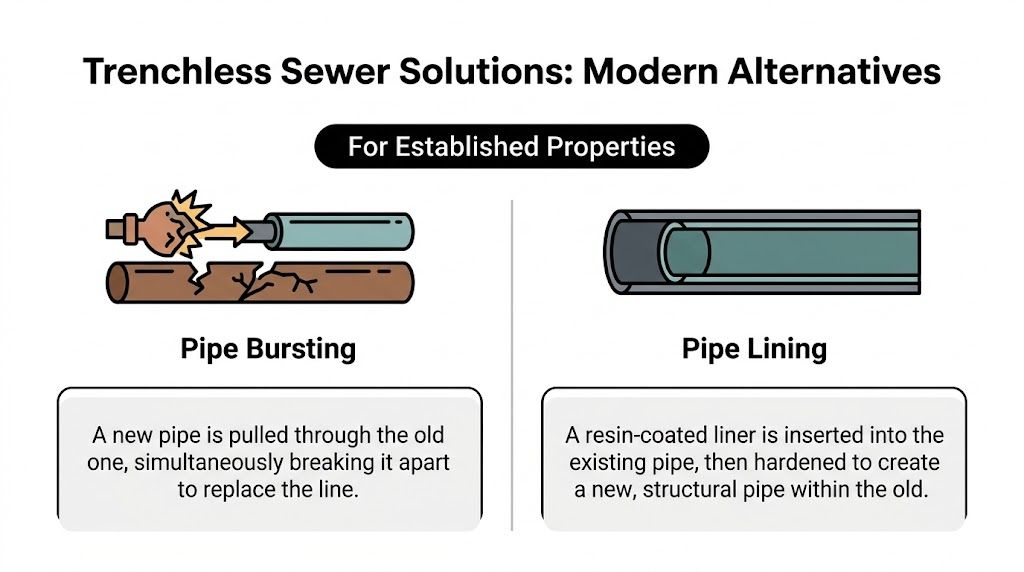
Pipe bursting replaces the old pipe by pulling a new pipe through it while breaking the old one apart. Pipe lining creates a new pipe inside the existing one.
Trenchless technologies like pipe bursting can reduce excavation by up to 90% compared to open-trench replacement (Toolup guide to sewer line installation). For a homeowner, that usually means less surface disruption and less restoration afterward.
The trade-offs are real
Trenchless isn't automatically the right answer. The existing line has to be a good candidate, access pits still need to be created, and some alignments or collapses still call for open excavation.
Pipe lining also doesn't solve every problem. If the old line has major grade issues, severe deformation, or a bad route to begin with, lining may preserve a problem instead of correcting it.
A useful comparison for homeowners weighing both approaches is should I choose trenchless or traditional pipe replacement.
Established homes and ADUs benefit the most
This comes up often on older lots in Santa Rosa and across the Central Coast. The house is staying, the landscaping is finished, and the owner doesn't want a full open trench across the property unless it's necessary.
In those situations, trenchless methods can protect hardscape, reduce disturbance, and keep the project more contained. The key is knowing when the method fits the condition of the existing line and when it doesn't.
Common Questions About Sewer Line Installation
How long does the installation of sewer pipe usually take
It depends on the length of the run, access, soil conditions, permits, and the type of connection. A short, straightforward residential line moves much faster than a hillside run or a replacement under existing improvements.
Can I install my own sewer line
In most cases, this isn't a good DIY project. Sewer work involves permits, inspections, utility conflict risk, trench safety, and exact grading. One slope mistake or bad connection can leave you with recurring backups.
What are the signs that my sewer line may need replacement
Frequent backups, slow drains across the house, sewage odor outside, wet spots along the line path, or recurring root intrusion are common warning signs. If sewage has already escaped into the property, cleanup needs to happen quickly. This overview of sewage damage clean up explains why that part can't wait.
Is PVC always better than cast iron or clay
Not in every situation, but it's the standard choice in many residential jobs because it's light, corrosion-resistant, and practical to install. Existing clay or cast iron may still be serviceable in some locations, but many older lines are replaced because of cracking, corrosion, roots, or age-related wear.
Will my yard or driveway have to be torn up
Sometimes yes, sometimes no. A new installation usually requires excavation along the route. A repair or replacement may be a candidate for trenchless work if the existing line and site conditions allow it.
What causes a new sewer line to fail early
Bad slope, poor bedding, weak backfill practices, and poorly assembled joints cause a lot of early trouble. Most of those failures start with installation quality, not with the pipe itself.
Get Expert Help With Your Sewer Pipe Installation
The installation of sewer pipe is one of those jobs where the work you don't see matters most. If the line is planned well, installed to grade, and backfilled correctly, it should serve the property for the long haul.
If you need help with a sewer installation, replacement, trenchless repair, or site planning in Sonoma County, Monterey County, or the California Central Coast, you can talk with DW Excavation, LLC about the project scope and next steps. Call (707) 601-9091, visit 470a Caletti Avenue, Windsor, CA 95492, or go to dw-excavation.com for a free estimate or site consultation.
Sources
National Clay Pipe Institute. "History of Vitrified Clay Pipe." https://www.ncpi.org/history/
Skeen Plumbing & Gas. "Decades of Drainage: How Different Eras of Sewer Pipes Hold Up Today." https://skeenplumbinggas.com/blog/decades-of-drainage-how-different-eras-of-sewer-pipes-hold-up-today/
Park Enterprise Construction. "5 Common Sewer Line Installation Setbacks and Solutions." https://parkenterpriseconstruction.com/2020/07/06/5-common-sewer-line-installation-setbacks-and-solutions/
Patriot Dirt. "Common Sewer Line Installation Mistakes and How to Avoid Them." https://patriotdirt.com/common-sewer-line-installation-mistakes-and-how-to-avoid-them/
Toolup. "Beginner's Guide to Sewer Line Installation." https://toolup.com/blogs/news/beginners-guide-to-sewer-line-installation/