
It’s a frustratingly common sight for homeowners on the Central Coast: a heavy rainstorm rolls through, and suddenly your driveway is a mess of puddles or new cracks. You might think the asphalt or concrete is to blame, but the real problem is almost always hidden right underneath.
The hard truth is that your driveway is likely failing because water isn't being channeled away from it. Instead, it's soaking into the base layer, turning it into an unstable sponge that destroys the surface from below.
The Hidden Cause Behind Driveway Damage in Monterey
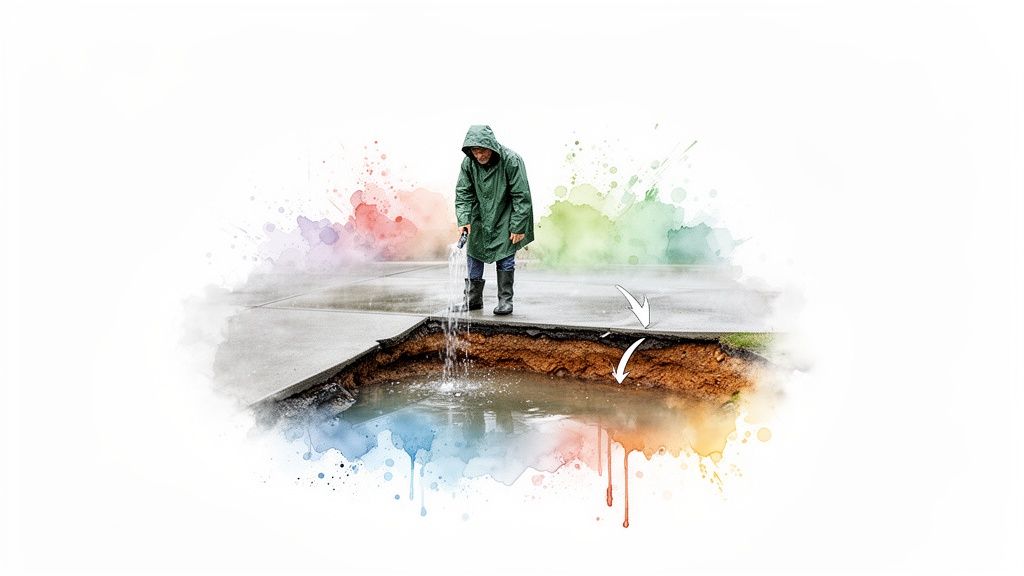
We’ve seen it time and again in Monterey and Salinas—homeowners invest in a new layer of asphalt, hoping it will finally solve their cracking and pooling issues. Unfortunately, that's just a temporary patch on a much deeper problem. The real culprit is almost always poor subgrade preparation and improper grading, especially given our local conditions.
Residents of Monterey and the Central Coast know that sudden downpours can overwhelm older properties. The region’s compact clay soil and sloped terrain lead to poor water runoff, especially in older subdivisions that weren’t built with modern drainage in mind. When a driveway is built without a carefully engineered slope, that water has nowhere to go.
Why a Weak Subgrade Guarantees Failure
Once that sub-base gets waterlogged, it loses its structural integrity. This soggy foundation can no longer support the weight of your vehicles, leading to the damage you see on top. This is the core reason why Monterey driveways fail after rain and how proper grading fixes it—the root cause must be addressed, not just the symptoms.
Many local paving contractors don’t address subgrade issues, which leads to driveways that crack, puddle, or erode within a few seasons. A driveway is only as strong as the ground it's built on. If the base fails, the surface will always follow.
The Consequences of Poor Grading
Ignoring an underlying grading problem is signing up for a predictable and expensive cycle of repairs. The issues you see on the surface are a direct result of what's happening below ground. This is especially true during our intense winter storms, as water main break rates have increased by 27% in the last decade, placing even more stress on local drainage systems [GlobeNewswire, 2021].
This table connects the dots between the driveway problems you can see and the hidden grading issues causing them.
Driveway Failure Symptoms And Their Hidden Causes
| Visible Symptom | The Hidden Cause (Poor Grading) | Long-Term Risk |
|---|---|---|
| Growing Alligator Cracks | The saturated base is shifting and moving, flexing the pavement until it shatters. | Total pavement failure and the need for a complete replacement. |
| Persistent Puddles | Low spots (or "bird baths") were built into the driveway, collecting water instead of shedding it. | Water seeps into the sub-base, accelerating deterioration and creating slip hazards. |
| Sinking and Heaving | Waterlogged soil expands when wet and contracts when dry, pushing the driveway up and down. | An uneven, dangerous surface that can damage vehicles and trip pedestrians. |
| Eroded Edges | Water runs off the sides, washing away the gravel base and leaving the pavement unsupported. | The driveway edges will continue to crumble, narrowing the usable surface over time. |
These issues can even start redirecting water toward your home's foundation or into your garage, causing far more serious structural damage. Our guide to Monterey water management solutions dives deeper into protecting your entire property.
A Homeowner’s Checklist for Diagnosing Your Driveway Drainage
You don’t need an engineering degree to spot the early warning signs of a failing driveway. The best time to play detective is right after the next big Monterey rainstorm. By watching how water behaves on your property, you can uncover the hidden drainage issues that lead to expensive pavement damage.
This simple checklist will help you assess your driveway like a pro. Grab a notepad, put on your boots, and take a walk around your property during or just after a steady rain.
Do You See Standing Water?
The most glaring red flag is puddling water, which we often call "bird baths." These low spots collect water because it has nowhere else to go. Any puddle that sticks around for hours after the rain stops is a dead giveaway that you have an improper slope or a compacted subgrade that’s completely saturated.
Pay close attention to where these puddles are forming. Is water collecting in the middle of the driveway, pooling along the edges, or creeping right up to your garage door?
How Does the Water Flow?
Next, just watch how the water moves. Does it sheet evenly off the sides and flow away from your house, or does it create little rivers that head straight for your foundation? A properly graded driveway should act like a very wide, gentle roof, shedding water away from the structures you want to protect.
If you see water flowing back toward your house, you have a negative slope. This is a serious problem that can lead to foundation damage and costly repairs.
Are the Driveway Edges Eroding?
Get down and take a close look at the edges of your asphalt or concrete. Are they still sharp and well-defined, or are they looking crumbly and washed out?
Here’s exactly what to look for:
- Missing Gravel: If the soil or gravel that’s supposed to support the edge has washed away, that's a classic sign of erosion.
- Miniature Canyons: Look for small channels or ruts forming in the dirt right alongside your driveway. This is proof that concentrated streams of water are pouring off the surface.
Are There Cracks in the Surface?
Finally, it’s time to examine the driveway surface itself. The patterns cracks form can tell you a lot about the health of the sub-base beneath.
- Alligator Cracking: This network of interconnected cracks looks like a spiderweb and is a tell-tale sign of base failure.
- Linear Cracks: Single cracks often point to a poorly constructed seam or a reaction to soil movement and settling.
If you’re noticing several of these issues, it's a clear sign your driveway’s problems run much deeper than the surface. For a more detailed look, check out our guide on fixing drainage and grading problems.
How Proper Grading Creates a Permanent Solution
When homeowners see a failing driveway, their first thought is usually paving. But paving is just the cosmetic top layer—the real, lasting solution is what lies beneath. Proper grading is an engineering-first approach that turns a problem driveway into a robust drainage system.
Think of it less like leveling dirt and more like sculpting the land with one purpose in mind: controlling water. Instead of letting water pool, seep in, and destroy your investment, professional grading tells water exactly where it needs to go.
What Is a Positive Slope in Grading?
The cornerstone of proper grading is creating a positive slope. This means making sure your driveway gently angles away from your house and garage. A subtle slope of 1-2% is often all it takes to keep water from standing still.
DW Excavation takes site grading seriously—especially in Monterey’s microclimates, where drainage behavior varies drastically from block to block. We ensure proper slope, water redirection, and sub-base compaction before paving anything.
The Power of a Crowned Driveway
For wider driveways, another professional technique is building a crown. Think of a country road—it’s slightly higher in the middle and slopes off toward the edges. We build that same subtle high point right down the center of your driveway.
This design is incredibly effective because it splits the water in two, sending half to drain off each side.
Building a Bulletproof Foundation with Lifts
A professional job involves building the sub-base in multiple thin layers, which we call lifts. This is a critical step many contractors skip.
The process includes these steps:
- First, we excavate and remove the weak, clay-heavy topsoil.
- Next, we lay down a few inches of an engineered aggregate.
- Then, we use a heavy roller to compact that layer until it’s incredibly dense.
- We repeat this process, adding and compacting more lifts until the sub-base is perfect.
This method creates a foundation that’s practically waterproof. For more on getting your site ready, check out our expert grading tips to use before the rain hits.
What Are Advanced Drainage Solutions?
Sometimes, a simple slope isn’t quite enough, especially for properties on hillsides or in low-lying areas around Salinas. In these more complex situations, we integrate additional drainage features right into the grading plan.
- Swales: These are shallow, wide channels designed to catch runoff and guide it safely away.
- French Drains: A perforated pipe in a gravel-filled trench intercepts subsurface water before it can even reach the sub-base.
These features work together with the graded slope to manage even the heaviest downpours.
The Grading And Paving Process Done Right
Many people think a new driveway is all about that final, smooth layer of asphalt or concrete. But a professional project designed for Monterey’s specific climate and soil is different. The secret to a driveway that lasts is a transparent, engineering-first process that puts the foundation above everything else.
A quick, superficial fix might look great for a season or two, but it won’t solve the root problems causing puddles and cracks. Our commitment at DW Excavation is to get the sub-base and grading perfect.
Step 1: Comprehensive Site Assessment
It all begins with a detailed site assessment where we analyze your property’s unique topography, soil composition, and existing water flow challenges. We don’t just look at the driveway; we look at the whole picture.
Answering these questions is how we get to the root cause of previous failures. This step is non-negotiable in Monterey County’s varied microclimates.
Step 2: Precise Grading And Drainage Plan
Once we have a full understanding of your site, we map out a precise grading plan. This blueprint establishes the perfect slope, lays out water redirection paths, and identifies where we might need features like French drains or swales.
The goal is to make sure every drop of water that hits your driveway is managed intentionally. The infographic below breaks down the three core components of a professionally graded driveway.
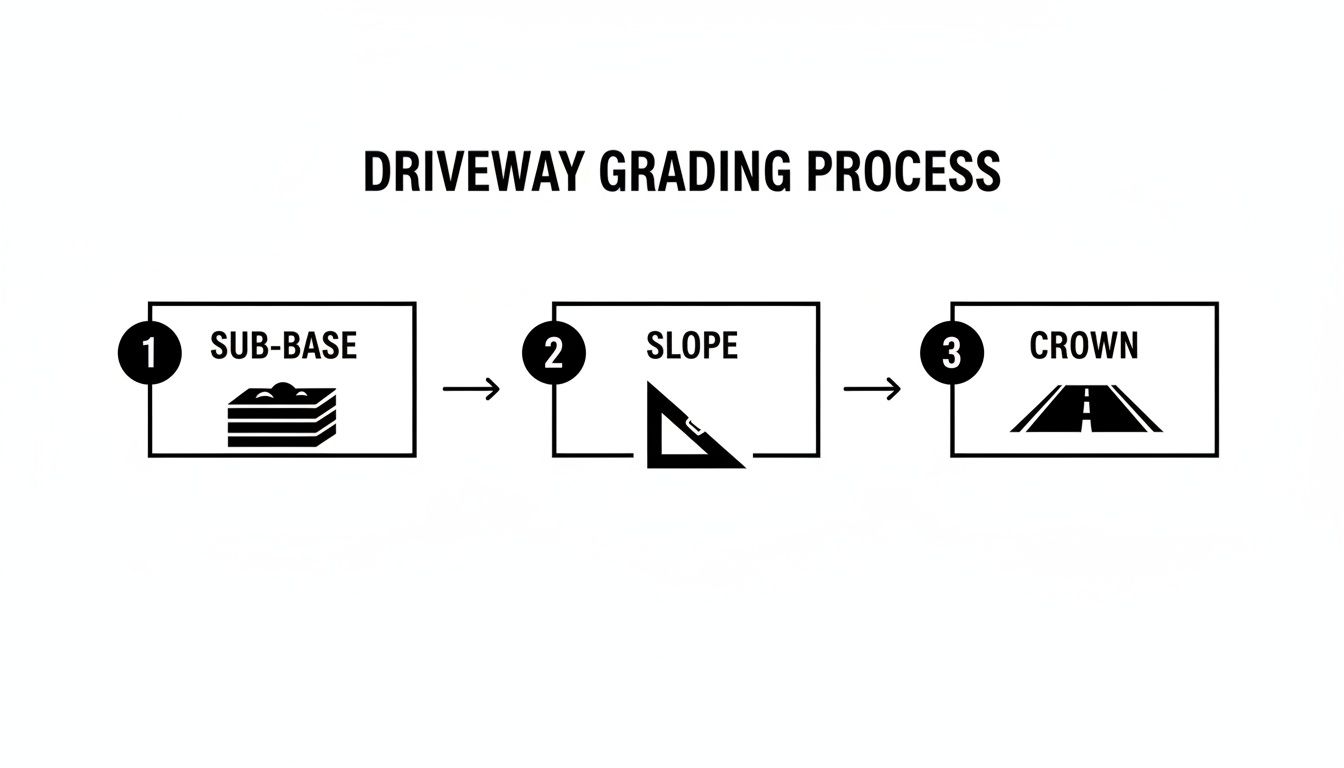
This shows how a stable sub-base, the right slope, and a crowned surface all work together.
Step 3: Excavation And Meticulous Sub-Base Preparation
This is where the real work begins—and where many contractors cut corners. Our process is meticulous:
- Excavation: We remove the old pavement and dig out the weak, moisture-loving clay soil underneath.
- Sub-Base Construction: We build a new foundation using an engineered aggregate base.
- Compaction in Lifts: The sub-base is laid down in several thin layers, or "lifts," and each one is individually compacted with heavy machinery.
We can't stress this enough: proper sub-base compaction is the single most important factor in a driveway's longevity. A weak, poorly compacted base will inevitably settle and shift. We dive deeper into this critical process in The Ultimate Guide to Monterey Driveway Excavation and Leveling.
Step 4: The Final Paving Surface
With a rock-solid, properly graded foundation locked in place, the final paving is just the durable, aesthetic capstone. Whether you choose asphalt, concrete, or permeable pavers, the surface is now supported by a base that’s engineered to handle vehicle loads and resist water damage for years.
Questions To Ask Any Monterey County Grading Contractor
Hiring the right contractor is the single most important decision you'll make to protect your property. The difference between a driveway that stands strong for decades and one that fails after a few rainy seasons almost always comes down to the crew's expertise.
Before hiring a paving contractor in Monterey or Salinas, ask for their grading plan. Make sure they assess slope, downspout drainage, and whether the base will be compacted in lifts—not just leveled. This is how you tell the real pros from the corner-cutters.
Can You Provide a Detailed Grading Plan?
A true professional never works on guesswork. They should be able to hand you a clear, site-specific grading plan that outlines:
- The exact proposed slope, measured in percentage.
- Where any crowns, swales, or drainage systems will be placed.
- How deep they need to excavate to build a stable foundation.
If you get a vague answer like, "Oh yeah, we'll make sure it slopes," that’s a huge red flag. For a deeper look at what separates the pros, check out our guide on finding the best grading contractors in Monterey.
How Do You Prepare the Sub-Base?
Pay close attention here, because this is arguably the most critical question you can ask. A great answer will involve a discussion about removing Monterey’s infamous clay-heavy soil.
They should also talk about building up the sub-base with an engineered aggregate and compacting it in several thin layers, or "lifts." If their plan is just to level the existing dirt, they're setting your driveway up for failure.
How Will You Manage Water Runoff?
The entire point of grading is to control water. Your contractor needs to clearly explain their strategy for handling runoff from the driveway, roof downspouts, and surrounding landscape.
An expert plan fights drainage issues by engineering a slope of at least 1-2% to shed water effectively. Poorly managed runoff on paved surfaces can cause concrete cracking rates to spike by as much as 30% after a storm [University of Texas, 2022].
Answering Your Questions About Driveway Grading And Drainage
We understand that dealing with a failing driveway is frustrating. Homeowners often search for “driveway paving near me” or “fix water pooling in driveway.” They aren’t just looking for asphalt—they’re searching for a solution to a drainage problem, even if they don’t yet realize that’s the core issue. Here are some answers to common questions.
How Much Does Proper Driveway Grading Cost In The Monterey Area?
The cost of a proper grading and paving project depends on your property’s specific challenges. The final price tag reflects the driveway's size, its steepness, soil conditions, and whether advanced drainage features are needed. Paying for professional grading is a one-time expense that stops the costly cycle of patching pavement or fixing water damage to your home.
Can My Existing Cracked Driveway Be Saved?
Whether an old driveway can be salvaged comes down to the health of its sub-base. If your driveway is covered in "alligator" cracking or has major sunken spots, the foundation has likely failed, and a full replacement with proper grading is the only permanent solution. If you only have minor surface cracks and the driveway drains well, a simpler repair might work, but it's often a temporary band-aid.
How Long Does A Driveway Replacement With Grading Take?
For a typical residential driveway replacement—including full excavation, building a new sub-base, and paving—we're usually looking at about five to ten working days. Weather, site complexity, and local permitting timelines in Monterey County can affect the schedule, but we always provide a clear project plan upfront.
Is A Permit Required For Regrading A Driveway In Monterey County?
It depends on the scope of the work. A simple asphalt overlay that doesn't change the driveway's footprint or height usually doesn't need a permit. However, any project that involves significant digging that alters your property's grade or drainage patterns almost always requires a permit from the county or city. We handle this entire process to ensure your project is 100% compliant.
What Paving Material Is Best For A Properly Graded Driveway?
Once we've built a rock-solid, perfectly graded sub-base, you have several great choices for the surface. The best one for you depends on your budget and desired aesthetic.
- Asphalt: A cost-effective, durable, and flexible choice for our local soil conditions.
- Concrete: A more premium, rigid surface that offers a very long lifespan.
- Permeable Pavers: An eco-friendly option that lets rainwater soak through into the ground, reducing runoff.
The performance of any of these materials is 90% dependent on the quality of the foundation beneath it. A properly graded and compacted sub-base ensures your chosen surface will stay stable and last for decades.
If your driveway shows the classic signs of failure, don't waste money on another temporary patch. If you’re a homeowner or contractor on the Central Coast, DW Excavation can help you avoid costly driveway failures by starting with the right grading. Let’s get your site prepped for long-term performance.
Ready to fix your driveway for good? Contact us today for a professional site assessment.